The storm did not arrive with a warning because it simply crashed against the house like a physical blow. The wind howled through the massive pine trees surrounding my isolated cottage and the rain lashed against the windows in sheets of grey violence.
At 3:00 A.M., the world belongs to the ghosts and the guilty. I was awake, of course, because I am always awake at that hour. It is an old habit, a scar left over from a life I buried thirty years ago.
I sat in my armchair, knitting a scarf that was already too long, listening to the rhythm of the thunder. To the outside world, I was Beatrice O’Malley, seventy two years old, a widow, a lover of dahlias, and a woman whose hands shook slightly when she poured tea.
Then came the knocking.
It was not the polite rap of a neighbor but a frantic, desperate pounding that shook the front door in its frame. I did not freeze and I did not gasp.
My hands stopped knitting and the slight tremor that I feigned for the benefit of my doctors vanished instantly. I set the needles down on the side table, next to the picture of my late husband, and stood up.
My movements were fluid, silent, and precise. I walked to the door, checking the peephole.
What I saw made the blood run cold in my veins, though my heart rate remained a steady fifty five beats per minute. It was Leo, my eight year old grandson.
He was soaked to the bone, his pajamas clinging to his shivering frame. He was barefoot, his small feet caked in mud and bleeding from the gravel driveway.
But it was his face that ignited a cold fury deep in my gut. His left eye was swollen shut, a bloom of purple bruising spreading across his cheek.
I threw the bolts and opened the door. The wind tried to tear it from my grasp, but I held it firm.
“Leo,” I said, my voice low.
He collapsed into me. He smelled of rain, pine needles, and terrified sweat. I scooped him up, noticing he felt lighter than he should, and kicked the door shut, locking it instantly.
I carried him to the kitchen, setting him on the counter. I did not ask what happened immediately because panic makes witnesses unreliable.
Instead, I grabbed a towel and began to dry him, checking for other injuries. Ribs intact. No defensive wounds on the arms. Just the face.
“Leo,” I said, catching his chin gently. “Look at me and please just breathe.”
He gasped, his single open eye wide with trauma. “Grandma, Dad he did this.”
“Slow down,” I commanded softly. “Where is your mother?”
Leo began to sob, a sound that tore at my soul. “Dad said she went on vacation and he told me she left while I was sleeping.”
“Okay,” I said, keeping my tone steady. “Why are you here?”
“I woke up and I heard a noise in the basement,” Leo stammered. “I went down and I hid in the closet behind the water heater.”
He stopped, his body convulsing with a fresh wave of terror.
“What did you see, Leo?” I asked.
“I saw Dad,” he whispered. “He had a rug and it was the big Persian one from the hallway. He was rolling it up but Grandma there was a foot sticking out. Mom’s foot and she was inside. She was not moving.”
The kitchen went silent, save for the hum of the refrigerator and the storm outside.
“Are you sure?” I asked, knowing it was the most important question of my life.
“I am sure,” Leo cried. “Then he saw me and he dragged me out and hit me. He said if I told anyone he would put me in the rug too. He locked me in my room, but I climbed out the window.”
My daughter. Penelope. My beautiful, kind, foolish Penelope, who had married a man with a smile like a shark and the ambition of a Caesar.
Lucas Kincaid. The town’s prominent real estate developer. The golden boy. The monster.
I looked at the clock and saw it was 3:15 A.M.
If Leo had climbed out the window, Lucas would know by now. He would be coming.
I turned away from Leo for a second and looked at my reflection in the dark kitchen window. The frail grandmother was gone. In her place stood Colonel Beatrice O’Malley, former Director of Black Operations for the Intelligence Division.
“Drink this,” I said, sliding a glass of water to Leo.
I walked to the bookshelf in the living room. I pulled out a heavy volume. It was hollow. Inside sat a secure satellite phone and a pistol with a full magazine.
I checked the chamber. The metallic sound was the noise of my old life waking up.
The landline rang. I did not flinch. I picked it up.
“Hello?” I answered.
“Open the door, Beatrice,” Lucas said.
His voice was calm, smooth, the voice he used to charm business partners.
“Lucas,” I said. “It is late.”
“I know my son is there,” Lucas said. “I tracked his smartwatch. Open the door, Beatrice. The boy is confused and having night terrors. He needs his father.”
“He has bruises, Lucas,” I said.
There was a pause on the line. The charm evaporated, replaced by a cold, metallic menace.
“He fell,” Lucas said. “He is a clumsy kid. Now, open the door, you old hag. Or I will kick it down, drag him out, and then I will deal with you.”
“Deal with me?” I asked.
“I will bury you, Beatrice,” Lucas hissed. “I am the law in this town. You are just a senile relic. Disappear, or I will make you disappear.”
I looked at the gun in my hand. I looked at Leo, shivering on the counter.
“Lucas,” I said, my voice devoid of any grandma’s wobble. “You have no idea what you just started.”
I hung up.
I moved with efficiency. Emotions were a luxury I could not afford. Panic gets you killed; protocol keeps you alive.
“Leo,” I said, returning to the kitchen. “I need you to be brave. Can you do that for me?”
He nodded, though his lip trembled.
“Good. Come with me.”
I led him to the pantry. To the naked eye, it was a closet full of canned food. I reached under the second shelf and pressed a hidden latch. The back wall swung open silently, revealing a small, steel reinforced room.
“It is a secret fort,” I told him. “There are blankets and snacks. You go in, you lock the door from the inside, and you do not open it for anyone but me. Not even for the police. Do you understand? Only Grandma.”
“Is Dad coming in?” Leo asked.
“He is going to try,” I said. “Go.”
I closed the false wall. I heard the lock click. He was safe. For now.
I went to the living room window and peered through the blinds. A black SUV was idling at the bottom of my driveway. The headlights cut through the rain. Lucas was standing by the gate, but he was not alone. There were two other cars. Police cruisers.
Of course. Lucas Kincaid did not do his own dirty work if he could help it. He brought his lapdogs.
The intercom by the door buzzed.
“Beatrice,” Lucas’s voice crackled through the speaker. “I see you are awake. I have Sheriff Hammond here. We have a warrant for the removal of a minor. Open up.”
Sheriff Hammond. A man who had been fixing Lucas’s parking tickets for a decade. A man who owed his position to Lucas’s political machine.
I pressed the talk button. “A warrant? At 3:30 in the morning? That was fast, Sheriff.”
“Mrs. O’Malley,” Hammond’s voice came through, trying to sound authoritative but sounding merely tired. “We have a report of a kidnapping. Mr. Kincaid says you took the boy. Just hand him over and we can settle this civilly.”
“The boy walked here,” I said. “He was fleeing domestic abuse. I am invoking emergency protective custody under local statutes.”
“She is citing statutes now,” Lucas laughed in the background. “She is off her meds, Hammond. Break it down.”
“Beatrice,” Hammond said. “Don’t make us do this. You are an old woman. We don’t want to hurt you. But if you don’t open this door in three minutes, we are coming in. And if you resist, we will arrest you for kidnapping.”
“You are making a mistake, Hammond,” I said. “Lucas killed his wife. Penelope is missing.”
“Penelope is in the Bahamas,” Lucas shouted. “She texted me an hour ago! You are delusional! This is what I am talking about, Hammond! She is senile and dangerous!”
“Three minutes, Beatrice,” Hammond said.
I stepped away from the intercom. They thought they were dealing with a frightened pensioner. They thought the power dynamic was heavily in their favor: three armed men, the weight of the law, and youth against one geriatric widow.
I went to the kitchen island and opened my laptop. It was not a consumer model. It was a military grade device with an encrypted satellite uplink.
I typed in a password I had not used since the turn of the century.
AUTHENTICATING. WELCOME, DIRECTOR O’MALLEY. ACCESS LEVEL: OMEGA.
I did not call the local emergency number because it went to Hammond’s dispatch. I needed a higher authority.
I accessed the cloud servers. Not mine, but Lucas’s. Most criminals are stupid. They think deleting a file makes it go away. They do not understand that digital shadows remain.
I initiated a brute force attack on Lucas’s personal cloud account and his vehicle’s dashcam footage.
While the progress bar loaded, I prepared the house. I turned off the main lights. I wanted them to come into the dark. I knew every creak of these floorboards; they did not.
I moved the heavy oak sideboard in front of the hallway leading to the pantry. It would not stop them, but it would slow them down.
I sat in the armchair in the center of the living room, the gun resting on the armrest, covered by a knitted blanket.
The three minutes were up.
“Time is up!” Lucas yelled.
The violence began with a shatter. They did not pick the lock. Hammond threw a brick through the bay window. Glass exploded inward, scattering across the hardwood floor like diamonds.
“Police! Coming in!”
The front door was kicked open. It took two tries, but the frame gave way. Two uniformed officers entered first, flashlights sweeping the room. Guns drawn. They were nervous. They expected a confused old lady, maybe wielding a kitchen knife.
Lucas followed them in. He was not wearing a raincoat. He was wearing a suit, drenched, his hair plastered to his skull. He held a baseball bat. He looked manic.
“Check the bedrooms!” Lucas ordered the cops. “Find the brat!”
“Lucas,” Hammond whispered. “Put the bat down. We have to do this by the book.”
“Screw the book!” Lucas roared. “She kidnapped my son!”
The beams of their flashlights found me. I was sitting perfectly still in the armchair, bathed in shadow.
“Mrs. O’Malley,” Hammond said, blinding me with the light. “Hands where I can see them! Stand up!”
I did not move.
“Get her out of here,” Lucas spat. “Cuff her. Drag her to the asylum.”
“Lucas,” I said calmly. My voice did not echo; it cut through the room. “I gave you a chance to leave.”
Lucas laughed. He walked toward me, slapping the bat into his palm. “You think you are scary, Beatrice? You are nothing. You are a leech living in a house I pay the taxes on. Where is he?”
“He is safe from you,” I replied.
Lucas swung the bat. He did not aim for me, he aimed for the lamp on the table, shattering it. It was an intimidation tactic. It was meant to make me flinch.
I did not blink.
“Search the house!” Lucas screamed at the officers.
One of the young officers moved toward the hallway.
“Officer,” I said. “If you take one more step toward that hallway, you will be violating Federal Jurisdiction.”
The young cop stopped, confused. “What?”
“She is crazy!” Lucas yelled. “Go!”
“I am currently uploading a data packet to the federal cyber division,” I announced. “It contains dashcam footage from a vehicle. Footage timestamped 1:00 A.M. tonight. Footage that shows a man dragging a large, rug wrapped bundle into the trunk.”
Lucas froze. The bat lowered slightly.
“You are lying,” he whispered. But his eyes betrayed him. The arrogance flickered, replaced by the first spark of genuine fear.
“Am I?” I glanced at the laptop on the kitchen island behind me. The screen was glowing green. UPLOAD COMPLETE.
“I also have the geolocation data,” I continued. “You did not go to the dump, Lucas. You went to the old quarry off the highway. You thought the water was deep enough.”
The room was deadly silent. The storm raged outside, but inside, the air was thick with the realization of horror.
Sheriff Hammond looked at Lucas. “Lucas, what is she talking about?”
“She is making it up!” Lucas screamed, his face turning purple. “She hacked my car? That is illegal! Arrest her for hacking!”
“Murder is also illegal, Lucas,” I said.
Lucas looked at Hammond. “Shoot her.”
Hammond stepped back. “What?”
“She has a gun!” Lucas lied, pointing at my hands under the blanket. “I saw it! She is going to kill us! Shoot her, Hammond, or I swear to God I will expose every bribe you ever took!”
It was the cornered rat maneuver. Lucas knew he was caught. Now he needed to eliminate the witness. Hammond looked at me. He was sweating. He was a corrupt man, a weak man, but was he a murderer?
“Mrs. O’Malley,” Hammond said, his voice shaking. “Show me your hands. Slowly.”
“You do not want to do this, Sheriff,” I warned.
“SHOOT HER!” Lucas screamed, and he raised the bat, charging at me himself.
Time slows down in combat. It is a phenomenon I have experienced in cities far away, in operations that never made the news. The brain processes information faster than the body can move.
Lucas lunged. He was forty years old, six feet tall, and fit. I was seventy two. But Lucas fought with rage. I fought with geometry.
As the bat came down, I did not cower. I stood up, sliding to the left. The bat smashed into the armrest of the chair. Before Lucas could recover, I stepped inside his guard. I did not use strength; I used leverage. I grabbed his wrist and his elbow, twisting in opposite directions.
There was a wet snap.
Lucas howled, dropping the bat. He fell to his knees, clutching his broken arm. The two officers raised their guns. “Don’t move! Drop it!”
I let the blanket fall from my right hand. I raised the pistol. I did not point it at the officers. I pointed it at the ceiling.
“Stand down!” I barked. It was not an old lady’s voice. It was the Command Voice. The voice that had ordered massive strategic missions.
The officers hesitated. They were trained to deal with drunks and domestic disputes, not this.
“Who are you?” Hammond whispered, staring at the way I held the weapon.
“He told me to disappear or he would bury me,” I said, looking down at Lucas, who was writhing on the floor. “He did not know that I spent thirty years deciding who gets buried and who holds the shovel. Today, I am holding both.”
I reached into my cardigan pocket with my free hand and tossed a leather wallet to Hammond. He caught it. He opened it. His face went pale. He looked at the badge. He looked at the ID card with the high level security clearance codes.
“Intelligence Division,” Hammond read aloud. “Director of Operations. Retired.”
“And currently reactivated under the Emergency Protocol,” I lied. “The men surrounding this house are not your deputies, Hammond.”
As if on cue, the sound of the storm changed. The rumbling was not thunder anymore. It was the rhythmic thrumming of rotors. Floodlights from above blasted through the broken window, blinding everyone. A voice, amplified by a loudspeaker, boomed from the sky.
“THIS IS THE FEDERAL HOSTAGE RESCUE TEAM. THE HOUSE IS SURROUNDED. DROP YOUR WEAPONS AND EXIT THE BUILDING IMMEDIATELY.”
I had not just called the cyber division. I had called an old friend who owed me a life debt. Assistant Director Sterling at the Bureau. I told him I had a domestic terrorist situation. It was a stretch, but it got the birds in the air.
Hammond dropped his gun. It clattered on the floor. “I did not know,” Hammond stammered. “I did not know.”
“Ignorance is not a defense, Sheriff,” I said.
I looked down at Lucas. He was pale, sweating from the pain of his broken arm, staring up at me with absolute disbelief.
“You,” Lucas wheezed. “You are just a grandma. You knit scarves.”
“I knit,” I agreed. “It keeps my hands steady for when I have to shoot rabid dogs.”
The front door swarmed with men in tactical gear. Laser sights danced across the room.
“Federal Agents!”
They tackled Hammond. They tackled the young officers. And when they got to Lucas, I stepped back.
“Be careful with that one,” I told the team leader. “He has a broken wing. And he knows where the body is.”
The sun rose over a scene of controlled chaos. My quiet cottage was now a federal crime scene. Black SUVs lined the driveway. The local police had been relieved of duty; the state police and the federal agents were in charge now.
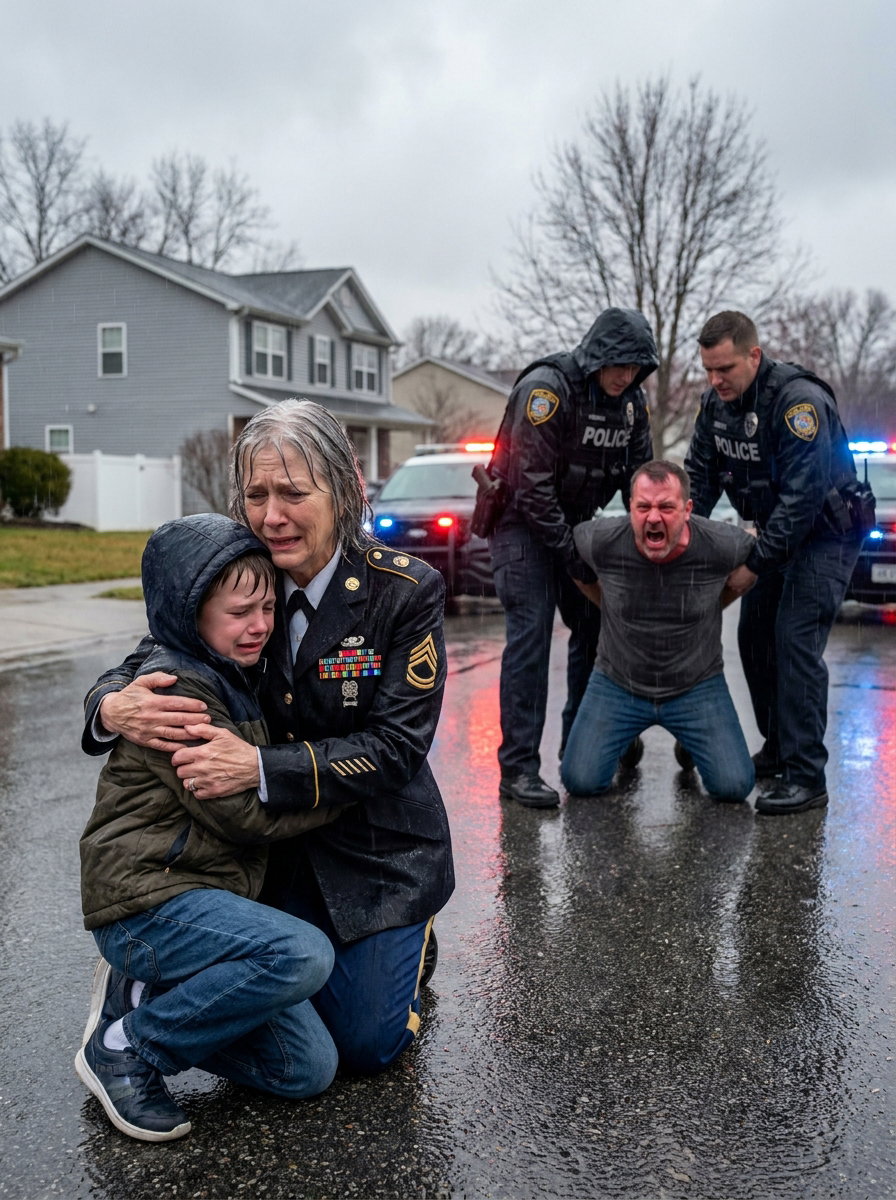
I sat on the back of an ambulance, a shock blanket around my shoulders, holding a mug of coffee. I watched them drag the quarry. Leo was sitting next to me. He had finally come out of the panic room when I gave the code word. He was clinging to my arm like a limpet.
“Is Dad going to jail?” Leo asked quietly.
“Yes,” I said. “For a very long time.”
“Is Mom,” he could not finish the sentence.
I saw a black sedan pull up. Assistant Director Sterling stepped out. He walked over to me and looked at Leo, then at me.
“Beatrice,” he said.
“Sterling.”
“We found her,” Sterling said softly.
My heart stopped. I squeezed Leo’s hand. “The quarry?” I asked, dreading the answer.
Sterling shook his head. “No. Lucas lied to you. He did not dump her in the water. He buried her in the woods behind your property line. Shallow grave.”
I felt the tears prick my eyes. “Is she,”
“She is alive, Beatrice,” Sterling said quickly. “Hypothermia, severe head trauma. She was wrapped in the rug. The cold actually slowed her metabolism. The paramedics have a pulse. They are airlifting her to the hospital right now.”
I let out a breath that I felt I had been holding for thirty years. I turned to Leo and hugged him so hard I thought I might break him.
“Did you hear that?” I cried. “Mom is alive.”
Leo started crying. I started crying. For a moment, the Colonel was gone, and there was just a mother and a grandmother, shaking with relief.
They brought Lucas out of the patrol car to transfer him to the federal transport. He was cuffed, his arm in a sling. He saw me. He stopped fighting the agents. He just stared.
I stood up and walked over to him. The agents let me pass.
“You missed,” I said simply.
Lucas looked at me with hate, but underneath the hate was fear. “Who are you?” he whispered. “Really?”
“I am Penelope’s mother,” I said. “And if you ever speak my name, or Leo’s name, or Penelope’s name again, I will not call the federal agents next time. I will handle it in house.”
Lucas swallowed hard. He looked at the hard eyes of the woman he thought was a victim. He saw the truth. He nodded, once, terrified.
They shoved him into the van.
Sterling walked up beside me. “That was a hell of a bluff with the vehicle footage, Beatrice. We checked the car. Dashcam was disabled.”
I smiled. “Intelligence is the art of knowing what your enemy fears, Sterling. He knew what he did. He just needed to believe I knew it too.”
“You still got it,” Sterling said. He handed me a business card. “You know, we could use a consultant. Someone with your skillset. The pension is good.”
I looked at the card. Then I looked at Leo, who was watching the helicopter take off, carrying his mother to safety. I looked at my garden, trampled by tactical boots. My dahlias were ruined.
“No,” I said, handing the card back. “I have a job.”
“Oh?” Sterling asked. “What is the assignment?”
I put my arm around Leo. “Reconstruction. And security.”
Six months later, the garden was recovering. The dahlias were blooming again, heads nodding in the gentle breeze. I sat on the porch swing, knitting. The scarf was finally finished.
Penelope was sitting in the garden chair. She was thin, and she had a scar on her hairline that would never fully fade, but she was smiling. She was watching Leo chase a puppy across the lawn.
The legal battle had been short. Lucas pleaded guilty to attempted murder and kidnapping to avoid a trial where my testimony would have destroyed him publicly. He was serving thirty years without parole.
The town was quiet. The neighbors looked at me differently now. They did not just see the widow O’Malley anymore. They waved with a little more respect, perhaps a little hesitation. They had heard rumors. Small towns always have rumors. Some said I was an intelligence officer. Some said I was something much worse.
I let them talk. Fear is a good perimeter fence.
Leo ran up to the porch, out of breath. “Grandma! Look! I found a beetle!”
I smiled, putting down my knitting. “Let me see.”
He showed me the bug. He was happy. The bruises were gone. The nightmares were less frequent.
“Can we make cookies later?” he asked.
“Of course,” I said.
He ran back to his mother. I looked at the side table. The hollowed out book was still there. But next to it was a new addition. A secure, direct line phone that Sterling had insisted I keep.
I picked up my knitting needles. The rhythm was soothing. Click clack. Click clack.
Lucas had told me to disappear. He wanted to bury me. He did not understand the nature of things. Seeds are buried, and from the dirt, they grow stronger. He had buried us, yes. But he forgot that I was the gardener.
I looked at my daughter and my grandson. My bloodline. My mission.
The sun dipped below the horizon, casting long shadows across the grass. I was not afraid of the dark anymore. I knew what lived in it. And I knew that nothing in the dark was as dangerous as the old woman sitting on the porch, watching over her pack.
I took a sip of tea. My hand did not shake.
THE END.