South Florida carried a strange heat in late May, humid air pressing against the windows of my Fort Lauderdale penthouse while the canals below caught broken gold reflections from yachts drifting through Las Olas long after midnight. I had fallen asleep on the Italian leather sofa with the television glowing silently, financial news crawling across the screen.
Ethan Caldwell, my husband of seven years, was supposed to be attending a luxury real estate summit in Key West.
At least, that was the story he sold me before leaving three days earlier with two monogrammed suitcases, linen shirts, and the inflated confidence of a man who spent too much time pretending he was more successful than he truly was. He claimed the conference would change everything—investor dinners, private receptions, presentations that would supposedly lift his consulting business into another tax bracket.
I almost believed him.
At 2:47 a.m., my iPhone notification shattered the silence.
Half asleep, I reached for the phone beside the couch.
The message was from Ethan.
I married Savannah tonight. Beach ceremony. Rings, vows, champagne, the whole thing. You can keep your spreadsheets and your colorless little world, Claire. I need someone who actually knows how to live instead of acting like a human calculator every minute of the day.
For several seconds, I stared without breathing.
Then I read it again.
And again.
Not because I doubted it, but because my brain refused to process how casually someone could destroy an entire marriage through a paragraph typed between cocktails and fireworks.
No tears came.
Shock worked differently inside people like me.
As a Certified Public Accountant specializing in forensic auditing, my mind did not collapse emotionally under pressure. It organized information the way it did when I uncovered fraud hidden beneath corporate balance sheets.
Patterns.
Assets.
Exposure.
Risk.
Ethan loved calling our marriage a “partnership,” but the records told a uglier story. The penthouse overlooking the Intracoastal Waterway belonged entirely to me before the marriage, bought with my father’s inheritance and five years of brutal eighty-hour weeks in Manhattan.
Ethan contributed charm.
Expensive watches bought with my bonus checks.
Luxury car payments for the Porsche Cayenne registered under his name but funded through our joint account.
Most of all, he contributed the illusion of success while I quietly paid for the life he bragged about online.
I stared at his message one final time before typing exactly two words.
Confirmed receipt.
Then I got to work.
If Ethan wanted excitement, I was about to introduce him to consequences.
At 3:08 a.m., I logged into every financial platform connected to our household and began removing him from my life with surgical precision.
American Express came first.
Then Chase.
Then Citibank.
Within twenty minutes, Ethan no longer existed as an authorized user on any account tied to me personally or professionally. I froze his Platinum cards while imagining the moment they would decline inside whatever luxury resort suite he was celebrating in with his new bride.
At 3:31 a.m., I changed passwords.
Streaming services.
Cloud storage.
Shared calendars.
Private email servers.
The smart-home security system.
Biometric garage access.
Elevator permissions.
Every digital doorway Ethan once walked through freely disappeared beneath my fingertips.
At 3:57 a.m., I called an emergency locksmith.
“I need every biometric lock in my residence replaced immediately,” I said calmly. “I’ll pay triple your overnight rate if someone arrives within thirty minutes.”
The technician showed up twenty-two minutes later with enough equipment to secure a federal building. As he replaced the entry systems, he studied me quietly.
“Ex-husband situation?”
I leaned against the kitchen counter with black coffee in my hand.
“Not yet,” I said. “Right now he’s simply an accounting discrepancy I intend to remove permanently.”
By 5:30 a.m., the penthouse was completely inaccessible to Ethan.
I sat beside the massive windows as dawn spread pink and silver over the Atlantic, and for the first time in years, I felt something unfamiliar inside my own marriage.
Peace.
Not sadness.
Not rage.
Freedom.
At 8:14, the private video intercom chimed.
Two Fort Lauderdale police officers stood outside my entry corridor looking deeply uncomfortable.
I opened the door politely.
“Mrs. Caldwell,” the younger officer said, “your husband claims you unlawfully locked him out of his residence and seized shared marital property.”
I smiled and handed him my iPad.
“Shared marital property?” I repeated. “Do you mean the husband who informed me at nearly three this morning that he married another woman while still legally married to me?”
The older officer looked immediately interested.
“This penthouse was acquired entirely before marriage and remains under sole ownership classification. Here are the property records, purchase documents, and trust disclosures.”
Both officers reviewed everything carefully.
Then the older one handed the tablet back with something close to sympathy.
“Have a good morning, ma’am,” he said. “We’ll inform Mr. Caldwell this is a civil matter.”
By noon, the circus arrived.
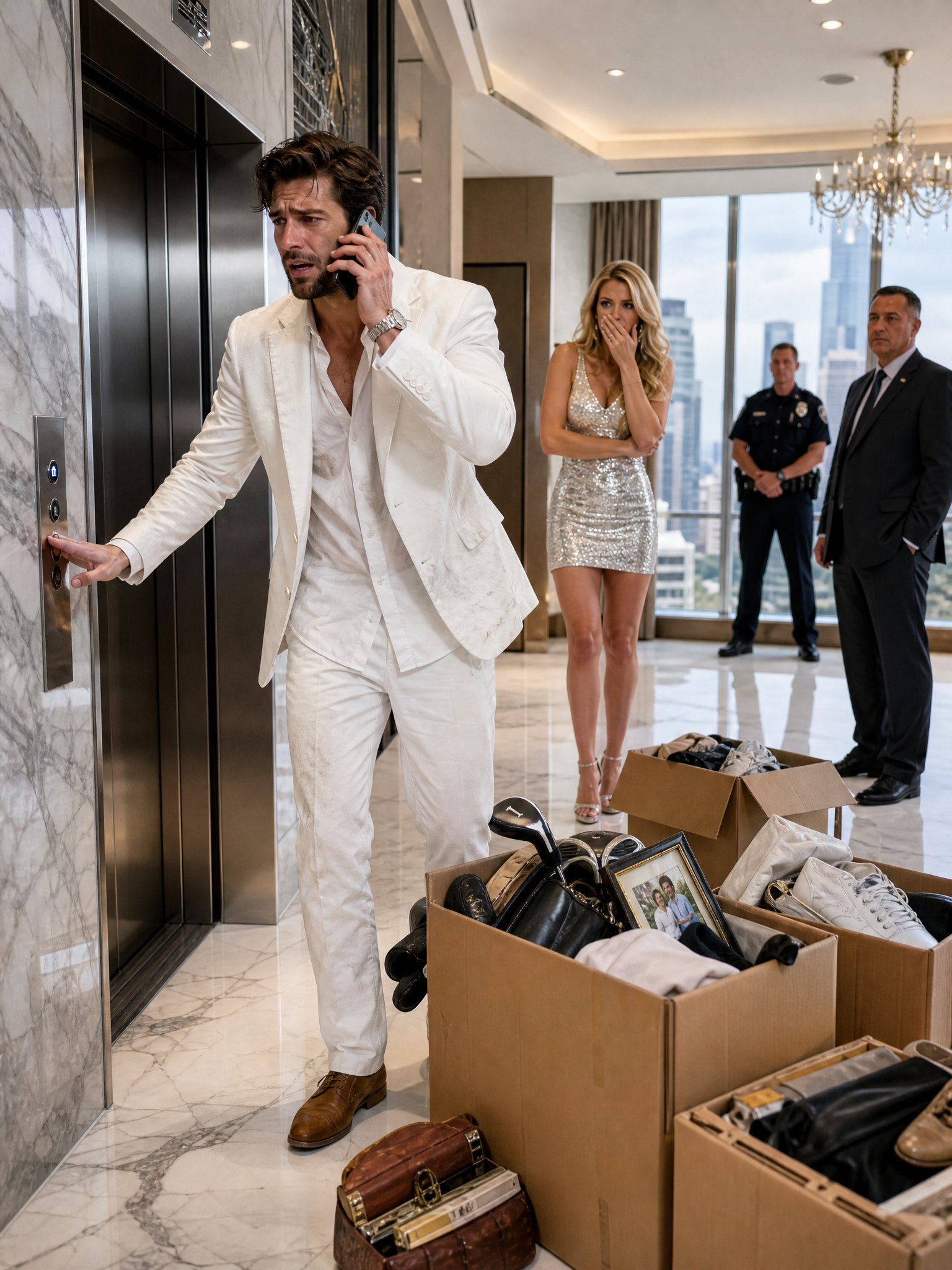
Ethan appeared outside the penthouse elevator in the wrinkled white linen suit from his beach ceremony. Beside him stood Savannah Monroe in a sparkling short wedding dress better suited for a nightclub than a wedding. Behind them came Patricia Caldwell, Ethan’s mother, and Alyssa, his sister, both carrying the outrage people develop when family money suddenly disappears.
Patricia screamed through the intercom.
“Claire, open this door immediately! You cannot treat my son this way after everything he sacrificed for you!”
Sacrificed.
The word almost made me laugh.
I calmly rolled several cardboard boxes of Ethan’s belongings into the hallway beside the elevator—designer loafers, expensive watches, golf clubs, folded clothes. On top, taped neatly in place, were the remains of every canceled credit card I had cut in half that morning.
“I’m not mistreating him,” I said through the speaker. “I’m simply adjusting his lifestyle to reflect his actual net worth.”
Savannah noticed the destroyed cards first.
Her expression shifted.
“Wait,” she whispered loudly enough for the microphone to catch. “You told me the penthouse belonged to you. You said your accounts were unlimited.”
Ethan’s face drained of color.
Their honeymoon collapsed right there beside the private elevator while movers passed through the hallway pretending not to listen.
But men like Ethan rarely surrender gracefully. Public image matters more to them than truth.
Within forty-eight hours, he launched an online campaign portraying himself as the victim of a cold, emotionally detached wife who cared more about financial statements than love. LinkedIn became his battlefield. He wrote about “toxic ambition,” “controlling behavior,” and the loneliness of living with someone who treated marriage like a corporate merger.
Patricia and Alyssa attacked me under professional posts.
Gold digger.
Emotionless.
Manipulative.
Financially abusive.
I never replied publicly.
Instead, I called Marcus Reed, a former cybersecurity analyst from my firm who specialized in forensic data recovery.
Together, we examined the old MacBook Ethan had accidentally left behind inside his office closet.
What we found went far beyond infidelity.
Falsified business deductions tied to shell consulting invoices.
Personal vacations disguised as client development.
Transfers from my company operating account routed toward Savannah’s apartment lease.
Then Marcus uncovered a folder titled EXIT STRATEGY.
Inside were spreadsheets outlining Ethan’s long-term divorce plan, including notes about filing separation proceedings after my restricted stock options vested later that year.
One line stopped me cold.
Convince Claire emotional burnout affecting judgment.
Seek majority claim against liquid assets.
He had been planning this for months.
Possibly years.
Then came the worst discovery.
Marcus opened mortgage authorization documents tied to a private lending company in Tampa.
The property listed as collateral was my penthouse.
My signature appeared at the bottom.
Except it was fake.
Not sloppy.
Not obvious.
But fake enough for someone trained in auditing and document verification to recognize immediately.
Ethan had tried to leverage my property secretly to finance his new life with Savannah.
This was no longer emotional betrayal.
This was organized financial fraud.
That evening, I made exactly one public statement.
No insults.
No dramatic speeches.
I uploaded verified financial records showing Ethan used marital accounts to buy Savannah’s engagement ring while forging authorization documents connected to my property holdings.
Then I logged off.
The reaction across South Florida business circles was almost instant.
Potential clients withdrew from Ethan’s consulting firm.
Investors stopped answering calls.
Savannah deleted every wedding photo from Instagram within twenty-four hours.
But the final collapse had not even begun.
Five days later, Savannah contacted me privately.
She asked to meet at a waterfront café near Las Olas Boulevard because there were things I “deserved to know.”
When she arrived, she no longer looked like the triumphant bride from outside my elevator. Dark circles shadowed her eyes. Her hands trembled around her coffee cup.
Finally, she slid a folder across the table.
“I didn’t know he was lying to both of us,” she said. “He convinced me to invest fifty thousand dollars into a development project he claimed you personally guaranteed.”
Inside the folder were copies of the same forged financing documents Marcus had uncovered.
“He told me the penthouse was basically his already,” she continued. “He said you were emotionally unstable and would never notice the paperwork.”
My stomach tightened.
Not because he had betrayed me again.
Because he truly believed I was too distracted, exhausted, or weak to catch him.
I contacted my attorney before leaving the café.
Then I contacted the FBI.
Once interstate lending fraud and forged financial documentation entered the equation, this moved far beyond divorce court.
Six weeks later, the hearing took place inside Broward County Courthouse under relentless Florida rain.
Ethan looked exhausted in a borrowed navy suit that hung awkwardly from his shoulders. Patricia sat behind him, silent and older-looking than she had during her screaming performance outside my penthouse.
The judge reviewed the evidence slowly.
Then he removed his glasses and stared at Ethan.
“Mr. Caldwell, you attempted to remarry while still legally married, falsified federal lending documentation, forged your wife’s signature, and transferred marital assets under fraudulent pretenses. At what point exactly did you believe this would remain hidden?”
Ethan lowered his head.
“I just wanted another chance to start over.”
The judge’s expression hardened.
“You do not finance fresh starts through fraud and identity deception.”
The divorce finalized that afternoon.
I retained complete ownership of every protected asset connected to the marriage. Ethan faced financial penalties, probation, professional licensing suspension, and court supervision tied to the fraud investigation.
The consulting world that once welcomed him disappeared almost overnight.
Within months, he moved into a deteriorating mobile home outside Jacksonville owned by his mother.
The man who mocked me for loving spreadsheets lost everything because he underestimated the woman who understood numbers better than he understood honesty.
One year later, I stood inside my new penthouse overlooking Elliott Bay in Seattle while rain drifted across the glass skyline beyond my office windows.
I had sold the Fort Lauderdale property after the divorce.
Not because I feared Ethan.
Because I refused to remain attached to a version of myself built around survival and compromise.
Shortly afterward, I launched Caldwell Forensic Advisory, focusing on financial protection strategies for women navigating hidden assets, forged signatures, secret debts, and marriages where manipulation was disguised as love.
The work became personal.
Every week, another woman arrived carrying a story disturbingly similar to mine.
One evening, while organizing old cloud storage, I found a wedding photo.
Ethan stood beside me beneath golden ballroom lights, smiling confidently. I wore the careful expression women wear when they already sense something is wrong but cannot yet explain why.
I stared at my younger self.
Then I felt something unexpected.
Compassion.
Not shame.
Not anger.
Compassion for the woman who had exhausted herself carrying a marriage almost entirely alone.
I deleted the photograph permanently.
Three weeks later, Ethan contacted me one last time through a prepaid number.
Collectors were pursuing him.
Legal fees had destroyed what remained of his finances.
He wanted help.
Forgiveness.
Access to the stability he once mocked.
I read the message quietly before replying with two words.
Access permanently denied.
Then I placed the phone facedown beside my laptop and returned to reviewing forensic reports for a client preparing to leave a financially abusive marriage.
Balance sheets eventually reveal everything hidden beneath appearances.
Debits.
Credits.
Losses.
Liabilities.
And in the final accounting of my life, freedom became the first truly positive number I protected entirely for myself.
Ethan thought he humiliated me with that message sent at 2:47 in the morning.
What he never understood was that the moment he typed “I married someone else,” he unknowingly signed the most expensive release form of his life.
My name is Claire Holloway.
And for the first time in years, every part of my life finally balances perfectly.