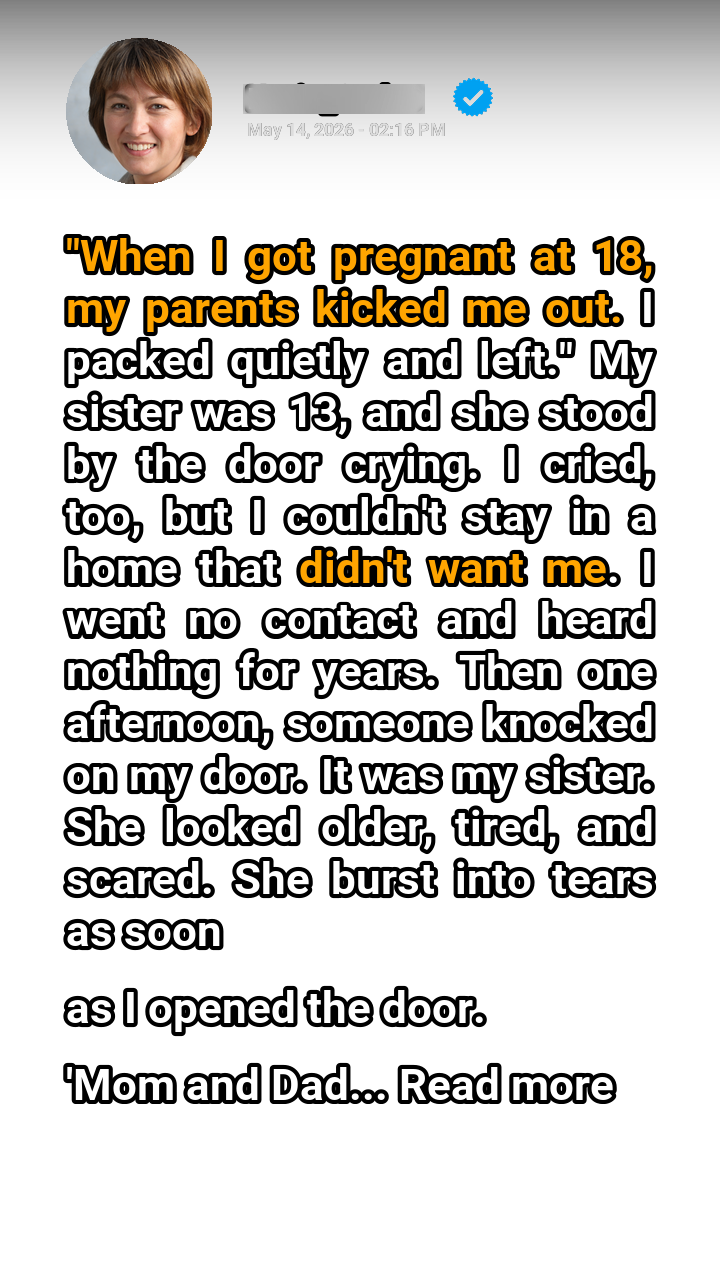
My world, once a carefully constructed tapestry of expectations and quiet suburban dreams, unraveled with two pink lines on a cheap plastic stick. I was eighteen, barely out of high school, and suddenly, devastatingly, pregnant. The confession to my parents, I remember, hung in the air like a death sentence. My mother, usually so composed, paled to an ashen shade, her hand flying to her mouth. My father, a man whose presence usually commanded a room, simply clenched his jaw, his eyes narrowing into slits of utter disappointment and fury. There was no discussion, no offer of support, no flicker of understanding. Just a cold, hard ultimatum delivered in a voice I barely recognized as his own: “You made your bed, you lie in it. But you won’t be doing it under this roof.”
The words sliced through me, sharper than any physical blow. They echoed in the sterile silence of the living room, stripping away every illusion of unconditional love I’d ever harbored. My mother, usually the softer parent, stood beside him, silent, her gaze fixed on the floor, an accomplice in my sudden exile. It was clear then: their perfect daughter, their future aspirations, had been irrevocably tainted. I was no longer a daughter, but a problem to be expunged. With a hollow ache in my chest, I turned and walked towards my bedroom, the silence of the house pressing down on me, heavier than any spoken accusation.
Packing felt surreal, a disembodied act. Each item I placed in my worn duffel bag – a favorite sweater, a dog-eared novel, a framed photo of my sister and me giggling on a beach – felt like a piece of my past being severed. I moved quietly, mechanically, the rustle of fabric and the soft clink of a forgotten trinket the only sounds disturbing the suffocating quiet. Every fiber of my being screamed to fight, to plead, to demand the compassion I thought I deserved, but a stubborn pride, born of profound hurt, kept my lips sealed. I wouldn’t beg for a home that so clearly didn’t want me.
As I cinched the drawstring of my bag, ready to face an unknown future, I saw her. My sister, Lily, stood framed in the doorway of her own room, her small 13-year-old frame trembling, her face a blotchy mess of tears and snot. Her big, innocent eyes, usually so full of mischief, were wide with a terror I knew mirrored my own. She didn’t say anything, couldn’t, perhaps, but her silent, desperate sobs were a symphony of heartbreak that tore at my already shredded soul. I wanted to run to her, to hug her tight and promise her everything would be okay, but I knew I couldn’t. This goodbye, this tearing apart of our shared childhood, was happening, and all I could do was offer a weak, watery smile through my own torrent of tears before turning my back and walking out the front door, leaving her weeping silhouette behind.
The years that followed were a blur of hardship and fierce determination. There was no contact. The silence from my parents was absolute, a chasm I learned to navigate with a hardened heart. I moved across states, found a tiny, rundown apartment, worked two minimum-wage jobs, and gave birth to my beautiful daughter, Maya, alone. There were nights I cried into my pillow, wondering if I’d made the right choice, if my pride had cost me everything. But then I’d look at Maya’s innocent face, her tiny fingers wrapped around mine, and find a renewed strength. We built a life, Maya and I. A small, often precarious life, but one filled with love and resilience. I finished my degree online, slowly climbed the corporate ladder, and eventually bought a small house with a garden, a testament to the grit forged in the fires of abandonment. The past became a distant echo, a scar I rarely touched, but one that shaped every decision I made.
Then, one crisp autumn afternoon, just as the golden light of the setting sun began to paint my living room in warm hues, and Maya was engrossed in her homework at the kitchen table, a sharp, insistent knock rattled my front door. It wasn’t the tentative tap of a delivery driver or the familiar rap of a neighbor. This was urgent, almost frantic. My heart, usually a steady drum, gave an uncharacteristic lurch. I paused, a half-written email blinking on my laptop screen, a strange premonition prickling the back of my neck. Who could it be? I hadn’t given my address to anyone from my past.
Hesitantly, I rose and walked towards the door, my hand trembling slightly as I reached for the doorknob. The moment I pulled it open, my breath hitched. Standing on my porch, bathed in the fading sunlight, was a woman who looked both hauntingly familiar and utterly changed. Her face was gaunt, lines of exhaustion etched around eyes that were far too old for her presumed age. Her once vibrant blonde hair, which I remembered as a cascade of sunshine, was dull and streaked with gray, pulled back in a messy bun. But there was no mistaking the shape of her nose, the curve of her lips, the way her shoulders hunched slightly. It was Lily. My little sister. She looked older, yes, tired, certainly, but more than anything, she looked utterly terrified. As our eyes met, a wave of unspeakable emotion washed over her, and her carefully constructed composure shattered. Her lips began to tremble, and a choked sob tore from her throat as she practically collapsed against the doorframe, her voice a raw whisper of pure agony. “Mom and Dad…”
The words, barely more than a ragged breath, hung in the air, thick with unspoken tragedy. Lily’s knees buckled, and she would have crumpled to the ground if I hadn’t instinctively reached out, my arms wrapping around her surprisingly frail shoulders. Her body shook violently against mine, a thin, reedy sound of pure anguish escaping her lips. “Mom and Dad… they’re gone. Everything’s gone,” she choked out, her face buried in my shoulder, soaking my shirt with hot tears. My mind reeled. Gone? Dead? Lost? The world outside, usually so vibrant with the sounds of late autumn, seemed to dim, and the sweet scent of fallen leaves turned acrid with the sudden onset of dread. I pulled her inside, away from the prying eyes of the street, gently closing the door behind us, the click echoing with a chilling finality. Maya, still absorbed in her algebra, barely registered the commotion from the kitchen.
I led Lily to the living room, easing her onto the plush velvet sofa, a stark contrast to the threadbare furniture she probably remembered from my old apartment. Her hands, calloused and trembling, clutched at the fabric of her worn coat. Her eyes, bloodshot and swollen, darted around my tastefully decorated room, landing on a framed photo of Maya and me, beaming on a recent vacation. A fresh wave of tears welled up. “They… they lost everything, Sarah,” she whispered, her voice raspy, strained. “The house, Dad’s business… it all just fell apart after you left. Like a house of cards. Mom got sick, really sick. And Dad… he just faded away. He couldn’t cope.” The words came in disjointed fragments, punctuated by gasps and sobs, each one a hammer blow to the carefully constructed wall I’d built around my past.
It took what felt like an eternity, and several glasses of water, for Lily to compose herself enough to recount the full, harrowing tale. After I’d left, the carefully maintained façade of my parents’ perfect life had slowly, inexorably, begun to crack. My father’s architectural firm, which had once been a pillar of the community, suffered a series of bad investments and then, a devastating lawsuit. He retreated into himself, drinking heavily, his once sharp mind dulled by despair. My mother, who had always thrived on social approval and appearances, became withdrawn, her vibrant energy replaced by a deep, pervasive depression. Then came the physical ailments – first a persistent cough for Mom, then the diagnosis of a rare autoimmune disease that ravaged her body and drained their savings. Lily, a child herself when I left, had been left to navigate their spiraling decline alone, watching as their beautiful home was foreclosed upon, their possessions sold off piece by piece, their dignity eroded.
Lily, now a young woman of twenty-six, had become their sole caregiver, sacrificing her own youth and dreams to keep them afloat. She’d worked multiple dead-end jobs, scraping together enough for rent in a dingy, one-bedroom apartment, trying to manage Mom’s mounting medical bills and Dad’s increasing apathy. Her voice broke as she described the last few years: “They’re in a hospice, Sarah. Both of them. Mom’s barely conscious, and Dad… he just stares at the wall. They don’t have long. And I… I don’t know what to do. The bills, the funeral arrangements, everything. I’m all alone. I tried to get help from other family, but no one wants to touch it. They just see the mess.” Her confession hung heavy in the air, painting a grim portrait of a family devoured by its own unspoken grief and pride.
A cold knot formed in my stomach. The anger, the hurt, the feeling of abandonment that had fueled my independence for so long, warred with a primal sense of responsibility. These were the people who had cast me out, who had chosen their reputation over their daughter. Yet, they were also my parents, and Lily, my sweet Lily, had suffered for their choices and my absence. Could I turn my back on her again? On them, even in their broken state? The thought of facing them, seeing the ruin they had become, twisted my gut. But the sight of Lily, so utterly defeated, so utterly alone, pierced through the hardened shell I’d built. She was the innocent party, trapped in the fallout, and she was reaching for me, her last hope.
I took a deep, shaky breath, the weight of the past and the present pressing down on me. I looked at Lily, really looked at her, and saw not just the tired, scared woman, but the little girl who had stood crying at the door. “Okay,” I said, my voice surprisingly steady despite the tremor in my hands. “Okay, Lily. You’re not alone anymore. We’ll figure this out. Tell me everything. Where are they? What do you need me to do first?” The relief that flooded Lily’s face was immediate and profound, her tense shoulders slumping as if an invisible burden had been lifted. She burst into fresh tears, but this time, they were tears of something akin to hope.
As I listened to Lily pour out more details, my gaze drifted towards the kitchen, where Maya was humming softly, oblivious to the storm that had just broken. My daughter, my anchor, my future. I had built this life for us, brick by painstaking brick, out of the ashes of my past. Now, that past was knocking on my door, demanding to be acknowledged. I knew this journey back into the wreckage of my original family would be painful, perhaps even soul-crushing. But I also knew I couldn’t abandon Lily again, and perhaps, in confronting the ghosts of my past, I could finally lay them to rest, not just for myself, but for the little girl who had stood crying by the door, and for the woman I had become. The sun had fully set, plunging the living room into shadows, but a faint, resilient light began to glimmer somewhere deep within me.