The air in the sun-drenched ballroom, usually thick with the scent of lilies and celebration, felt strangely hollow that day. I stood at the altar, my heart a frantic hummingbird against my ribs, watching Mark, my soon-to-be husband, beam at me with a love so pure it almost made me forget the gnawing emptiness. My ivory lace gown, a creation I’d dreamed of since childhood, felt heavy, not with fabric, but with the weight of absence. Every seat in the first three rows, reserved meticulously with little silk bows and handwritten tags – ‘Mother of the Bride,’ ‘Father of the Bride,’ ‘Brother of the Bride’ – remained starkly, painfully vacant. No hurried apologies, no last-minute emergencies, not a single text or call to explain the gaping chasm where my family should have been. Just an echoing silence that screamed louder than any shout. My bridesmaids, bless their loyal hearts, tried their best to fill the void, their smiles unwavering, their hands squeezing mine reassuringly, but even their warmth couldn’t thaw the ice spreading through my veins.
The ceremony itself was a beautiful blur, a testament to Mark’s unwavering devotion and the love of our chosen family – his parents, our friends, colleagues who had become like siblings. We exchanged vows, rings, and a kiss that sealed not just our partnership, but a silent pact to face the world together, whatever it threw at us. Yet, even as Mark spun me around the dance floor, his eyes twinkling with joy, a part of me felt like a ghost at my own feast. I kept glancing towards the entrance, a flicker of desperate hope refusing to die, imagining my mother, tears in her eyes, finally bursting through the doors with some wild, unbelievable excuse. But the doors remained shut, and with each passing hour, the hope dwindled, replaced by a cold, hard knot of bewilderment and profound, aching betrayal. How could they? How could *my* family, the people who raised me, simply vanish on the most significant day of my life, leaving not a trace?
The weeks that followed were a strange cocktail of marital bliss and emotional desolation. Mark was everything I could ever wish for – patient, understanding, his arms a constant refuge against the lingering sting of abandonment. We honeymooned in a cozy cabin upstate, the quiet solitude a balm to my frayed nerves, but even amidst the idyllic peace, the unanswered questions gnawed at me. I replayed every interaction, every argument, every perceived slight, searching for a reason, a clue, anything that could explain such a complete and utter disownment. But there was nothing. Just the deafening silence from the people who were supposed to be my foundation. The wedding photos, brimming with joy, felt bittersweet, a stark reminder of who *wasn’t* there, a constant, nagging ache in the background of my new, beautiful life.
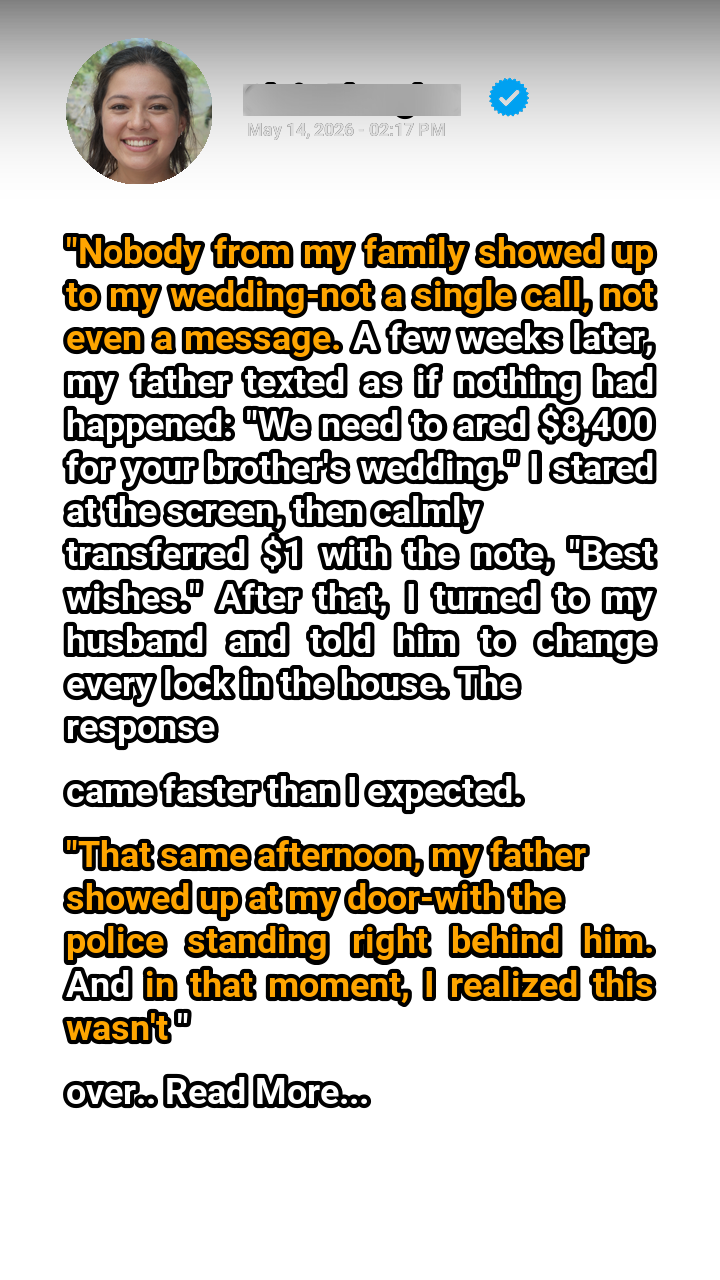
Then, precisely three weeks and two days after I’d walked down that aisle alone, my phone buzzed with an incoming text. It was my father. My heart hammered, a mix of apprehension and a foolish, desperate hope that this was finally the apology, the explanation, the olive branch. I opened it, my thumb trembling slightly. The message was short, devoid of any preamble, any acknowledgment of the past month’s deafening silence. “We need to raise $8,400 for your brother’s wedding. Transfer it to the usual account.” It was as if no time had passed, as if my wedding day had never happened, as if I hadn’t been left to crumble on one of the most important days of my life.
I stared at the screen, the words blurring, then sharpening again, each character a tiny dagger twisting in the wound they had left gaping. Eight thousand four hundred dollars. For *my brother’s* wedding. The audacity, the sheer, unmitigated gall of it stole my breath. It wasn’t just the request for money; it was the absolute lack of remorse, the entitlement, the blatant disregard for my feelings, my pain, my very existence as an autonomous human being. A slow, simmering rage began to boil beneath my carefully constructed composure. The hurt was still there, a dull throb, but now it was overshadowed by a righteous fury that felt almost liberating. They wanted money? For a celebration they would undoubtedly attend, unlike mine? A cold, clear resolve settled over me.
Without a word, I opened my banking app. My fingers moved with a deliberate, almost surgical precision. I navigated to the transfer screen, entered their account details, and then, for the amount, I typed in a single, defiant digit: ‘1’. One dollar. It was a symbolic gesture, a middle finger cloaked in digital politeness. For the transfer note, I paused, a wicked smile playing on my lips, before typing: “Best wishes.” It was curt, dismissive, and utterly devoid of the warmth that phrase usually conveyed. With a final, satisfying tap, I sent it. The confirmation popped up, a tiny digital declaration of independence.
I turned to Mark, who had been watching me, his brow furrowed with concern. “Change the locks,” I stated, my voice steady, betraying none of the turmoil within. “Every single one. Front door, back door, garage. And get a new code for the alarm system.” His eyes widened slightly, understanding dawning. He didn’t ask questions; he simply nodded, his gaze meeting mine, a silent promise of support. This wasn’t just about the money; it was about drawing a line in the sand, a definitive severing of the toxic ties that had bound me. I felt a strange mix of exhilaration and sorrow, like closing a chapter I hadn’t realized was still open. The silence that had once haunted me now felt like a shield, a boundary I was finally enforcing. The response came faster than I expected, a testament to their entitlement and my father’s quick temper. That same afternoon, a frantic pounding erupted from the front door, rattling the entire frame. I walked towards it, my heart thudding, knowing exactly who it was. As I peered through the peephole, my father’s enraged face filled the frame, his fists balled. But it wasn’t just him. Standing right behind him, their uniforms stark against the afternoon light, were two police officers, their expressions unreadable, their presence a chilling declaration of war. My breath hitched. This wasn’t just an argument; this was something far more insidious, and in that moment, I realized with a sickening lurch, this wasn’t just over, it had barely begun.
The world outside the peephole seemed to sharpen into terrifying focus. My father’s face, usually a mask of stoic authority, was contorted with a furious indignation I had rarely witnessed directed solely at me. His eyes, usually a calm blue, sparked with a dangerous, almost desperate anger. But it was the two figures flanking him, their crisp blue uniforms and stern visages, that truly sent a jolt of icy fear through me. This wasn’t a family squabble; this was an escalation into something far more public, far more serious. My father, in his boundless entitlement, had actually called the police because I hadn’t coughed up the “owed” money. The sheer audacity was breathtaking, but beneath the fear, a cold, hard resolve solidified in my core. I was done being intimidated.
I unlatched the door, slowly, deliberately, the click echoing unnaturally loud in the sudden silence. My father lunged forward slightly, but one of the officers, a tall, imposing man with a weary expression, subtly placed a hand on his chest, holding him back. “Ma’am,” the officer began, his voice calm but firm, “your father states you’ve refused to transfer funds owed to him, and that you’ve been harassing him.” My father interjected, his voice hoarse with rage, “She stole from us! She’s holding our money hostage! And she changed the locks to keep us out!” I met his furious gaze, my own eyes unflinching, a quiet strength I hadn’t known I possessed rising to meet his aggression. Mark, sensing my need, stepped up beside me, his hand finding the small of my back, a solid, reassuring anchor.
“Officer,” I began, my voice surprisingly steady, “I assure you, no money was stolen, and no harassment has occurred. My father requested a significant sum of money for my brother’s wedding, three weeks after my own wedding, which he and the rest of my family deliberately chose not to attend. Not a single call, not a single message of explanation or apology for their absence on the most important day of my life. I transferred one dollar with a note of ‘Best wishes’ as a symbolic gesture. As for the locks, this is my private residence, and I am well within my rights to change them. There is no legal obligation for me to provide any money, nor for me to grant them access to my home.” I laid out the facts, calmly, concisely, watching the officers’ expressions shift from neutral to a flicker of understanding, then mild skepticism towards my father.
The second officer, a younger woman, pulled out a small notepad. “So, you’re saying this is a dispute over a requested, not legally binding, transfer of funds, and a change of locks on your own property?” she clarified, her gaze now fixed on my father, who was visibly deflating, his bluster losing its edge under the officers’ professional scrutiny. “She owes us!” my father insisted, though his voice was weaker now, tinged with desperation. “For the years of raising her, for everything! This is our family money!” The officers exchanged a look that spoke volumes. The tall officer turned back to me. “Ma’am, is there any written contract or agreement obligating you to transfer these funds?” I shook my head. “None whatsoever.”
The tall officer then turned to my father, his voice firm, leaving no room for argument. “Sir, this appears to be a civil matter, not a police matter. There is no criminal offense here. Your daughter is under no legal obligation to transfer money, nor is she required to grant you access to her private residence. We cannot force her to do either.” My father sputtered, his face reddening, but the officers held their ground. “If you believe you have a claim,” the female officer added, “you may pursue it through civil court, but we cannot intervene.” He looked from me to Mark, then back to the officers, a dawning realization of his miscalculation slowly eroding his anger, leaving only a bitter, humiliated defeat.
As they began to turn, signalling the end of the confrontation, I stepped forward slightly, my voice clear. “Dad,” I said, my voice devoid of emotion, “you made your choice when you didn’t show up to my wedding. You showed me exactly where I stand. This isn’t just about $8,400; it’s about respect, about family, about love. And you chose to show me I have neither of those from you. Consider this the final conversation.” He flinched, a raw pain flashing in his eyes that was quickly replaced by a cold, hard stare. Without another word, he turned his back, the officers following, their presence now a silent rebuke to his failed attempt at coercion.
As the squad car pulled away, disappearing down the street, a profound silence descended upon our home. I leaned back against the closed door, the tension draining from me, leaving me trembling slightly. Mark wrapped his arms around me, pulling me into his chest, and I buried my face in his shoulder, letting out a shaky breath I hadn’t realized I’d been holding. It wasn’t a satisfying victory in the traditional sense; it was a painful severing, a final, definitive breaking of ties that had been fraying for years. But there was also a strange, liberating lightness, a sense of having finally found my voice, my boundaries, and my true family in the man holding me. The chapter was closed, not with a gentle fade, but with a dramatic, undeniable slam, clearing the way for a future built on genuine love, respect, and peace. This wasn’t over, not in the sense that the hurt would instantly vanish, but the battle for my independence had been fought and won.