The aroma of roasted garlic and fresh herbs hung tantalizingly in the air of “The Ember Hearth,” a cozy bistro Sarah and I had chosen for what I genuinely believed would be a simple, intimate Tuesday night dinner. We’d been together for eight months, a whirlwind of movie nights, park strolls, and shared dreams. I was completely smitten with Sarah – her infectious laugh, the way her eyes crinkled when she smiled, her seemingly carefree spirit. Tonight was meant to be a quiet celebration of a small personal victory I’d had at work, just us, a chance to unwind and reconnect amidst the weekly grind. I’d made the reservation for two, picturing us sharing an appetizer, perhaps a bottle of their house red, and just enjoying each other’s company without any fuss. My heart fluttered with that familiar warmth as I checked my watch, a few minutes early, and settled into our booth, anticipating her arrival.
My smile, however, faltered and then completely evaporated as Sarah walked through the restaurant doors, not alone, but trailed by an entire entourage. First, her mother, Maria, a woman whose every accessory seemed to cost more than my monthly rent, followed by her stern-faced father, David, his gaze sweeping the room with an almost proprietary air. Bringing up the rear was her younger brother, Leo, a lanky teenager glued to his phone, earbuds firmly in place. My initial reaction was a surge of bewildered confusion, quickly followed by a cold, prickly dread that crawled up my spine. Sarah, oblivious to the seismic shift in my emotional landscape, beamed, pulling me into a quick hug before gesturing grandly to her family. “Surprise, Alex! I thought it would be lovely if my family joined us tonight! We haven’t had a proper meal out together in ages, and I told them you wouldn’t mind.” The words tumbled out, innocent enough on the surface, but a chilling premonition of disaster had already begun to form in my gut.
The “simple dinner” quickly morphed into a boisterous family reunion. Maria immediately took charge, dismissing the two-person table and demanding a larger one, which the maître d’, clearly intimidated, hastily arranged. David, without a word, snatched the wine list and began poring over the most expensive vintages, occasionally grunting approval or disdain. Leo, barely looking up from his screen, just pointed at random items on the menu when prompted by his mother, seemingly indifferent to what he’d be consuming. Sarah, meanwhile, was in her element, basking in the attention, regaling her family with anecdotes about our relationship, often embellishing details to make me sound far more impressive (and presumably, affluent) than I actually was. Every time I tried to catch her eye, to subtly ask what was going on, she’d either miss my glance or offer a dismissive, reassuring smile that did anything but reassure me. My initial excitement had been replaced by a growing knot of anxiety, a frantic mental tally of the escalating cost of appetizers, multiple main courses, and now, what looked like two bottles of imported Cabernet. My wallet felt significantly lighter just thinking about it.
The meal continued in a blur of forced smiles and internal panic. Maria ordered the most expensive seafood platter, insisting it was “Alex’s treat,” while David debated the merits of a Wagyu steak. Leo, surprisingly, devoured two servings of the artisanal pasta. Sarah, ever the diplomat, ordered a mid-range chicken dish, but then added a series of elaborate desserts for the whole table, again, with a casual wave of her hand and a glance in my direction that clearly implied I was covering it. I felt trapped, unable to voice my discomfort without appearing rude or stingy in front of her family. Every clink of cutlery, every burst of laughter from their end of the table, felt like a hammer blow to my rapidly dwindling bank account balance. I tried to engage with David, to steer the conversation away from our finances, but he seemed more interested in dissecting the restaurant’s wine list and making pointed remarks about “young men today” and their career prospects. The entire evening felt like an elaborate, expensive performance I hadn’t auditioned for, and certainly couldn’t afford.
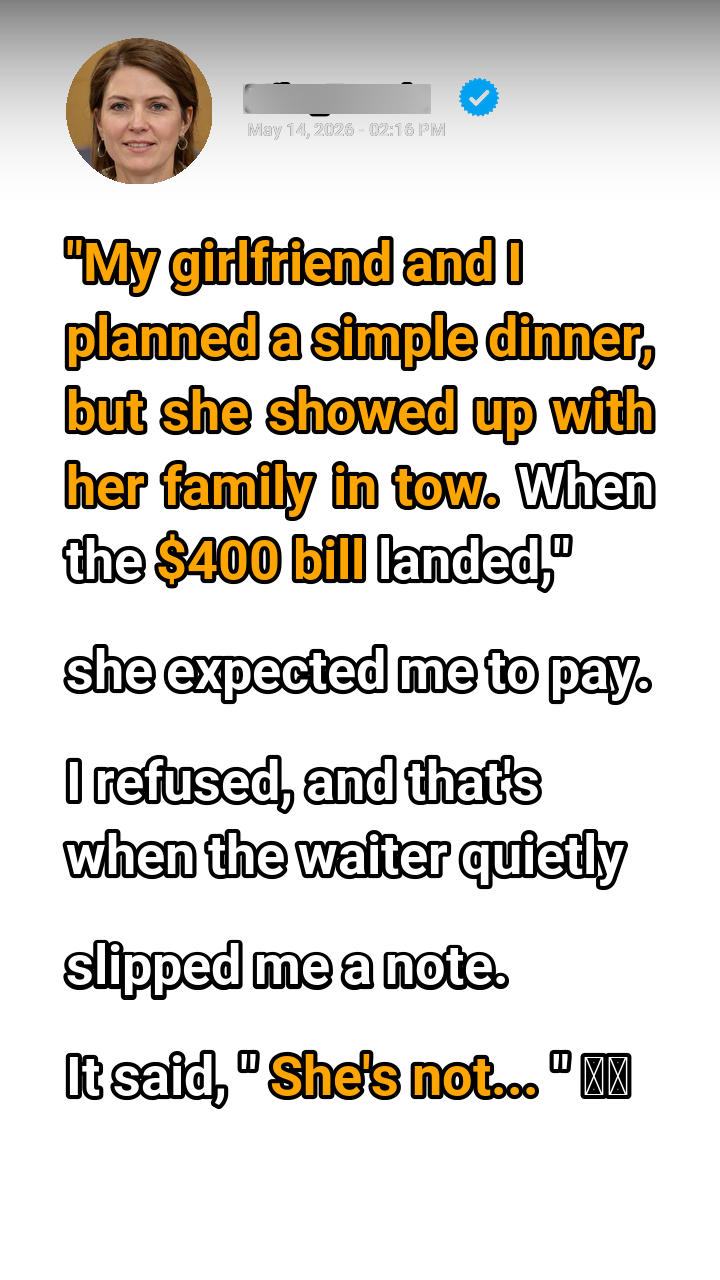
Finally, after what felt like an eternity, the waiter, a young man with tired eyes who had clearly witnessed similar dramas unfold countless times, approached our table. He presented the small, leather-bound folder with a quiet, almost sympathetic sigh, placing it squarely in front of me. My heart hammered against my ribs, a frantic drumbeat of impending doom. My hand trembled slightly as I reached for it, knowing, even before I opened it, that the number inside would be astronomical. I peeled back the cover, and there it was, stark and unforgiving: **$400.75**. My breath hitched. It was more than I’d spent on groceries for the entire month, a significant chunk of my emergency savings. Sarah, seeing me freeze, leaned over, her expression a mix of gentle expectation and mild impatience. “Everything alright, honey? Just go ahead and take care of it.” Her words, delivered with such casual confidence, felt like a physical blow. I looked at the bill, then at Sarah, then at her family, who were now quietly chatting amongst themselves, oblivious to my internal meltdown. A sudden, fierce wave of indignation, mixed with utter humiliation, washed over me. I couldn’t do it. I simply couldn’t.
“Sarah,” I began, my voice barely a whisper, but laced with a tremor of steel. “I… I can’t pay this.” The words hung in the air, heavy and awkward. The table fell silent. Maria stopped mid-sentence, David lowered his wine glass, and even Leo looked up from his phone, a flicker of surprise in his eyes. Sarah’s face, usually so animated, froze, her smile dissolving into a look of utter disbelief, quickly followed by a flush of embarrassment. “Alex! What are you talking about?” she hissed, her voice low and tight, her eyes darting nervously towards her parents. “Don’t be ridiculous. It’s just a dinner.” My gaze met hers, unyielding. “It’s a $400 dinner, Sarah. And we planned a *simple* dinner for two.” The tension in the air was palpable, thick enough to cut with a knife. Just then, as Sarah’s face began to contort with a mixture of anger and humiliation, the tired-eyed waiter, who had been subtly lingering nearby, moved closer. With a practiced, almost imperceptible flick of his wrist, he slid a small, folded piece of paper across the table, right next to my hand, his eyes meeting mine with a fleeting, knowing intensity before he turned and walked away. My fingers closed around the note, a desperate spark of curiosity overriding the crushing weight of the moment. I unfolded it quickly, my eyes scanning the handwritten message, and my blood ran cold. The words, scrawled in hurried cursive, read: “She’s not…”
My fingers, still trembling from the shock of the $400 bill, tightened around the small, folded paper. My eyes, darting between Sarah’s indignant face and the waiter’s receding back, snapped back to the hurried cursive. I unfolded it completely, the light from the overhead fixture glinting off the cheap paper. The full message hit me with the force of a physical blow, a cold, hard truth that instantly shattered the illusion of our eight-month relationship. It read: “She’s not your girlfriend. She and her family are known here. They pull this stunt on unsuspecting men. Don’t pay.”
The words swam before my eyes, then sharpened into brutal clarity. *She’s not your girlfriend.* The phrase echoed in my mind, each syllable a hammer blow to my heart. *Known here. Pull this stunt. Don’t pay.* Suddenly, every confusing, unsettling moment of the evening, and indeed, of our entire relationship, clicked into place with horrifying precision. Her vague answers about her past, her constant need for me to “treat” her, the way she always seemed to forget her wallet, her uncanny ability to always choose the most expensive items on a menu – it wasn’t carefree spirit; it was calculated exploitation. The “small personal victory” I was celebrating tonight, which she’d encouraged me to share, now felt like a bait-and-switch, a setup for this very moment. The casual confidence with which she’d expected me to pay, her family’s proprietary air, Maria’s immediate dismissal of our original table – they weren’t just rude; they were complicit, a well-oiled machine designed to extract maximum value from unsuspecting marks. My initial confusion and dread morphed into a searing, white-hot rage, tempered by a profound sense of betrayal and utter foolishness.
I slowly lifted my gaze from the note, my eyes locking onto Sarah’s. The flush of embarrassment on her face had deepened, but beneath it, I could now see a flicker of something far more sinister: a calculated panic, a dawning realization that her carefully constructed charade was crumbling. “Alex, put that note down,” she hissed, her voice barely audible, but laced with an urgent venom I’d never heard before. “What are you doing? This is humiliating!” Her parents, sensing the shift in dynamics, had stopped their quiet chatter. Maria leaned forward, her perfectly manicured brows furrowed with concern, while David’s stern gaze intensified, now fixed squarely on me. Leo, for the first time all evening, had actually taken out his earbuds, his teenage eyes wide with curiosity, sensing the unfolding drama.
But I wasn’t listening to Sarah. The image of the waiter’s “knowing intensity” and “sympathetic sigh” burned in my mind. He hadn’t just given me a note; he’d thrown me a lifeline. My voice, when I finally spoke, was low, steady, and devoid of the tremor that had plagued me moments before. It was the voice of a man who had just seen the matrix. “This isn’t just a dinner, Sarah,” I said, my gaze unwavering, holding the note up slightly so she could see the crumpled paper. “This is a setup. This is a scam.” Her face went ashen. Maria gasped, her hand flying to her mouth. David’s eyes narrowed dangerously, and Leo looked like he’d just witnessed an alien invasion.
Sarah tried to recover, her voice rising in a desperate attempt to regain control. “A scam? Alex, how *dare* you! My family and I are here to celebrate! You’re making a scene! Are you seriously accusing us of something so vile?” She turned to her parents, tears already welling in her eyes, a performance for the ages. “Mom, Dad, he’s being absolutely horrible! He’s accusing us of… of this!” But the carefully crafted innocence in her voice rang hollow in my ears, replaced by the grating sound of a con artist caught in the act. The waiter, having discreetly observed from a distance, now approached, a subtle, reassuring nod in my direction.
“I’m not accusing you of anything, Sarah,” I stated, my voice cutting through her theatrics. “The note explains it all. You and your family frequently pull this stunt. You target unsuspecting men, invite them to an expensive meal under false pretenses, and then expect them to foot the bill.” I looked at her parents, who were now exchanging uneasy glances. “This isn’t a simple misunderstanding. This is a calculated deception.” Maria looked genuinely shocked, or at least put on a very convincing show of it, while David’s face hardened, a flicker of outright anger replacing his earlier disdain. Sarah, realizing her usual tactics weren’t working, let her facade drop. Her eyes flashed with pure fury, and she lunged forward, snatching the note from my hand and crumpling it further. “You absolute bastard!” she hissed, her face contorted with rage. “You think you’re so smart?”
“Smart enough not to pay for your family’s elaborate dinner,” I retorted, standing up. The entire restaurant seemed to have gone quiet, all eyes on our table. “I’m not paying a cent. You brought your family, you ordered the most expensive items, and you clearly had no intention of contributing. This isn’t a relationship; it’s a parasitic arrangement.” I turned to the waiter, whose face held a mix of relief and concern. “Sir, I will cover my own meal, which was a single chicken dish and a glass of water. For the rest, I suggest you speak to Ms. Sarah and her family.” With that, I pulled out my wallet, placed a twenty-dollar bill on the table for my modest consumption, and a generous tip for the waiter for his intervention. I then looked at Sarah, her family, and the now-exposed scam artists they were. “Enjoy your meal,” I said, a cold, bitter smile on my face. “You bought it.” I turned and walked out of The Ember Hearth, leaving Sarah and her family in stunned, mortified silence, facing a $400 bill and the judging stares of an entire restaurant. The cool night air hit my face, and for the first time in eight months, I felt truly free.