Part 1

At exactly 3:07 on a rainy Tuesday afternoon, the steady sound of rain rattled the windows of our pediatric orthopedic clinic. The hallway carried its familiar mix of disinfectant, wet jackets, and stale coffee, while the cast saw in my hand was still warm from my previous patient. After more than a decade working with injured children, I had repeated the same reassuring promise countless times.
“You’ll be out of that cast before you know it.”
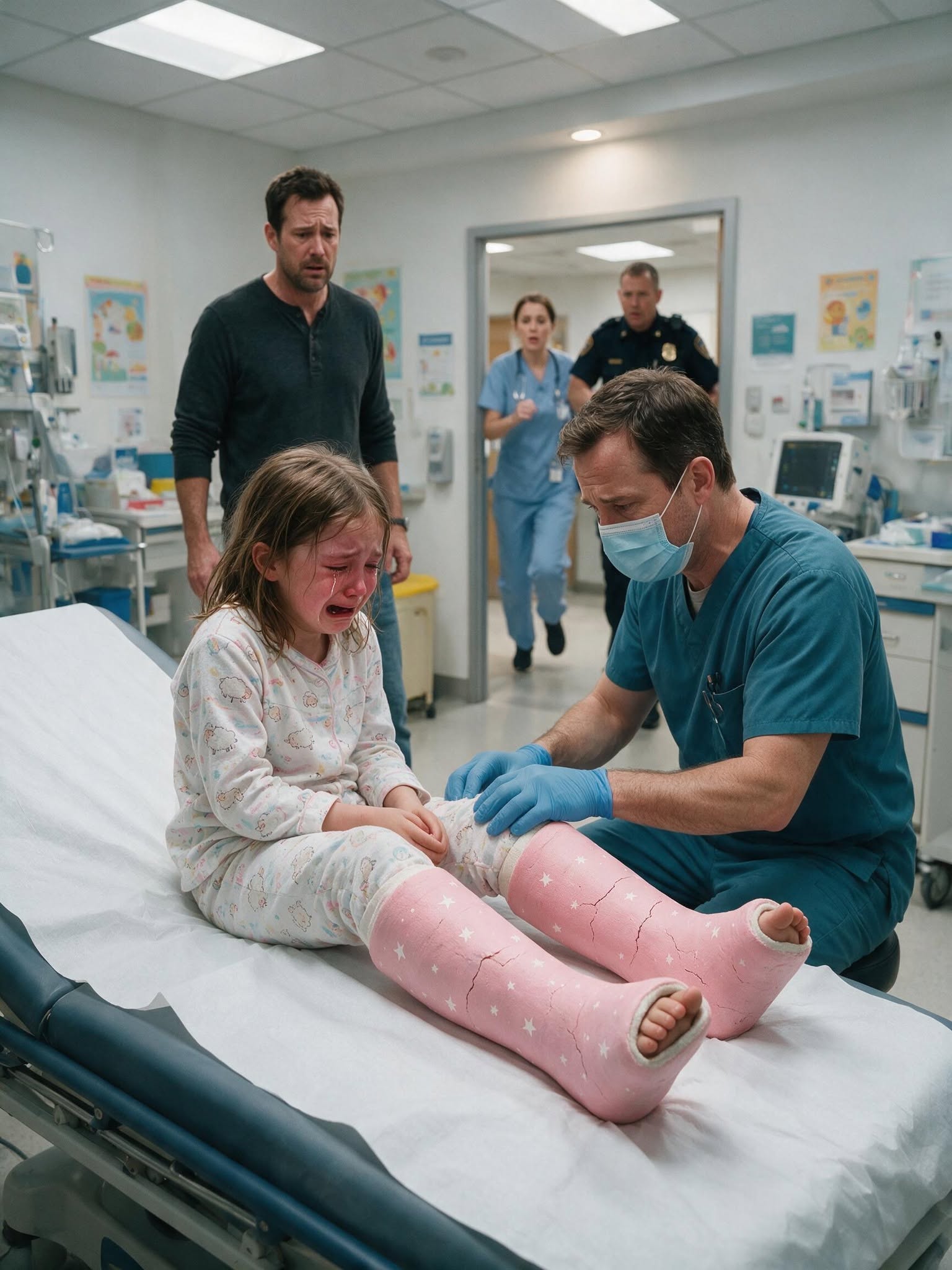
Then six-year-old Maya entered Exam Room 4 wearing a bright pink full-leg cast and an expression no child her age should ever have.
That was the first thing that unsettled me.
According to her chart, she had suffered a spiral fracture of her tibia six weeks earlier. The paperwork looked routine. Her guardian, Arthur, had already signed the required forms, and the injury could easily have resulted from an ordinary playground accident. On paper, nothing seemed unusual.
But medical charts never tell the whole story.
Children often reveal far more through their body language than any report ever can.
Maya climbed onto the examination table without saying a word. Her oversized yellow T-shirt hung loosely over her tiny shoulders, making her seem even smaller beneath the bulky cast covering nearly her entire leg. She folded her hands tightly together, as though she had practiced sitting perfectly still.
Arthur stood beside her with crossed arms, towering over the room. The smell of stale cigarettes clung to his jacket despite the peppermint gum he was chewing. He never comforted Maya, never asked whether removing the cast might hurt, and never smiled at the thought that she would soon walk freely again.
Instead, he looked irritated that he had been forced to bring her.
“Hi, Maya,” I said warmly. “I’m Julian. Today we finally get rid of that giant pink cast.”
She kept staring at her lap.
Arthur answered instead.
“Just take it off,” he said sharply. “We’ve got somewhere else to be.”
Years of treating children had taught me how fear develops. It first appears in tense shoulders, then clenched hands, and finally in frightened eyes. By the time it reaches a child’s voice, adults have usually ignored it for far too long.
I gently rested one hand near her knee to steady the cast.
Maya jerked backward so violently that she nearly hit the wall behind the examination table.
It wasn’t ordinary nervousness.
It was the instinctive reaction of someone who expected every touch to cause pain.
“It’s okay,” I said softly. “I’m not going to hurt you.”
“I said stop talking and do your job,” Arthur snapped as he stepped closer, his work boot bumping against my stool.
Outside the room, conversations suddenly stopped. A nurse fell silent. A resident looked up from his chart. Even parents waiting in the hallway became unusually quiet.
Everyone sensed something was wrong.
No one moved.
Every instinct told me to stand between Maya and the man beside her.
Instead, I reminded myself of hospital policy.
Suspicion isn’t enough.
Evidence matters.
Keeping my expression calm, I checked the intake paperwork once more before switching on the cast saw.
Its familiar vibration filled the room as I carefully cut through the fiberglass. White dust drifted into the air while Maya silently cried, tears rolling down both cheeks without making a sound.
“You’re doing great,” I reassured her.
Arthur simply sighed impatiently.
A cast saw normally slices smoothly through fiberglass while leaving the skin beneath untouched. I had performed thousands of removals exactly the same way.
Then, halfway down her shin, everything changed.
The blade suddenly struck something solid.
The tool jolted violently in my hands.
A harsh grinding noise echoed through the room—completely unlike anything a cast saw should ever make.
I shut it off immediately.
The silence that followed felt overwhelming.
“What’s wrong?” Arthur asked.
“Probably just a stubborn section,” I replied, watching him carefully.
His expression had changed.
I picked up the cast spreaders and gently pried the fiberglass apart.
The shell cracked open.
For a brief moment, I expected to find something harmless—a toy, a coin, perhaps a pencil children sometimes accidentally push inside their casts.
Instead, a metallic smell reached me.
Not sweat.
Not old bandages.
Blood.
I aimed my flashlight into the opening.
Pressed tightly against Maya’s bruised leg was a jagged piece of rusted industrial metal wrapped in blood-stained plastic. It had been deliberately positioned exactly where every movement of her healing bone would grind painfully against it.
Behind the metal was something else.
A small crumpled piece of notebook paper had been hidden deep inside the padding.
Dark stains covered part of it.
Across the paper, written in uneven crayon, were five words.
I couldn’t make out every word from where I sat.
But I saw enough to understand one terrifying fact.
Maya hadn’t hidden a toy inside her cast.
She had hidden a plea for help.
My hands suddenly felt numb.
“Why did you stop?” Arthur asked again, this time in a quiet voice.
A dangerous voice.
The spreaders slipped from my fingers and clattered onto the floor.
Maya slowly looked up at me.
For the first time since entering the room, she met my eyes.
She wasn’t asking whether the procedure would hurt.
She was silently asking whether someone finally believed her.
I looked back toward Arthur.
The color had completely drained from his face.
He wasn’t surprised by what I’d found.
He recognized it immediately.
His right hand disappeared beneath his jacket.
Without taking my eyes off him, I slammed my palm against the emergency panic button beneath the counter.
A red warning light flashed above Exam Room 4.
Within seconds, pounding footsteps echoed through the hallway as hospital security rushed toward the room.
And for the first time since Maya had arrived…
Arthur looked afraid.
I acknowledged him with a brief glance before resting one hand lightly near Maya’s knee to steady the cast.
The reaction shocked me.
Her entire body jerked backward.
She slammed against the exam table as though my touch had frightened her more than any medical procedure ever could.
The paper beneath her crackled loudly.
She squeezed her eyes shut.
For a moment, she stopped breathing.
That wasn’t ordinary nervousness.
Children who are simply anxious still move.
They ask questions.
They cry.
Fear this deep is different.
Fear like this freezes.
“It’s okay,” I whispered.
“I won’t hurt you.”
Before Maya could respond, Arthur stepped closer.
The toe of his heavy work boot struck my stool.
“I said stop talking.”
“Just do your job.”
His tone echoed into the hallway.
Outside the room, conversations suddenly became quieter.
A nurse looked toward the doorway.
Someone pushing a supply cart slowed down.
A parent sitting across the hall instinctively pulled her toddler a little closer.
Hospitals are strange places.
Even when people pretend not to listen, everyone notices raised voices around children.
I wanted to tell Arthur to step back.
I wanted to move between him and Maya.
But experience had taught me something important.
Suspicion isn’t evidence.
Anger isn’t documentation.
If you’re going to protect a child, you need facts that no one can dismiss.
So I took a slow breath.
I quietly reviewed the intake form again.
Guardian listed: Arthur.
Reason for injury: playground incident.
No witness recorded.
No second caregiver present.
Three details.
None of them proved anything.
Together, they felt heavier than they should have.
I switched on the cast saw.
The familiar buzzing immediately filled the room.
White fiberglass dust floated into the air as I began cutting carefully below Maya’s knee.
She squeezed her eyes shut while silent tears rolled down both cheeks.
“You’re doing great,” I told her softly.
Arthur let out an irritated sigh.
Every encouraging word seemed to bother him.
The procedure followed the rhythm my hands had memorized years ago.
Short pass.
Lift.
Reposition.
Never force the blade.
Let the oscillation do the work.
About halfway down the cast, directly over the original fracture site, something changed.
The blade suddenly struck something solid.
The saw jolted violently in my hand.
That wasn’t fiberglass.
It wasn’t a thick seam.
It wasn’t normal.
I released the trigger immediately.
Silence flooded the room.
Arthur spoke behind me.
“What happened?”
His voice sounded different now.
Not impatient.
Careful.
Too careful.
“Probably just a rough section,” I replied, buying myself a few seconds.
I set the saw aside and picked up the cast spreaders.
My hands looked steady.
My heartbeat wasn’t.
I gently separated the cut.
The fiberglass cracked open with a sharp pop.
For one brief second, I assumed I would find something harmless.
Kids sometimes hide crayons.
Coins.
Tiny toys.
Anything that fits through the edge of a cast.
Then an unfamiliar smell drifted into the room.
Metal.
Old blood.
Something sour trapped beneath weeks of fiberglass and cotton padding.
I reached into my pocket for my penlight.
The beam slipped through the narrow opening.
Everything inside me froze.
Pressed tightly against Maya’s bruised skin was a jagged piece of rusty industrial metal wrapped in stained plastic.
It wasn’t loose.
It hadn’t accidentally fallen inside.
Someone had deliberately wedged it exactly where every movement of her healing leg would press against it.
Behind the metal, almost hidden inside the padding, was a tightly folded strip of notebook paper.
Its edges were stained.
Crayon writing covered the front. I couldn’t read the entire message yet.
But I knew immediately that this wasn’t a child hiding a toy inside her cast.
Someone had hidden evidence.
And Maya had been carrying it for six weeks.
I slowly looked up.
Arthur had gone completely pale.
His eyes weren’t on me.
They were locked on the opening in the cast.
Then, without saying a word, his right hand slipped beneath his jacket.
In that instant, I knew this appointment had stopped being routine.
Whatever happened next…
Would decide whether that little girl finally had someone willing to believe her.
Part 2 – The Five Words Hidden Inside the Cast
For a brief moment, nobody spoke.
The room felt unnaturally quiet as I stared through the narrow opening in Maya’s cast. Years of experience told me immediately that the object inside hadn’t ended up there by accident, and the expression on Arthur’s face confirmed what my instincts were already beginning to suspect.
“What is it?” Arthur asked.
His voice was controlled.
Too controlled.
I forced myself to stay calm.
“Just checking something.”
I didn’t look at him again.
Instead, I carefully picked up the cast spreaders and widened the opening just enough to see more clearly.
The smell became stronger.
Old blood.
Rust.
Heat trapped beneath layers of fiberglass.
I aimed my flashlight deeper into the cast.
The jagged piece of metal had been positioned directly beside the healing fracture.
Every step Maya had taken.
Every shift in bed.
Every tiny movement of her leg.
That piece of metal would have pressed against injured tissue again and again.
It wasn’t an accident.
It was placed there deliberately.
Then I focused on the folded piece of notebook paper tucked behind it.
My pulse quickened.
Before I could reach for it, Arthur took one slow step forward.
“So…”
“Can we finish this?”
His eyes never left the opening in the cast.
People who are worried ask what happened.
Arthur wasn’t worried.
He looked afraid of what I might discover.
Without making any sudden movements, I slid my hand beneath the examination counter.
Every orthopedic room has an emergency assistance button.
Most patients never notice it.
I pressed it.
A small red indicator lit beneath the counter where only staff could see it.
No alarms sounded.
No voices echoed through the hallway.
But I knew the signal had already reached the nurses’ station.
I returned my attention to Maya.
She was watching me now.
For the first time since entering the room, she looked directly into my eyes.
There was no confusion there.
No curiosity.
Only one silent question.
Would this adult finally understand?
I offered her the smallest reassuring smile I could manage.
“You’re okay.”
“We’re going to help you.”
Her lower lip trembled.
She gave the slightest nod.
Seconds later, footsteps approached the room.
Nurse Clara quietly entered without asking why she had been called.
She had worked in pediatrics even longer than I had.
One glance was all it took.
She looked at the opened cast.
She looked at my face.
Then she noticed Arthur standing unusually close to the exam table.
“What seems to be the problem?” she asked evenly.
I kept my eyes on Maya.
“Possible foreign object inside the cast.”
“Potential evidence.”
“Please don’t let anyone touch it.”
Clara didn’t ask unnecessary questions.
She simply nodded.
At almost the same moment, two hospital security officers appeared behind her.
Arthur stiffened.
“What is this?”
“It’s a cast removal.”
“You’re acting like I’m a criminal.”
Neither officer answered immediately.
One remained near the doorway.
The other positioned himself quietly between Arthur and the exam table.
Then Clara spoke.
“Sir.”
“Please step back while we complete the examination.”
For several seconds, Arthur didn’t move.
Instead, his right hand slipped beneath his jacket.
Every person in the room noticed it.
One security officer immediately stepped forward.
“Sir.”
“Slowly.”
“Take your hand out.”
Arthur hesitated.
Then he pulled it free.
There wasn’t a weapon in his hand.
Only his cell phone.
His thumb was already moving across the screen.
“Please hand me the phone,” the officer said.
“Why?”
“Hospital policy.”
Arthur’s breathing became heavier.
His confidence was disappearing.
When the officer took the phone, the screen was still unlocked.
I didn’t know exactly what he had been trying to do.
But it clearly wasn’t making a phone call.
Then everything fell apart.
Arthur suddenly looked at Maya.
“You little liar.”
His voice exploded across the room.
Maya immediately curled into herself.
She wrapped both arms tightly around her chest and lowered her head.
The fear on her face was heartbreaking.
Without thinking, I stepped between them.
“No.”
Only one word.
But it was enough.
Arthur looked at me with open anger.
“You have no idea what she’s like.”
“She lies.”
“She makes things up.”
No one answered him.
Because every sentence only made him look more desperate.
The officers escorted him into the hallway while he continued insisting that children invented stories.
His voice faded as the door closed behind him.
Silence returned.
A different kind of silence.
The kind that finally felt safe.
Clara immediately contacted the attending physician.
Then she called the hospital social worker.
Within minutes, mandatory child protection procedures were underway.
Meanwhile, I remained beside Maya.
I never touched the folded paper.
I simply stayed close enough that she knew she wasn’t alone anymore.
The attending physician arrived a few minutes later with additional staff.
Everything was documented before anything inside the cast was removed.
Photographs.
Measurements.
The position of the object.
The condition of Maya’s skin.
Every detail mattered now.
The doctor carefully widened the cast another few centimeters.
The rusty metal fragment came out first.
It had been wrapped in blood-stained plastic before being wedged against her injured leg. When the padding was finally lifted away, the skin underneath looked even worse than I expected.
Dark bruising.
Raw pressure injuries.
Fresh irritation exactly where the metal had been pressing.
Maya never cried.
Instead, she watched every adult’s face.
As if trying to decide whether anyone truly believed her.
Finally, the doctor carefully unfolded the small piece of notebook paper.
Purple crayon covered the front.
The handwriting was uneven.
Clearly written by a young child.
Five simple words.
Tell my mom he did it.
Nobody spoke.
Clara quietly covered her mouth.
The physician lowered the note onto a sterile tray before closing his eyes for a brief moment.
I felt my chest tighten.
Not because I was surprised anymore.
Because I suddenly understood what Maya had been carrying all those weeks.
A six-year-old child had hidden the only message she believed might someday reach someone who would listen.
The social worker reviewed the intake paperwork again.
Something immediately caught her attention.
The emergency contact listed a woman named Evelyn.
But someone had aggressively crossed out her phone number with black ink.
The electronic medical record still contained the original information.
Paper can be changed.
Hospital databases remember.
The social worker located Evelyn’s number from an earlier visit.
Then she placed the call.
About twenty minutes later, Clara returned to the room.
“She answered.”
“She’s on her way.”
Maya looked up.
“My mommy?”
Clara smiled gently.
“Yes.”
“She’s coming.”
For the first time all afternoon, hope appeared on Maya’s face.
And I realized the hardest part of this story…
Was only beginning.
Part 3 – The Message That Finally Reached Her Mother
Less than half an hour after the call, a woman burst through the pediatric clinic entrance, completely soaked by the rain.
Her hair clung to her face, one shoelace had come undone, and she looked as though she had run every step from the parking lot. Before anyone at the reception desk could explain why she had been called, she asked only one question.
“Where’s Maya?”
Security stopped her just long enough for the social worker to verify her identity.
The moment everything was confirmed, she hurried toward Exam Room Four without wasting another second.
When the door opened, Maya immediately looked up.
For a heartbeat, neither of them moved.
Then Maya slowly reached both arms toward her.
“Mommy…”
The tiny word seemed to stop the entire room.
Evelyn dropped to her knees beside the exam table.
She didn’t pull Maya into a tight embrace right away.
Instead, she waited.
She allowed her daughter to choose the moment.
Only after Maya leaned into her did Evelyn carefully wrap her arms around the little girl, holding her as gently as though she feared even love might cause pain.
Both of them cried without saying another word.
Watching them together explained something I hadn’t fully understood until then.
Maya had never stopped believing her mother would come.
She had simply stopped believing anyone would tell her.
While Evelyn comforted her daughter, the social worker quietly filled us in on what investigators had already confirmed.
Arthur wasn’t Maya’s biological father.
He had once been Evelyn’s partner and had obtained temporary guardianship while Evelyn struggled through a difficult period after losing stable housing.
The arrangement was supposed to be short-term.
Instead, it had become something far more complicated.
Someone had crossed Evelyn’s phone number off the intake paperwork.
Someone had made sure she would never receive calls about Maya’s appointments.
Fortunately, hospitals rarely rely on paper records alone.
The electronic system still contained every previous emergency contact.
That single detail had allowed the social worker to reach the one person Maya had desperately been trying to contact.
Meanwhile, hospital security transferred Arthur to local police officers waiting downstairs.
His phone was secured before he could erase anything.
The cast, the rusty metal fragment, the blood-stained wrapping, Maya’s handwritten note, the photographs, and every medical record were carefully preserved as evidence.
By the end of the afternoon, I had already completed my own statement.
I documented every important detail.
The exact time Maya entered the room.
Arthur interrupting every conversation.
Maya’s violent flinch when I touched the cast.
The strange resistance beneath the fiberglass.
The smell after the cast opened.
The hidden metal.
The note.
His hand disappearing beneath his jacket.
The panic button.
Reading the report afterward felt strange.
Everything looked so organized on paper.
Real fear never is.
Real fear lives inside tiny moments.
A child becoming unnaturally quiet.
A guardian answering every question for them.
A little girl watching adults instead of worrying about her own pain.
Sometimes those details matter more than any X-ray.
Maya remained at the hospital overnight so specialists could evaluate the injuries beneath her cast and make sure the fracture itself had healed properly.
Evelyn never left her side.
Every time I passed their room during the remainder of my shift, I saw the same thing.
Evelyn holding Maya’s hand.
Maya sleeping peacefully for the first time all day.
It wasn’t that the fear had disappeared.
Healing doesn’t work that quickly.
But she no longer looked like she expected danger every time a door opened.
Several weeks later, I learned through official hospital channels that the investigation had expanded.
Medical experts determined that the rusty metal inside the cast couldn’t possibly have found its way there accidentally.
It had been intentionally placed where every movement of Maya’s healing leg would cause pain.
Digital evidence recovered from Arthur’s phone, along with medical findings and witness statements, became part of the criminal investigation.
Custody hearings followed soon afterward.
Evelyn regained full custody of Maya while child protective authorities continued their work.
I never asked for details beyond what I needed to know.
Medical professionals learn early that some stories don’t belong to us after our role ends.
Months later, however, the social worker stopped by the orthopedic clinic carrying an envelope.
“There’s something for you,” she said with a smile.
Inside was a handmade thank-you card.
The front showed a child standing beside a doctor wearing blue scrubs beneath a bright yellow sun.
Inside, written in uneven purple crayon, were just a few simple sentences.
“Thank you for believing me. My leg doesn’t hurt anymore. Mom says I’m safe now.”
I stared at those words for a long time.
Then I carefully placed the card inside my locker, where it still remains today.
People often think orthopedic technicians fix broken bones.
That’s only part of what we do.
Sometimes we remove casts.
Sometimes we help frightened children through difficult appointments.
And once in a very rare while…
We uncover the truth hidden beneath something everyone else believed was protecting them.
Even now, years later, I still remember the exact sound.
Not the buzzing of the cast saw.
Not the panic alarm.
The sound I remember most is the blade striking something that didn’t belong there.
One unexpected vibration.
One brief moment when routine stopped being routine.
If I had dismissed it as an uneven layer of fiberglass…
If I had hurried because the schedule was busy…
If I had ignored the fear in a little girl’s eyes…
That note might never have been found.
Five words written in purple crayon changed everything.
Tell my mom he did it.
Those words didn’t simply expose what had happened.
They reminded everyone in that hospital of a lesson we should never forget.
Children don’t always know how to explain their pain.
Sometimes they whisper.
Sometimes they stay silent.
And sometimes…
They hide the truth in the only place they believe someone will finally be forced to look.