Part 1: The Table for Leftovers

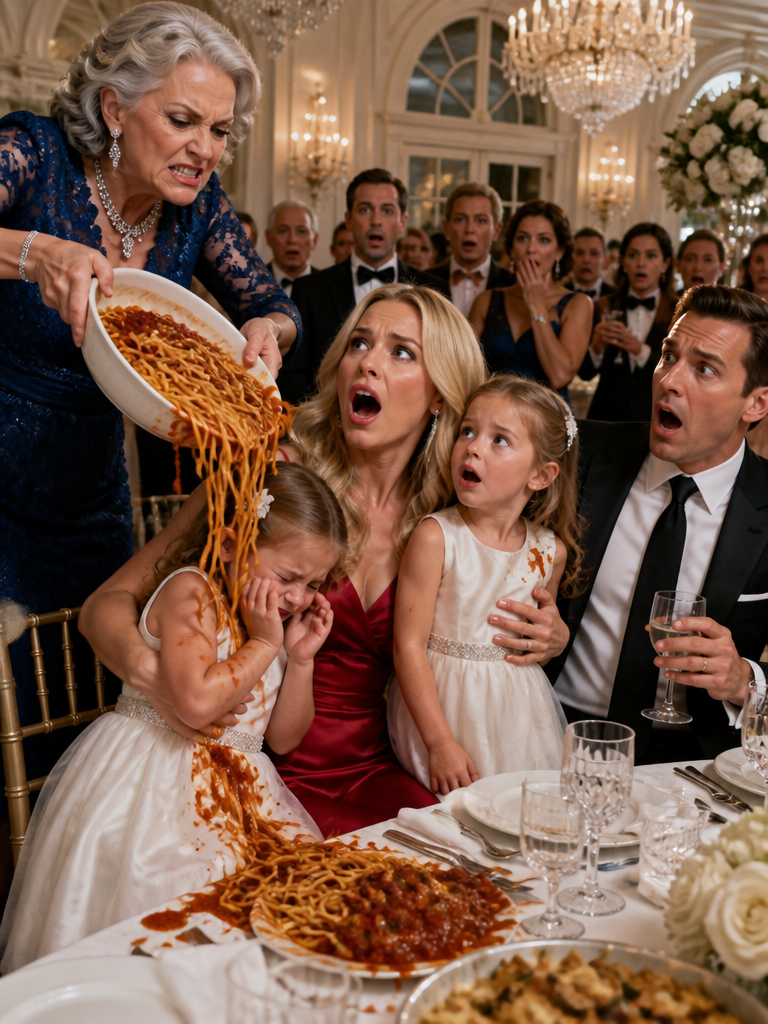
“That food isn’t for girls who won’t carry on the family name,” Patricia said, taking my daughters’ plates away right in front of everyone.
She did it without raising her voice, with the unsettling calm of someone who believed humiliation could also be a form of discipline. Sophia, eight years old, froze with her fork suspended in midair. Chloe, who was only five, stared at her fish fillet as though she couldn’t understand why a grandmother would take dinner away from her in the middle of a celebration.
The party was being held at a rented private estate on the outskirts of Charlottesville, Virginia, although my husband, Andrew Vance, had spent weeks bragging that he had finally bought the place. Long tables were covered with white tablecloths and outrageously expensive floral arrangements. Uniformed servers moved among the guests, a live chamber ensemble played nearby, and almost ninety relatives raised their glasses to “the man who had restored the Vance family name.”
I was seated with my girls at a table off to the side, almost beside the gardens, far from the head table where Andrew laughed with his brothers, uncles, and business partners. According to his mother, that was where we belonged: close, but not too close; present, but never in the way.
Patricia approached wearing an ivory suit, a pearl necklace, and a smile that never reached her eyes.
Without asking, she picked up Sophia’s plate and then Chloe’s.
“Grandma, I was still hungry,” Chloe murmured.
Patricia gave a dry little laugh.
“Sweetheart, the main table is for women who give this family sons. Your mother should understand that by now.”
A few aunts lowered their eyes. One cousin pretended to answer a text. Nobody said a word.
Then Patricia placed a plastic tray of cold leftovers in front of us: clumped rice, stale bread, crushed vegetables, and spilled sauce. As she pushed it toward us, a red sauce stain splattered across Chloe’s yellow dress and onto Sophia’s cheek.
My older daughter didn’t cry. That was what hurt the most. She simply turned toward her father, waiting for him to stand up.
Andrew saw us. He raised his glass from the head table and called out:
“Lauren, don’t start with your drama. Mom knows how these things are handled. Let me enjoy my day.”
My day.
He didn’t say “our daughters.” He didn’t say “my mother was wrong.” He said nothing that could preserve even a little dignity for those two little girls.
I picked up a napkin and wiped Sophia’s cheek. Then I cleaned Chloe’s dress with the same careful patience you use when clearing something fragile from the floor so your children won’t get hurt.
For eleven years, the Vance family had believed I was a wife who lived off her husband. Andrew had told them I worked part-time showing modest apartments. His mother introduced me as “the little girl who got lucky and married well.”
At Christmas, they gave me mops, detergent, and aprons “as a joke,” while my sisters-in-law received designer handbags. Patricia said I should be grateful Andrew had stayed with me despite her disappointment that we didn’t have a son.
What none of them knew was that I was the founder and majority owner of Vance & Horizon Capital, an investment and development firm with commercial projects across Atlanta, Charlotte, and Washington, D.C.
They also didn’t know that the Charlottesville estate didn’t belong to Andrew.
And they certainly didn’t know that inside my purse was a copy of a $350,000 promissory note bearing his signature.
I slowly stood up. I lifted Chloe into my arms, took Sophia by the hand, and looked at Patricia one last time.
“Enjoy the head table,” I said. “Sometimes the leftovers aren’t on the plates. They’re the people sitting around them.”
Andrew shot to his feet, visibly angry.
“Lauren, don’t you dare embarrass me!”
I didn’t answer. I walked toward the exit with my daughters while the music continued playing and everyone pretended not to watch.
But before we crossed the estate’s arched doorway, Sophia squeezed my hand and asked a question that changed everything for me:
“Mom, is Dad ashamed of us?”
And in that moment, I realized the worst of it hadn’t even begun…
Part 2: The Price of Pretending
I didn’t answer right away because any lie would have been another way of betraying them.
I got them into the car, locked the doors, and drove to a small scenic overlook where the road was quiet. Chloe kept touching the stain on her dress. Sophia stared out the window as if she had aged years in a single afternoon.
I climbed into the back seat and sat between them.
“No, my girls,” I said, wrapping my arms around them. “You are not an embarrassment. You never have been.”
“Then why didn’t Dad stand up for us?” Sophia asked.
I took a deep breath. For years, I had softened the truth to protect Andrew’s image. I would say he was tired, that his mother was difficult, that old-fashioned families had ugly traditions. But a little girl doesn’t need polished explanations after someone has just taken away her food in front of ninety people.
“Because your father chose to stay on his mother’s good side instead of protecting your hearts,” I answered. “And I was wrong for allowing that to happen so many times.”
Chloe buried her face against my arm.
“Do we have to go back?”
“No,” I said. “Never again to a table where someone tells you that you’re worth less.”
I turned on my phone only long enough to call my attorney. Then I switched it off. I already had more than twenty missed calls from Andrew in less than fifteen minutes.
While the three of us drove south toward Charlottesville’s quiet countryside, back at the estate, the performance my husband had built was beginning to go up in flames.
I learned what happened later through videos, voice memos, and text messages that some relatives sent me—not out of affection, but because when an arrogant man falls, everyone wants to be close enough to hear the crash.
At 7:30 that evening, the catering manager approached Andrew carrying a black leather folder. The final bill for food, drinks, music, decorations, and staffing came to more than $120,000. Andrew smiled, pulled out his metal credit card, and placed it on top of the folder as though he were signing a monument to himself.
“Charge the whole thing,” he said. “That’s what I work for.”
The card was declined.
He tried another. Declined.
A third. Declined as well.
The music was turned down. The uncles stopped raising their glasses. Patricia stormed over, accusing the manager of trying to humiliate her son in front of the family.
The manager, perfectly composed, simply opened the contract.
“Ma’am, Mr. Vance signed as the party directly responsible for payment. He also signed a personal guarantee.”
Then one uncle asked why he wasn’t using the money from the sale of his old house. A cousin asked why the venue manager had said the event needed to end before midnight if the property belonged to him.
Under pressure, sweating, surrounded by the same family that had applauded him all afternoon, Andrew admitted that the estate had only been rented for six months.
No one spoke for several seconds.
Then Uncle Richard threw the first stone.
“You made us travel all this way to show off a house that isn’t even yours?”
Patricia blamed me. She said I had abandoned him on the most important day of his life. She said the girls were overly sensitive because of me. She said a decent wife stays, even if she has to swallow her pride.
But the worst came when Andrew, desperate, tried to explain that he would soon receive money from “Lauren’s family” because I had supposedly arranged a commercial bridge loan for him.
That was when the other document surfaced.
Part 3: The Unraveling
The document Andrew was referring to was a $350,000 corporate promissory note. He had forged my authorization on a preliminary application, assuming I would quietly endorse it once he presented it as a fait accompli to save his sinking real estate venture.
What Andrew didn’t realize was that my attorney had caught the fraudulent filing two days prior. Instead of confronting Andrew at home, I had filed a quiet injunction, freezing the disbursement of funds and placing a legal flag on his corporate accounts.
Back at the estate, as Andrew tried to explain his way out of the $120,000 party bill, my corporate legal team arrived accompanied by local law enforcement officers.
The room went dead silent.
“Andrew Vance?” the lead deputy asked, stepping into the grand pavilion. “We have a court-ordered freeze on your business assets and a summons regarding alleged financial fraud and forgery.”
Patricia stood frozen, her glass of champagne slipping from her fingers and shattering against the stone floor. “This is a mistake! My son is the owner of Vance Holdings!”
My attorney stepped forward, handing a certified binder to the venue manager and Uncle Richard.
“Mr. Vance does not own Vance Holdings,” my attorney announced clearly so the entire family could hear. “He was a minor equity holder whose shares were collateralized against unpaid debts to Vance & Horizon Capital—a firm owned exclusively by his wife, Lauren.”
Gasp after gasp echoed across the courtyard.
The uncles looked at Andrew in utter shock. The cousins who had laughed at my “modest real estate job” stared in disbelief. Andrew’s face turned gray as he looked around at his family—the very people whose respect he had tried to buy with stolen money and false pride.
“Where is she?!” Patricia shrieked, her voice cracking with desperation. “Where is Lauren?! Tell her to fix this right now!”
“Lauren is safe with her daughters,” my attorney replied coldly. “And she will see you both in court.”
Without another word, the venue manager ordered the event shut down. The lights were turned off, the chamber ensemble packed their instruments, and the catering staff began clearing the untouched tables.
The proud Vance family was forced to pack their own leftover plates in plastic containers and leave the rented estate in total darkness.
Six months later, the divorce and financial settlement hearings concluded in Charlottesville family court.
Andrew tried every legal tactic to claim half of my investment firm, but my legal team presented eleven years of meticulous records proving Vance & Horizon Capital was built entirely with my pre-marital capital, personal loans, and sweat equity.
Furthermore, Andrew’s attempt to forge my name on a $350,000 loan rendered his financial claims dead on arrival. To avoid felony fraud charges, Andrew agreed to sign a full surrender of all marital property claims, sign over sole legal and physical custody of Sophia and Chloe, and accept a court-ordered repayment plan for the debts he had run up under my company’s name.
Patricia came to the courtroom on the final day, stripped of her expensive designer clothes, wearing a dark coat and looking fifteen years older. She tried to approach me in the hallway outside the courtroom.
“Lauren… please,” she whispered, her voice trembling. “They are my granddaughters. You can’t keep them from their family.”
I stopped and looked at her with calm, unyielding clarity.
“They have a family, Patricia,” I said softly. “A family that respects them, protects them, and values them for who they are—not for what gender they were born or what title they carry.”
She opened her mouth to speak, but no words came out.
“You told my daughters that the good table was reserved for women who give this family sons,” I added. “Now you can sit at your own table alone.”
Two years later.
The morning sun streamed through the floor-to-ceiling windows of our new home overlooking the Blue Ridge Mountains. Downstairs, the smell of fresh pancakes filled the kitchen.
Sophia, now ten, was sitting at the island counter working on an architectural drawing for a school project. Chloe, seven, was giggling as she poured maple syrup over her plate.
My firm, Vance & Horizon Capital, had just broken ground on a major sustainable housing project in downtown Richmond—a project dedicated to supporting single mothers starting over.
My phone chimed with a news alert. Andrew’s small firm had officially declared bankruptcy, and he had been forced to take an entry-level sales job to meet his court-mandated restitution payments. His family’s grand estate dreams were gone, replaced by the quiet, unrelenting reality of their own choices.
I set my coffee mug down on the counter and sat between my daughters.
Sophia looked up from her drawing and smiled. “Mom, look! I designed a house where every room has a window so no one feels left out in the dark.”
I pulled both of my girls close and kissed the tops of their heads.
“It’s perfect, sweetheart,” I whispered.
We had left the leftovers, the cruelty, and the false pride behind us on that cold evening in Charlottesville. And at our table, there would always be a place for love, dignity, and room for everyone to shine.