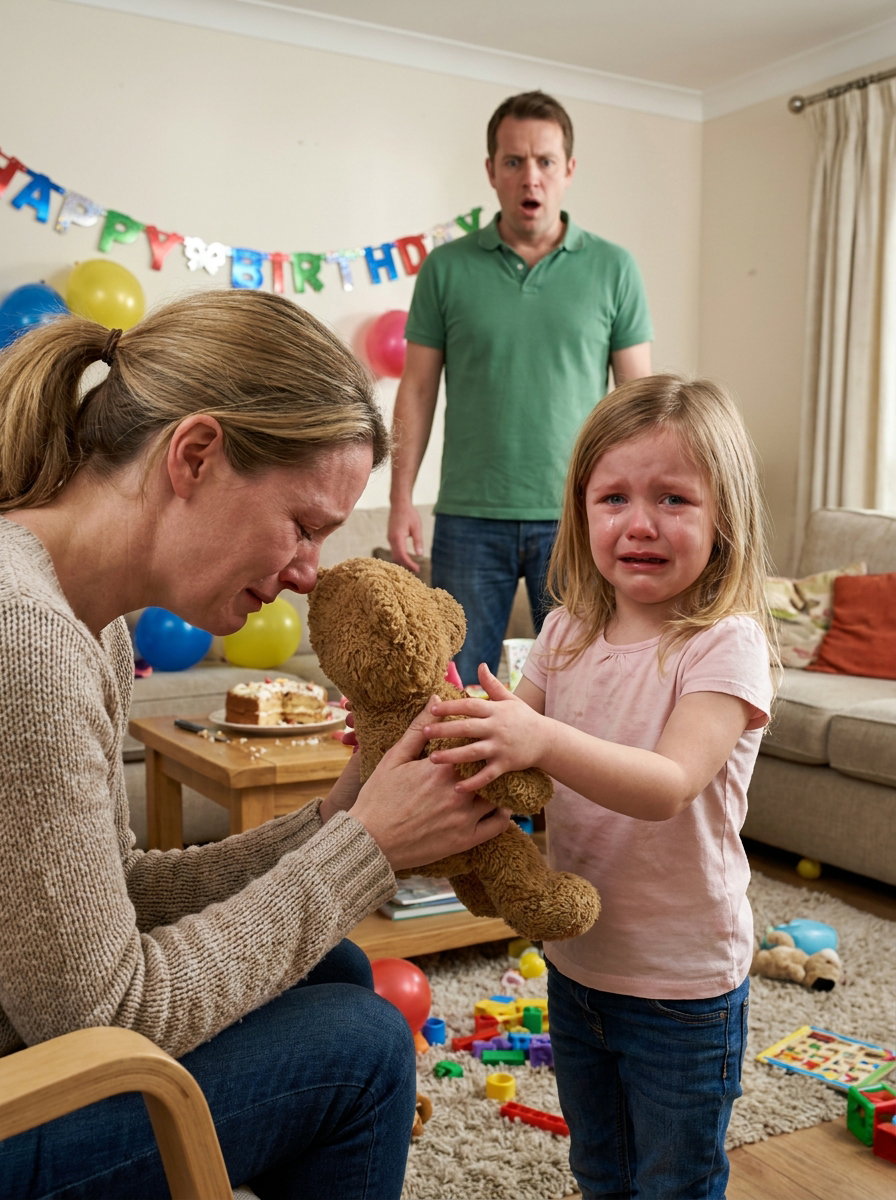

For my daughter Isabella’s sixth birthday, my husband’s parents sent a sweet chestnut teddy bear wrapped in shimmering gold paper and finished with a satin ribbon.
Isabella squealed the moment she saw the box waiting on our porch in our quiet neighborhood in Madison.
“Grandma and Grandpa remembered,” she said, bouncing barefoot across the living room carpet.
I smiled at her excitement, even though my stomach tightened with a familiar, uncomfortable sensation.
My husband, Patrick, had not spoken to his parents in almost eight months.
The silence began after the bitter argument about personal boundaries, their habit of showing up unannounced, and the way his mother, Helen, kept whispering to Isabella that mommy was far too strict whenever I denied her something trivial.
Still, it was our daughter’s birthday, and I did not want to darken such a special day with my own lingering anxieties.
“Go ahead,” I said, leaning against the doorframe. “Open it.”
She ripped through the wrapping paper with clumsy, eager fingers, lifted out the bear, and hugged it tight against her chest.
It was soft, chestnut brown, and looked ridiculously cute, featuring shiny black eyes, a stitched smile, and a small red bow around its furry neck.
For three seconds, Isabella looked absolutely delighted.
Then she went completely rigid.
Her small arms loosened around the bear, and her bright smile vanished into a look of genuine confusion.
“Mommy,” she whispered, holding the toy away from herself as if it were suddenly heavy. “What is wrong with it?”
I moved closer, concerned by the sudden change in her demeanor.
At first, I thought she was worried about the gift tag, which was tucked neatly under the bow.
But then I saw the bear’s left eye and felt my blood run cold.
The right eye was glossy, flat, and standard, but the left eye had a tiny dark circle at the very center, appearing too deep and too exact, almost like a pinhole camera.
My mouth went dry, and my heart began to hammer against my ribs.
I carefully took the bear from Isabella, trying to keep my hands from shaking.
“Sweetheart,” I said, forcing my voice to remain steady and calm. “Why don’t you go help Daddy put the candles on your birthday cake?”
She frowned up at me, sensing something was wrong. “Is it broken, Mommy?”
“Maybe,” I lied gently. “I need to check it to make sure it is safe for you.”
Patrick looked over from the kitchen, saw the expression on my face, and immediately walked toward me with a concerned look.
I turned the bear over in my hands, feeling the weight shift as I examined the seams.
There was a seam along the back, but near the battery compartment, I felt something hard and solid.
It was clearly not a music box or extra stuffing.
“Claire?” Patrick whispered, standing right behind me.
I did not answer because I was too busy processing the reality of the situation.
I carried the bear into our bedroom, closed the door behind me, and set it on the dresser.
Then I switched off the lights, watching as the left eye faintly glimmered in the shadows.
Patrick’s face changed from confusion to pure horror as he understood what he was seeing.
“No,” he breathed, reaching out to touch the bear before pulling his hand back as if burned.
I searched the bear carefully until I found a small, hidden switch buried under the thick fabric near its leg.
My fingers were trembling, but I did not scream, and I refused to call Helen or demand answers from her.
I took several clear pictures of the device with my phone, placed the bear in a locked drawer, and then called my brother, Scott, who worked as a detective in a nearby county.
He listened to my frantic explanation without cutting me off once.
“Claire, do not try to open it yourself,” Scott said, his voice turning into his professional tone. “Do not destroy it, put it in a paper bag instead of plastic, and I am calling someone who handles these things immediately.”
Three days later, police were knocking on the front door of my in-laws’ house in suburban Connecticut.
By the time the police reached the colonial house belonging to Helen and Walter, I already understood that the bear was not some innocent toy with a faulty manufacturing defect.
A technician arrived at our house the morning after the party wearing plain clothes, carrying a heavy black case, and introduced himself simply as Grant from digital forensics.
Scott stayed beside me the entire time, not acting as a detective on the official case, but simply as my supportive brother.
Grant placed the teddy bear on our dining room table as if it belonged in a high-security evidence locker.
Isabella was at school, which was a relief, while Patrick had called out of work and sat beside me, looking pale and silent with a mug of coffee he had not touched in hours.
Grant used a small blade to carefully cut open the seam along the bear’s back.
Inside, hidden deep behind the polyester stuffing, was a compact wireless camera module, a microphone, a battery pack, and a tiny microSD card.
The lens had been positioned perfectly behind the bear’s artificial left eye.
Patrick stood up so quickly that his wooden chair scraped harshly against the floor.
“My parents did not do this,” he said, though his voice carried absolutely no certainty.
Grant did not look up from his work. “Someone definitely did.”
He removed the card, slid it into a reader, and opened the files on his laptop.
There were short recordings, each carefully marked with specific dates and times.
The first file had been created two weeks earlier, long before the bear ever reached our front porch.
That was the moment Patrick stopped trying to defend them.
The footage showed Helen’s kitchen table, her thin, manicured hands turning the bear’s head toward herself.
Then Walter’s voice came from somewhere off camera, questioning his wife’s sanity.
“Are you sure this is legal?” he asked.
Helen answered with chilling confidence, “It is our granddaughter, and we have a right to know what goes on in that house.”
Patrick covered his mouth, looking like he might be sick.
I felt something icy slide down my spine as I watched them scheme.
There were many more clips, including Helen testing the audio and Walter complaining that the battery would not last long enough to catch anything significant.
Helen said, “Patrick has been poisoned against us by that woman, and if we can prove she screams at Isabella or neglects her, we will have exactly what we need.”
“What does she need for what?” I asked, my voice cracking.
Grant’s face stayed professional, but his eyes softened with genuine pity.
“Custody pressure, family court, or maybe even blackmail, but that is for the investigators to determine,” he replied.
The police did not storm into their house that day, as they wanted to document everything first.
They took the bear, interviewed Patrick and me separately, and asked endless questions about our history with his parents.
They wanted to know if they had keys to our house or if they had ever threatened us in the past.
Patrick told them about the incident at school months earlier when Helen tried to sign Isabella out early without our permission.
I refused to let her go, and Helen later screamed at Patrick that we were keeping their own granddaughter hostage.
Walter had not screamed, as he rarely did, but he simply stood behind his wife and said that her mother was absolutely heartbroken.
That was always how he took part, quietly and completely.
Three days after the party, two officers and a lead detective went to the house with a signed warrant.
Patrick and I were not there, but Scott told me everything later.
Helen opened the door with a practiced smile, clearly assuming they were neighbors or church volunteers.
When the detective identified himself, her smile vanished instantly.
Walter came out from the den and asked what this was about, but he already knew.
The detective said, “We are here regarding electronic surveillance equipment sent to a minor child.”
Helen’s first words were not asking what equipment they were talking about.
She just said, “Claire is behind this.”
That single sentence told the police everything they needed to know about her mindset.
The detective later called the search productive, which sounded far too neat for what it actually was.
Inside their house, the police found the packaging for the camera module tucked away in a drawer under various takeout menus.
They found printed instructions with highlighted sections about motion detection, night vision, and remote viewing.
They even found a second device still unopened in Walter’s home office desk.
But the laptop mattered the most to the investigation.
It was Helen’s laptop, the one she used for church newsletters, recipes, and long emails to relatives about how Patrick had changed since marrying me.
In a folder hidden under the name “Isabella Memories,” investigators found many clips from the teddy bear.
There was no footage from inside our home because I had noticed the camera before it had been activated in Isabella’s room.
However, there were test recordings, screenshots of our private social media pages, and a scanned copy of Isabella’s school calendar.
There was also a document titled “Concerns About Claire.”
When the police showed us that document two days later, Patrick read only the first page before pushing it away in disgust.
I read every single page, my hands trembling as I saw the depth of their delusion.
It was a meticulous plan.
Helen had written down dates, specific incidents, and accusations, most of them distorted beyond any recognition.
One note said that I isolated Isabella from her paternal family.
Another said that Patrick appeared afraid to contradict his wife.
A third said she needed proof of my emotional instability to take action.
There were even blank spaces under some of the claims, as though she had been waiting to fill them in later with fake evidence.
The hidden camera had been intended to give her exactly that proof.
“She was building a case against me,” I said, feeling hollow.
The detective nodded grimly. “That appears to be the primary direction.”
Patrick sat beside me in the sterile interview room, looking as if the floor had completely opened up beneath him.
He had always known his mother was controlling and could be vicious when challenged.
But knowing someone is difficult is not the same as seeing concrete proof that they planned to spy on your own child.
“Our child,” he said quietly, his voice breaking. “She put a camera in our child’s favorite toy.”
No one corrected him, and no one tried to soften the harsh reality of his words.
The legal process moved slowly at first, then suddenly all at once as the evidence became impossible to ignore.
Helen and Walter were questioned separately by authorities.
Walter tried to shrink himself inside every sentence, saying Helen had ordered the camera and sewn it into the bear.
He claimed he had only helped with the technical part because she did not understand the setup.
But the financial receipts told a much more complete story.
The camera had been bought with Walter’s credit card, the software account was created using his email address, and his phone was used to test the live feed.
Helen, meanwhile, gave a desperate performance for the investigators.
She cried, she shook, and she told the detective she was just a concerned grandmother.
She said she was afraid for Isabella and claimed I had a violent temper, though she could not give one example that did not involve me simply telling her no.
She said Patrick was being controlled and that the bear was only meant to protect Isabella.
The detective asked, “Protect her from what exactly?”
Helen answered, “From being taken away from us.”
That was the sentence that followed me home and haunted me for weeks.
Not from danger, and not from abuse, but from being taken away from them.
As if Isabella were a family heirloom rather than a human being.
As if my daughter’s life was a room Helen believed she had been unfairly shut out of.
After the charges were filed, Patrick stopped sleeping properly, often waking at two in the morning to check the windows, the back door, and the garage.
Sometimes I found him standing in the hallway outside Isabella’s room, arms crossed, staring at the small teddy bear nightlight she had picked out herself from a store after the police took the other one away.
“I should have cut them off a long time ago,” he said one night in the dark.
I leaned against the wall beside him, feeling the weight of the last few months.
“You were raised to think their behavior was normal,” I reminded him.
“That is not an excuse for what they did,” he replied.
“No, but it is an explanation for why it took so long to see them clearly,” I said.
He nodded, although I could tell it gave him little comfort to understand the root of his upbringing.
Isabella only knew part of the truth.
We told her the bear had a camera inside it and that adults were not allowed to hide such things in children’s toys.
We told her Helen and Walter had made a very serious mistake and that we would not be seeing them for a very long time.
She asked if they were angry with her because of the bear.
Patrick dropped to his knees in front of her so quickly I thought he might fall apart.
“No, baby,” he said, holding her small hands firmly. “You did nothing wrong at all.”
“Then why did they do it to me?” she asked, her eyes wide with confusion.
He looked at me for help.
I answered because he could not bear the weight of it.
“Because sometimes grown-ups make very selfish choices when they want control over things that do not belong to them,” I explained. “That does not make it your fault in any way.”
Isabella thought about that for a long time.
Then she said, “I don’t want any more surprise presents from them.”
And just like that, my six-year-old had learned a lesson she never should have had to learn.
The first court hearing took place in early October, the air smelling like rain on pavement.
Patrick wore a navy suit, and I wore a gray dress because I wanted to feel steady.
Helen arrived with Walter and a high-priced lawyer.
She looked smaller than usual, but not weaker, and her hair was sprayed perfectly into place.
When she saw Patrick, her face collapsed into a mask of theatrical grief.
“My son,” she whispered, reaching out a hand.
Patrick did not step toward her, and his expression remained hard.
Her expression hardened for half a second before she remembered where she was and started crying again.
The prosecutor presented the evidence, including the unlawful surveillance and the attempted invasion of privacy.
He emphasized the aggravating factor that the target was a minor inside the safety of her own home.
Helen’s lawyer argued that no footage had been captured inside our home and that Helen had acted out of misguided concern.
The judge looked down over her glasses with a look of pure disgust.
“Misguided concern does not require hidden recording equipment,” she said.
I remember that statement clearly.
I also remember Helen turning her head to stare at me after the judge said it, as if I had somehow put those words into the judge’s mouth.
A protective order was issued that day, forbidding Helen and Walter from contacting us directly or indirectly.
No calls, no letters, no gifts, and no messages through other relatives.
They were banned from showing up at Isabella’s school, our home, Patrick’s workplace, or any of Isabella’s activities.
When the order was read aloud, Helen made a small, pathetic sound like an injured animal.
Patrick closed his eyes, finally exhaling a breath he seemed to have been holding for years.
I wanted to feel victorious, but I only felt deeply exhausted.
The family fallout arrived fast and furious.
Patrick’s aunt Brenda called first, leaving a voicemail saying that Helen was devastated and that I needed to stop escalating this whole situation.
Patrick deleted the message without listening to the end.
Then his cousin Gary texted, asking if it was really necessary to involve the police.
Patrick answered with one sentence, “They hid a camera in my daughter’s teddy bear.”
Gary did not respond.
For weeks, relatives tried to shrink the crime by making Helen seem like a delicate, misunderstood victim.
They talked about her loneliness and her fear of losing her granddaughter, speaking of forgiveness as if it meant pretending the evidence did not exist.
But Patrick did not bend.
One evening, after another cousin sent a message suggesting a family meeting to clear the air, he typed a reply and showed it to me.
“My daughter’s privacy and safety are not family discussion topics,” he wrote. “Anyone who minimizes what happened will not have access to us.”
He stared at the screen for a long time before hitting send.
“That sounded harsh,” he said, looking at me with doubt.
“It sounded like a father protecting his child,” I replied.
The case did not become a dramatic trial because Helen and Walter eventually accepted a plea agreement.
They avoided jail time, which angered me, but the conditions were strict, including probation, fines, mandatory counseling, and a permanent record.
The judge also extended the protective order indefinitely.
During sentencing, Helen tried to speak, saying she had only wanted to make sure Isabella was safe.
The judge asked whether she understood why hiding a camera inside a child’s toy was a violation of the law.
Helen hesitated, and that hesitation answered the question better than any apology could.
Walter spoke next, his voice low as he said, “I should have stopped it.”
Patrick, sitting beside me, whispered, “Yes, you absolutely should have.”
Walter looked toward him, but Patrick stared straight ahead.
After court, Helen attempted one last scene in the hallway, stepping toward us and saying, “Danny, please, I am your mother.”
The bailiff immediately moved between them.
“Ma’am, step back,” he commanded.
Her face flushed with rage. “I just want to talk to my son.”
Patrick finally looked at her with pity.
“No,” he said. “You wanted control and access, and those are two very different things.”
For once, Helen had nothing left to say.
Life did not return to normal quickly, but it came back in small pieces.
We changed locks, passwords, school pickup permissions, and every emergency contact form we could find.
We checked smoke detectors, nightlights, and every stuffed animal that entered our house.
I hated that we had to do it, and I hated that every innocent object looked suspicious for a while.
Isabella began asking before accepting any gifts.
“Who sent it?” she would ask. “Did you check it? Can it see me?”
Every question cut into me, but little by little, she asked less often.
One day she refused to sleep with any stuffed animals, but a month later, she carried a purple rabbit everywhere and named it Waffles.
Patrick started therapy, not because he was broken, but because he finally understood that growing up with Helen had trained him to question his own boundaries.
He learned to say out loud the things he used to bury deep inside.
“My mother confuses love with possession,” he would say.
“My father enables harm by staying quiet,” he admitted.
“I do not owe access to people who hurt my family,” he finally concluded.
Those sentences changed him, not instantly, but steadily.
As for me, I stopped replaying that birthday so often.
For a while, I kept seeing the bear’s left eye, that tiny black circle staring out from a toy meant to be pressed against my daughter’s chest.
I kept wondering what might have happened if Isabella had not noticed something strange.
But she had, and that mattered more than anything else.
Isabella had seen what the adults tried to hide.
On her seventh birthday, she asked for a backyard party with cupcakes, bubbles, and a bounce house shaped like a castle.
We invited her classmates, our neighbors, and my brother Scott, but we kept the guest list very small and safe.
Near the end of the party, Isabella opened presents at the picnic table while Patrick and I stood close by.
There were art supplies, books, a glittery backpack, and a box with a stuffed fox inside.
Isabella lifted it, studied its face, then looked at me.
“Mommy?” she asked.
I stepped closer and asked, “Want me to check it?”
She nodded, and I checked the seams, the eyes, the tag, and the battery compartment before handing it back.
“All clear,” I smiled.
She hugged the fox, and for the first time in a year, I watched her hold a stuffed animal without fear passing across her face.
Patrick took my hand under the table, squeezing it tightly.
Across the yard, children screamed with laughter as bubbles drifted above the grass, and the late afternoon sun turned everything warm and golden.
Isabella ran toward the bounce house with the fox tucked under one arm, her ponytail swinging behind her.
“I think we are going to be okay,” Patrick said softly.
I watched our daughter climb into the castle and vanish among the laughing children.
“No,” I said, leaning my head on his shoulder. “We are better than okay.”
The truth was that the teddy bear had not destroyed our family, but it had revealed the part of it that had already been dangerous.
Once we saw it clearly, we finally locked the door and moved forward.
THE END.