
The moment my boots hit the pavement outside the taxi, the first thing I heard was my wife speaking to Mrs. Smith regarding my mother’s supposed cognitive decline. The second sound was the frantic thud of Mom’s fist striking the inside of a locked bedroom door upstairs.
“Samuel!” she screamed from behind the wood. “I am begging you, do not leave me trapped in this room.”
Only sixteen hours earlier, I had been sitting on a cramped military transport plane, daydreaming about a cup of hot coffee, the taste of Mom’s signature apple crumble, and my wife, Abigail, running into my arms to greet me. Instead, Abigail stood on our porch wearing a crisp cream summer dress, smiling at the neighbors with the poise of someone hosting a high society charity luncheon.
“She suffers from severe confusion,” Abigail said softly to the woman next door, shaking her head as if burdened by a tragedy. “Sometimes she gets violent and hurts herself, so we are currently arranging for professional care in a facility.”
I glanced up at the window on the second floor and caught the distinct movement of a curtain being pulled aside.
Abigail stepped forward and embraced me, but I felt her entire body go rigid the second I asked her why my mother’s bedroom door was locked.
“It is for her own safety,” she replied without blinking.
I offered a polite smile and said, “Of course, I understand.”
My deployment had taught me that displaying panic was the fastest way to surrender your tactical position. I kissed Abigail on the forehead, carried my duffel bag into the house, and bided my time until the neighbors finally wandered back to their own homes.
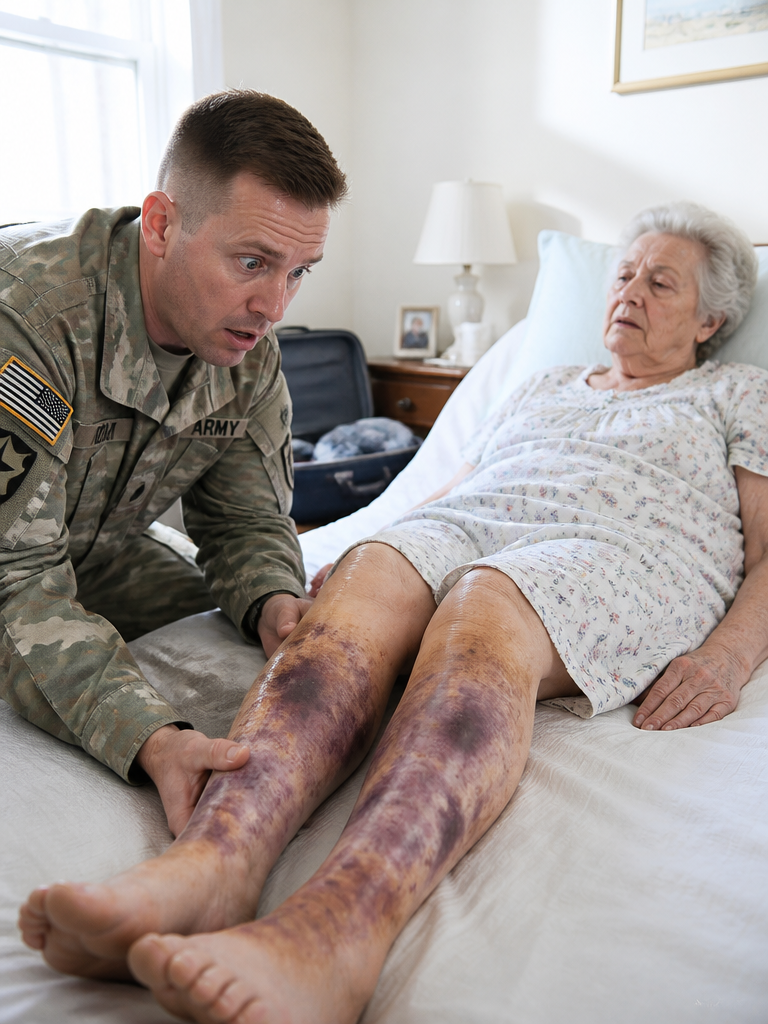
I knew exactly where the key was hidden, buried deep in the back of Abigail’s mahogany jewelry box. Behind the heavy door, I found a room plunged into darkness, a bed stripped of its sheets, a single plastic cup of tepid water, and my mother huddled against the wall wearing the same clothes she had on days ago. Her phone was nowhere to be found, and raw, purple bruises marked both of her wrists where someone had gripped her too tightly.
Mom looked up at me, her eyes clear and burning with a fierce, quiet rage. “I want you to know that I am not losing my mind, Samuel.”
“I know you aren’t,” I whispered back.
She began to recount the nightmare she had been living, but we heard the distinct sound of footsteps approaching in the hallway. Mom’s facial expression shifted into a mask of hollow emptiness instantly.
“Not yet,” she whispered to me. “She watches everything I do.”
I relocked the door from the outside just moments before Abigail entered the room. I despised myself for the charade, but Mom reached out and squeezed my hand firmly before the door clicked shut.
At dinner, Abigail poured a glass of wine and began a rehearsed performance about appointments, wandering episodes, and imaginary falls she claimed Mom had taken. She had already manipulated our family physician into recommending a full psychiatric evaluation for the purpose of incompetence. She had even gone so far as to draw up power of attorney papers for me to sign.
“You have truly done so much for her,” I said, keeping my voice steady.
A wave of visible relief flickered across her face because she assumed the military uniform made me a compliant husband. She had completely forgotten that before I ever enlisted in the Army, I spent four years working as an investigator for the state attorney general, specializing in complex financial fraud.
That night, I quietly accessed our home security system to see what had been hidden. Abigail had wiped three months of footage, but the cloud account still retained the digital access logs, and every single deletion was traced back to her personal laptop. I also discovered that Mom’s bank statements had been surreptitiously redirected to Abigail’s private email, and I found a pending transfer request for eighty thousand dollars.
At the stroke of midnight, I placed a high fidelity audio recorder beneath the kitchen table.
Before I went to bed, I sent an urgent email to my commanding officer requesting emergency family leave. I proceeded to change every password to every account that Abigail might know, knowing that if she tried to run, spend money, or delete files again, each move would leave an undeniable digital trail.
I went back to Mom’s room, unlocked the door, and whispered, “Tomorrow, you need to act confused for her.”
Mom looked down at the dark bruises on her wrists and then stared directly into my eyes.
Her smile was colder and more calculated than anything I had ever seen on my wife.
“Just how confused do you want me to be?” she asked.
At breakfast, Mom shuffled into the kitchen wearing a light robe I had passed through her bedroom window before the sun came up. She stared at the toaster with a vacant expression and asked Abigail, “Is this where I catch the bus into town?”
Abigail’s smile grew wider and more predatory.
“Oh, Adela,” she sighed, making sure to project her voice toward the hidden recorder. “Do you see what I have been dealing with every single day?”
Mom deliberately knocked the ceramic sugar bowl off the table, and Abigail lunged forward, grabbing Mom’s wrist with enough force to turn her skin white.
“Stop embarrassing me in front of your son,” Abigail hissed.
I lowered my eyes to my plate to hide my reaction. “Abigail, please, just try to be more patient with her.”
She released Mom’s arm and gave a short, dismissive laugh. “I am glad you are finally starting to understand the reality of the situation.”
After Mom went back upstairs, Abigail opened a thick folder on the table. The psychiatric evaluation was officially scheduled for nine o’clock the following morning with a specialist named Dr. Angela Ross. If Mom were officially declared incompetent by the doctor, Abigail wanted me to sign the guardianship papers immediately.
“We can finally sell her house,” Abigail said, tapping the documents. “We will use the proceeds to pay for a high end facility.”
“Her house has been paid off for years,” I reminded her.
“Exactly,” she replied.
That single word confirmed that this had never been about Mom’s safety or health.
I spent the entire afternoon gathering the evidence I needed to destroy her case.
I called the county clerk and verified that Mom’s property records now carried an official fraud alert, meaning no deed, lien, or guardianship order could be used to move the house into the shell company owned by a local developer named Raymond.
A contact of mine in the attorney general’s office confirmed that the transfer request carried a scanned, forged version of Mom’s signature. I had a locksmith document that the bedroom door lock was modified to open only from the outside, and a military physician photographed Mom’s wrists, noting that the pattern of bruising suggested intentional, forceful restraint rather than accidental falls.
Then Mom gave me the missing piece of the puzzle that Abigail had completely overlooked.
“Check your father’s old desk,” she whispered to me. “Look in the bottom drawer.”
Inside, I found a small, vintage camera disguised as a smoke detector. Dad had installed it years ago after a string of neighborhood burglaries, and Abigail had disabled the modern cameras but missed this older, independent system. The memory card inside contained weeks of incriminating footage.
It showed Abigail dragging Mom by the arms through the house.
It showed Abigail taking her phone and locking her away.
It showed Abigail sitting at the table, rehearsing her lines for the neighbors.
And, three nights earlier, it showed Abigail meeting with Raymond, a local property developer.
“Once she is declared incompetent,” Raymond said on the tape, “the house can be sold well below market value without any legal trouble.”
Abigail leaned in and kissed him, sealing the pact.
At that moment, my desire for revenge stopped being personal, and it became a professional case.
That evening, I copied everything into three separate digital files. One was sent to Dr. Ross, one was sent to Detective Cooper in the elder abuse unit, and the third was scheduled for automated delivery to Abigail’s defense attorney the moment the evaluation began.
Abigail grew reckless because I kept acting like the oblivious, obedient soldier.
Over dinner, she drank more wine than usual and said, “Your mother always hated me, and now she just looks pathetic.”
“She might eventually recover,” I replied, watching her carefully.
Abigail snorted. “From dementia? Do not be ridiculous.”
“I meant from whatever happened to her wrists,” I said.
A heavy, jagged silence tightened the atmosphere of the room.
Abigail leaned close to me, her eyes narrow. “No one is going to trust that old woman over me. I have told every single person in this neighborhood that she lies, falls, screams, and forgets everything. By tomorrow morning, a doctor will put it all in writing.”
The recorder beneath the table caught every single word of her admission.
I lifted my glass toward her. “To tomorrow, then.”
She clinked her glass against mine, unaware she was toast.
Upstairs, Mom waited by the bedroom door, and I gave her a clean dress and a photograph of my father.
“Are you absolutely sure you can do this?” I asked.
She straightened her spine and looked ready for battle.
“Your wife demanded a psychiatric examination,” Mom said. “Let us make certain she actually gets one.”
The next morning, Abigail wore a pair of expensive pearls, looking like she was attending a funeral for someone she had already buried.
I drove us to Dr. Ross’s clinic while Mom sat in the back seat, staring out the window in silence. Abigail spent the entire ride explaining exactly how Mom should answer the doctor’s questions.
“Do not try to argue with the doctor, Adela,” she warned. “Remember that confusion can often make you look aggressive.”
Mom gazed through the glass and said, “I will be sure to remember that, Abigail.”
In the sterile waiting room, Abigail handed the receptionist her folder of fake medical reports. I walked up to Dr. Ross and handed her my own folder.
It contained the forged bank transfer, the photos of the bruises, the digital access logs, the locksmith’s report, the camera footage, and the audio recording of Abigail’s confession. Dr. Ross read the first page, looked at the medical notes regarding the bruises on Mom’s wrists, and immediately asked her nurse to lock the office door.
The evaluation lasted forty minutes.
Mom named the date, the current president, our home address, her medications, her bank account details, and the birthday of every single grandchild in the family. She solved complex memory tests in seconds, explained how the hidden camera system worked, and clearly described every act of assault she had endured.
Abigail interrupted, shouting, “She practiced this! She is just rehearsing!”
Dr. Ross turned to Abigail with a cold expression. “Mrs. Mercer, why was an independent, competent adult kept locked in a room without a way to call for help?”
“It was for her safety,” Abigail stammered.
“Why did the lock on that bedroom door open only from the outside?”
Abigail looked toward me, desperate. “Samuel, tell her the truth.”
I placed my phone on the doctor’s mahogany desk and pressed play on the recording.
“No one will trust that old woman,” Abigail’s voice rang out clearly in the room.
The color drained from Abigail’s face until she was ghostly white.
The next recording began, and we heard Raymond discussing the discounted sale of our family home. Then, the video played on the office tablet, showing Abigail dragging Mom across the floor by her arms.
Abigail lunged for my phone, but Detective Cooper stepped out from the adjoining office door.
“Abigail Mercer,” he said, holding up his badge. “You are under arrest for suspected elder abuse, unlawful imprisonment, forgery, and conspiracy to commit financial exploitation.”
“This is all a setup!” she screamed as the handcuffs went on.
“No,” Mom said, standing tall. “The lock on my door was your setup.”
Abigail spun toward me, her eyes wild. “I was your wife! You slept in the same bed as me!”
“I was merely protecting a witness,” I replied calmly.
Her confidence finally shattered, and she began bargaining, blaming Raymond, the alcohol, the stress, and eventually, my mother. Every excuse was captured by the police microphones. At that exact same hour, other investigators arrested Raymond at the county records office while he was attempting to file the fraudulent purchase agreement.
Dr. Ross’s final report found Mom to be perfectly competent and recommended professional trauma counseling. The court issued immediate protective orders, froze all of Abigail’s accounts, and voided every single legal document she had touched.
Abigail eventually pleaded guilty after her own attorney saw the video evidence. She received a significant prison sentence, an order for full restitution, and a permanent legal prohibition from ever working with vulnerable adults again. Raymond received an even longer sentence because the police discovered he had used similar predatory schemes against two other elderly families in the area. Our divorce was finalized in eleven minutes. Abigail left with nothing but her clothes and a mountain of legal debt, knowing that the neighbors she had spent months manipulating were the first ones to attend Mom’s competency hearing just to apologize to her.
Eight months later, the afternoon sunlight poured into the bedroom where Mom had once been imprisoned. Mom had ripped out the old lock and painted the walls a soft, pale blue. She used the room as a quiet space for reading, with a new phone sitting right beside her favorite chair and Dad’s photograph resting on the windowsill.
I returned to active military duty only after she personally asked me to.
Before I left for the airport, I found her in the kitchen baking a lemon pie.
“Are you still feeling confused, Mom?” I asked with a smile.
She laughed. “Terribly confused. I just keep forgetting why I was ever afraid of her in the first place.”
Outside, a modern security camera blinked steadily above the hallway.
This time, it was guarding our peace.
THE END.