PART 1

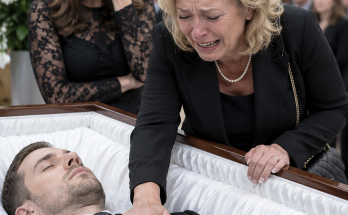
“If you truly wish to see me gone, bury me right beside my boy, but you must open this casket for me first.”
Mrs. Joyce’s voice echoed through the funeral parlor, shattering the heavy, artificial silence that had settled over the room. She was sixty-eight years old, her hair tied back in a hurried bun, her worn sandals coated with the dust of a long journey, and her eyes red with the raw agony of a mother who had traveled halfway across the country with only one singular obsession in her mind: to say her final goodbye to Oliver, her only child.
Nobody in the room dared to move or make a sound.
Before her stood the closed mahogany coffin, surrounded by elaborate arrangements of lilies, expensive flickering candles, and soft, somber music that felt like it had been purchased specifically to manufacture a sense of manufactured grief. Standing right next to the casket, dressed in a sleek and impeccable black designer dress, was Samantha, Oliver’s wife, her face frozen in a mask of tension with her lips pressed tightly into a thin, white line.
“Please do not make a scene here, Mrs. Joyce,” Samantha said in a low, controlled tone. “Oliver is finally at peace now, and he deserves to rest in quiet.”
Mrs. Joyce looked at her daughter-in-law as if she had just uttered a deeply offensive blasphemy.
“At peace, you say? And tell me, just who gave you the authority to dictate how I should say goodbye to my own son?”
An uncomfortable murmur rippled through the small group of mourners standing nearby. There were very few people present, mostly junior associates from the firm, a couple of former college roommates, and a stiff lawyer who kept checking his wristwatch as if he had somewhere much more important to be. None of them seemed to understand why the mother of the deceased had suddenly arrived late, entirely alone, and clearly uninvited to the service.
However, Mrs. Joyce understood perfectly well why she was there.
The truth was that absolutely nobody had bothered to warn her about what was happening.
She had received the devastating news through a short, impersonal text message from a neighbor back in the old suburb where Oliver had spent his childhood.
“Mrs. Joyce, I am so incredibly sorry to hear about Oliver, I had no idea they were already holding the funeral today,” the neighbor had written.
She read those words while standing in her small kitchen in the outskirts of Kansas City, busy heating up tortillas on the stove. At first, she was convinced it had to be a cruel mistake or some kind of sick joke. She dialed Oliver’s cell phone number seven times, but every single time it went straight to his voicemail. She tried calling Samantha’s number, but there was no response. She desperately reached out to his old classmates, distant acquaintances, and people she hadn’t spoken to in years, until finally, one of them answered the phone with a voice that was clearly breaking.
“Mrs. Joyce, everyone is saying that Oliver died in his sleep, and Samantha insisted on making all the arrangements extremely quickly so the funeral could be held early tomorrow morning.”
The coffee mug slipped from her fingers and shattered against the linoleum floor.
Oliver could not possibly be dead, it simply was not true. He would never go without calling her first, he would never leave this world without hearing her voice one last time.
Throughout the entire long bus ride across the state, Mrs. Joyce clutched an old, faded photograph against her chest, showing Oliver at the age of six, wearing an oversized school uniform and beaming with pure pride because he had won his very first elementary school math competition. As the shifting landscape passed by the window, she remembered every single sacrifice she had made to keep him healthy, fed, educated, and pushed toward a bright future that she herself had been denied.
She remembered Richard, the man who had stolen her heart when she was only twenty-one, a man with a charming smile and a endless supply of empty promises. He told her he would lift her out of the poverty she had always known, that they would eventually own a house with a sprawling yard, and that their child would be born into a life of absolute security and love. But the moment Mrs. Joyce told him she was pregnant, Richard’s entire expression shifted into something cold and unrecognizable.
“That was never part of my plans, and you need to decide right now, because either you fix that problem or I am leaving you today,” he told her while they sat in a downtown diner.
He left a few crumpled bills on the table, as if the life growing inside her were nothing more than a temporary, inconvenient debt to be settled and forgotten.
Mrs. Joyce refused to touch that money, even though she cried for hours and her hands trembled with pure terror. She made the choice to keep her son, and from the very day Oliver was born, she swore an oath to herself that no man in this world would ever abandon him as long as she still had the breath in her body.
That was exactly why, when she saw Samantha blocking the path to the coffin, a deep, ancestral fire ignited within her chest.
“Open it right now,” Mrs. Joyce ordered, her voice echoing off the walls.
“No, I will not,” Samantha replied, her voice now turning sharper and more aggressive. “He specifically requested that he not be seen like that by anyone.”
“My son would call me even if he just wanted to know how to properly make chicken soup, so do not you dare try to tell me what he wanted for his funeral.”
Samantha took a hostile step toward the older woman, looking down at her with disdain.
“Mrs. Joyce, you and Oliver had been completely estranged for many months, so please do not come here now pretending to be the perfect, loving mother.”
That sentence stung deeper than anything else because it contained the bitter poison of the truth. It was true that they had drifted apart, and it had all started when Oliver announced he was marrying Samantha, a partner at a tech firm that had been scaling its operations far too quickly. Mrs. Joyce had never fully trusted her, as there was something unsettling about the way she smiled without her eyes ever truly lighting up, the way she constantly spoke for Oliver before he could finish his own sentences, and the way she would firmly stroke his arm whenever he tried to assert his own opinion.
“That young woman does not see you as a wife, my son, she sees you as a calculated investment,” she had told him one afternoon during a heated discussion.
Oliver had become absolutely furious at the suggestion.
“You are always doing the same thing, Mother, you just love to distrust the people who actually care about me,” he had yelled back.
After that argument, he had stormed out of her house, slamming the door so hard it rattled the frames on the walls. Weeks later, Mrs. Joyce learned through social media updates that Oliver and Samantha had held a private wedding ceremony in a distant city, and she hadn’t been invited to attend.
From that moment on, the phone calls became fewer and the text messages became colder, and the distance between them turned into an open, festering wound.
However, pride was one thing, and the finality of death was something entirely different.
“Open that coffin for me right now,” Mrs. Joyce repeated, her voice dropping into a dangerous, low register. “Open it, or I swear I will open it myself.”
Samantha looked at the lawyer standing nearby, looking panicked.
“Do something to stop her, please,” Samantha demanded.
The lawyer swallowed hard and stepped forward, looking terrified.
“Mrs. Joyce, legally speaking, I cannot allow you to interfere with the proceedings.”
Mrs. Joyce did not bother listening to another word he said. She shoved Samantha aside with an unexpected, sudden force that no one in the room would have expected from a woman her age, and she lunged forward toward the casket. Two funeral home employees tried to physically block her path, but she broke through them with the frantic desperation of a mother who no longer gave a single thought to social shame or decorum.
Her hands were shaking violently as she gripped the lid and forced it upward.
The entire funeral parlor descended into a sudden, vacuum-like silence.
Oliver was lying there inside, pale and motionless, with his lips a ghostly, frightening shade of purple.
Mrs. Joyce let out a low, guttural moan that sounded like it had been torn from the depths of her soul. She leaned down to kiss his forehead, just to say her final goodbye, and that was when she saw it.
A tiny, almost invisible movement of his eyelid.
It was almost nothing at all, but it was there.
Oliver’s chest rose and fell in a shallow, rhythmic motion, like a dying candle flame that refused to completely extinguish in the dark.
Mrs. Joyce opened her eyes wide, gasping for air.
“He is alive,” she whispered, her voice trembling.
No one in the room answered her, paralyzed by the sight.
She turned to face the stunned crowd, her expression a mix of fury and pure maternal instinct.
“My son is alive, can you not see it, he is still breathing!”
Samantha took a terrified step back, the color completely draining from her face.
“That is impossible, that just cannot be,” the words slipped out of her mouth before she could stop them.
In that singular moment, everyone standing in that funeral parlor understood that this was not a tragic medical error or a fluke of nature.
PART 2
“Call an ambulance immediately!” Mrs. Joyce shouted, pulling her son’s cold, stiff body closer to hers to keep him warm. “Do not just stand there staring at us as if you are watching some cheap soap opera, get help now!”
One of Oliver’s old friends, a man named Marcus, was the first one to snap out of his shock. He clumsily pulled his smartphone from his pocket and dialed emergency services, while the rest of the room seemed frozen in time. Some of the younger employees were crying, others were quietly whispering prayers, and Samantha remained pressed hard against the wall, her eyes locked onto the open coffin with a look of pure dread.
“You knew, did you not,” Mrs. Joyce said, not taking her hand away from her son’s cooling face. “You knew he was not actually dead.”
Samantha blinked rapidly, her composure crumbling into pieces.
“Do not talk such ridiculous nonsense, I simply followed the directions provided by the medical staff.”
“Whose directions were those, Samantha?”
There was no response from her, only the heavy silence of the room.
The paramedics arrived only a few minutes later, though to Mrs. Joyce, it felt like an eternity had passed. They rushed to check on Oliver, immediately administering oxygen, checking his vitals, and confirming the impossible to everyone present: he was indeed alive, though in critical condition, apparently sedated by some unknown substance that had reduced his heart rate to almost imperceptible levels.
“We have to transport him to the hospital immediately,” one of the paramedics said, preparing the stretcher.
Mrs. Joyce climbed into the back of the ambulance without even asking for permission. She grabbed Oliver’s hand, which felt cold and heavy in her grip, and began whispering into his ear just like she had done when he was a small child suffering from a high fever.
“I am right here, my boy, you just hold on to me,” she whispered. “You promised me that we would finally have dinner together once you got some rest from all that exhausting work, and you cannot possibly leave me with the table set for two and no one to share it with.”
As the ambulance sped through the thick city traffic, Mrs. Joyce stared at Oliver’s motionless eyelids and felt the weight of the past crushing her chest all over again.
She had raised that boy entirely on her own, first by cleaning large suburban houses, then by selling homemade food outside the local high school, and later by working grueling twelve-hour shifts at a convenience store. Oliver grew up watching his mother count out every single nickel and dime just to buy his school supplies, mend his tattered uniforms, and pretend she was not hungry at night so that she could give him the very last piece of chicken.
But he also grew up being completely and utterly loved.
He was a brilliant child from the very beginning. By the time he was eight years old, he had managed to fix a broken kitchen blender just by watching an instructional video online. When he was twelve, he was already tutoring all of his classmates in advanced math concepts. By the time he turned seventeen, he had earned a full academic scholarship to study computer engineering at a prestigious university three states away.
“Mother, I got accepted into the program,” he told her that day, holding the printed email in his shaking hands. “It is a full ride, every single cost is covered.”
Mrs. Joyce wept as if she had just won a fortune.
“You go, my son, and you do not look back, because the world was never meant for you to stay small and limited like I was.”
The final farewell at the bus station remained one of the sweetest, yet deepest wounds she had ever carried in her heart. Oliver hugged her tight and looked her in the eyes, promising her that everything he ever became would be because of her hard work.
For many years, he kept his promise to her faithfully. He called her every single Sunday without fail, telling her all about his classes, his wild campus projects, the terrible tacos they sold near the library, his long nights of studying, and his grand dreams for the future. When he finally graduated with top honors, Mrs. Joyce traveled to the ceremony wearing a royal blue dress she had purchased on layaway plans. She applauded so loudly that the people sitting around her had to turn and look, but she didn’t care one bit.
Then came the high-pressure job at a major software firm, and eventually, he met Samantha.
In the beginning, Oliver spoke of her with such genuine admiration and wonder.
“She is brilliant, Mother, she has such a bold vision for the future and she is not afraid of taking big risks,” he had said.
Mrs. Joyce listened to him, but something always felt stuck in her throat, a warning bell that she couldn’t silence. Samantha always seemed too eager to win everyone’s trust, too interested in discussing corporate investments, ironclad contracts, and rapid global expansion. When Oliver told her that they were going to launch their own startup company together, Mrs. Joyce felt a cold shiver of fear run down her spine.
“Just be very careful what you sign your name to, my son,” she had cautioned him.
“Mother, please, not everyone in this world is out to hurt me,” he had laughed off.
But Samantha certainly was.
At the hospital, the doctors worked for hours behind closed doors to reverse the effects of the sedative. Mrs. Joyce paced back and forth in the sterile waiting room, her hands clutching the old, wooden rosary she had carried since her youth. Marcus stayed with her the entire time to offer support. Commander Leo, a close friend of Oliver’s from their university days who had since become a state police detective, arrived at the hospital shortly after.
“Mrs. Joyce,” Leo said with a grave expression, “this is now a formal criminal investigation, because nobody ends up inside a coffin while still breathing by mere accident.”
“I know,” she replied simply. “And I think you also know exactly who wanted to put him there.”
Leo glanced down the hallway where Samantha was sitting with a high-priced lawyer. She wasn’t crying anymore, and she wasn’t pretending to be the devastated widow. She was just sitting there, watching the clock and calculating her next move.
“I am going to make sure that she is not allowed to leave the city, and I need to review all the business documents, the security footage, the medical certificates, and every single digital footprint they have,” Leo promised.
Hours later, the first major piece of evidence surfaced.
Oliver’s death certificate had been filed with forged signatures from a doctor who later denied ever having treated him. The funeral home admitted that they had received an urgent, emergency request for a closed-casket service, which had been paid for in large amounts of cash by Samantha herself. Worst of all, Oliver’s company had suddenly changed all of its legal power of attorney documents exactly forty-eight hours before his “death.”
Samantha was now set to become the sole administrator of the entire multi-million dollar corporation in the event of his passing.
“It was never about love,” Mrs. Joyce murmured when Leo explained the financial findings. “It was entirely about the money.”
However, there was still one more piece of the puzzle missing.
That night, Marcus showed Detective Leo a cryptic message that Oliver had sent him only three days prior.
“I am checking for suspicious internal activity, because Samantha does not know I have already found some unauthorized transfers. If anything ever happens to me, make sure she is not the one who handles my affairs and contact my mother immediately.”
Mrs. Joyce felt the air being sucked out of her lungs, and she had to sit down to keep from fainting.
“My son reached out for me when he was scared,” she said, finally breaking down into tears. “And I wasn’t there to hear him.”
Leo knelt down in front of her to look her in the eyes.
“No, Mrs. Joyce, you were there exactly when he needed you most, and you are the only reason he is still alive.”
The following morning, Samantha was taken into custody for intensive questioning. At first, she flatly denied everything, claiming that Oliver had been suffering from extreme mental stress, that he had fainted, that a private physician had confirmed his death, and that she was merely following the proper instructions he had left behind.
But Detective Leo placed the documents, the security footage from the funeral home, the bank transfer records, and Oliver’s final text message on the table in front of her.
Samantha stopped blinking, her face turning pale as she realized the game was over.
“He was going to ruin everything I worked for,” she finally spat out with a chilling, calm voice. “He did not understand that a real company requires making cold, big decisions. Oliver was weak and too sentimental, he was always obsessing over his mother, his employees, and doing the right thing. That is not how you build a real empire.”
“What exactly did you give him, Samantha?” Leo asked.
Samantha clenched her jaw tightly, refusing to look at him.
“A heavy sedative, I only needed him to appear dead for a few hours so I could finish the transition.”
“They were going to bury him alive,” Leo said, his voice hard.
She lowered her gaze, not out of any sense of guilt, but out of burning, selfish anger.
“I never imagined that old woman would have the audacity to force her way in and open that coffin.”
When Leo left the interrogation room, he found Mrs. Joyce waiting at the far end of the hallway.
“She confessed to everything,” he said gently.
Mrs. Joyce closed her eyes, letting out a long, shuddering breath.
At that exact same moment, a doctor appeared from the intensive care unit with a look of cautious optimism.
“Mrs. Joyce, your son has finally woken up.”
She took one step, then another, but just before she entered the room, her legs suddenly felt like they were going to give way beneath her. Because Oliver was alive, yes, but now she would have to face the most painful truths from his own lips.
And nobody in the world was truly prepared for what he was about to reveal in the days that followed.
PART 3
When Mrs. Joyce finally entered the quiet hospital room, Oliver was lying there amidst a tangled web of wires, an IV drip, and beeping monitors. His face was ghostly pale, his lips were cracked and dry, and there was an ugly, dark bruise near his throat where he had struggled. But his eyes were open, clear, and fixed on the door.
Those were the same eyes she had first seen in a small, humble clinic in the middle of a snowy winter, when a nurse first placed into her arms the baby that everyone in her life had said would ruin her future.
“Mother,” he whispered, his voice raspy and thin.
Mrs. Joyce covered her mouth with one hand and walked over to the side of the bed. She desperately wanted to be strong for him, but her heart simply shattered at the sight. She took Oliver’s hand and kissed his knuckles many times, as if she could transfer all the warmth that had been cruelly stolen from him back into his veins.
“I am right here, my boy, I am not going anywhere,” she murmured.
Oliver tried to say more, but no sound came out, so Mrs. Joyce stroked his hair with a gentle, steady hand.
“Do not try to speak just yet, you are alive, and that is truly all that matters right now.”
But Oliver began to cry. He did not cry like the successful businessman he had become, he did not cry like the man who led intense meetings with board investors, nor like the bright young prodigy everyone admired. He cried like the little boy who once used to hide behind his mother’s skirt whenever he felt afraid of the dark.
“Please forgive me,” he managed to say through his sobs. “I drifted so far away from you.”
Mrs. Joyce shook her head, tears streaming down her face.
“Pride has a way of making fools of us all, my son, but no argument or distance can ever erase the bond of a mother’s heart.”
Oliver closed his eyes, and tears trickled down his temples, dampening his hospital gown.
“You were right about everything regarding Samantha.”
The room fell into a heavy silence, punctuated only by the steady, rhythmic pulse of the cardiac monitor.
When Oliver regained a bit more of his strength the following day, he asked to speak with Detective Leo. Mrs. Joyce started to stand up to leave, but he squeezed her hand firmly, signaling her to stay.
“I need you to listen to this too, Mother, because I do not want to hide a single thing from you ever again.”
Leo turned on his digital recorder, and Oliver took a deep, shaky breath before beginning his story.
“I started to suspect that something was terribly wrong about two months ago,” Oliver explained. “Samantha kept telling me we needed to move massive amounts of money to attract bigger investors, but the numbers on the statements simply did not add up. There were shell companies, fake consulting firms, and huge deposits into accounts that didn’t belong to any of our legitimate suppliers. When I finally questioned her about it, she became extremely annoyed and told me I was far too naive to understand what real corporate growth looked like.”
He paused, his voice breaking as he recalled the betrayal.
“Then I found the hidden documents where she had forged my legal signature. She had prepared an ironclad power of attorney so that if I ever became incapacitated or died, she would gain full, total control of the company assets. She had even changed the equity clauses, essentially erasing me from my own life’s work.”
Mrs. Joyce pressed her lips together tightly, determined not to cry anymore. She wanted to remember every word so that Samantha would eventually have to face the consequences for every single one of them.
“The night before this happened to me,” Oliver continued, his eyes darkening with pain, “we had a massive argument. I finally told her that I was going to contact the authorities and report the fraud. She suddenly went quiet and very calm. She apologized profusely, saying she was under immense pressure, that she didn’t want to lose me, and that we could talk it out at home. She insisted on making me a cup of tea.”
Oliver looked at his mother with deep regret.
“I felt so embarrassed, Mother. Because when I started feeling dizzy and my lungs felt like they were shutting down, the very first thing I wanted to do was call you. But I was so ashamed that I thought you wouldn’t answer because you were still angry at me for how I had treated you.”
Mrs. Joyce put her hand to her chest, feeling a sharp pang of sorrow.
“Oh, my sweet boy, you never should have felt ashamed to call me.”
“After that, I don’t remember much of anything. I would wake up in fits and starts, hearing strange voices and feeling like I was freezing to death. I distinctly heard Samantha saying that everything would be finalized by the next morning. Then I woke up in total, suffocating darkness. I couldn’t move a single muscle, even though I was wide awake inside. I wanted to scream for help, but I couldn’t even draw a breath. And then, I heard your voice.”
Detective Leo lowered his gaze, visibly affected.
Even he, as a man accustomed to violent crimes and difficult cases, seemed shaken by the reality of the situation.
“Mrs. Joyce quite literally saved his life,” Leo said, turning to look at her with respect.
Oliver looked at her with a beautiful, painful mix of guilt and adoration.
“Just like you always have.”
The official investigation moved very quickly because Samantha, in her arrogance, believed herself to be entirely untouchable and had left far too many traces behind. On her office computer, they found the altered contracts, the emails where she pressured a private doctor to sign falsified documents, the illegal transfers to offshore accounts, and the text messages with her lawyer where they discussed “resolving the problem” before Oliver had a chance to speak.
The corrupt doctor was arrested within twenty-four hours. He confessed that Samantha had paid him a fortune to declare a death he had never actually verified. The funeral home, despite their flimsy claim of ignorance, was forced to hand over security camera footage that showed Samantha specifically demanding a closed-casket service and an immediate, rush burial.
The news hit the headlines across the country:
“Local tech mogul almost buried alive by his own wife.”
“Mother forces her way into funeral parlor and discovers her son is still breathing.”
“Samantha M., accused of premeditated attempted murder and massive financial fraud.”
But Mrs. Joyce did not care about the media attention or the cameras flashing outside. She only wanted Oliver to get better, one day at a time.
The first few weeks were incredibly difficult. Oliver suffered from recurring, vivid nightmares. He would wake up in the middle of the night drenched in cold sweat, screaming that he couldn’t breathe. Sometimes he would sit and stare at the ceiling for hours in total silence. Other times he would beg them to keep the bedroom door wide open because the silence of a closed room reminded him too much of the coffin.
Mrs. Joyce moved into a small hotel room in the city so she could be nearby. She slept in a chair right next to his bed, brought him fresh homemade chicken broth in a thermos, adjusted his pillows to keep him comfortable, and told him stories from when he was just a little boy back home.
“Do you remember when you used to sell your own handmade crafts in elementary school just to buy dog food for that stray golden retriever we found?” she asked him once.
Oliver smiled weakly.
“You scolded me because I used my lunch money for the week.”
“I scolded you because you did not tell me what you were doing, but I went to the store and bought two big bags of kibble anyway.”
Those small, simple memories were what sustained him through the darkest days. They reminded him that long before Samantha, before the high-stakes company, before the money and the hollow ambitions, there was a simple life where love didn’t require legal contracts or proof of value.
A month later, the trial officially began.
The courtroom was packed to the brim with journalists, employees, curious onlookers, and former business partners. Samantha arrived in heavy handcuffs, wearing a stiff gray suit, her face cold and unreadable. She no longer resembled the charming, polished woman Oliver had once introduced to his family. Without her heavy makeup and her confident, practiced smile, she looked smaller, though not a bit more remorseful.
When she caught sight of Mrs. Joyce, she held her gaze with a flash of pure hatred.
Mrs. Joyce did not lower her eyes, refusing to be intimidated.
The prosecutor presented the evidence one piece at a time. Toxicological reports showed that Oliver had received a massive, dangerous dose of a powerful sedative that could simulate a state of apparent death under superficial conditions. The financial documents proved an embezzlement of millions of dollars. The digital messages provided a timeline of the cold-blooded planning. The doctor’s testimony shattered any remaining attempt at a defense.
Then the prosecutor called Oliver to the witness stand.
He walked slowly to the podium, still visibly weak, but his voice came out firm and clear.
“I trusted Samantha with my entire life,” he said, looking at the jury. “I loved her, and I gave her access to my work, my dreams, and my very identity. But she didn’t want a life with me, she wanted everything I had built for myself. And when she realized that I was finally going to uncover the truth, she decided to simply erase me from existence.”
Samantha clenched her jaw until the muscles in her neck bulged.
The prosecutor asked one final question.
“Is there anything else you would like to say to the court today?”
Oliver turned his head and looked directly at Mrs. Joyce.
“Yes, there is. For a long time, I wrongly believed that growing up meant that I didn’t need my mother anymore. I was profoundly wrong. Growing up actually means recognizing who was the only one standing by your side when you had absolutely nothing. My mother tried to warn me, but I foolishly mistook her protective love for control. If I am alive today, it is only because she refused to be silenced by anyone.”
Mrs. Joyce wept silently, her hands over her mouth.
Then she walked up to the stand herself.
Everyone in the courtroom expected a broken, timid woman who might be unable to speak before so many people. Instead, Mrs. Joyce sat up straight, adjusted the microphone, and told her story with absolute clarity.
She spoke of Richard, the man who had abandoned her and his unborn child decades ago. She spoke of the sleepless nights, the carefully counted pennies for groceries, the hand-washed uniforms, the neighborhood taunts, and the many times she had to choose between paying the electricity bill or buying books for school. She spoke of the young boy who promised to take care of her and the adult man who, out of pure love, fell into the hands of someone who mistook selfish ambition for true greatness.
Then she turned and looked at Samantha.
“You honestly thought I was just some ignorant, old country woman. You thought you could silence me with fancy flowers and a closed casket. But a mother recognizes her own child even in the darkest of places. I didn’t need a fancy degree or a corporate title to know that my Oliver was still in there somewhere. It was enough for me to see him take a single breath.”
The room fell into an absolute, deathly silence.
Samantha did not cry, and she did not offer a single apology. When the judge finally gave her the opportunity to speak, she only had this to say:
“I helped build that company just as much as he did, and I deserved much more than I was given.”
The judge looked at her with stern, icy eyes.
“What you think you deserve does not give you the right to attempt to take a human life.”
The sentence was severe: fifteen years in prison for attempted murder, grand larceny, document forgery, and criminal conspiracy with the rogue doctor who had collaborated in the scheme. Furthermore, she lost all rights to the company, and her personal assets were seized as restitution for the victims.
When she heard the final verdict, Samantha closed her eyes, finally realizing that her absolute control over others had come to a permanent end.
As they walked out of the courthouse, reporters swarmed Mrs. Joyce and Oliver with cameras and microphones.
“Mrs. Joyce, what would you say to other mothers out there who feel like their children are drifting away from them?”
She hugged Oliver’s arm tightly, looking at the cameras with a proud smile.
“Do not ever confuse distance with forgetting. Sometimes children get lost while trying to prove to the world that they can do it all on their own. But if a mother truly loves her child, she never gives up. And she certainly does not stay silent when something smells wrong.”
Oliver lowered his head, feeling the weight of her wisdom.
“And what about you, Oliver, what did you learn from all of this?”
He looked at his mother with deep affection.
“There is no success in this world worth having if you have to let go of the hand of the person who held you when you were a nobody.”
The long road to recovery did not end with the trial, as it had actually only just begun.
Oliver had to rebuild his company from the absolute rubble Samantha had left behind. Many of his employees were terrified and confused. Some had unknowingly participated in the shady decisions, while others were thinking of quitting entirely. Investors demanded lengthy explanations, and major clients were hesitant to stick around.
In the past, Oliver would have tried to handle every single detail entirely on his own. He would have slept for only three hours, avoided incoming calls, and hidden his mounting fear behind endless meetings and emails.
This time, he decided to do something completely different.
He brought Mrs. Joyce to the office with him every day.
He introduced her to every single member of the staff, not just as “my mother,” but as “the person who taught me the only thing I truly know about integrity and responsibility.”
Some employees were genuinely surprised to see that simple, kind woman, with her woven tote bag and her firm, warm gaze, sitting in the head boardroom where Samantha used to inspire only fear.
“I do not know anything about software or computer code,” Mrs. Joyce told the entire team during a morning meeting. “But I know about hard work. I know that when you promise something, you keep your word. I know that if someone trusts you, you do not betray them. And I know that no company built on lies can stand for very long without eventually collapsing.”
Those simple words did more to restore the team’s confidence than any polished corporate speech could have ever done.
Oliver launched a full, transparent audit of the company. He refunded money to every single affected client. He reported all the illegal operations to the government, even though it meant losing some high-value contracts. He took a massive pay cut for several months to avoid laying off any of his staff. He started over, moving much slower, but with a clean conscience.
And every single Friday, without fail, he had dinner with his mother.
Sometimes they ate at a small, crowded diner in the neighborhood. Sometimes they ate at home, with simple beans, rice, and fresh warm tortillas. What truly mattered was not the menu, but the time spent at the table together.
“I used to only call you when I had spare time,” he told her one night over coffee. “Now I finally understand that time isn’t something you just have a ‘spare’ amount of. You make time for the people who actually matter.”
Mrs. Joyce smiled, a twinkle in her eye.
“Just look at that, so much expensive schooling and you finally learned something I had known all along.”
They both laughed, the sound filling the small room.
As the months passed, Oliver finally regained his footing. But he no longer wanted his company to be just a soulless money-making machine. Inspired by his own harrowing story, he created a special educational program for underprivileged youth who wanted to study technology. He called it Roots, because he realized that no one can grow tall if they despise exactly where they came from.
The first group of students received full scholarships, new computers, and professional mentorship. At the grand opening ceremony, Oliver invited Mrs. Joyce to cut the ceremonial ribbon.
“This is yours as much as it is mine, Mother.”
She shook her head with a shy, humble smile.
“I did not do anything, Oliver.”
Oliver took her hand and held it firmly.
“You did absolutely everything.”
Among the first group of scholarship recipients was an eighteen-year-old girl named Elena, the daughter of a local street vendor. Upon receiving her new computer, she began to cry and hugged Mrs. Joyce tightly.
“My mother keeps saying she doesn’t know if she will be able to support me until I finish my degree,” Elena whispered.
Mrs. Joyce stroked the girl’s cheek with kindness.
“You tell your mother not to give up. Sometimes a mother doesn’t have much money, but she has something much stronger than that: blessed stubbornness.”
The phrase quickly became a favorite saying among all the employees.
“Blessed stubbornness,” they would say whenever a project seemed impossible, and they would push through the difficulty.
A year later, Oliver returned to their old neighborhood with his mother for a visit. He was not there as a sad, grieving visitor, nor as a guilty son, but as a grateful, grounded man. They walked through the busy market where she had sold food years before, and several people stopped to greet her with respect.
“Mrs. Joyce, we saw what you said on the news, you have so much courage,” one neighbor told her.
She just shrugged her shoulders.
“It was not courage, he was my son.”
They bought fresh bread, flowers, and a small candle before walking to the tiny apartment where Oliver had grown up. The walls still carried the small marks of time. The wooden table still had a dark corner burned by an old iron. On the bedroom door, barely visible through the coats of new paint, were the little pencil lines Mrs. Joyce used to measure his height as a child.
Oliver ran his fingers over those marks, remembering.
“I used to want to get out of here so badly that I promised myself I would never look back,” he confessed quietly.
“And you did get out, which is not a bad thing at all,” she said.
“The bad thing was believing that looking back made me less of a person.”
Mrs. Joyce walked over to him and put a hand on his shoulder.
“No, my son, looking back doesn’t make you less. It only reminds you exactly how far you have truly come.”
That afternoon, as the golden sun set over the rooftops of the neighborhood, Oliver made fresh coffee for the two of them. They sat by the window in a comfortable silence, without needing to fill every space with unnecessary words.
After all the pain they had endured, that moment of peace felt like a genuine miracle.
“Mother,” Oliver said suddenly, “when I was trapped inside that coffin, I couldn’t move, but I heard something. I don’t know if it was real or just in my head, but I heard your voice telling me the old story of the hummingbird.”
Mrs. Joyce opened her eyes, remembering.
That was a story she used to tell him when he was a tiny child: a hummingbird carrying single drops of water to put out a massive forest fire. All the other animals made fun of him because his drops were so small, but the hummingbird kept flying back and forth, saying, “I am doing my own part.”
“I always loved that story,” Oliver said.
“Because you were just as foolish as that hummingbird, always trying to do everything yourself.”
“No, Mother. Because you were the hummingbird.”
Mrs. Joyce could not answer, and her eyes filled with tears of joy.
Oliver stood up and hugged her, holding on to her for a long time.
“All my life you carried me drop by drop so I wouldn’t get burned. And when everyone else thought I was gone for good, you kept doing your part.”
She clung to him, feeling complete.
“And I am going to keep doing it for as long as I have breath.”
The story of Mrs. Joyce and Oliver didn’t go viral simply because a mother opened a coffin and found her son alive. It went viral because thousands of people saw in it something that hurts and heals at the same time: the brutal truth that we often disregard the very voice that loves us most, until life finally forces us to listen.
Samantha lost her freedom because she wanted to turn love into a business and trust into a weapon to be used against others.
Oliver lost his naivety, but he recovered something much more valuable: the humility to return to his own roots.
And Mrs. Joyce, the woman who had been abandoned with a baby in her womb, the mother who sold food, cleaned houses, and swallowed her tears so her son could study, proved that true love doesn’t always speak softly, doesn’t always try to please, and doesn’t always keep silent.
Sometimes true love arrives late to a funeral parlor, pushes whoever it has to push, and opens a coffin even though everyone else tells it not to.
Because a mother can make mistakes in many things.
But when she feels that her son is still breathing, not even death dares to contradict her.
THE END.