Chapter 1: The Flowerpot Table
“Your children can sit over there, by the oversized ceramic planters,” my father said, his tone as casual as if he were pointing out two discarded backpacks blocking the doorway.
My eight-year-old daughter, Emily, tightened her grip on my fingers, sensing the sudden shift in the atmosphere.
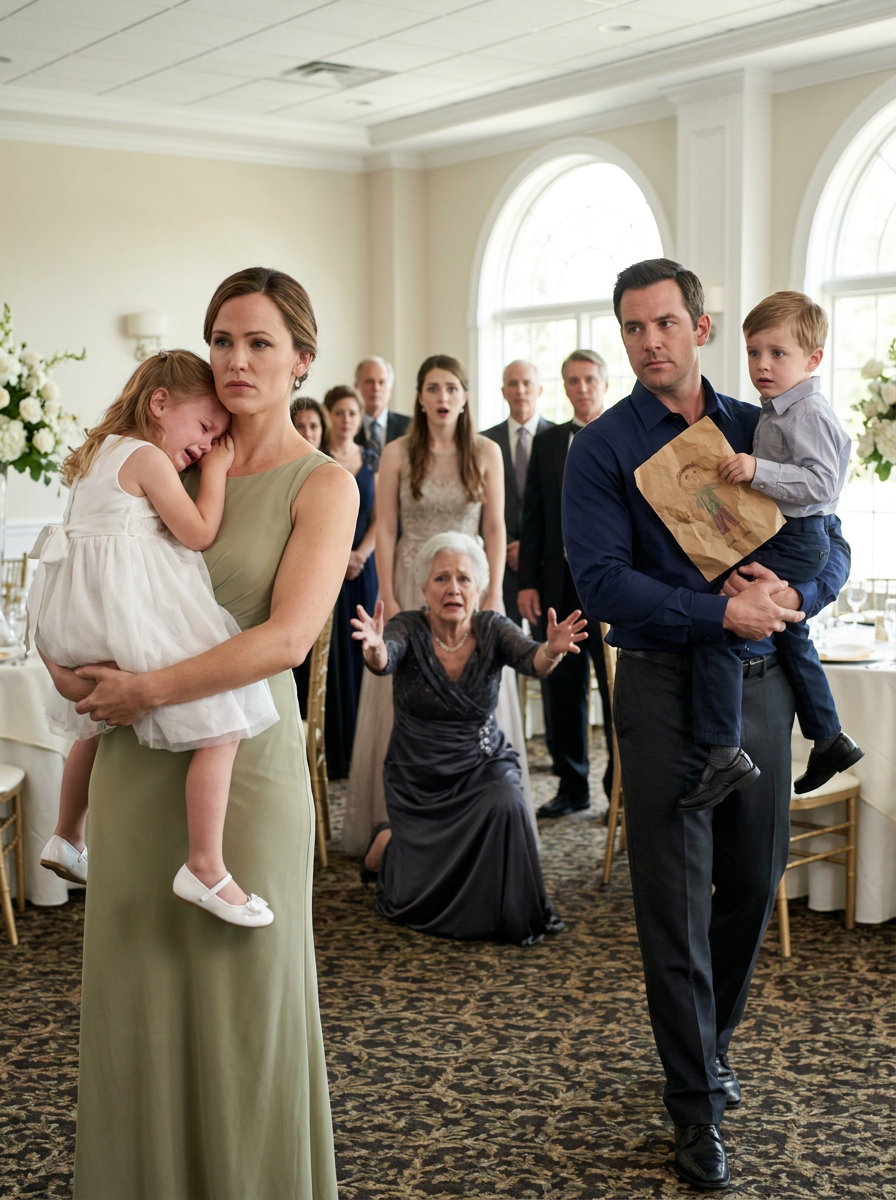
My six-year-old son, Noah, held the handmade birthday card he had painstakingly crafted for his grandmother in both hands, showcasing his shaky drawing of a lopsided cake with glowing candles and the words “Happy Birthday, Grandma Joyce” printed in bright purple crayon.
Across the room, at the prestigious main table, my sister Brenda’s children were already seated like visiting royalty.
They occupied velvet chairs adorned with intricate silver bows, while fine china plates and crystal glasses filled with sparkling fruit punch sat before them, complemented by custom gift bags with their names printed on shimmering gold labels.
My mother, draped in a deep velvet burgundy suit that I had personally funded, barely lifted her gaze from her wine glass to acknowledge our presence.
“Do not start a scene, Kenneth,” my mother whispered, her voice cold and detached.
“Children simply need to learn that you cannot always expect to be in the front row of life,” she added, adjusting her diamond necklace.
That specific sentence stung more than any shout could have, especially because she did not deliver it with anger, but with a condescending calmness that suggested humiliating my own children was merely a necessary, educational lesson in hierarchy.
My name is Kenneth Miller, I am thirty-nine years old, and for exactly half of my life, I fell into the trap of confusing being a devoted son with allowing myself to be a convenient doormat for my family.
I worked as a lead consultant for a prominent logistics firm based in Omaha, and while I was certainly not a millionaire, I made enough of a living that my extended family decided my bank account belonged to the collective.
I was the one who paid for my parents’ monthly prescriptions, Brenda’s delinquent rent payments, my nieces’ private school tuition, emergency home repairs, and every single holiday gathering.
Nobody ever paused to ask if I had the funds to spare; they simply operated under a singular, exhausting mantra: “Kenneth will solve it.”
My wife, Sarah, a dedicated high school teacher who possessed an uncanny ability to read people, had warned me about this dynamic for years.
“Your family does not actually look for you, Kenneth, they only look for your checkbook,” she had told me, her eyes filled with genuine concern.
I used to get defensive and annoyed, insisting she was exaggerating the situation and claiming that all families were complex in their own ways.
I argued that my parents were just being cautious with their limited pensions and that Brenda had simply fallen on a string of bad luck.
However, every single family meeting proved that my wife’s intuition was, unfortunately, entirely accurate.
Brenda was eternally the golden child, the favorite who could do no wrong.
If she accumulated massive debt, my mother claimed it was because she had simply had a run of unfortunate luck.
If she quit another job after only a month, it was because the company simply failed to value her immense talent.
If she needed money, my mother would look at me and say, “Please help her, Kenneth, after all, she is your own flesh and blood.”
Meanwhile, I was strictly forbidden from ever admitting I was tired or that I needed a break from the financial drain.
My mother’s seventieth birthday bash had to be spectacular, described by her as something ripped straight out of a glossy lifestyle magazine.
She demanded a luxury event space in the hills of Franklin, featuring a live mariachi band, an elaborate dessert station, an open bar stocked with top-shelf liquor, a professional photographer, and a massive three-tiered cake.
The initial catering and venue contract arrived on my smartphone via a link without a single question regarding my budget.
There was only a short, demanding message from my father: “Please make the full deposit today to secure the booking.”
And, like a fool, I made the deposit.
That Saturday, I arrived early with Sarah and the children, feeling a glimmer of hope that the day might actually be pleasant for once.
The banquet hall sparkled under warm, amber lights, decorated with fresh hydrangeas and perfectly pressed tablecloths.
My mother entered the room like a reigning monarch, greeting guests with a practiced, performative smile, while my father walked beside her with an air of unearned pride.
Brenda arrived nearly an hour late, yet she was greeted by the entire room as if she were the mastermind who had organized the entire event.
When Emily asked me where our family was supposed to sit, I confidently led them toward the grand table where the rest of the clan was gathering.
That was when my father blurted out the phrase that changed everything.
“Your children can sit over there, next to those large flowerpots in the back,” he commanded, gesturing toward a dark, drafty corner.
I turned to my mother, waiting for her to step in and correct the obvious insult, but she merely shrugged and murmured, “Not everything in this world has to revolve around your kids, Kenneth.”
I felt my throat tighten, a wave of cold realization washing over me as I saw Sarah lower her gaze to hide the tears welling in her eyes.
Noah quickly tucked his handmade card behind his back, feeling the sting of rejection, while Emily looked at her cousins and understood far too quickly that in this house, we were considered second-class citizens.
I did not scream, I did not throw a tantrum, and I did not make a scene.
I simply looked at my father and nodded with a sudden, icy clarity.
“That is perfectly fine,” I said quietly, taking my children by the hands and walking toward an isolated table in the far corner.
At that exact moment, the event coordinator, a woman named Jennifer, approached me with a digital tablet in her hands.
“Mr. Miller, I just need your final authorization to unlock the premium open bar, the specialty dessert cart, and the extended service hours for the rest of the evening,” she said, tapping her screen.
I took a deep, steadying breath, realizing that nobody in that room had the slightest clue what I was about to do next.
Chapter 2: The Price of Disrespect
Jennifer spoke to me in a gentle, professional voice, completely unaware that she was standing in front of a man who had finally reached his absolute limit.
“All we require is your digital signature, sir, and we will immediately release the gourmet dinner courses, the grand cake, the imported wines, and the live band for two extra hours,” she explained, holding the device out toward me.
I looked down at the bright screen, seeing every line item as a representation of my own hard work.
Every single dollar had come from my career, from countless sleepless nights at the office, from the family vacations I had canceled to save money, and from personal luxuries I had denied Sarah so that my mother could host this superficial display.
I gently handed the tablet back to Jennifer, my hands surprisingly steady.
“I would like to make some significant adjustments to the contract before I sign anything,” I said firmly.
Jennifer blinked, clearly surprised by the sudden shift in my tone.
“I can certainly try, sir, but what specific changes were you thinking of making tonight?”
“Remove the entire premium bar and replace it with simple water and standard sodas, cancel the specialty dessert spread, and cut the extended hours for the band,” I listed off, watching her eyes widen.
“And if you can still modify the dinner service, please switch it to the basic, no-frills menu,” I added, looking her directly in the eyes.
Jennifer’s face lost its color, and she glanced nervously toward my parents at the main table.
“Sir, those changes will be incredibly noticeable to all of your guests,” she whispered.
“That is exactly the point,” I replied.
“Your family is likely going to be very upset with you for doing this,” she warned, clearly trying to save me from the fallout.
Read More Part 2 Click Here : https://redditfamilystory.com/archives/39613