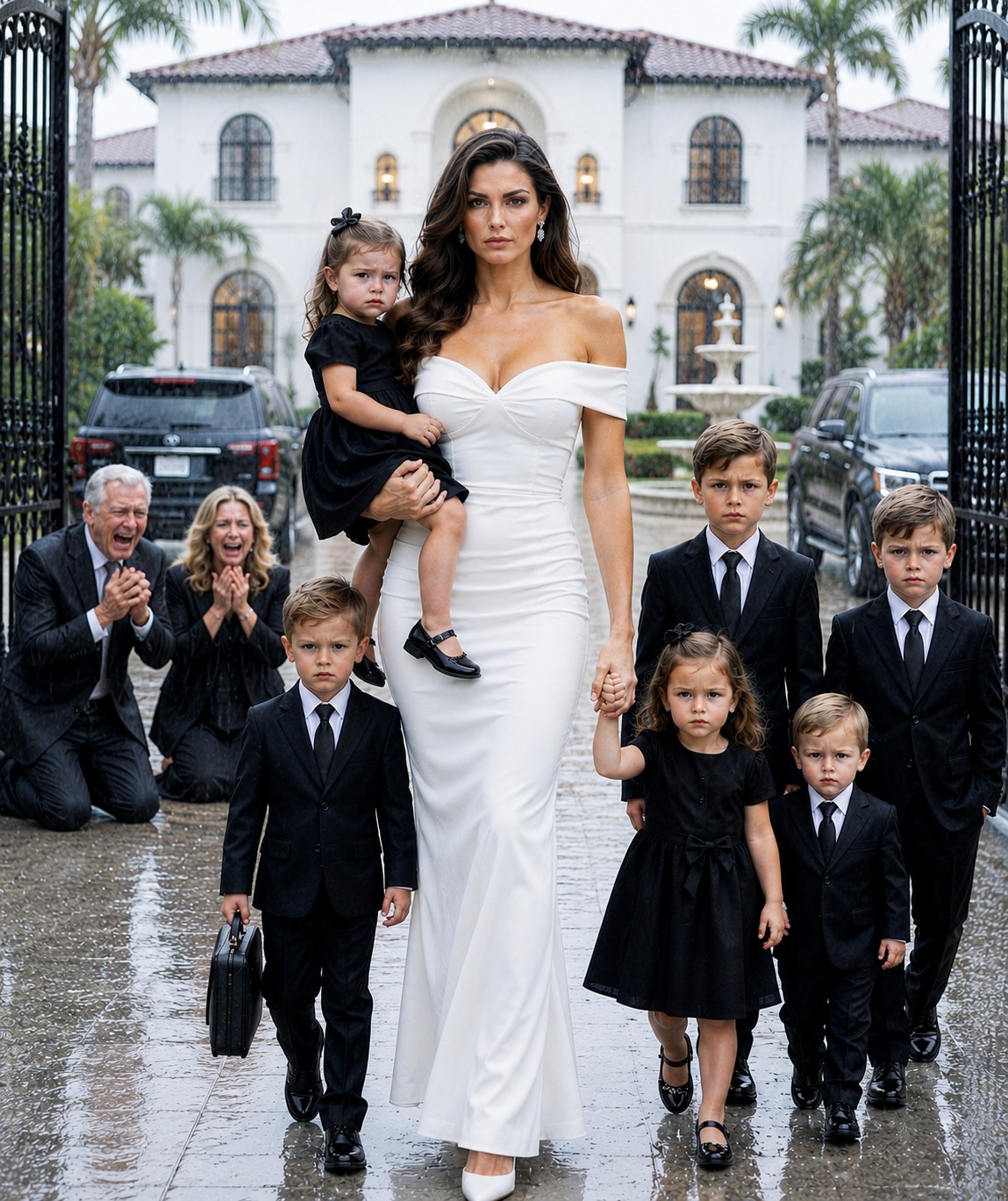
“Take your six children and leave this house. My son is gone, and you no longer belong here.”
Wallace Sterling’s pronouncement pierced me deeper than the relentless midnight rain lashing Pine Valley. I gripped my infant, Lily, tight against my chest at the ornate iron gate. Behind me, my five other offspring huddled, shivering, clutching school bags and two flimsy trash sacks brimming with the meager possessions my mother-in-law had haphazardly tossed together.
My husband, Julian, had been laid to rest merely a week prior.
That was all the time his parents required to swap their sorrow for avarice.
“Wallace, please,” I pleaded, striving to steady my trembling voice. “These are your grandchildren. This was Julian’s home, too.”
Evelyn Sterling glided to his side, enveloped in a lavish cashmere shawl.
“It was Julian’s because we permitted it,” she stated icily. “But don’t deceive yourself, Felicity. Marrying a Sterling did not make you one of us.”
My eldest son, Ethan, thirteen, stepped forward, his eyes blazing crimson with fury.
“Dad said Mom was meant to stay here,” he declared. “I heard him.”
Wallace’s expression turned to stone. An instant later, Ethan reeled back, clutching his stinging cheek.
Something within me went utterly still.
“Do not ever touch my son again,” I uttered, my voice dangerously low.
Wallace scoffed.
“And what will you do? Sue us? You came into this family with nothing. You are nothing.”
My daughters, Clara and Nora, were openly weeping. The twins, Leo and Finn, clung desperately to my skirt. Lily felt hot with fever, and the downpour only intensified our misery.
Evelyn deliberately kicked one of the bags. Clothing spilled out, soaking into the mud.
“We’ve changed the locks,” she announced. “Return, and we’ll inform the authorities you’re unstable. A destitute widow with six children? No one will believe your word over ours.”
I gazed up at the sprawling house. Curtains twitched. Relatives watched from within, yet not a single soul emerged to offer aid.
For fourteen years, I had maintained silence for Julian’s sake. I endured their slights. I swallowed their harsh judgments. I allowed them to treat me as an unwelcome outsider.
But that night, my endurance had reached its end.
I grasped Ethan’s hand and guided my children toward the street. I had no strategy, no destination. All I possessed were my children, the drenching rain, and a yellow folder nestled in the diaper bag—the folder Julian had entrusted to me before his passing.
“If my parents ever attempt to force you out,” he had whispered, “take this to Victoria Hayes. Don’t open it until you’re in her office. Promise me.”
I paused in the driveway and turned back, resolute.
“Before you get too comfortable,” I stated, “you might want to verify who actually holds the deed to this residence.”
Wallace’s face transformed instantly, draining of color.
Evelyn’s smile vanished completely.
For the first time that night, only the drumming rain dared to speak.
We spent the night in a cheap motel adjacent to the highway. The carpet reeked of age, the television remained inert, and the bathroom light flickered incessantly. Still, my children were dry. They were secure.
Ethan sat by the window, his gaze fixed on the parking lot, already seeming far older than thirteen. Clara and Nora helped Leo and Finn into bed. When the room finally fell silent, I retrieved the yellow folder.
Inside lay legal documents, a USB drive, and a heartfelt letter from Julian.
His familiar handwriting was notably shaky.
Felicity, I’m deeply sorry you must endure this. They never truly accepted you, but they cannot seize what we built together. The house is held in a trust. You are its sole administrator. The children are fully protected. If they try anything, Victoria possesses every detail. My father has been siphoning company funds for years. Don’t be afraid.
I pressed my hand over my mouth, stifling a raw, desperate sob.
The following morning, as the children nibbled stale bread, my phone vibrated ceaselessly. Evelyn had uploaded a photo of the Sterling living room online with the triumphant caption:
“True family always finds its way back home.”
People flooded the comments with sympathy, praising her resilience.
Then a formal legal notice arrived. Wallace and Evelyn were accusing me of abandoning the property and attempting to embezzle from Julian’s estate.
At noon, Evelyn called.
“Felicity,” she cooed sweetly, “let’s be entirely reasonable. Sign over your rights to the house, and I’ll give you $150,000. You can begin anew somewhere else.”
“And if I decline?”
Her tone sharpened abruptly.
“Then we’ll prove you’re an unfit mother. You’re unstable, penniless, and alone with six children. Consider your options carefully.”
My eyes burned fiercely, but I refused to let my voice waver.
“I’ll see you in court, Evelyn.”
Then I hung up.
That afternoon, I met Victoria Hayes. She was composed, serious, and possessed piercing, intelligent eyes. She opened the folder, scanned the papers, and gave a firm nod.
“Julian came to me several months ago,” she revealed. “He anticipated this exact scenario.”
She then played the USB video.
Julian appeared on the screen, thin and tired, but his eyes were clear.
“If you’re watching this, Felicity, it means they tried to hurt you. My wife never took anything from me. She built this life with me. She raised our children. She cared for me. The house belongs to her and the kids. Don’t let them scare you.”
That was when I cried.
Rebecca showed me the rest: bank records, hidden accounts, fake contracts, and emails proving Patrick had been moving money before Julian even died.
“This is serious,” Rebecca said. “And it will hold up.”
Then my phone buzzed again. A former housekeeper had sent a video. It showed Patrick in the garage speaking to a real estate agent.
“Sell it this week,” he said. “Before she realizes the deed isn’t in my name anymore.”
A cold anger settled inside me.
Then came one final message from Margaret: a photo of her wearing my mother’s ring—the one Julian had saved for me.
“Some women are born to wear jewelry,” she wrote. “Others are born to clean it.”
I looked at the courthouse address in my hand.
It was time.
On the day of the hearing, I wore a simple blue dress and brought all six children with me. Ethan’s cheek had mostly healed, but his eyes still carried the memory of that night.
Patrick walked in like the courtroom belonged to him. Margaret sat beside him, wearing my ring and making sure everyone saw it.
Their lawyer painted me as unstable. He claimed Julian was not thinking clearly when he created the trust. He said I had never contributed anything to the Callahan family.
Ethan shifted angrily beside me, but I held his hand.
Then Rebecca stood.
She didn’t raise her voice. She didn’t need to.
“Your Honor, we have the notarized trust documents, medical records, financial evidence, and a recorded statement from Julian Callahan himself.”
She laid everything out.
The house did not belong to Patrick.
It belonged to a trust.
I was the administrator.
My children were the beneficiaries.
Patrick had no legal right to remove us.
“This is a lie!” Patrick shouted.
Rebecca pressed play.
Julian’s face appeared on the courtroom screen.
“Felicity gave up her job to raise our children and care for me,” he said. “If anyone says she did not contribute to this family, they are lying. She held us together while my parents counted money.”
Margaret went pale.
Then Rebecca presented the emails, the bank records, and the video from the garage. Finally, she showed proof of what happened to Ethan outside the gate.
The judge looked at Patrick.
“Did you put your hands on this child?”
Patrick stammered.
“It was a misunderstanding.”
Ethan stood.
“I was defending my mom.”
The judge’s expression hardened. He confirmed the trust, froze Patrick’s accounts, and ordered both grandparents to stay away from us.
Then Rebecca pointed at Margaret’s hand.
“And the ring, Your Honor.”
Margaret clutched it.
“It’s mine.”
The judge looked at her coldly.
“Remove it.”
Her hands shook as she took off my mother’s ring and placed it on the table.
I did not feel victorious.
I felt free.
A week later, my children and I returned home. They ran through the halls, loud and laughing, filling the house with life again.
Ethan stood beside me at the gate.
“Dad knew, didn’t he?” he asked.
I nodded.
“He knew.”
Months later, Patrick was buried in legal trouble. The house was truly ours. One afternoon, Ethan planted a lemon tree near the gate.
“So something good can grow where they made us feel unwanted,” he said.
I hugged him tightly.
That was when I understood: family is not about a famous last name, a mansion, or a bank account. Family is the people who stand beside you in the rain when everyone else tries to shut the door.