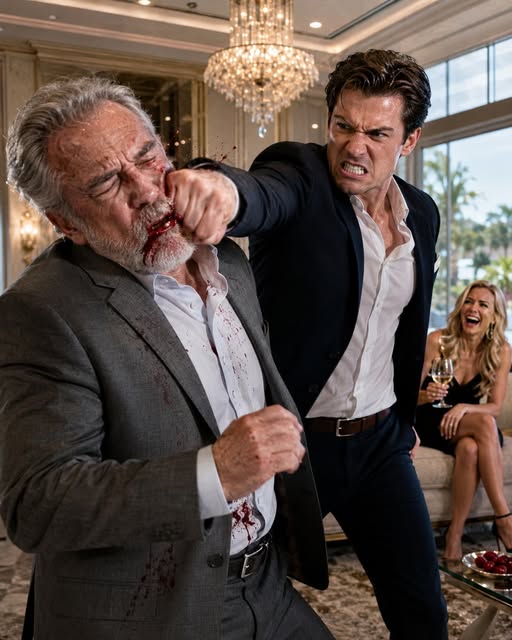
The following dawn, I stirred, my left eye almost sealed by swelling, a crust of dried blood clinging to the edge of my lip.
For a fleeting moment, my surroundings were a blank slate.
Then, the agony resurfaced.
It began as a dull throb beneath my cheekbone, escalating to a sharp, insistent pulse along my jaw, before settling into a profound ache in my ribs, precisely where Brandon had propelled me into the unforgiving corner of his marble coffee table. I remained motionless in the guest suite of my former downtown office building, my gaze fixed on the sluggish rotation of the ceiling fan overhead.
My own residence had been bypassed.
The concept of ‘home’ had grown intricate.
The Carmel house, where my beloved wife, Eleanor, had drawn her last breath, remained undisturbed—a silent monument filled with her cherished books, her worn garden gloves, her preferred blue coffee mug still resting by the kitchen sink. I occasionally called upon it, yet I hadn’t truly inhabited it for years. Far too many chambers harbored far too many specters.
Thus, following my exit from Brandon’s birthday dinner, I instinctively gravitated toward the sole sanctuary that had always been unequivocally mine: Sterling Holdings’ inaugural headquarters, a sturdy brick edifice on Alameda Street where I had inked my very first significant agreement four decades and one year prior.
I attempted to sleep on the plush leather sofa within my private office.
Or rather, I tried.
Mostly, I sat shrouded in darkness, reliving each impact.
Impact one.
Impact two.
Impact three.
By the thirtieth blow, the sensation of fatherhood had entirely vanished.
I felt merely an observer.
An observer to the demise of something I had safeguarded long past the point it merited such defense.
At precisely 5:12 a.m., my mobile phone buzzed upon the coffee table.
For one imprudent second, my heart offered a flicker of false hope.
Brandon.
Perhaps he had awakened with sobriety. Perhaps remorse had pierced him in the pre-dawn hours. Perhaps my son, the very boy who once scampered across building sites adorned in a plastic hard hat, had finally recalled my visage after his hand had repeatedly connected with it.
But the incoming message bore no sender ID for Brandon.
It originated from Clara.
You created a scene last night. Kindly refrain from visiting the residence for a period. Brandon is deeply distressed.
I fixated on the text until its characters dissolved into an indistinct haze.
Brandon is deeply distressed.
Not, ‘Are you still breathing?’
Not, ‘My apologies.’
Not, ‘The events of last night are inexcusable.’
Merely that.
Brandon is deeply distressed.
A profound quietude descended within me.
Not fury.
Fury ignites with a scorching heat. This was a chillier sensation. More precise. The kind of irreversible finality a man acknowledges when affixing his signature to a demolition permit for a structure irrevocably beyond salvation.
I slowly pushed myself upright, every muscle joint protesting vehemently, then proceeded into the private washroom adjoining my office. Beneath the unforgiving glare of the white light, I confronted my own reflection.
My left cheekbone bore a dark purple contusion. My lip was lacerated. My right eye was puffy and distended. Bruising, from where Brandon’s fingers had clenched my collar, was beginning to blossom across my throat. I appeared older than sixty-eight. Older than seventy-eight. I resembled a man who had squandered too many years conflating sheer endurance with genuine affection.
I unlatched the medicine cabinet, retrieved a bottle of antiseptic solution, and meticulously cleansed the blood from my mouth.
Subsequently, I donned a pristine shirt from the wardrobe behind my desk, fastened my cuffs, knotted a dark blue tie, and initiated three distinct telephone calls.
The inaugural call was directed to my legal counsel, Silas Blackwood.
Silas had managed all my corporate contracts for close to three decades. He was a meticulous individual, rarely impressed and virtually never caught off guard. He answered on the third signal, his voice hoarse with lingering sleep.
“Arthur?”
“I require your presence in my office by seven o’clock.”
A beat of silence followed. “Are you unharmed?”
“No.”
The quality of the silence shifted.
“I shall be there.”
The second communication was placed to my chief financial officer, Abigail Chen, the sole individual apart from Silas who comprehended the entire intricate structure of my financial assets.
She responded instantly, as Abigail regarded sleep as little more than a manageable inconvenience.
“Good morning, Arthur.”
“I am initiating the divestment of the Beverly Hills estate.”
A momentary hush.
Then, guardedly, “The Mapleton property?”
“Precisely.”
“Brandon’s residence?”
“My property.”
Another stretch of quietude.
This particular silence held no confusion.
It was stark recognition.
“I shall prepare the comprehensive ownership dossier,” she stated.
“Assemble every relevant document. Deeds, corporate holding papers, occupancy contracts, fiscal records, insurance policies, trust indentures.”
“Understood.”
The third and final call was directed to an individual named Maxwell Thorne.
Maxwell was neither a confidant nor kin. He was, purely and simply, a purchaser.
More precisely, he was a prominent hotel developer who had been persistently observing the Mapleton property for two years, given its enviable position on a rare double lot commanding views over one of Beverly Hills’ most coveted expanses. He had previously extended an exorbitant offer, which I had rejected solely because Brandon resided there.
That particular sentiment now struck me as darkly humorous.
Brandon resided there.
As if that fact held any genuine significance.
Victor picked up with the smooth alertness of a predator who slept near his phone.
“Arthur Finch Mercer,” he said warmly. “This is early.”
“The Mapleton estate is available.”
His breathing changed.
“Available as in you’re entertaining offers?”
“Available as in I’ll sell it today if the number is respectful and closing terms are clean.”
“Is there a problem with the property?”
“No.”
“With the occupants?”
I looked toward the window, where dawn was beginning to gray the city.
“The occupants are temporary.”
Victor did not ask another foolish question.
“I can have my legal team ready within the hour.”
“Good.”
I ended the call.
Then I sat behind my desk and placed Clara’s message in a folder on my phone labeled Evidence.
Not because I intended to sue.
Not yet.
Because men like Brandon rewrite history quickly, and women like Clara polish the lies until they shine.
At 6:47 a.m., Samuel arrived.
He stepped into my office holding a leather briefcase and wearing yesterday’s suit, his white hair still damp from a hurried shower. He took one look at my face and stopped dead.
“Arthur Finch.”
“I know.”
“Did Brandon do that?”
“Yes.”
His expression tightened in a way I had rarely seen. Silas Blackwood was not an emotional man. He believed anger was only useful once converted into paperwork.
“How many times did he hit you?” he asked.
“Thirty.”
His eyes closed briefly.
“Was anyone present?”
“Clara. Guests. Staff.”
“Security cameras?”
“The house has interior cameras. Brandon insisted on them after Clara claimed she felt unsafe when delivery drivers came to the gate.”
Samuel’s jaw hardened. “Good.”
“Can we access the footage?”
“You own the property and the security contract is billed to Mercer Holdings. So yes.”
I leaned back, feeling the ache in my ribs.
“Pull it.”
He opened his briefcase. “Arthur Finch, before we discuss the sale, I need to ask whether you want criminal charges pursued.”
“No.”
“Why?”
“Because prison would make him a victim in his own mind. I want him free enough to understand consequences.”
Samuel studied me.
Then nodded once.
At 7:03, Grace arrived with two bankers’ boxes and a tablet tucked beneath her arm. She was forty-nine, sharp-eyed, immaculate, and had once told a room full of executives that incompetence should be taxed.
She looked at my face and went completely still.
“Brandon?” she asked.
“Yes.”
She set the boxes down with unusual care.
“I’ll need five minutes alone with my temper.”
“You have three,” I said.
She breathed in through her nose, then out.
“Fine. I’ll invoice him for the remaining two.”
That almost made me smile.
Almost.
By 7:30, my office had become a war room.
Samuel spread documents across the conference table. Grace pulled up corporate ownership charts. Maxwell Thorne’s team joined by secure call. An independent notary was requested. A title officer was notified. Tax implications were reviewed. Transfer authority was confirmed.
The Mapleton estate had been purchased through Mercer Stone Residential LLC, a holding company of which I was sole manager. Brandon and Clara had never signed a purchase contract. They had never contributed to the mortgage because there was no mortgage. They paid no property taxes. No insurance. No maintenance beyond decorative nonsense Clara posted online and charged to a credit card I had quietly funded for “house expenses.”
Legally, they were permitted occupants.
Nothing more.
A phrase that looked small on paper but changed everything.
At 8:16 a.m., Grace turned her tablet toward me.
“Brandon posted on Instagram.”
I looked.
There he was.
My son, standing in the kitchen of the mansion I bought, wearing a silk robe and holding an espresso cup. His face was relaxed, smug, unmarked by remorse. Clara stood behind him in designer pajamas, one arm draped over his shoulder.
The caption read:
Some people confuse generosity with ownership. Boundaries are healthy. Protect your peace.
I read it once.
Then again.
Protect your peace.
Underneath, comments bloomed.
Proud of you, bro.
Family can be toxic too.
Your house, your rules.
Clara had commented with a white heart.
My house.
My rules.
I set the phone down gently.
Grace said nothing.
Samuel said, “We can include that.”
“In what?”
“The file.”
I nodded.
“Include it.”
At 8:42 a.m., Samuel’s assistant sent over the security footage.
We watched it in silence.
I had expected it to hurt.
It did.
But not because of the blows.
The physical pain was nothing compared to seeing the room.
The guests frozen in expensive clothes.
Clara smiling into her wine glass.
Brandon shouting, red-faced and wild, his hand rising and falling.
My own body standing there, older and smaller than I felt inside, refusing to raise a hand against him.
One.
Two.
Three.
At hit number eleven, someone in the background laughed nervously.
At seventeen, Clara leaned toward her friend and whispered something.
At twenty-four, Brandon shoved me backward.
At thirty, I wiped my mouth, bent down, picked up the Rolex box, and walked out.
The camera captured my face as I passed through the foyer.
I did not look angry.
I looked empty.
Grace turned away from the screen.
Samuel removed his glasses and rubbed the bridge of his nose.
“Arthur Finch,” he said quietly, “are you sure you don’t want to report this?”
“I’m sure.”
“Then we proceed?”
“Yes.”
At 9:05 a.m., Maxwell Thorne made the formal offer.
It was higher than expected.
Very high.
Even Grace blinked.
“He wants the land,” she said.
“I know.”
“The number is clean. Cash closing. No financing contingency. Thirty-day possession.”
“No,” I said. “Seven-day possession.”
Samuel looked at me. “That is aggressive.”