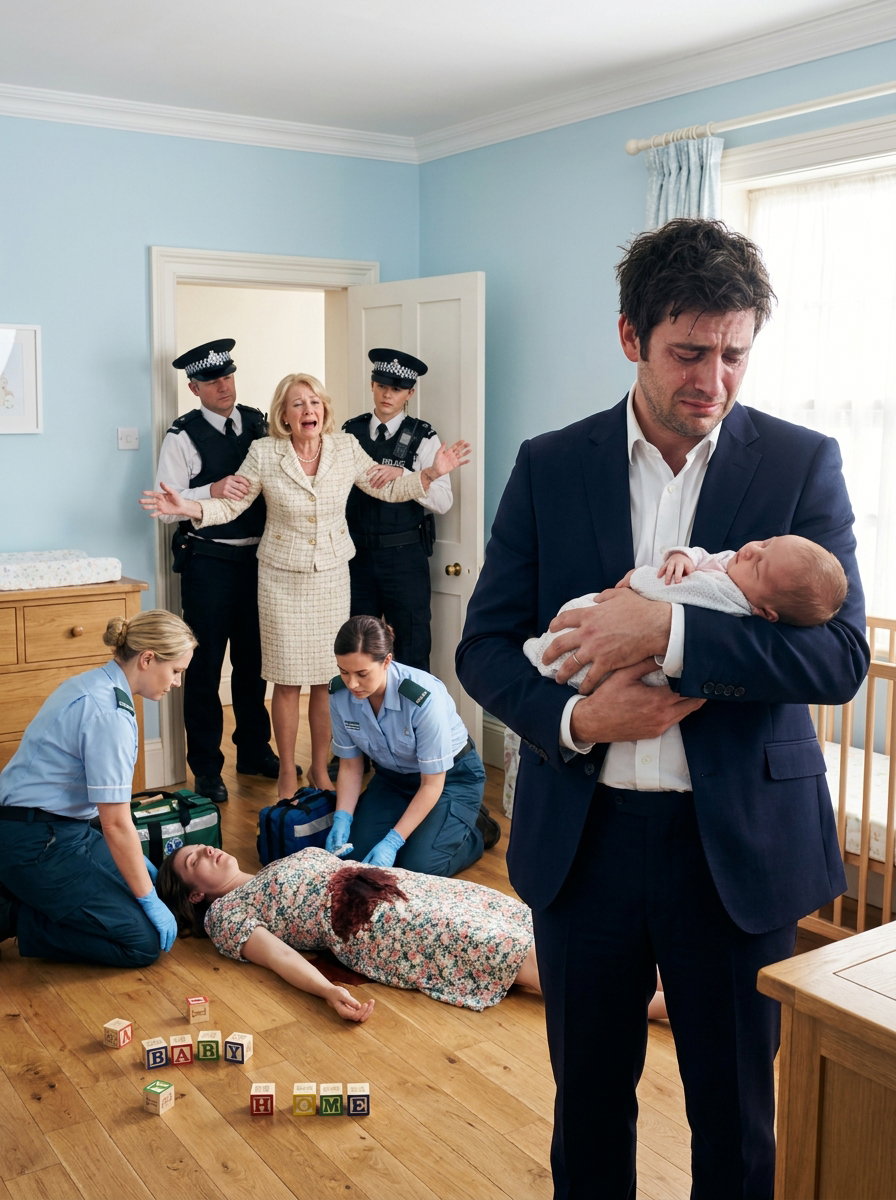
The metallic tang of fear is something you never truly wash out of your clothes. It lingers in the threads, a phantom scent that catches you off guard when you least expect it.
I am Julian Kent, a Senior Project Manager at Vertex Dynamics in Portland, a man who builds contingency plans for a living. I map out risk, mitigate disasters, and ensure systems run smoothly.
But no spreadsheet, no predictive algorithm, could have prepared me for the day the foundation of my life ruptured, or for the monster who walked through the front door disguised as a savior.
My wife, Rachel, had always been the vibrant center of my universe. Her laughter could fill a room, warming the damp chill of a Pacific Northwest winter.
But the birth of our son, Toby, had stolen that light, replacing it with the harsh, terrifying glare of surgical lamps. The phrase Postpartum Hemorrhage sounds clinical, detached.
In reality, it is a chaotic nightmare of alarms, rushing nurses, and a terrifying amount of blood. Rachel had flatlined for twelve seconds.
Twelve seconds where my entire world ceased to spin. When she finally opened her eyes in the recovery room, pale and translucent as spun sugar, the doctor’s orders were absolute: total bed rest.
Her internal stitches were fragile. Any strain could be catastrophic.
Enter my mother, Beatrice Kent.
She arrived three days after we brought Toby home, trailing matched leather suitcases and the overwhelming scent of expensive floral perfume. I had begged her to come, blinded by a desperate, exhausted need for the woman who had raised me.
I thought a mother’s touch was what our shattered home needed. I was a fool.
The micro-aggressions began before her coat was even off. She didn’t embrace Rachel; she inspected her.
“You are looking incredibly drawn, dear, are you sure you are eating enough?” she asked while eyeing Rachel with a critical gaze.
The criticism escalated quickly, a slow drip of poison masked as maternal wisdom. Beatrice would hover over the bassinet, tutting loudly at the way Rachel swaddled Toby, declaring it too loose or too tight, entirely dismissing the fact that Rachel’s hands trembled from severe anemia.
The true fracture, however, occurred on my first morning back to the office. I stood in the nursery doorway, the soft glow of the nightlight casting long shadows.
Rachel was asleep, her breathing terribly shallow, her skin terrifyingly pale against the sheets. Beatrice materialized beside me, lacking the quiet reverence the room demanded.
She didn’t offer a comforting hand to my shoulder. Instead, she pointed a manicured finger at a stray nursing pad resting on the oak nightstand.
“In my day, Julian, we did not let the house look like a triage ward just because we had a baby,” she whispered, her tone brittle and sharp. “A man needs a clean home to come back to, and this is just untidy.”
A heavy exhaustion settled in my bones. “Mom, please,” I sighed, keeping my voice low. “She almost died, so please let it go because the house does not matter right now.”
Beatrice turned to me, and for a fleeting second, the mask slipped. Her eyes narrowed, a cold, sharp glint reflecting in the dim light.
“She is fragile when it suits her, Julian, but mark my words, laziness is a habit that starts in the recovery room,” she stated with cold conviction. “If you let her play the invalid, she will never stop.”
I should have thrown her out then. I should have recognized the venom.
Instead, I chalked it up to generational differences and exhaustion. I kissed my sleeping wife’s forehead, grabbed my briefcase, and headed for the door.
But as I rode the elevator down to the parking garage, preparing for my first high-stakes board meeting since the birth, I pulled out my phone and opened the nursery camera app. I told myself I just wanted one last look at Toby.
But deep down, a strange, inexplicable knot of dread was already tightening in my stomach. The boardroom on the thirty-second floor offered a panoramic view of the Willamette River, the grey water churning under a heavy, overcast sky.
Around the polished mahogany table, my colleagues were locked in a heated debate over quarterly financial projections. Usually, I thrived in this environment.
Today, the corporate jargon sounded like white noise. The knot in my gut had twisted into a jagged rock.
Under the cover of the table, my phone buzzed with a motion alert from the nursery. I slid the device onto my lap and tapped the screen, expecting to see Rachel gently rocking Toby.
What I saw paralyzed me. The high-definition feed showed Rachel out of bed.
She was hunched over, one hand desperately clutching her side, right over the area of her C-section incision. Her face was contorted in sheer agony.
She was trying, with agonizing slowness, to sway the bassinet to soothe a crying Toby. Then, Beatrice entered the frame.
She didn’t rush to help. She didn’t ask what was wrong.
She marched across the rug, her face twisted into a sneer of absolute disgust. I watched in mute horror as my mother grabbed the edge of the bassinet and jerked it away from Rachel with such force it nearly tipped over.
Rachel gasped, stumbling forward. I fumbled for the volume button, pressing the phone to my ear just as Beatrice leaned in.
“Get up!” Beatrice’s voice crackled through the tiny speaker, a venomous hiss audible only to me amidst the boardroom chatter. “I am tired of looking at these dusty baseboards.”
Rachel whimpered, a breathless plea. “Beatrice, please, my stitches are hurting and I am bleeding again.”
Beatrice didn’t even flinch. She snatched the two-week-old infant from the mattress, holding him awkwardly against her hip.
“Blood loss is no excuse for a dirty house,” she spat, pointing down at the floor. “Get up and scrub the floor immediately.”
On the screen, Rachel’s knees buckled. She collapsed back onto the pillows of the armchair, violently sobbing, both hands clutching her abdomen as the fresh trauma threatened to tear her internal sutures apart.
Something inside me snapped. It wasn’t a loud break; it was the quiet, absolute severing of a lifelong bond.
The corporate professional evaporated, replaced entirely by a primal protector whose fight instinct had been ignited with a blinding, white-hot fury. I stood up abruptly.
My heavy leather chair screeched violently against the hardwood floor, echoing like a gunshot in the sterile room. The debate over the spreadsheets died instantly.
My boss, Marcus, stopped mid-sentence, his brow furrowed. “Julian? Everything okay?”
I didn’t look at him. I couldn’t.
I was already shoving my laptop into my bag, my face a mask of cold, white fury. I didn’t utter a word of excuse.
I simply walked out. I sprinted down the hallway, hit the stairwell, and did not stop running until I hit the concrete floor of the parking garage.
As I reached my car, my hands were shaking, but not from panic. From rage.
I didn’t dial home. I didn’t call my mother to scream.
Instead, I pulled up a browser, searched my contacts, and dialed the numbers for a local locksmith and a private security firm. My voice was steady, terrifyingly calm, as the dispatcher answered.
“I need an emergency re-key at my residence right now,” I said firmly.
The drive back to the suburbs was a blur of rain-slicked asphalt and suffocating silence. The windshield wipers beat a frantic rhythm that matched my racing pulse.
I connected my phone to the car’s Bluetooth, staring at the road as I dialed my older sister, Sarah. I had always thought Sarah was overly sensitive, the one who distanced herself from the family for no reason.
“Julian? You are supposed to be in a meeting,” she answered, the surprise evident.
“Sarah,” I said, my voice dangerously flat. “Did Mom ever force you to work when you were sick or when you had your surgery?”
A long, heavy pause hung on the line. I heard a shaky exhale.
“Julian, what did she do?” she asked with hesitation.
“Just answer the question, please,” I urged.
“Yes,” Sarah whispered. “She told me I was milking it for attention, and she made me vacuum the stairs three days after surgery, saying my tears were manipulative. It is a pattern, Jules, it is narcissistic rage because if she is not the center of the universe, she destroys whoever is, so who is she hurting?”
“Rachel,” I growled, my knuckles turning white on the steering wheel. “I brought a wolf into my house.”
“Get her out,” Sarah urged, her voice suddenly fierce. “Before she breaks her spirit.”
I hung up, the guilt threatening to drown me. I had ignored the red flags my entire life.
I had smoothed over Beatrice’s sharp edges, translating her cruelty into quirks. And by doing so, I had served my vulnerable, broken wife up on a silver platter.
The resolve that settled in my chest was iron-clad. I wasn’t going to argue with my mother.
I was going to excise her like a tumor. I pulled into my driveway, but I did not rush the door.
I parked across the street, watching the rain hammer against the asphalt. Ten minutes later, a white van bearing the logo of a local security firm pulled up, followed closely by a locksmith.
I stepped out into the downpour, greeting the locksmith with a curt nod. “Front, back, and garage locks,” I instructed, my voice devoid of emotion. “Make it fast.”
As the locksmith worked silently at the front door, I moved to the large bay window that looked into our kitchen. I stood in the rain, pulling out my phone and hitting record.
I needed the evidence. I needed the final nail in the coffin.
Through the glass, the scene was a grotesque tableau. Beatrice was standing near the island, casually sipping a cup of hot tea.
In her other arm, she held Toby like a prop. And there, on the linoleum floor, was Rachel.
She was on her hands and knees, shaking violently, a bucket of soapy water beside her. She held a sponge, her movements agonizingly slow, her face pale as a ghost.
Beatrice casually reached out with her foot, pointing the toe of her expensive leather shoe at a spot near the refrigerator. Even through the glass, I could read her lips perfectly.
“Missed a spot, Rachel, and if you cannot be a wife, at least be a maid,” she mocked.
A wave of nausea washed over me, immediately followed by a crystalline clarity that took my breath away. In that singular moment, I realized I did not just marry Rachel to love her; I married her to protect her from the world.
And today, I learned that the world included my own blood. The locksmith stepped back, tapping my shoulder.
He handed me a set of four gleaming silver keys. I stared at them for a second, the cold metal biting into my palm.
I slid one into the lock, turned it with a definitive, heavy click, and pushed the door open. The air inside the house felt thick, heavy with the scent of bleach and my mother’s perfume.
The silence of the hallway was oppressive. I did not take off my wet coat.
I did not wipe my shoes. I walked straight past the entryway, my wet boots leaving dark tracks on the hardwood, and rounded the corner into the kitchen.
Beatrice looked up, her eyes widening in genuine shock. Rachel gasped, dropping the sponge into the bucket with a wet slap, her terrified eyes darting from me to my mother.
I didn’t look at Beatrice. I didn’t acknowledge her existence.
I walked straight to Rachel, knelt in the soapy water, and gently but firmly scooped her up into my arms. She felt terrifyingly light, like a bundle of hollow reeds.
I carried her out of the kitchen, down the hall, and laid her gently on the living room sofa, grabbing a woven blanket to cover her trembling shoulders. Footsteps hurried up behind me.
Beatrice had followed, her heels clicking frantically. She immediately tried to pivot, her voice pitching up into a fluttering, high-pitched tone of mock concern.
“Julian, thank God you are home!” she exclaimed. “This girl is so lazy, I was just trying to teach her how to manage a household, but she was insisting on doing the floors.”
I stood up slowly and turned to face her. I didn’t raise my voice.
I didn’t need to. I simply held up my phone, the screen facing her.
The video from the nursery played on a silent, damning loop. Beatrice’s mouth snapped shut.
The color drained from her face, leaving her rouge looking garish and painted on. “The locksmith is done, Mom,” I said, my voice a low, dangerous rumble that seemed to vibrate in the floorboards.
“The locks are changed.” I took a step toward her, forcing her to look up at me.
“I went upstairs while you were terrorizing my wife, and your suitcases are already packed and sitting on the front porch,” I added.
“Julian, you cannot be serious about this,” she stammered, the facade crumbling.
“You have sixty seconds,” I continued, the icy calm in my voice scaring even myself. “You have sixty seconds to hand me my son before I call the police and report an assault on a medical convalescent.”
Beatrice’s face went from pale to a mottled, furious purple. The narcissistic injury was total.
Her authority, her control, had been stripped bare in an instant. “I am your mother!” she shrieked, the sound raw and ugly.
“You cannot do this to me because I gave you life!” I stepped directly into her personal space, my eyes like flint.
“You were my mother, but today, you are just a trespasser,” I retorted. “Give me Toby.”
For a terrible second, I thought she was going to drop him. Her hands shook with a rage so profound it bordered on madness.
But the cold, unblinking promise of violence in my eyes won. She practically shoved Toby into my chest.
I secured him in my left arm, feeling his tiny heartbeat against mine, and pointed to the front door with my right hand. Beatrice stumbled backward, her chest heaving.
She turned and marched to the door, throwing it open to the rainy porch where her bags sat getting soaked. She paused on the threshold, whirling around, her face twisted into a mask of pure hatred.
“You will crawl back when she leaves you!” she screamed into the rain. “You are nothing without me, do you hear me?”
I looked at her, feeling absolutely nothing at all. I reached out, grabbed the heavy oak door, and slammed it shut in her face.
The sound of the new deadbolt sliding home echoed through the silent house like a gunshot. The physical shift in the house was immediate.
It was as if a suffocating pressure had been vented from the atmosphere. Over the next two weeks, the sterile scent of bleach faded, replaced by the warm, comforting aromas of lavender, milk, and powder.
With the predator removed, Rachel’s physical recovery accelerated at a miraculous pace. The color returned to her cheeks, a soft, healthy pink replacing the terrifying pallor.
She could walk down the stairs without clutching the banister, and her laughter, tentative at first, began to echo in the hallways again. But the silence from Beatrice’s departure was quickly filled by the buzzing of her enablers.
The smear campaign began three days after her eviction. My phone blew up with calls from cousins, aunts, and family friends I had not spoken to in years.
Beatrice was spinning a tragic tale of elder abuse, claiming she was thrown out into the rain by a son who was under Rachel’s spell. I did not engage.
I did not explain. I systematically opened my contact list and slid the block toggle to the right for every single one of them.
The digital guillotine fell again and again, severing ties with anyone who questioned the boundary I had drawn. Late one night, Rachel and I sat in the nursery.
Only the amber glow of the salt lamp illuminated the room. Toby was fast asleep in my arms.
Rachel sat up in the rocking chair, pulling a blanket over her legs. “I was so scared, Julian,” she whispered, her voice thick with unshed tears.
“When she was hovering over me, I thought if I did not do what she said, you would believe her,” she confessed. “I thought you would think I was a failure as a mother and as a wife.”
The confession felt like a knife to the chest. I crossed the small room and knelt beside her chair, taking her hand and pressing her palm to my lips.
“I saw the truth, Rachel,” I said, my voice thick with emotion. “I saw exactly who she is, and my only failure was letting her through that door in the first place.”
“I promised to protect you, and I failed, but it is a mistake I will never, ever make again,” I added. Rachel leaned down, resting her forehead against mine.
In that messy, dimly lit nursery, surrounded by discarded cloths and half-empty bottles, our bond forged into something unbreakable. We had survived a siege.
On the nightstand across the room, my phone screen lit up silently. It buzzed against the wood, a string of fifty missed calls and vitriolic texts from my mother, slipping through a secondary number she had created.
I did not even look at it. I reached over, swiped the screen, and blocked the new number without a second thought.
But the quiet peace of the night was shattered the very next morning. As we sat at the kitchen island drinking coffee, the doorbell rang.
It was a courier. He handed me a thick, stiff envelope requiring a signature.
I tore it open, scanning the heavy stock paper bearing the letterhead of a prominent law firm. My stomach plummeted.
Beatrice was not done. She was suing us for grandparents’ rights.
Time is the ultimate architect of perspective. One year later, the memory of that registered letter felt like a minor bump in the road, rather than the catastrophic earthquake Beatrice had intended it to be.
Toby was turning one. The backyard of our home was strung with fairy lights and filled with the chaotic joy of a child’s first birthday.
Rachel’s family had flown in from Ohio, and the lawn was crowded with our true friends. There was laughter, the smell of barbecue, and a profound, impenetrable sense of safety.
Beatrice’s lawsuit had backfired spectacularly. My meticulous nature as a project manager had paid off.
I had not just saved the nursery camera footage; I had the timestamped video of her forcing a post-surgical woman to scrub floors. When our lawyer presented the digital files in family court, demonstrating a clear pattern of psychological abuse and physical endangerment, the judge did not just throw out her petition for visitation.
He granted us a permanent restraining order. As I stood by the grill, watching Rachel, vibrant and glowing with health, chase a waddling Toby across the fresh-cut grass, I reflected on the last twelve months.
I had spent my entire life trying to be a good son, bending to the whims of a woman whose love was strictly conditional. But standing here, I realized that breaking my mother’s heart was the only way to save my son’s soul.
To be a good man, I had to cease being her son. A few weeks prior, I had seen her.
I was walking out of a downtown coffee shop, and I spotted Beatrice across the street, emerging from a high-end boutique. She looked older, her posture slightly stooped, her face set in a permanent scowl.
For a second, our eyes met through the bustling crowd. I expected the old familiar spike of guilt, the ingrained urge to cross the street and apologize.
But nothing came. The well was completely dry.
I felt no anger, no hatred, only a cold, distant pity for a woman who would die alone, surrounded by her spotless baseboards and her bottomless resentment. I broke eye contact, turned on my heel, and walked away without looking back.
The party began to wind down as the sun dipped below the Oregon skyline, painting the clouds in bruised hues of purple and orange. I picked up my camera, capturing a candid photo of Rachel and Toby laughing, covered in chocolate frosting.
It was a moment of pure, unadulterated peace. Just as I lowered the lens, my phone chimed in my pocket with a sharp, dissonant notification.
I pulled it out. It was a text message from an unknown number, routed through a secure, encrypted messaging app.
I opened the message. My blood ran cold.
It was a photograph. It wasn’t taken from the party.
It was a high-resolution, long-distance shot of Toby, taken earlier that day through a telephoto lens from the street outside our privacy fence. The image was zoomed in perfectly on my son’s face.
Beneath the chilling photograph was a single, terrifying caption. It said he has my eyes and I cannot keep him from her forever.
I stared at the screen. The old Julian would have panicked.
The old Julian would have looked over his shoulder, terrified of the shadows. But I did not flinch.
I did not show Rachel the phone. I calmly slipped it back into my pocket, walked into the quiet of my home office, and locked the door.
I picked up my encrypted landline and dialed the direct number for my security consultant. He answered on the first ring.
“Mr. Kent?” he asked. “Phase two,” I said, my voice a weapon forged in ice.
“The perimeter has been compromised, so initiate the transfer and move the family to the New Jersey office.” “Understood, sir, when?” he asked.
“Tonight,” I replied, looking out the window at my family, laughing in the fading light. “We are disappearing.”
The line clicked dead. I began to pack, moving not with the frantic energy of fear, but with the cold, tactical precision of a man who will move mountains, cross oceans, and burn the world down to keep his family safe.
If you want more stories like this, or if you’d like to share your thoughts about what you would have done in my situation, I’d love to hear from you. Your perspective helps these stories reach more people, so don’t be shy about commenting or sharing.
THE END.