It was a Tuesday evening, the kind of late autumn night where the air already held the crisp promise of winter, biting at the edges of the fading twilight. I was in the kitchen, the comforting aroma of garlic and herbs from the simmering pasta sauce filling our small home, a stark contrast to the chill outside. My husband, David, was still at work, and I was looking forward to a quiet dinner, maybe a book, before calling it a night. The only other presence was my mother-in-law, Eleanor, perched imperiously on her favorite armchair in the living room, a half-finished crossword puzzle on her lap, occasionally punctuated by a tut or a sigh of disdain for some perceived societal ill she’d just read about in the newspaper. A fragile peace, as always, hung in the air, a delicate truce I constantly worked to maintain.
Then came the knock. Not the polite, rhythmic tap of a delivery driver, nor the familiar, cheerful rap of a friend. This was a frantic, almost desperate pounding, echoing through the quiet house like a series of small, sharp explosions. My heart lurched, a primal instinct of alarm seizing me. I glanced towards the living room, but Eleanor merely stiffened, her gaze fixed on the door with an expression of annoyance rather than concern. “Who on earth could that be at this hour?” she huffed, as if the very act of someone knocking was a personal affront. Ignoring her, my feet were already moving, a knot of unease tightening in my stomach.
I peered through the peephole, and my breath caught in my throat. It was Sarah, our neighbor from two houses down, a woman I knew casually but always found warm and gentle. But the Sarah I saw now was a ghost of her usual self. Her usually vibrant auburn hair was disheveled, plastered to a tear-streaked face that was ashen under the porch light. Her eyes, normally sparkling with an infectious optimism, were wide with terror, rimmed with red. Her heavy winter coat was askew, revealing the unmistakable, prominent curve of her 8-months-pregnant belly. And then I saw it – her left arm, twisted at an unnatural angle, cradled awkwardly against her chest, her fingers clutching at the sleeve, a dark, blossoming bruise already visible on her forearm. She was trembling uncontrollably, her entire body wracked with deep, guttural sobs that she was barely managing to suppress.
I flung the door open, the rush of cold air doing little to cool the sudden surge of panic within me. “Sarah! My God, what happened?” I whispered, my voice barely audible above the wind and her own choked cries. She stumbled forward, collapsing against the doorframe, her body wracked with tremors. “Please… please, Emily,” she choked out, her voice raw and hoarse, barely a whisper. “I… I need help. I don’t know where else to go. He… he broke it. He broke my arm.” Her eyes, swimming with tears, pleaded with a desperate intensity that pierced straight through me. She looked utterly broken, a woman on the precipice, and the sight of her, so vulnerable and so close to bringing new life into the world, filled me with a profound sense of horror and urgency.
Before I could even process her words, Eleanor’s sharp voice cut through the air, slicing like ice. She had risen from her armchair, drawn by the commotion, and now stood directly behind me, her expression a mask of cold disdain. Her gaze swept over Sarah, taking in her disheveled state, her tears, her swollen belly, and the injured arm, not with pity, but with a chilling judgment. “What is all this commotion?” she demanded, her voice dripping with venom. Her eyes narrowed, fixing on Sarah with an unyielding glare. “Oh, it’s *you*. Well, I suggest you take your drama elsewhere. **GO away.** Our house isn’t a shelter for **cheap women** and their… *problems*.” The words were delivered with a sneer, each syllable a calculated insult, designed to wound and dismiss. A wave of shame and fury washed over me, burning hot and intense.
My jaw clenched, a muscle twitching in my temple. The air thickened with Eleanor’s cruelty, but Sarah’s desperate, pleading eyes held me captive. I felt a visceral urge to protect her, to shield her from the venomous words that had just been hurled her way. My mother-in-law’s pronouncement was a challenge, a line drawn in the sand, but there was no question in my mind which side I would stand on. Ignoring Eleanor’s stony glare and the silent, disapproving judgment radiating from her, I took a deliberate step forward, moving past my mother-in-law and out onto the porch. The cold wind whipped around me, but a different kind of chill ran down my spine – the chill of confronting a deeply ingrained family dynamic, of choosing compassion over familial expectation.
“Sarah,” I murmured, reaching out to her gently. Her body flinched at my touch, a raw nerve, but I continued, pulling her into a careful, tender hug, mindful of her injured arm and her prominent belly. Her body felt frail, trembling against mine, and I could feel the ragged rhythm of her breathing. “It’s okay. You’re safe here, for now,” I whispered into her hair, hoping my words would offer some small comfort against the storm raging around her. As I held her, I subtly reached into the pocket of my jeans, my fingers closing around the small wad of cash I kept for emergencies. It was two hundred dollars, meant for a new set of tires I desperately needed, but in that moment, it felt insignificant compared to the abyss of her need. Discretely, I pressed the folded bills into her uninjured hand, closing her fingers around them. “This is everything I have right now,” I said softly, meeting her tear-filled gaze. “Please, get somewhere safe. Get help.” Her eyes widened slightly as she felt the money, a flicker of bewildered gratitude amidst the terror. She nodded, unable to speak, clutching the money as if it were a lifeline.
I watched her stumble away, melting into the darkness of the street, her silhouette a poignant testament to human fragility and resilience. I closed the door, the heavy click echoing in the sudden silence. Eleanor was still standing there, arms crossed, her face a mask of furious disapproval. “You just encouraged that… that *strumpet*,” she hissed, her voice low and dangerous. I didn’t respond, couldn’t. The weight of Sarah’s pain, Eleanor’s cruelty, and my own act of defiance settled heavily upon me. The evening passed in a tense, suffocating silence. The next few days were no better, marked by Eleanor’s frosty glares and pointed remarks about “wasting good money on undeserving people.” I tried to push Sarah from my mind, hoping she was safe, but her tear-streaked face and broken arm haunted my dreams. A week later, the memory had begun to recede, replaced by the mundane rhythm of daily life, though a quiet worry still hummed beneath the surface. I was cleaning the kitchen, listening to a podcast, when the front door suddenly burst open.
I jumped, dropping the sponge, my heart leaping into my throat. Eleanor stood framed in the doorway, not with her usual haughty posture, but hunched, utterly transformed. Her face, usually flushed with a robust, almost aggressive vitality, was now stark white, bloodless, her lips trembling. Her eyes, normally sharp and critical, were wide with a terror I had never seen on her before, a raw, primal fear that twisted her features into an grotesque caricature. Her hands were shaking violently, clutching at her chest as if to contain a burgeoning panic. She took a gasping breath, her chest heaving, and pointed a trembling finger towards the large bay window that overlooked our quiet suburban street. Her voice, when it came, was a choked, desperate rasp, barely recognizable. “Emily,” she whimpered, her eyes huge and unblinking, fixed on something unseen. “Emily, for God’s sake… **Look outside!**”
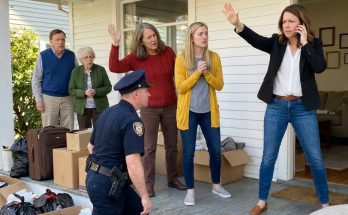
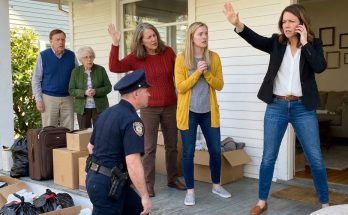
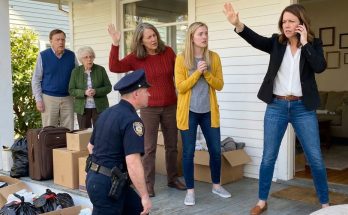
I didn’t need to be told twice. The raw terror in Eleanor’s eyes was a stark, undeniable force, pulling me forward. I rushed past her, my heart hammering against my ribs, and peered through the large bay window. The sight that greeted me stole the air from my lungs. Our quiet suburban street was no longer quiet. It was alive with the pulsating, urgent glow of blue and red police lights, casting an eerie, frantic dance across the manicured lawns and stately houses. Several cruisers lined the curb, their presence a jarring intrusion. A local news van, its satellite dish extended like a metallic flower, was parked haphazardly, its crew bustling with a grim efficiency. A small, hushed knot of neighbors stood on their porches and sidewalks, their faces a mixture of shock, morbid curiosity, and thinly veiled horror.
But it wasn’t the general commotion that held Eleanor captive in her silent scream; it was the focal point of the tableau. Two doors down, at the impeccably maintained residence of Mr. Arthur Henderson – a man Eleanor had always lauded as a “pillar of the community,” a “true gentleman” – something was happening. As I watched, a figure emerged from the front door, flanked by two stern-faced police officers. It was Mr. Henderson himself, his usually immaculate suit rumpled, his distinguished silver hair disheveled, and his face a mask of ashen disbelief. His wrists were bound behind his back with gleaming handcuffs, catching the flashing lights as he was roughly guided towards a waiting unmarked car.
A strangled gasp escaped Eleanor’s lips, a sound so raw and guttural it barely resembled human utterance. Her trembling hand flew to her mouth, her eyes fixated on the scene, wide and unblinking. The news reporter, a young woman with a practiced solemnity, was speaking directly into her microphone, her voice carrying faintly on the crisp autumn air. “…arrested on multiple charges of domestic violence and aggravated assault. Sources confirm the investigation was initiated after a brave young woman, eight months pregnant, came forward with her harrowing account…” The words, though muffled, resonated with a chilling clarity in the sudden, profound silence of our living room. It was Sarah. The $200, my small act of defiance, had been her lifeline. It had allowed her to get to safety, to find the strength and resources to speak her truth.
Eleanor swayed, her face now not just pale, but a ghastly shade of green. Her carefully constructed façade of superiority, her entire world of social standing and self-righteous judgment, was crumbling before her eyes. Arthur Henderson wasn’t just an acquaintance; he was her late husband’s closest business partner, a man she had considered almost family, a frequent guest at their dinner parties, a man whose “impeccable reputation” she had often used as a yardstick to measure the supposed moral failings of others. The very man she had once described as having “the kind of character you rarely see in these cheap times” was now being led away in handcuffs, exposed as the very monster Sarah had described. Her venomous words from a week ago – “GO away. Our house isn’t a shelter for cheap women” – echoed in the room, a grotesque, self-indicting prophecy.
I turned from the window, my gaze settling on Eleanor. She looked utterly broken, not by empathy for Sarah, but by the shattering of her own carefully cultivated reality. The shame was a palpable thing, radiating from her in waves. Her “pillar of the community” was a brutal abuser, and the “cheap woman” she had scorned had brought him down, aided by the very money Eleanor had scoffed at. The irony was a bitter, burning taste in my mouth. She saw my gaze, and for the first time, her eyes held not disdain, but a flicker of something akin to fear, perhaps even a desperate, unspoken plea for me not to reveal her complicity, her cruel dismissal.
The silence that followed stretched, thick and suffocating, punctuated only by the distant wail of a siren and the low murmur of the news reporter. Eleanor remained frozen, her trembling hands now clutching the back of her armchair, her knuckles white. Her world had just imploded, and with it, her carefully guarded sense of moral superiority. The social circles she had so meticulously cultivated, the reputation she had so fiercely protected, were now stained by association with a man publicly revealed as a domestic abuser. And she, in her judgment, had not only turned away a victim but had unknowingly scorned the very person who would expose the truth.
I watched her, a quiet, profound sense of vindication settling over me, mingled with a heavy sadness for Sarah’s ordeal. Justice, in its own unexpected way, had arrived on our quiet street, and it had brought with it a reckoning. Eleanor’s sneer was gone, replaced by a permanent tremor in her lips, a haunted look in her eyes that spoke of a public humiliation far worse than any private slight. Her carefully constructed life, built on appearances and judgment, had been irrevocably shattered, not by an external force she could rail against, but by the very compassion she had so vehemently denied. And in that moment, I knew that while Sarah had found her voice and her safety, Eleanor had lost everything she truly valued, exposed not as the arbiter of decency, but as a silent enabler, a woman whose cruelty had ultimately come back to haunt her. The house was no longer just a shelter, or a home; it was a silent witness to both a woman’s suffering and another’s downfall.