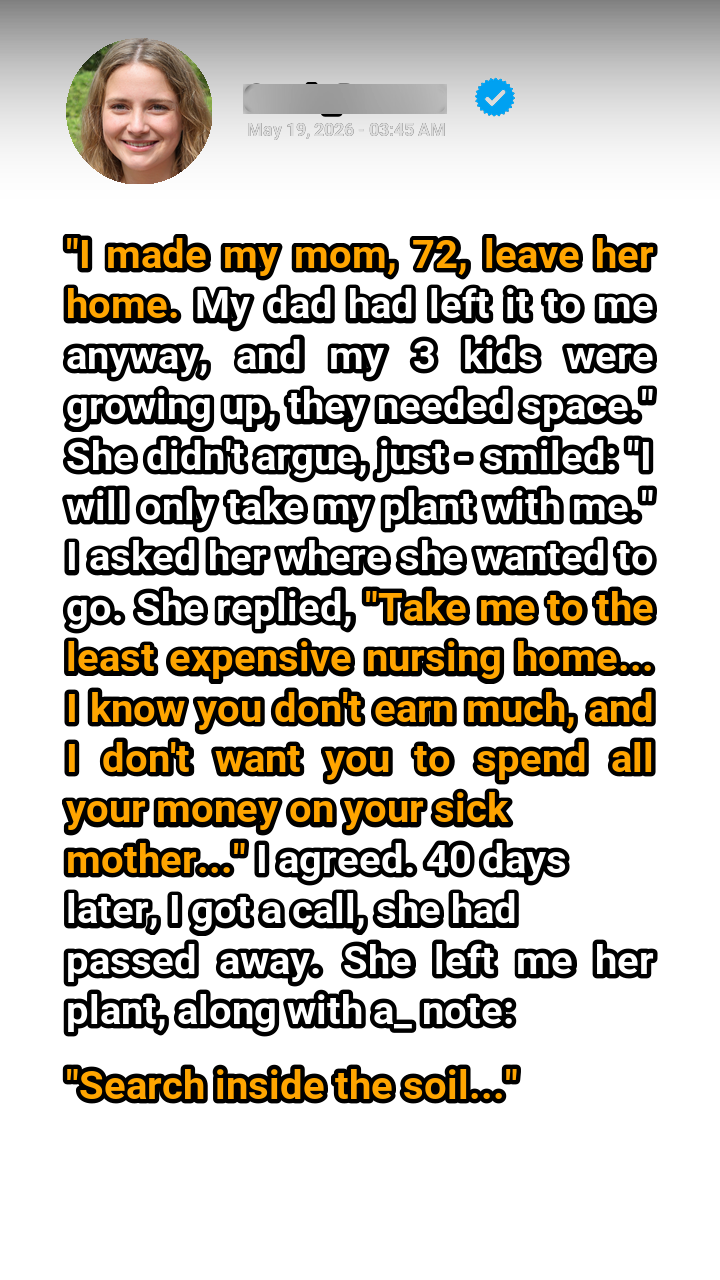
Mark stood in the doorway of the small sunroom, the afternoon sun casting long, accusatory shadows across the worn floral carpet. Outside, the boisterous laughter of his three children, Lily (10), Tom (8), and baby Leo (1), echoed from the backyard, a constant, joyful reminder of their ever-expanding presence. Inside, his mother, Eleanor, a woman of 72 years whose silver hair was always impeccably pinned, sat by the window, meticulously misting the leaves of an old jade plant. The scent of damp earth and lavender potpourri hung heavy in the air, a fragrance that had defined this house for as long as Mark could remember. This house, the one his father had willed solely to him five years ago, was now bursting at the seams. And today, Mark had to deliver the news he’d been rehearsing in his head for months, the words feeling like stones in his throat.
He cleared his throat, the sound unnaturally loud in the quiet room. Eleanor turned, her eyes, the same warm hazel as his own, twinkling with an almost imperceptible curiosity. There was no judgment, no anticipation of conflict, just a serene calm that both unnerved and shamed him. “Mom,” he began, his voice a little rougher than he intended, “we need to talk. The kids… they’re growing so fast. Lily and Tom need their own rooms, and Leo’s crib is practically in the hallway now. Sarah and I, we just don’t have the space.” He gestured vaguely around the cozy, but undeniably compact, living area, feeling the weight of his justification pressing down on him. He didn’t mention the escalating property taxes, the rising cost of living, or Sarah’s increasingly pointed suggestions about “reclaiming our space.”
Eleanor listened, her gaze unwavering, a faint, almost imperceptible smile playing on her lips. It wasn’t a smile of amusement, nor one of bitterness or sorrow. It was a smile of profound, almost ancient, understanding, a quiet acceptance that chilled Mark to the bone. He braced himself for the inevitable argument, the tears, the emotional blackmail he had prepared logical counter-arguments for. But nothing came. She simply nodded, her eyes still on his, and then slowly turned her attention back to the jade plant, running a tender finger along one of its thick, glossy leaves. “I understand, dear,” she said, her voice soft, devoid of any trace of reproach. “Just… can I take my plant with me?”
Mark blinked, caught off guard. The jade plant. It was ancient, a gnarled, robust survivor that had sat in that very spot since he was a small boy, a silent witness to decades of family life. It was nothing special, just a common houseplant, yet it seemed to hold an inexplicable significance to her. “Of course, Mom,” he managed, the unexpected ease of the conversation leaving him feeling strangely hollow. “Where… where would you like to go? We can look at some lovely retirement communities, maybe a small apartment nearby.” He offered, hoping to project an image of dutiful concern, even as a wave of relief washed over him.
Her smile broadened slightly, still that unsettling, knowing expression. “No, dear. No need for anything expensive. Take me to the least expensive nursing home you can find. I know you don’t earn much, and I don’t want you to spend all your money on your sick mother.” The words, delivered with such gentle selflessness, were like a physical blow. “Sick mother.” She rarely complained, never spoke of ailments, yet her quiet acceptance of this label, her immediate concern for his finances, twisted a knot of shame and guilt deep in Mark’s stomach. He wanted to protest, to insist on something better, but the truth was, his budget was indeed stretched thin, and her suggestion, however painful, was undeniably practical. The fleeting stab of conscience was quickly overridden by the cold logic of numbers and the undeniable appeal of a simpler, less expensive solution. He agreed, the word barely a whisper, feeling a profound sense of unease settle over him.
The move itself was a quiet, almost clandestine affair. Eleanor packed a single suitcase with a few clothes and some cherished photographs. The jade plant, carefully wrapped in a old newspaper, was the last item loaded into the trunk of Mark’s car. There were no goodbyes from the children, who were conveniently at school, sparing them the awkwardness. The “Serene Meadows” nursing home was anything but serene; a drab, functional building on the outskirts of town, smelling faintly of antiseptic and something vaguely institutional. Mark helped her settle into her small, sparsely furnished room, placing the jade plant on the single windowsill. As he left, Eleanor stood by the window, her hand resting on the plant’s pot, offering him that same enigmatic smile. He drove away, the rear-view mirror reflecting her small, receding figure, and a strange emptiness settled in the pit of his stomach, far heavier than any relief he might have expected.
The next forty days passed in a blur of escalating domestic chaos and a persistent, dull ache of unacknowledged guilt. Mark made two brief visits, each one feeling like an obligation rather than a comfort. Eleanor was always quiet, always polite, and always, unsettlingly, smiling that same gentle, knowing smile. She never complained about the food, the lack of privacy, or the monotonous routine. Then, on a Tuesday morning, exactly forty days after he had dropped her off, the phone call came. A polite, clinical voice from Serene Meadows informed him, with practiced detachment, that Eleanor had passed away peacefully in her sleep. Mark felt a sudden, sharp pang, a sensation that was both grief and a profound, chilling regret. He hadn’t seen her in nearly two weeks.
The funeral was a small, somber affair, attended only by Mark, Sarah, and a handful of distant relatives. There were no grand eulogies, just a quiet remembrance of a woman who had lived a simple, dignified life. A few days later, a package arrived from Serene Meadows, containing Eleanor’s last few possessions. Inside the box, nestled amongst a worn Bible and a framed photo of his father, was the jade plant. It looked a little sadder, a little less vibrant than he remembered, its leaves slightly dulled. As Mark lifted it out, a small, folded piece of paper fluttered from beneath the pot, landing softly on the polished hardwood floor. His breath caught in his throat. It was a note, written in Eleanor’s familiar, elegant script. His hands trembled slightly as he unfolded it, his eyes scanning the brief, poignant message. A single sentence stared back at him, simple, yet utterly perplexing, chilling him to the core: “Search inside the soil…”
The words, “Search inside the soil…”, pulsed in Mark’s mind like a silent accusation. He stared at the elegant script, then at the jade plant, its dull leaves suddenly seeming to pulse with a hidden life. A knot of dread, cold and insistent, tightened in his stomach. What could possibly be hidden there? A will? A message? Or something far more unsettling? The thought of disturbing the soil of a plant his mother had cherished so deeply, a plant that had witnessed so much, felt almost sacrilegious. Yet, her final, enigmatic instruction compelled him. He had to know.
He went to the kitchen, his movements stiff and deliberate, and returned with a small, tarnished silver spoon, an old souvenir from a forgotten family vacation. He set the plant down carefully on the polished dining table, the same table where Eleanor had served countless Sunday dinners. His hands trembled slightly as he began to spoon away the top layer of earth, revealing the dense network of roots beneath. The scent of damp soil filled the air, mingling with the lingering lavender from his mother’s box. He dug deeper, slowly, meticulously, each scoop of earth feeling heavier than the last, as if he were unearthing a secret that had been buried not just in the pot, but in the very fabric of their lives.
Just beneath the thick, gnarled main roots, his spoon struck something hard. Not a stone, but something metallic, wrapped tightly. His heart hammered against his ribs. He carefully scraped away the remaining soil, revealing a small, tarnished metal box, no larger than a jewelry casket, sealed with a thick layer of wax. It felt ancient, almost sacred. With trembling fingers, he pried open the lid. Inside, nestled on a bed of faded velvet, was not jewelry, but a thick stack of crisp, old hundred-dollar bills, bound with a brittle rubber band. Beside it, a folded, yellowed envelope, addressed simply to “My Dearest Mark,” in his father’s strong, familiar hand.
Mark’s breath hitched. He carefully lifted the money, the weight of it surprisingly substantial. It was thousands, perhaps tens of thousands, far more than he could have ever imagined. His father, a man who had always seemed to live paycheck to paycheck, had hidden this? He tore open the envelope, his eyes blurring as he recognized his father’s distinctive handwriting. The letter, dated just a month before his father’s unexpected passing five years ago, was brief but devastatingly clear. It explained that this money, accumulated over decades through small, careful investments and a secret second job, was meant solely for Eleanor – a “nest egg” for her later years, a guarantee of comfort and security. “She deserves more than I could ever give her openly,” his father had written, “and this way, she’ll never be a burden to anyone, especially not to you, my son. Take care of your mother, Mark. She is precious.”
The words hit Mark with the force of a physical blow. He sank into the dining chair, the ancient money a leaden weight in his lap, the letter clutched in his shaking hand. Eleanor had known. She had known all along about this money, this hidden fortune meant specifically for her comfort. And yet, she had never touched it. She had allowed him to send her to Serene Meadows, the cheapest nursing home, without a single complaint, without a hint of reproach, only that serene, knowing smile. She had sacrificed her own comfort, her own security, to avoid being a “burden” to him, to ensure he didn’t “spend all his money on his sick mother,” even when she had her own means. She had, in her quiet, profound way, given him back his inheritance, not just the house, but the peace of mind she had ensured for him by removing herself from his financial equation.
A wave of gut-wrenching shame and an unbearable, crushing regret washed over Mark. The memory of her gentle “I understand, dear,” her unwavering gaze, her final, enigmatic smile as he drove away from Serene Meadows – it all coalesced into an agonizing understanding. She hadn’t been sick, not in the way he’d conveniently assumed. She had been simply, profoundly, selfless. He had rationalized his actions, convinced himself he was doing what was best for his family, but in his haste and self-absorption, he had overlooked the quiet dignity, the immense love, and the ultimate sacrifice of the woman who had nurtured him. He had chosen space for his children over comfort for his mother, believing it was a necessary evil, only to discover she had already provided for her own needs, and then some, choosing instead to gift him freedom from that burden.
The money, meant to secure her future, now sat in his hands, a stark monument to his failure. It was too late to offer her a better home, a softer bed, a more serene final chapter. The jade plant, now empty of its secret, stood on the table, a silent, verdant witness to a legacy of love, sacrifice, and a son’s profound, irreversible regret. Mark looked at the thriving plant, then at the money, then at the empty space in his heart where his mother’s knowing smile now resided, a permanent, searing reminder of the price of his own convenience. The space his children had gained felt impossibly vast and cold, filled not with joy, but with the echoing silence of what he had lost. He knew, with a certainty that chilled him to the bone, that he would carry the weight of this revelation, and the profound wisdom of his mother’s silent sacrifice, for the rest of his days.