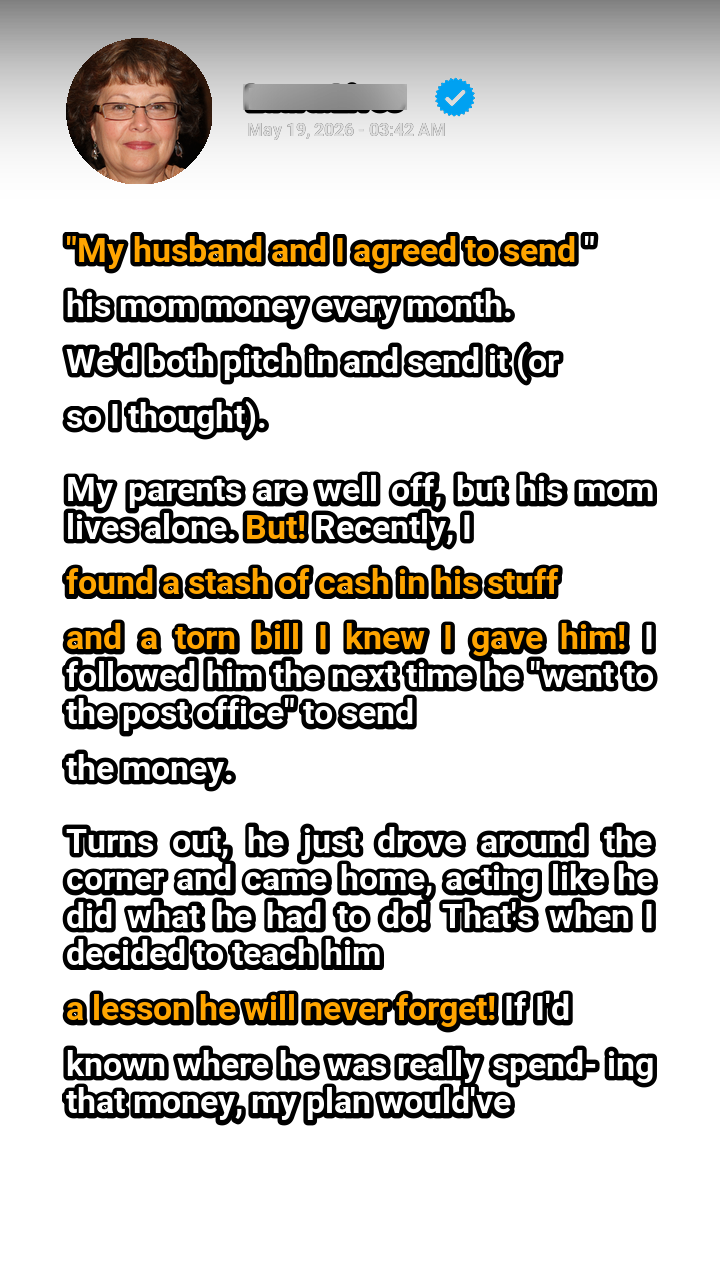
Our agreement, forged over lukewarm coffee on a quiet Sunday morning, felt like an unbreakable pact, a cornerstone of our shared future. Mark, my husband of seven years, and I had solemnly vowed to pool our resources each month to financially support his mother, Eleanor. She lived alone in a small, slightly rundown house on the outskirts of town, her pension barely stretching to cover utilities, let alone groceries or the occasional medical bill. My own parents, bless their hearts, were comfortably well-off, their retirement years a leisurely dance of travel and philanthropy. But Eleanor, a kind woman with a perpetually worried frown etched between her brows, didn’t have that luxury. It was a simple, compassionate decision, one that filled me with a quiet sense of purpose, believing we were truly building a life rooted in care and responsibility. We would each contribute a substantial sum, enough to genuinely ease her burden, and Mark, being her son, would handle the weekly bank transfer or the occasional trip to the post office to send a money order. Or so I thought.
For months, this system operated like clockwork. Every second Friday, I would meticulously withdraw my share, usually a crisp stack of hundreds and fifties, and hand it directly to Mark. He’d nod, give me a quick, appreciative kiss on the forehead, and promise to “take care of it first thing Monday.” I never questioned it. Why would I? Mark was my husband, my partner. We shared everything, from our dreams to our darkest fears. The thought that he might betray such a fundamental trust, especially concerning his own vulnerable mother, was simply unthinkable. I envisioned Eleanor receiving the money, perhaps treating herself to a new pair of reading glasses or a warm winter coat, and a sense of quiet satisfaction settled over me. Our contributions, I believed, were making a tangible difference, providing her with the dignity and comfort she deserved.
The first tremor in the bedrock of my trust came not with a bang, but with the subtle rustle of paper. I was tidying up Mark’s study, a rare foray into his domain, searching for an old tax document he’d mentioned. My hand brushed against a loose floorboard near his desk – a common, benign quirk of our old house. But this time, it wasn’t just loose; it was slightly ajar. Curiosity, that dangerous mistress, got the better of me. Peering into the narrow cavity, my fingers met something unexpected: a thick, rubber-banded wad of cash, tucked away as if forgotten. My heart gave a strange lurch. We weren’t struggling financially, but we certainly weren’t flush enough to have such a significant sum just lying around, unclaimed. As I carefully pulled it out, a small, crinkled bill fluttered to the floor. It was a fifty, torn at the corner in a distinctive, jagged pattern. A pattern I knew intimately because I had accidentally ripped it myself just two weeks prior, right before handing it to Mark as part of Eleanor’s monthly contribution.
A cold, sickening wave washed over me. The torn fifty was an undeniable fingerprint, a stark piece of evidence screaming betrayal. My mind reeled, frantically trying to construct an innocent explanation. Maybe he forgot? Maybe he just hadn’t gotten around to it? But the sheer volume of cash, far more than just my last contribution, and its clandestine hiding spot, shattered those flimsy excuses. The warmth of our shared purpose chilled into a bitter suspicion. Every “post office run” he’d ever made, every casual assurance that Eleanor was “all set,” now echoed with a hollow, deceitful ring. A knot of anger began to tighten in my stomach, a slow-burning fuse igniting deep within me. I carefully replaced the money, the torn bill nestled back into the stack, and sealed the floorboard. He wouldn’t know I knew. Not yet. I needed proof, irrefutable and damning.
The following Monday, my stomach churned with a mixture of dread and grim determination. I watched Mark meticulously prepare for his supposed errand, whistling a cheerful tune as he gathered a few envelopes and his wallet. He gave me a quick peck on the cheek, “Just heading out to the post office, honey. Be back in a bit.” I smiled, a tight, forced curve of my lips, and wished him a safe trip. The moment his car pulled out of the driveway, I was already moving, grabbing my own keys, my old, unassuming hatchback, and a pair of dark sunglasses. I gave him a minute’s head start, then followed, keeping several cars between us, my heart pounding a frantic rhythm against my ribs. My eyes, usually soft and trusting, were now narrowed, analytical, searching for any tell-tale sign of his deception.
He drove, not towards the main road that led to the post office, but in the opposite direction, towards a quiet residential loop just a few blocks away. My grip on the steering wheel tightened, knuckles white. He turned down a tree-lined street, slowed, and then, inexplicably, pulled over to the curb. He sat there for a full five minutes, staring idly at his phone, before putting the car back into drive. He didn’t go into a store, didn’t meet anyone, didn’t even make a phone call. He simply completed a pointless, circular drive, then headed straight back home. I watched from a discreet distance as he pulled into our driveway, got out of the car, and walked into the house, whistling that same irritatingly cheerful tune, his face alight with the self-satisfied air of a man who had just completed a vital duty. The raw fury that surged through me was a physical ache, a searing pain of betrayal. He hadn’t just lied; he had played me for a fool, a naïve pawn in his own twisted game.
That night, lying beside him in our silent bed, listening to his even breathing, my mind raced, constructing the architecture of a plan. The money, the lies, the sheer audacity of his deception – it all coalesced into a singular, burning resolve. He had stolen from his own mother, from our shared commitment, and from my trust. He would pay. I would teach him a lesson so profound, so utterly unforgettable, that it would reshape the very fabric of his understanding of honesty and consequence. My scheme began to take shape, meticulous and precise, an intricate web of retribution designed to hit him where it hurt the most. But if I’d known the true destination of those diverted funds, if I’d uncovered the dark, intricate web of deceit that money was funding, my meticulously planned retribution, born from a white-hot fury, would have evaporated on the spot. Because the reality of his betrayal, the actual secret he was guarding, was a monstrous shadow far larger and more terrifying than I could have ever conceived. My “lesson” would have been completely inadequate; a mere flick of a match against an inferno.
My “lesson” would have been completely inadequate; a mere flick of a match against an inferno. My initial plan, born of a white-hot fury, was meticulously crafted to inflict a mirrored pain, a financial and emotional blow that would leave Mark reeling. I envisioned taking the money he’d squirreled away – or at least an equivalent amount from our joint funds that was *his* contribution – and ensuring it reached Eleanor, perhaps even including a cryptic note, signed “a concerned well-wisher,” to subtly sow doubt in his mind. Or, more directly, I’d simply confront him after I’d made sure Eleanor was taken care of, laying out the evidence: the torn fifty, the fake post office runs, the undeniable proof of his deceit. The satisfaction of watching his self-satisfied smirk crumble, replaced by shame and fear, was a potent fuel for my righteous anger. I would make him understand the depth of his betrayal, the corrosive effect his lies had on our shared life. This was my justice, a calculated strike against his perceived financial gain.
My opportunity arose a few days later, Mark had a late meeting, providing me with the perfect window to put my plan into action. I returned to the loose floorboard in his study, my heart still thrumming with a mixture of anger and grim determination. Retrieving the stash of cash, I began to count it, mentally calculating how much I would redistribute to Eleanor. But as my fingers moved through the thick wad, a folded, thick envelope tucked beneath the money caught my eye. It wasn’t the kind of envelope for bank statements or utility bills; it was plain, unmarked, and surprisingly heavy, its edges worn from repeated handling. My fingers trembled as I pulled it out, a premonition of dread tightening in my chest. Inside, nestled amongst more crumpled bills, were not receipts or personal notes, but a collection of terse, threatening messages, scrawled in hurried, blocky handwriting. “Tick tock, Mark. We know where you live.” “The interest grows daily. Don’t be late again.” And then, a series of crude, violent drawings – a broken bone, a smashed car. My blood ran cold, solidifying into a block of ice in my veins. This wasn’t about him pocketing money for a secret indulgence or another woman. This was something far, far worse.
Among the crude threats, I found a few betting slips, not from a legitimate casino, but from an illegal, underground bookie. The dates stretched back for months, showing increasingly desperate wagers, each loss piling onto the next with alarming speed. And then, a crumpled ledger sheet, meticulously detailing an escalating debt – not just thousands, but tens of thousands, owed to shadowy figures with terrifying nicknames like “The Butcher” and “Razor.” The money I had been giving him for Eleanor, the money he had been stashing in the floorboard, wasn’t for himself. It was a desperate, futile attempt to pay off a burgeoning, terrifying gambling debt, a debt that had clearly spun wildly out of control. Eleanor’s contributions were being siphoned, not to enrich him, but to keep him from being physically harmed, or worse. The “post office runs” weren’t just a simple lie; they were a flimsy, pathetic cover for clandestine meetings, desperate hand-offs of cash to keep the hungry wolves at bay.
The white-hot fury I had felt just moments before evaporated, replaced by a paralyzing wave of icy terror that spread through every cell of my body. My carefully constructed “lesson” felt laughably insignificant, a child’s tantrum in the face of a looming catastrophe that could destroy everything. This wasn’t about teaching him a lesson; this was about survival. Our survival. His lies weren’t a personal affront or a selfish betrayal; they were a desperate, pathetic shield, an attempt to protect us from a danger he couldn’t control, a monster he had inadvertently created. The man I loved, the partner I had built a life with, was trapped in a nightmare of his own making, a nightmare that now threatened to consume us both. The thought of Eleanor, unknowingly caught in the terrifying periphery of this impending disaster, twisted my gut. My anger didn’t vanish entirely, but it transformed into a steely, desperate resolve, a burning need to understand the full scope of the threat and, somehow, to dismantle it before it was too late.
I waited for him that night, the threatening notes, the illegal betting slips, and the terrifying ledger spread out on the kitchen table, illuminated by the harsh, unforgiving overhead light. When he finally walked in, whistling his irritatingly cheerful tune, his eyes immediately fell upon the incriminating evidence. The color drained from his face with sickening speed, replaced by a ghastly pallor that made him look like a ghost. His self-satisfied smirk vanished, replaced by a look of pure, unadulterated fear, his eyes wide and vacant. “What… what is this?” he stammered, his voice barely a whisper, thick with disbelief and terror. I didn’t yell. I didn’t scream. My voice, though trembling, was laced with a chilling, unnatural calm. “This,” I said, my finger shaking as I pointed to the crude threats, “is what you’ve been protecting us from. This is where Eleanor’s money has been going. And this,” I gestured to the crumpled ledger, “is the monster you’ve been feeding.” The silence that followed was deafening, thick with the crushing weight of shattered trust and imminent peril. He sank into a chair, his head collapsing into his hands, his body wracked with silent, gut-wrenching sobs.
My plan for a “lesson” was indeed inadequate. It wasn’t a lesson he needed, but an intervention, a desperate fight for his life, for our future, for the very fabric of our existence. The path ahead was no longer about retribution or an eye for an eye, but about navigating a treacherous landscape of insurmountable debt, lurking danger, and the terrifying prospect of confronting the very people who held his life, and potentially ours, in their ruthless hands. The inferno wasn’t just at our doorstep; it had already engulfed us, its flames licking at the edges of everything we held dear. I looked at the man across from me, broken and terrified, and a new, terrifying question formed in my mind, echoing in the cavern of my chest: Could we ever escape this? Or was this the end of everything we had built, swallowed whole by the monstrous shadow he had so desperately, so foolishly, tried to hide? The future, once a clear and promising path, now stretched before us, a terrifying, uncertain abyss.