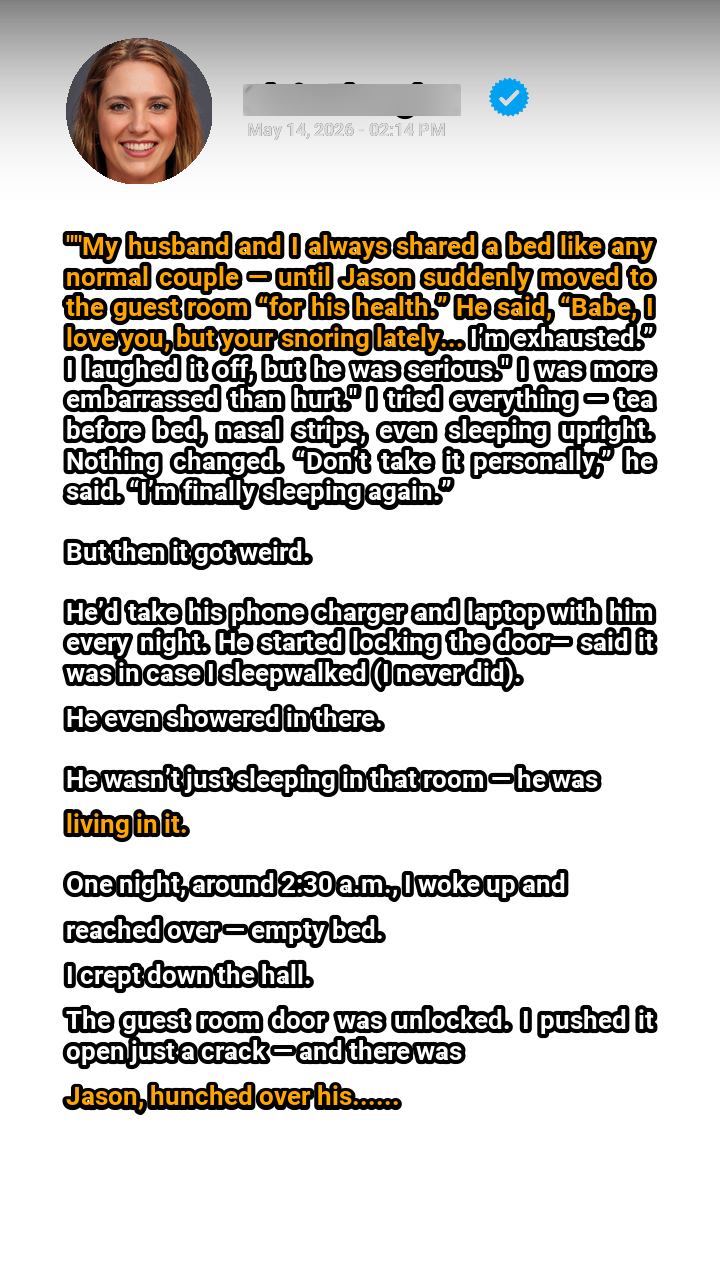
Our king-sized bed, a sanctuary for nearly a decade, had always been more than just a place to sleep. It was where we whispered secrets in the dark, where Jason’s warm arm would instinctively pull me closer in the pre-dawn chill, where the mundane tangles of everyday life dissolved into the comforting intimacy of shared space. So, when Jason, my rock-solid, utterly predictable husband, cleared his throat over a Sunday morning coffee and declared he was moving to the guest room, a laugh bubbled up from me, disbelieving and a little nervous. “Babe, I love you,” he’d said, his eyes avoiding mine, fixed instead on the swirling steam from his mug, “but your snoring lately… I’m genuinely exhausted. It’s for my health.” The words, delivered with a detached clinicality, felt less like a loving concern and more like a medical diagnosis, one that inexplicably placed *me* as the problem. My initial reaction was a flush of mortified embarrassment, quickly followed by a dull ache of hurt that I tried desperately to ignore.
I threw myself into a desperate campaign against my own nocturnal emissions. I bought every herbal tea promising tranquility and quiet nights, chugging chamomile and lavender infusions until I practically glowed with botanical calm. My nose became a laboratory for every brand of nasal strip, making me look like a perpetually surprised badger in bed. I even experimented with sleeping positions, propping myself up on an absurd pyramid of pillows, attempting to mimic a chaise lounge, all in the vain hope of finding that magical angle that would silence the offending rumble. Nothing worked. Each morning, Jason would emerge from the guest room, looking marginally more rested than I was, but with a subtle new distance in his gaze. “Don’t take it personally,” he’d repeat, a phrase that began to feel less like reassurance and more like a cold dismissal. “I’m finally sleeping again.” But the cost of his newfound rest felt like the growing chasm between us, a silent, unacknowledged wedge driven into the very heart of our shared life.
It started subtly, almost imperceptibly, like a slow erosion rather than a sudden crack. First, it was just the phone charger he’d take with him, then his laptop, ostensibly for “reading articles” before bed. But soon, the charger was a permanent fixture in the guest room’s outlet, and his laptop, once a shared screen for late-night movie binges, became an extension of his private, separate world behind that closed door. The hum of the machine, the occasional soft click of keys, would drift down the hall, a faint, alien soundtrack to my increasingly lonely nights. The guest room, once a catch-all for forgotten boxes and out-of-season clothes, began to feel like a meticulously curated bachelor pad, a fortress of solitude where he wasn’t just escaping my snoring, but escaping *me*.
Then the barriers became more overt, more physical. One evening, I tried to follow him down the hall, a desperate plea for a goodnight kiss on my lips, only to find the guest room door firmly locked. “Just in case you sleepwalk,” he’d called through the wood, his voice muffled, a hint of something I couldn’t quite decipher in his tone. I never sleepwalked. Not once in our ten years together. The excuse was flimsy, insulting even, but the lock was undeniably real, a cold, metallic statement of separation. The final, jarring piece of the puzzle clicked into place when he started showering in there. The guest bathroom, rarely used, now echoed with the daily rush of water, the scent of his soap no longer lingering in *our* bathroom, no longer a shared morning ritual. He wasn’t just sleeping in that room anymore — he was **living in it**, constructing an entirely separate existence within the walls of our own home, a parallel life just steps away, yet utterly inaccessible to me.
The emptiness in our bed felt like a physical weight, pressing down on me each night. The cool, undisturbed sheets on his side were a constant, chilling reminder of his absence, and with it, the gradual erosion of our connection. The initial hurt had morphed into a simmering resentment, laced with a growing, insidious suspicion. What was he doing in there, really? Was it truly just about sleep? The excuses felt thinner with each passing day, the locked door more impenetrable, the distance between us wider than the hallway that separated our rooms. My mind, once filled with mundane worries, now churned with unanswered questions, a relentless, anxiety-inducing hum. I missed the sound of his breathing beside me, even if it meant enduring my own supposed snoring. I missed the simple, comforting presence of my husband. But more than that, I began to fear what his absence truly signified.
One particularly cold, quiet night, the kind where the house settles into a profound silence that feels almost watchful, I woke with a start. My internal clock, honed over years of shared rhythms, registered 2:30 a.m. Instinctively, my hand reached out across the mattress, seeking the familiar warmth of his skin, the solid comfort of his presence. My fingers met only cool, empty sheets. A sudden, sharp jolt of adrenaline shot through me. He wasn’t just in the guest room; he wasn’t in the house. Or was he? A cold dread settled in my stomach. Slipping out of bed, careful not to make a sound, I crept down the hall, every floorboard creak a thunderclap in the oppressive silence. My heart hammered against my ribs, a frantic drumbeat against the quiet.
As I approached the guest room door, I braced myself for the familiar, unwelcoming lock. But to my surprise, the door was slightly ajar, a sliver of warm, golden light spilling onto the dark carpet. My breath hitched. With a trembling hand, I pushed it open just a crack, barely enough to peer inside. The sight that greeted me froze the blood in my veins. There was Jason, silhouetted against the soft glow of a bedside lamp, hunched over his desk, not his laptop, not his phone, but an old, weathered leather briefcase I had never seen before. It lay open, its contents partially obscured, but I could make out neat stacks of crisp hundred-dollar bills, more cash than I’d ever seen him handle, and nestled amongst them, a thick, crimson passport – **not his.**
The world tilted on its axis. The crimson passport, thick and official-looking, yet utterly alien, pulsed with an ominous energy. And the cash. Not just a few hundred, or even a few thousand, but neat, tightly bound stacks of crisp hundred-dollar bills, enough to fill a small suitcase, enough to buy a new life, or fund a very old, very dark one. The “snoring” excuse, the locked door, the separate showers – all of it shattered into a million pieces, revealing the hideous truth beneath: this wasn’t about rest, it was about a meticulously constructed lie. My husband wasn’t just tired; he was a stranger, living a clandestine existence barely ten feet from my pillow.
Jason, my Jason, was hunched over the desk, his back to me, but the intensity of his posture, the rigid set of his shoulders, spoke volumes. He wasn’t casually scrolling through articles; he was meticulously examining the contents of the briefcase. His fingers, the same fingers that had once laced through mine at the altar, now delicately sorted through the bills, then paused, tracing the edge of the crimson passport. I couldn’t see the photo, but I could imagine it – a man who looked like Jason, yet wasn’t him. A man with different eyes, perhaps a different haircut, certainly a different name. The cold, focused concentration on his face, even from behind, was not the face of the man I married. It was the face of a man with a singular, secret purpose.
Every single excuse, every dismissed concern, every lonely night in our once-shared bed, now clicked into a horrifying alignment. The guest room wasn’t a sanctuary for his health; it was a fortress for his deception, a private command center where he orchestrated an entirely separate life. The daily hum of his laptop, once a mild annoyance, now felt like the low thrum of a ticking bomb. He wasn’t just escaping my snoring; he was escaping our entire reality, meticulously building an alternate identity, brick by terrifying brick, right under my unsuspecting nose. The question wasn’t *if* he was planning to leave, but *when*, and what else he was leaving behind.
I strained to see more, my breath caught in my throat, my heart hammering against my ribs. Nestled amongst the stacks of cash, almost hidden, I glimpsed a small, worn photograph, face down. Beside it, peeking out from under a stack of hundreds, was the corner of a crumpled, but clearly printed, airline ticket stub. One way. The destination was obscured, but the date, emblazoned in bold black ink, screamed at me: *two days from now*. He wasn’t just living a separate life; he was preparing to abandon his current one, to vanish without a trace, leaving me to pick up the pieces of a marriage built on sand.
Then, with a deliberate motion, Jason flipped open the crimson passport. My eyes, wide with terror and disbelief, fixated on the open page. The name, printed in stark, unforgiving letters, seared itself into my brain: **ALEXANDER VOLKOV**. Alexander Volkov. The name echoed in the silent hall, a death knell to my decade-long marriage. Alexander Volkov. Where had I heard that name? A vague, chilling memory stirred, a fleeting glimpse of a news headline, a grainy photo on a true-crime documentary. A name associated with… something dark. Something dangerous.
As the full weight of the name crashed over me, Jason suddenly tensed. His head, previously bowed in focused study, snapped up. His eyes, sharp and alert, darted towards the guest room door, not directly at the sliver where I stood, but with an unnerving intuition, as if he’d felt the slight shift in air pressure, heard the faint whisper of my horror. His right hand, without hesitation, moved swiftly, disappearing from my view beneath the desk. The faint, unmistakable glint of metallic silver caught the ambient light for a fleeting moment. He was reaching for something. Something he kept hidden. Something lethal.
My breath hitched, a silent scream trapped in my throat. I yanked back, pulling the door shut with a soft, almost imperceptible click that sounded like a gunshot in my ears. I scrambled back down the hall, a frantic, silent escape artist, my bare feet barely touching the floorboards. I flung myself into our empty bed, pulling the covers up to my chin, feigning sleep, my body rigid, trembling uncontrollably. Alexander Volkov. Not Jason. Not my husband. The man lying ten feet away, armed and dangerous, was a phantom, a criminal, a complete stranger. The silence of the house was no longer merely watchful; it was utterly terrifying, a vast, echoing void where my life, as I knew it, had just ceased to exist, replaced by a cold, insidious dread.