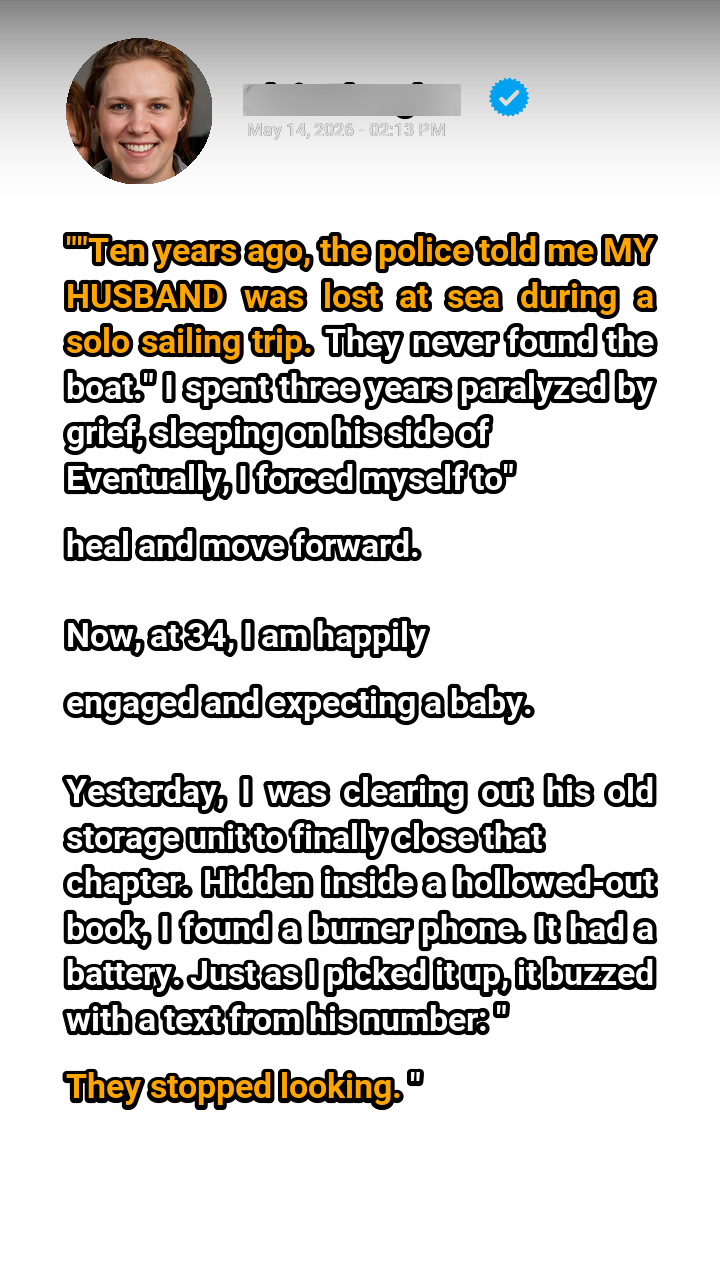
The ocean, usually a calming force in my coastal town, became my personal abyss ten years ago. It was a Tuesday morning when the call came – the kind that makes your blood run cold before a single word is spoken. Officer Miller’s grim, measured tone delivered the news that shattered my world into a million irreparable pieces: “We regret to inform you, Mrs. Hayes, that your husband, Arthur, is presumed lost at sea. His sailing vessel, the ‘Wanderer,’ was found adrift, completely empty, approximately fifty nautical miles off the coast. There’s no sign of him.” The words, clinical and brutal, echoed in the hollow space where my heart used to be. Arthur, my adventurous, sea-loving Arthur, had embarked on a solo sailing trip, a routine escape he cherished, only this time he hadn’t returned. The Coast Guard searched for three agonizing days, their helicopters a relentless thrum against the backdrop of my silent, tear-soaked vigil on the beach. They found nothing – no life raft, no debris, no trace of the man I had built my entire future with. Just the empty boat, a silent tombstone on the waves.
For three years, I existed as a ghost in my own life. Our king-sized bed, once a sanctuary of shared dreams and whispered secrets, became a cold monument to his absence. I slept exclusively on his side, the faint, lingering scent of his cologne a cruel comfort, clutching the pillow he used to rest his head on. My apartment, meticulously organized by Arthur and me, slowly succumbed to a layer of dust and neglect, mirroring the state of my soul. Every morning was a battle against the suffocating blanket of grief, every evening a surrender to the agonizing loneliness. Friends tried to pull me out, gently coaxing me to dinner, to walks, to anything that resembled life, but their efforts felt futile. How could I laugh when the very sound felt like a betrayal to the man who was gone, stolen by the merciless sea? I was paralyzed, a prisoner in the fortress of my sorrow, convinced that moving on would mean forgetting, and forgetting Arthur was an unimaginable blasphemy.
The turning point was slow, agonizingly so, like a ship pulling itself from the thickest fog. It began with small, almost imperceptible acts of defiance against the despair. A single potted plant, a gift from my sister, placed on the kitchen counter. A hesitant acceptance of a coffee invitation. Then, a more deliberate step: packing away Arthur’s clothes, not to discard them, but to preserve them, acknowledging that his physical presence was gone, but his memory would always remain. It was a painstaking, guilt-ridden process, punctuated by fresh waves of tears and memories, but each item meticulously folded and boxed was a tiny victory. I forced myself to heal, to breathe, to live again, not just for myself, but for the fierce, vibrant love Arthur and I had shared, a love that deserved to be remembered with joy, not just sorrow.
Slowly, painstakingly, a new life began to bloom from the ashes of the old. At 34, a decade after the tragedy, I found myself in a place I never thought possible: truly happy. My fiancé, Michael, was everything Arthur wasn’t – grounded, practical, a gentle anchor to my often-turbulent emotions. He understood my past, never tried to erase Arthur’s memory, but instead, helped me weave it into the tapestry of my present without letting it overshadow our future. The biggest, most miraculous chapter of that future was unfolding within me: a tiny life, a baby, due in just a few months. The thought of becoming a mother, of sharing that joy with Michael, filled me with a warmth and hope I hadn’t felt in years. It was a complete, beautiful circle, a testament to resilience and the enduring power of love.
With this new chapter firmly established, I felt a deep, almost spiritual need to finally, completely close the last lingering vestige of my old life. Arthur’s storage unit. It had sat untouched for years, a time capsule of our shared history, filled with his old books, camping gear, sailing equipment, and boxes of miscellaneous treasures he’d collected. It felt wrong to just leave it, a forgotten shrine collecting dust. Michael, ever supportive, agreed it was time. “It’s a way of honoring his memory, love,” he’d said gently, “and making space for ours.” So, yesterday, with a mixture of trepidation and resolve, I drove to the industrial park on the outskirts of town, key in hand, ready to confront the final echoes of a life I’d bravely, tearfully, moved beyond.
The unit was a tomb of memories, the air thick with the scent of old paper and forgotten dreams. Dust motes danced in the single beam of light filtering through a high vent as I began the methodical process of sorting. Each item was a punch to the gut, a bittersweet echo of a shared moment: his worn leather jacket, the old vinyl collection we’d danced to, the intricate model ship he’d painstakingly built. I carefully packed away the things I wanted to keep for our child, donating others, and discarding what was truly broken or beyond repair. Deep in one forgotten box, tucked beneath a stack of old nautical charts, I found a small, leather-bound copy of “Moby Dick.” Arthur loved classics, but this particular edition felt out of place, slightly thicker than it should have been. My fingers traced the spine, feeling an odd, subtle rigidity. Curiosity piqued, I pulled it open, and the weight shifted. Inside, meticulously hollowed out, was a cavity. And nestled within, sleek and incongruous against the yellowed pages, lay a burner phone.
My breath hitched. A burner phone? Arthur? The man who prided himself on transparency, who scoffed at anything clandestine. My heart hammered against my ribs, a frantic drumbeat of confusion and dread. It was an older model, a simple flip phone, but its screen was dark, not dead. Hesitantly, my fingers trembling, I reached for it. It was cold, metallic, a stark contrast to the worn paper surrounding it. Just as my fingertips brushed its smooth surface, a sudden, sharp vibration startled me, sending a jolt through my entire arm. The screen flickered to life, illuminating the dim storage unit with an eerie blue glow. A new message. From *his* number. The one I still had memorized, the one I had deleted from my contacts but could never truly erase from my mind. My eyes, wide with disbelief and a burgeoning terror, fixated on the stark, impossible words glowing on the screen. “**They stopped looking.**”
The words “They stopped looking” burned into my retina, a brand mark on the fragile peace I had so painstakingly constructed. It couldn’t be. Arthur was dead. I had mourned him, buried his memory, worn black for three years, and then, with agonizing slowness, built a new life from the ashes of the old. This was a cruel, impossible joke, a sick hallucination conjured by the dust and ghosts of the storage unit. My fingers, still hovering over the burner phone, felt alien, disconnected from my panicked brain. The air, already stale with the scent of old paper and forgotten dreams, suddenly felt thin, suffocating. My heart, which had just moments ago swelled with the quiet joy of closure, now pounded with a frantic, desperate rhythm against my ribs. This wasn’t closure. This was an explosion.
I fumbled with the flip phone, my mind racing, a thousand frantic questions screaming for answers. Was it a prank? Some sick, twisted individual who had somehow gotten hold of Arthur’s old number and planted this phone? But the phone was *his*, hidden in his most cherished book, in his untouched storage unit. I opened the message again, re-reading the impossible words. The sender was listed simply as “Arthur,” his full name, not just the number. There were no other texts, no missed calls, no notifications of any kind. I navigated to the call logs. Empty. No contacts. This was a clean slate, a device meant for one purpose, one message, and it had been activated just as I touched it. The battery indicator glowed an impossible green, impossibly full. It had been waiting. Waiting for *me*. The implication hit me with the force of a physical blow, stealing the air from my lungs: Arthur was alive. And he had orchestrated his own disappearance.
A wave of nausea, cold and sharp, washed over me, mingling with a burgeoning rage. The years of agonizing grief, the sleepless nights spent clutching his pillow, the therapy sessions, the slow, painful process of healing – it was all a monstrous, elaborate lie. He had let me believe he was dead. He had let my family grieve, let my friends offer their hollow condolences. He had let Michael, my kind, steadfast Michael, step into a life that was, apparently, still claimed by him. The baby inside me, a symbol of my new beginning, a beacon of hope, suddenly felt vulnerable, exposed to this terrifying, unfolding deception. Who was Arthur really? What kind of man could do this? Was he in danger, forced into hiding, using this as a desperate plea? Or was he a calculating, heartless monster, orchestrating a grand deceit for reasons I couldn’t fathom? The dust motes in the single beam of light now seemed to swirl with malevolence, and every shadow held a potential, terrifying secret.
Memories of Arthur, once cherished and held sacred, now fractured and distorted, seen through a new, horrifying lens. His love for the sea – was it a genuine passion or a convenient, elaborate cover? His meticulous planning for his solo trips – was it just thoroughness, or a careful rehearsal for his escape? The “Wanderer,” found adrift and empty, not a single trace of him. The Coast Guard’s fruitless, agonizing search. It all clicked into place with horrifying, stomach-churning precision. He hadn’t been lost; he had vanished. And he had used my grief, my love, as a smokescreen, a tragic backdrop to his audacious disappearing act. The anger was a hot, burning coal in my chest, threatening to consume everything good I had built. How dare he? How dare he shatter my world, then let me painstakingly rebuild it, only to tear it down again with a single, cryptic text?
“They stopped looking.” Who were “they”? The police? The Coast Guard? Or someone else, someone more dangerous, someone from whom Arthur was hiding? The text wasn’t a cry for help, not a desperate “I’m alive, come find me.” It was a statement of fact, almost a signal. A signal that the coast was clear. For what? For him to resurface? To contact me? Or was it a warning? My hand trembled, hovering over the “Call” button, my thumb aching with indecision. Every fiber of my being screamed at me to throw the phone against the concrete wall, to stomp on it, to erase this impossible truth and cling to the life I had. But another, colder, more resolute part of me, the part that had survived and rebuilt, knew I couldn’t. I had to know. I had to understand.
This wasn’t just about Arthur anymore. It was about Michael, the man who had loved me back to life. It was about our baby, the innocent life growing inside me, who deserved a future free from this kind of devastating deception. This phone, this single text, held the power to obliterate it all – my marriage, my peace, my sanity. If Arthur was alive, what did that mean for everything I held dear? The weight of that decision pressed down on me, heavy and suffocating. My breath hitched, a silent sob catching in my throat. I couldn’t move, couldn’t think, trapped between the man I had mourned for a decade and the ghost who had just sent me a text, pulling me back into a nightmare I thought I had escaped.
Just as I was about to make a choice, to either drop the phone or dial the impossible number, the device vibrated again, not with a new message, but with an incoming call. The screen flickered, illuminating the dim storage unit with an eerie blue glow that reflected in my wide, horrified eyes. “Incoming Call: Arthur.” My blood ran cold, then surged with a terrifying adrenaline. He was calling. Right now. In this dusty, forgotten tomb of memories, the ghost of my past was reaching out, threatening to consume my present and shatter my future into irreparable pieces. I stared at the glowing screen, the name “Arthur” burning bright, my finger hovering, paralyzed, just inches from the green “Answer” button, knowing that picking up would unleash a truth I might never recover from, a truth that would redefine every moment of my life.