Mark and Sarah had spent months planning their anniversary escape. They’d scrolled through countless Airbnb listings, each one blending into a blur of exposed brick and minimalist decor, until they stumbled upon “The Lakeside Haven.” It promised tranquility, panoramic views of Lake Serenity, and a charming, rustic-chic interior. The photos, bathed in golden hour light, depicted a secluded cabin nestled among towering pines, a private dock extending into glass-smooth water, and a cozy fireplace. The reviews were stellar – “a true sanctuary,” “unforgettable peace,” “the perfect romantic retreat.” Booking it felt like unlocking a hidden level of adulting success. They envisioned slow mornings with coffee on the porch, paddleboarding across the pristine lake, and evenings curled up by the fire, reconnecting away from the relentless demands of their city lives. The drive up, a scenic two-hour journey that wound through quaint New England towns and dense forests, only amplified their anticipation. As they pulled up the gravel driveway, the cabin truly lived up to its online persona, a beacon of rustic charm against the emerald backdrop of the woods.
The initial hours were everything they’d dreamed of. They unpacked, admiring the handcrafted wooden furniture, the plush throws, and the thoughtful welcome basket filled with local artisanal treats. Sarah, ever the interior design enthusiast, ran her hand over the smooth, cool granite countertops in the kitchen, a quiet hum of contentment escaping her lips. Mark, meanwhile, was already out on the deck, breathing in the crisp, pine-scented air, his gaze fixed on the shimmering expanse of the lake. Yet, as the afternoon light began to mellow, painting the living room in warm, amber hues, Sarah felt a tiny, almost imperceptible prickle of unease. It wasn’t anything specific, just a fleeting sense of being *observed*. She dismissed it as the usual post-travel jitters, the slight disorientation of being in an unfamiliar space. Perhaps the cabin felt a little *too* quiet, the silence almost heavy, a stark contrast to the distant drone of city life they were accustomed to. She shook it off, attributing it to an overactive imagination fueled by too many true-crime podcasts.
Later that evening, after a delicious homemade pasta dinner and a bottle of crisp Sauvignon Blanc, they settled onto the oversized sectional, a crackling fire casting dancing shadows on the walls. Mark was engrossed in a novel, while Sarah scrolled through her phone, half-watching a documentary. It was then, as her eyes drifted idly across the high ceiling, that she saw it. Above the main living area, near the corner where the wall met the ceiling, was a standard-issue smoke detector. Nothing unusual. But there, in the center of its white, unassuming disc, a tiny, almost imperceptible red light was pulsing. It wasn’t a steady, reassuring flicker that indicated active status. Instead, it was a quick, rhythmic flash, almost like a heartbeat, but too fast, too regular, too *deliberate*. Her brow furrowed. “Mark,” she murmured, nudging him with her foot. “Does that smoke detector look… normal to you?”
Mark, pulled from the depths of his fictional world, blinked at her, then squinted up at the ceiling. “Looks like a smoke detector, babe. What’s wrong with it?” He tried to go back to his book, but Sarah’s persistent gaze held him. “No, look at the light. It’s… blinking differently. Faster, somehow. And it’s not really *blinking* like a normal indicator. It’s more of a quick, sharp *pulse*.” Mark sighed good-naturedly, putting his book down. He had a knack for fixing things, for demystifying household quirks. He grabbed a kitchen chair, dragged it over, and carefully climbed onto it. The smoke detector was higher than he expected, nestled snugly against the ceiling. He reached up, his fingers exploring the edges of the plastic casing. “Hmm, feels pretty standard,” he muttered, trying to twist it counter-clockwise, the usual method for removal. It didn’t budge. He tried again, applying a bit more force, his muscles straining slightly. “Feels a bit… stuck,” he grunted, a flicker of irritation crossing his face. “Must be on pretty tight.”
With a final, determined twist, there was a soft click, and the device finally came loose from its base plate. Mark carefully lowered it, expecting to see a battery compartment or some standard circuitry. But as he turned it over in his hand, his eyes widened, and a gasp caught in his throat. It wasn’t a smoke detector at all. Not entirely. Nestled deeply within the hollowed-out casing, expertly concealed behind a clever false front that mimicked the typical sensor grille, was a tiny, high-definition camera lens. It was no bigger than a thumbnail, almost perfectly flush with the white plastic, its black, glassy eye glinting malevolently under the living room lights. Thin, almost invisible wires snaked from it, disappearing into what looked like a miniature power pack, clearly not designed for a standard smoke alarm. The red light, the one Sarah had noticed, was its operating indicator, brazenly broadcasting its sinister function. The weight of the device in his hand felt suddenly heavy, sickeningly so. He stared at it, then at Sarah, his face pale, a silent horror passing between them.
Sarah’s hand flew to her mouth, stifling a scream. “Oh my God, Mark. Is that… is that what I think it is?” Her voice was barely a whisper, laced with a raw, visceral terror. Mark could only nod, his throat tight, unable to form words. The tranquility of “The Lakeside Haven” shattered into a million sharp pieces. The cozy fireplace, the rustic charm, the panoramic views – all of it now felt like a meticulously crafted facade, a stage set for a deeply disturbing play. A cold dread seeped into every pore, replacing the earlier contentment with a chilling sense of violation. They had been watched. Every intimate moment, every unguarded gesture, every private conversation, potentially recorded, streamed, stored. The thought was nauseating, suffocating. “We have to go,” Sarah said, her voice firmer now, fueled by a surge of adrenaline. “Right now. We can’t stay here another second.” Mark didn’t argue. The unspoken understanding was absolute. Their dream getaway had curdled into a nightmare.
The next twenty minutes were a blur of frantic, silent activity. They didn’t speak, their movements sharp and hurried, fueled by a primal urge to escape. Every rustle of the leaves outside, every creak of the old cabin, sounded amplified, sinister. Sarah shoved clothes haphazardly into suitcases, her hands trembling so violently she could barely zip the bags. Mark, meanwhile, did a quick, paranoid sweep of the cabin, his eyes darting to every corner, every fixture, every innocuous object. The alarm clock on the bedside table? The small decorative plant in the bathroom? The quaint, framed print above the bed? Each held the potential for another hidden eye. He found nothing else, but the seed of suspicion was deeply planted. They carried their bags out to the car, the silence of the night now oppressive, menacing. As Mark started the engine, pulling out of the gravel driveway, he glanced back at the cabin, its windows dark and uninviting, a silent sentinel in the woods. He floored the accelerator, not daring to look in the rearview mirror, convinced that even now, someone was watching their hasty retreat.
They drove for what felt like hours, not stopping until they were well past the halfway point to their city apartment, pulling into a brightly lit gas station. The fluorescent lights felt like a balm after the suffocating darkness of their escape. Sarah, still shaken, was huddled in the passenger seat, clutching a half-empty coffee cup. Mark, after filling the tank, took a deep breath. The anger, cold and sharp, began to replace the fear. This couldn’t stand. No one else should have to endure this violation. He pulled out his phone, navigating to the Airbnb app, his fingers flying across the screen with a furious determination. He crafted his review, each word chosen carefully, precisely, to convey the gravity of their discovery without sounding hysterical. He detailed the blinking light, the hidden camera, the profound sense of betrayal and invasion. He warned future guests, urged Airbnb to investigate, and demanded accountability. He felt a grim satisfaction as he hit ‘submit’, a small act of defiance against the unseen voyeur.
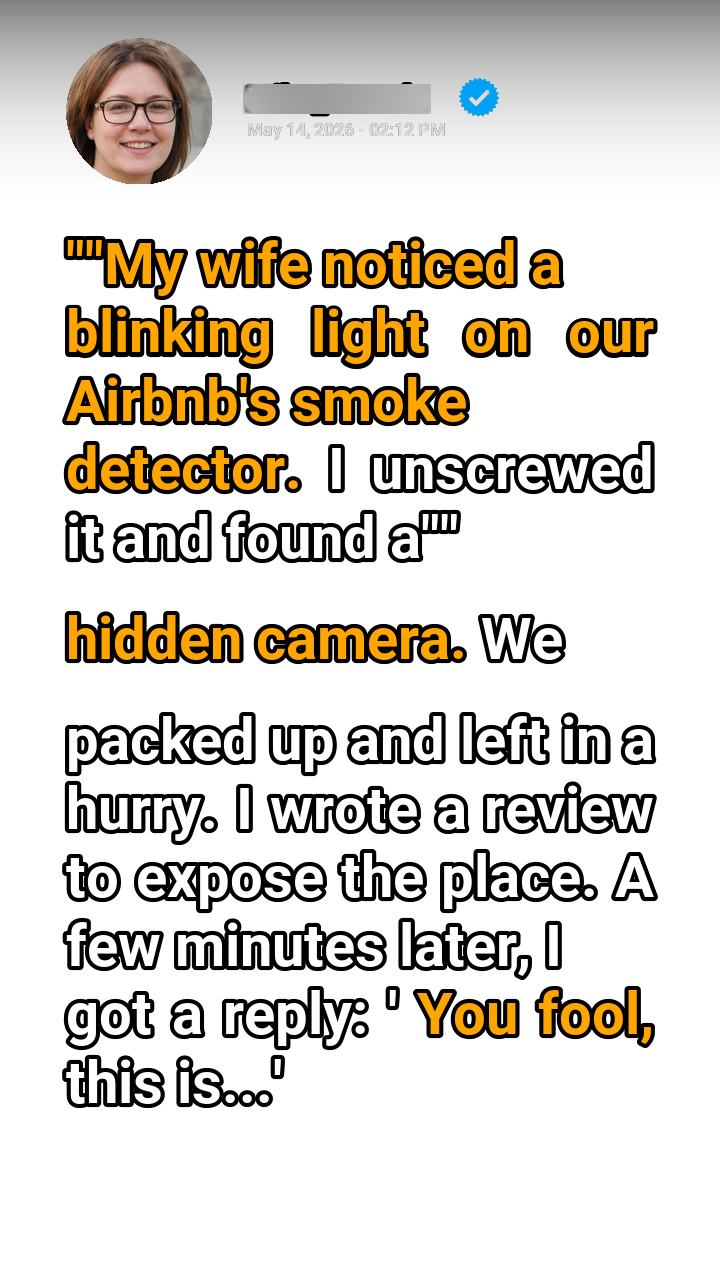
A few minutes later, as Sarah was trying to calm her racing heart with a lukewarm latte, Mark’s phone buzzed in his hand, a sharp, insistent vibration against his palm. His heart leaped. An immediate reply? That was unusual. He expected a standard automated message from Airbnb, perhaps an acknowledgement that his review was being processed, or a boilerplate apology from a customer service representative. He certainly didn’t expect a direct response, and so quickly. His thumb hovered over the notification, a knot tightening in his stomach. A new message. From “The Lakeside Haven” host. His breath hitched. He exchanged a quick, apprehensive glance with Sarah, whose eyes were wide with a mixture of curiosity and renewed dread. He tapped the screen, opening the message. The words seared themselves into his mind, stark and chilling against the white background of the screen. It wasn’t an apology. It wasn’t a denial. It was a cold, cutting retort, arriving with the speed and precision of a predator. He read it aloud, his voice barely a whisper, the blood draining from his face as the full, terrifying implication began to dawn on him. “You fool, this is…
“…**You fool, this is *our screening process. And you’ve just failed.***”
The words hung in the air, a venomous whisper that seemed to echo in the fluorescent-lit gas station. Mark’s blood ran cold, turning the earlier dread into a profound, bone-chilling terror. Sarah gasped, her lukewarm latte forgotten as it slipped from her trembling fingers, splashing unnoticed onto the floor mat. “Screening process?” she choked out, her voice thin and reedy. “What does that even mean? What are they *screening* for?” The question hung heavy, unanswered, twisting into a grotesque knot in their stomachs. This wasn’t just a pervert with a hidden camera; this was something far more organized, far more insidious. The cabin, the ‘tranquility’, the ‘unforgettable peace’ – it was all a meticulously crafted lure, a stage for a dark, unseen purpose.
Panic, raw and unbridled, seized them. The bright lights of the gas station, moments ago a beacon of safety, now felt like an exposed stage. Every mundane detail – the chirping of the credit card machine, the hum of the slushie machine, the casual glance from the attendant behind the counter – became charged with sinister meaning. Were they being watched *now*? Was this gas station part of the “process”? Mark’s eyes darted around, searching frantically for another hidden lens, another pulsing red light, his heart hammering against his ribs. The camera in his pocket suddenly felt like a ticking time bomb, evidence not of a crime committed against them, but of their own unwitting participation in something unspeakably vile.
“This isn’t just about privacy, Sarah,” Mark whispered, his voice hoarse, the implications of the message slowly, horrifyingly, solidifying in his mind. “They weren’t just watching us. They were *evaluating* us. Our reactions, our intimacy, our very vulnerabilities. They wanted to see how we’d behave, how we’d react to discovery.” He remembered his initial irritation at the stuck smoke detector, his methodical approach to unscrewing it. Was that a test? Was their hasty retreat, their decision to leave a review, the “failure”? The thought was paralyzing. What happened to the ones who *passed*? Or, more terrifyingly, what happened to the ones who *failed*?
Just as Mark’s mind reeled, his phone buzzed again. Another message, this time not a reply, but a new notification. A public comment had been added to his freshly submitted Airbnb review. He froze, dreading what he would see. With a hand that shook violently, he tapped it open. The comment was from a different user, an anonymous account with no profile picture, but the message was unmistakably from their tormentor. It read: “Enjoy the drive, Mark. And remember, the best candidates are always the ones who think they’ve escaped.” Below it, a single, chilling emoji: a winking face.
The air in the car thickened, suffocating them both. They weren’t just being watched; they were being *tracked*. Their escape was an illusion. The gas station attendant, the cars passing on the highway, every single person felt like a potential accomplice. Mark slammed the car into drive, peeling out of the gas station with a screech of tires, ignoring the blare of a horn from a truck pulling in. He called 911, his voice strained, trying to explain the hidden camera, the terrifying messages, the feeling of being hunted. But the dispatcher, while sympathetic, couldn’t act on vague threats and a discarded camera. “Sir, we need a specific location for the perpetrators, or a clear threat of immediate harm.” They were told to file a police report in the morning.
They drove through the rest of the night, the world outside their car a blur of menacing shadows. They didn’t go home. Instead, they checked into a nondescript motel miles away, paying in cash, using fake names. Sleep was impossible. Every shadow danced with unseen eyes, every creak of the building sounded like approaching footsteps. The camera, now wrapped in a plastic bag, lay on the bedside table like a malevolent trophy. It was no longer just an object of their violation; it was a symbol of their new reality. They were marked.
The next few weeks were a blur of paranoia. They filed police reports, contacted Airbnb, but the trail was cold. The ‘Lakeside Haven’ listing was gone, wiped clean from the internet as if it had never existed. The host’s account vanished. The police found no leads, no other similar incidents reported from that address. Mark and Sarah returned to their lives, but it was a hollow imitation. Every stranger felt like a potential observer, every flicker of light a hidden lens. They knew, with a certainty that chilled them to their bones, that they were still part of “the process.” They had failed the screening, but that didn’t mean the game was over. It simply meant their role had changed. They were no longer candidates; they were the hunted, forever looking over their shoulders, wondering when, and how, “the next one” would begin.