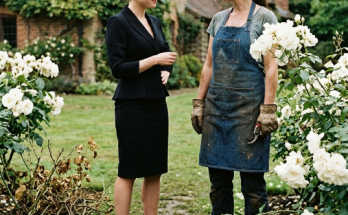
The sky wept as relentlessly as Mara’s heart, a ceaseless deluge mirroring the torrent of grief that had consumed her since Elias, her beloved husband, was lowered into the sodden earth just yesterday. The scent of damp soil and lilies still clung to her clothes, a morbid perfume that would forever mark this brutal chapter of her life. Six small figures huddled behind her, their faces pale and streaked with rainwater and the residue of endless tears. Her eldest, twelve-year-old Lily, clutched a worn teddy bear and a plastic bag filled with their meager belongings, her eyes wide with a fear that Mara recognized all too well – the primal terror of homelessness. The younger ones, from eight-year-old twins Leo and Lena down to four-year-old baby Finn, whimpered softly, their small hands instinctively seeking Mara’s skirt, their tiny bodies shivering not just from the cold, but from an unspoken dread that permeated the very air around them. The gravestone, a stark sentinel of polished granite, still glistened with fresh moisture, a cruel reminder of how little time had passed since Elias’s life, and their world, had been irrevocably shattered.
But the elements were not the only adversaries Mara faced on this bleak morning. Standing on the porch of the only home her children had ever known, a grand Victorian house that had been Elias’s family legacy for generations, was her father-in-law, Arthur Thorne. His formidable frame was shrouded in a bespoke black suit, his silver hair slicked back, and his sharp, hawkish eyes, usually reserved for boardrooms and legal documents, were fixed on Mara with an icy contempt that pierced deeper than any rain. Beside him, his sister, Beatrice, a woman whose smile had always felt like a thinly veiled sneer, stood with her arms crossed, a look of grim satisfaction etched upon her angular face. They were not here to offer comfort, nor to mourn. They were here to execute a judgment, to solidify their claim on a future they believed was rightfully theirs.
“Your husband is dead,” Arthur’s voice boomed, cutting through the drumming rain like a sharpened blade. It wasn’t a statement of sympathy, but a declaration of fact, delivered with a chilling finality that left no room for debate. He gestured dismissively towards the open gate, his finger a rigid, accusing spear. “This house belongs to blood, Mara. Thorne blood. And you, my dear, are no longer a Thorne. You are merely a widowed inconvenience.” The words were designed to shatter, to strip away her dignity, her identity, and her last shreds of hope. Mara felt a tremor run through her, a familiar ache of grief mixing with a fresh surge of indignation. She had loved Elias with every fiber of her being, borne him six beautiful children, and nurtured this home with devotion. To be cast aside so casually, so cruelly, before the earth had even settled on his coffin, felt like a desecration of everything they had built together.
Her mind raced, a frantic scramble for arguments, for pleas, for anything that could halt this unfolding catastrophe. “Arthur, please,” she began, her voice hoarse from crying, “Where will we go? We have nowhere else. The children… they’ve just lost their father. They need their home, their stability.” She gestured towards the terrified huddle of her offspring, hoping to appeal to some sliver of humanity that might reside within his granite heart. But Arthur’s expression remained impassive, his eyes betraying no flicker of empathy. Beatrice merely sniffed, adjusting the silk scarf around her neck as if Mara’s words were an unpleasant odor.
“That is no longer our concern,” Arthur replied, his voice devoid of warmth. “Elias made no provisions for you or your brood in his will. A glaring oversight, perhaps, but a legal reality nonetheless. The estate, and this property, revert to the direct male lineage. You are a guest no more.” The implication was clear: Elias had left her nothing, a fact that had wounded Mara deeply when the will was read, leaving her utterly bewildered. She had trusted him implicitly, believed in their partnership, their shared future. Now, it seemed, that trust had been tragically misplaced. The children, sensing the escalating tension, began to cry more openly, their small, heartbroken wails cutting through the rain. Finn, her baby, buried his face into her shoulder, his little body shaking uncontrollably.
“Out!” Arthur commanded, his patience clearly exhausted. “Now. Before I call the sheriff and have you forcibly removed. Your belongings are already on the lawn.” Indeed, a small pile of boxes and bags, hastily packed and poorly protected from the rain, lay by the curb, a pathetic testament to their sudden displacement. The children looked at the sodden pile, then back at their father’s grave, then at the house, their faces a canvas of confusion and despair. Lily, her small voice trembling, whispered, “Mama, what about our toys? My books?” Mara tightened her embrace around Finn, her heart aching with a pain so profound it threatened to suffocate her. This was it. They were truly being thrown out, reduced to vagrants on the very street they called home.
Arthur stepped forward, his shadow falling over them, an oppressive weight. He pointed a finger, thick and unyielding, at the heavy oak door of the house they were being expelled from. “This house belongs to blood,” he repeated, his voice laced with a final, cutting triumph. Mara looked at her children, their tear-stained faces reflecting the cruel reality of their situation. A fierce, protective fire ignited deep within her, burning away the last vestiges of her despair. Elias may have left her in a precarious position, but he had also left her something else. A flicker of memory, a hushed conversation, a knowing glance. And a document she had almost forgotten. She held her crying baby tighter, her eyes, though red-rimmed and exhausted, now held a glint of steel.
She looked up at Arthur, her gaze unwavering, and in a voice barely above a whisper, yet carrying the weight of an unyielding resolve, she uttered the words she had rehearsed silently a hundred times since finding the truth: “**Then you should have checked whose name is on the deed.**” The rain continued to fall, but for a moment, the world seemed to hold its breath. Arthur’s face, usually so composed, contorted in a mask of shock, then disbelief, then a sudden, dawning horror. Beatrice gasped, her hand flying to her mouth. They had thought her broken, powerless, a widow easily discarded. They thought she had lost everything, but in truth, Mara had just uncovered her husband’s final, brilliant secret, and the implications of those few whispered words were about to shatter the very foundation of the Thorne family’s meticulously constructed empire.
The air crackled with a tension that momentarily overshadowed the drumming rain. Arthur Thorne’s face, a mask of aristocratic disdain moments before, now crumpled into a grotesque tableau of shock and burgeoning fury. His jaw hung slack, his eyes, usually so calculating, darted frantically between Mara and the stately house behind them, as if trying to reconcile her defiant whisper with the immutable reality he believed in. Beatrice, her hand still clamped over her mouth, let out a strangled sound, a mix of disbelief and dawning horror, her carefully composed features dissolving into a contorted grimace. The children, sensing the sudden shift in the adult dynamics, quieted their whimpers, their wide, tear-filled eyes fixed on their mother, then on their grandfather, their small hearts pounding with an unspoken question.
“What… what are you talking about?” Arthur finally sputtered, his voice devoid of its earlier booming authority, now thin and reedy with confusion. “That’s absurd! This house has been in the Thorne name for a century! Elias would never…” He trailed off, the implication of his own words hanging heavy in the air. Mara met his gaze unflinchingly, the fierce, protective fire in her eyes burning brighter than ever. “Elias knew you, Arthur,” she stated, her voice still quiet, but now laced with a steely resolve that vibrated with power. “He knew what you would do. He knew you would try to cast us out, to erase us from his legacy. And he wouldn’t let that happen.” She tightened her arm around Finn, who had lifted his head, sensing his mother’s newfound strength.
The truth, Elias’s final, brilliant secret, had come to light in the most unexpected way. A week before his accident, Elias had given Mara a small, intricately carved wooden box, telling her it contained “something important, just in case.” Lost in the immediate aftermath of his death, she had only remembered it two days ago, buried deep within a drawer she rarely used. Inside, nestled amongst old love letters and a faded photograph of their wedding day, was a document – a quitclaim deed, dated six months prior, meticulously notarized and filed, transferring ownership of the grand Victorian house from Elias Thorne to Mara Thorne. He had done it quietly, without fanfare, knowing his father’s relentless scrutiny. He had built a fortress for his family, brick by painstaking brick, and then, with foresight born of deep love and a profound understanding of his own lineage, he had ensured that fortress belonged to her, and through her, to their children. He had protected them from beyond the grave.
Arthur’s face flushed a deep, unhealthy red. “A forgery! A manipulation!” he roared, his voice cracking with a desperate rage, the veneer of his composure finally shattering. “You tried to trick him, didn’t you, you scheming little gold-digger! I’ll have my lawyers expose this fraud, Mara! You’ll be lucky if you don’t end up in jail!” He lunged forward, his formidable frame trembling with fury, but Mara merely raised a hand, a small, weary smile touching her lips. “Already checked, Arthur. Every ‘i’ dotted, every ‘t’ crossed. Elias used a solicitor from out of state, a man entirely unconnected to Thorne & Co. And he included a signed, sealed letter of intent, detailing his reasons for ensuring his wife and children would always have a home, safe from the ‘petty greed and cruel machinations’ of his own family.” Her voice was a balm to her children’s ears, a chilling pronouncement of doom to Arthur’s.
The rain began to subside, as if the heavens themselves were pausing to witness the unfolding drama. Arthur stood frozen, his chest heaving, his eyes wide with a dawning, terrible understanding. The implication was clear: Elias had not abandoned her; he had outsmarted them all. Beatrice, her face pale, whispered, “Arthur… the will… if the house wasn’t his to bequeath…” The entire meticulously planned eviction, the calculated cruelty, was built on a foundation of sand. The house, the very symbol of Thorne legacy, was Mara’s. The children, sensing the profound shift in the power dynamic, began to move closer to Mara, their small faces reflecting a glimmer of hope. Lily, her eyes no longer wide with terror, but with a fierce admiration, reached out and squeezed her mother’s hand.
Mara looked around, from the sodden boxes on the curb to the glistening gravestone of her beloved Elias, then back at the grand Victorian house that was now unequivocally hers. A wave of exhaustion washed over her, but it was accompanied by an overwhelming sense of vindication and profound love for the man who had, in his final act, secured their future. “You wanted to throw us out into the rain,” she said, her voice now clear and strong, echoing slightly in the newfound quiet. “You wanted to watch my children shiver without a roof over their heads, just days after burying their father. You wanted to strip me of everything.” She paused, letting her words sink in, watching the realization dawn fully on Arthur’s face – the realization of his complete, utter defeat.
“Well,” Mara continued, her gaze sweeping from Arthur to Beatrice, whose faces were now portraits of humiliation and rage, “it seems Elias had other plans. This house belongs to Mara Thorne. And my children. And we’re not going anywhere.” She turned her back on them, a powerful, defiant figure, and led her children up the porch steps, past the stunned, defeated figures of Arthur and Beatrice, towards the heavy oak door. As she reached for the handle, Lily looked back at her grandfather, who stood frozen, utterly broken. “Grandpa,” she said, her voice small but firm, “you should have checked whose name was on the deed.” The door swung open, revealing the warm, welcoming interior of their home. Mara and her six children stepped inside, leaving Arthur and Beatrice standing alone in the fading rain, their carefully constructed empire crumbling to dust around them, haunted by the ghost of Elias’s silent triumph. The house, once a symbol of their dominance, now stood as a testament to their downfall and Mara’s unwavering strength.