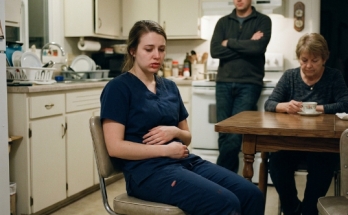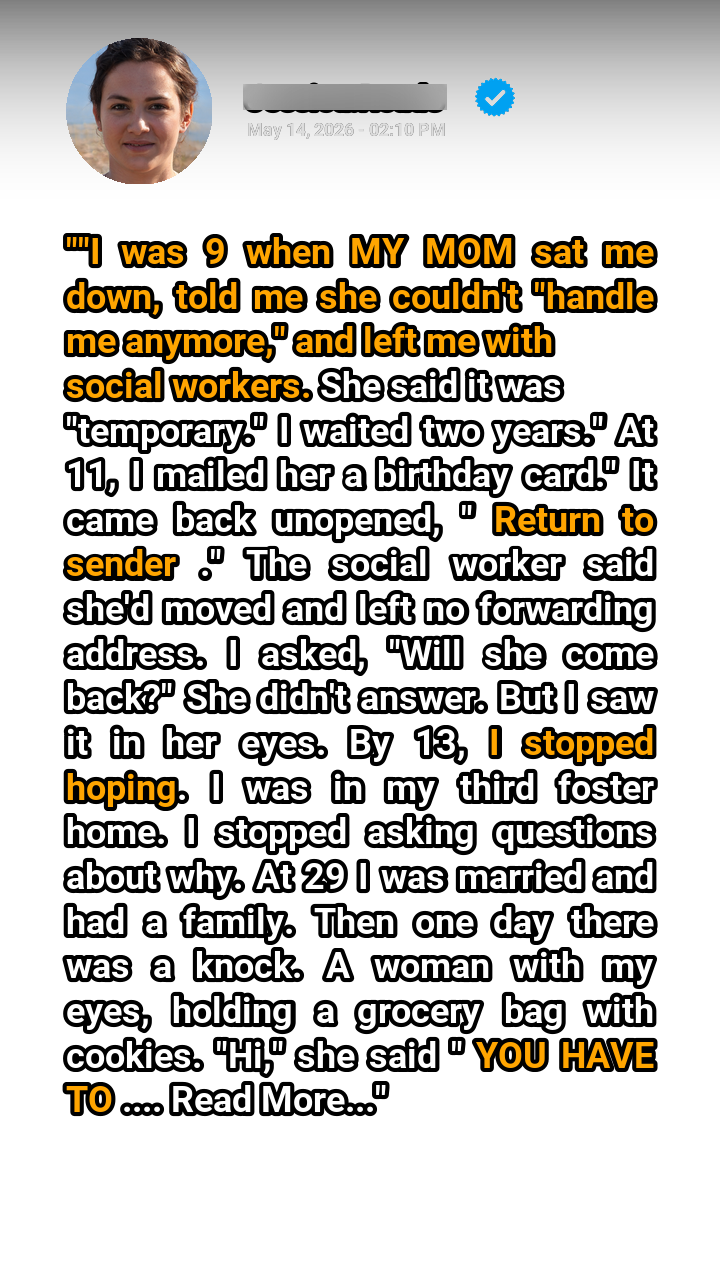
The memory is a splinter, buried deep but still capable of sending a phantom ache through me even decades later. I was nine, perched on the edge of the floral sofa in our living room – a room that always felt too big, too formal for a child like me. The afternoon sun, usually a cheerful splash across the worn carpet, seemed muted, heavy. Mom sat opposite me, her hands clasped tightly in her lap, her eyes, usually so vibrant, clouded with a weariness I was too young to fully comprehend. She didn’t look at me directly. Instead, her gaze drifted to the framed photos on the mantelpiece, then to the dusty grand piano in the corner, everywhere but into my small, questioning face. The words, when they finally came, were delivered in a voice so quiet it barely registered above the frantic thumping of my own heart. “Honey,” she began, a tremor in her tone, “I… I can’t handle you anymore.”
The phrase hung in the air, a cruel, invisible weight. *Couldn’t handle me anymore.* What did that even mean? Was I a toy she’d grown tired of? A chore too cumbersome? My mind, a nine-year-old’s chaotic storm, scrambled for an explanation, for a way to fix whatever I had done wrong. Had I left my toys out? Argued about bedtime? The silence stretched, thick and suffocating, until two strangers, a man and a woman in sensible clothes, entered the room, their smiles practiced, their eyes holding a professional kind of pity. They were social workers, Mom explained, her voice gaining a brittle edge of finality. She said this was “temporary.” Just until she got things sorted. A temporary arrangement. A temporary goodbye. I clung to that word, “temporary,” like a drowning child to a life raft, even as their gentle hands guided me out of the house, away from the only home I had ever known, and into the back of a beige sedan that smelled faintly of stale coffee and disinfectant.
The first foster home was a blur of unfamiliar faces and rules. Mrs. Henderson, a kind woman with flour perpetually dusting her apron, tried her best, but her house felt like a waiting room, not a home. Every morning, I’d wake up with a knot of anticipation in my stomach, convinced that today would be the day Mom came back. Every time the phone rang, every car that slowed outside, I’d hold my breath, my small heart soaring with hope, only to crash back down when it wasn’t her. Two years crawled by, each day a tick-tock of unanswered prayers and silent questions. Two years of adjusting to new schools, new families, new beds, always with the phantom ache of that “temporary” promise echoing in the hollow chambers of my chest. The social workers would visit, their notebooks filled with questions about my well-being, but never with answers about *her*.
When I turned eleven, a wave of desperate longing washed over me. It was her birthday soon, and I decided I would send her a card. It wasn’t just a card; it was a beacon, a message in a bottle, a plea. I spent hours carefully selecting the brightest, most cheerful card from the drug store rack – one with a fluffy, smiling kitten. Inside, I scrawled “Happy Birthday, Mom! I miss you. Love, [My Name]” in my best cursive, my hand trembling with the weight of the unspoken words. I addressed it meticulously, using the old address, the only one I knew, the one I still secretly hoped she was at, waiting for me. Mrs. Henderson helped me put the stamp on, her gaze soft and sympathetic, but she said nothing. I mailed it with a prayer, a fervent belief that this, this simple act, would break the silence, would finally bring her back.
The wait was agonizing. Every day, I checked the mailbox with an almost religious fervor, convinced I’d find a reply, a sign, anything. Weeks turned into a month. Then, one Tuesday afternoon, the familiar brown envelope appeared in the mail pile, addressed to my foster parents. My heart leaped, then plummeted. It wasn’t from her. It *was* her card, the one with the fluffy kitten, but it was pristine, unopened, a stark red stamp slapped across the front: “**Return to sender.**” The words were a physical blow, a cold, hard slap of reality. Mrs. Henderson, seeing the despair in my eyes, called the social worker.
Ms. Davies arrived the next day, her usual professional composure tinged with a visible sadness. She explained, her voice gentle but firm, that my mother had moved. She had left no forwarding address. No way to contact her. My small, fragile world, which had been precariously balanced on the edge of “temporary,” shattered. A single, desperate question escaped my lips, barely a whisper: “Will she come back?” Ms. Davies didn’t answer with words. She didn’t need to. Her eyes, usually so carefully neutral, held a profound, aching pity, a silent confirmation that sliced through the last remnants of my childish hope. In that moment, I saw it, understood it with a clarity that stung worse than any shouted accusation: she wasn’t coming back.
By thirteen, I had stopped hoping. The constant churn of foster homes – the third one now – had dulled the sharp edges of my longing, replacing them with a thick, protective layer of resignation. I learned to adapt, to observe, to become invisible when necessary. I stopped asking questions about why. Why me? Why did she leave? Why didn’t she want me? The answers, I realized, didn’t matter anymore. They wouldn’t change anything. My focus shifted from the past to the present, from longing for a mother who had vanished to building a life for myself, one piece at a time, brick by painful brick. I poured myself into school, into friendships, into anything that offered a semblance of stability and control.
Life, against all odds, found its rhythm. I worked hard, went to college, and eventually, at twenty-nine, I was married. I had a family of my own – a loving husband, two boisterous children who filled our home with laughter and the kind of unconditional love I had always craved. My past was a distant, painful echo, a scar that had long since faded, leaving behind only a faint outline. I had built a fortress of happiness, a life so full and vibrant that there seemed no room for the ghosts of abandonment. I believed I had truly moved on, that the chapter was closed, sealed shut with the balm of contentment.
It was a Tuesday afternoon, years after I’d last thought of her. The kids were at school, and I was in the kitchen, humming along to the radio, kneading dough for homemade bread – a small, domestic ritual that grounded me. Then, there was a knock. Not the polite, familiar tap of a neighbor, but a firm, almost insistent rap that seemed to reverberate through the quiet house. I wiped my floured hands on my apron, a slight frown creasing my brow. Unexpected visitors were rare. I opened the door, a casual smile on my face, ready to greet whoever it was. My breath caught. Standing on my porch, bathed in the same kind of muted afternoon light that had filled our old living room, was a woman. Her hair was streaked with gray, her face lined with an unfamiliar history, but her eyes… her eyes were mine. A mirror image of the deep hazel, flecked with gold, that stared back at me every morning. In her hand, she clutched a brown grocery bag, its contents clearly visible: a plastic container of store-bought cookies. “Hi,” she said, her voice raspy, unfamiliar, yet carrying an ancient, unsettling resonance. Her gaze was intense, desperate, sweeping over me as if searching for something lost, something she urgently needed to reclaim. “YOU HAVE TO…”
“YOU HAVE TO listen to me. Please.” The words tumbled out, ragged and raw, as if she’d been rehearsing them for decades, yet still couldn’t quite get them right. Her hand, clutching the flimsy grocery bag, trembled, making the cellophane-wrapped cookies rustle faintly. My own heart, which had momentarily stalled, now hammered against my ribs, a frantic drumbeat of confusion and a primal, unbidden rage. The woman who stood before me, a ghost from a past I had meticulously buried, was undeniably my mother. Her eyes, those familiar hazel pools, were clouded with a lifetime of something – regret? Desperation? Fear? I didn’t know, but the sight of them, reflecting my own startled gaze, sent a jolt of ice through my veins, quickly followed by a burning heat.
I stood rooted to the spot, the scent of fresh bread from my kitchen suddenly clashing with the faint, unfamiliar perfume clinging to her clothes. My mind raced, flashing through images: the floral sofa, the beige sedan, the “Return to sender” stamp, Ms. Davies’s pitying eyes. All the pain, all the unanswered questions, all the years of carefully constructed peace threatened to unravel in a single, gut-wrenching moment. “Mom?” I whispered, the name feeling alien on my tongue, tasting like dust and betrayal. It was less a question and more an accusation. The cookies, a cheap offering, seemed to mock the homemade warmth of my kitchen, the life I had built without her.
She took a hesitant step forward, her gaze fixed on my face, searching, pleading. “I… I know it’s been a long time,” she began, her voice cracking. “So long. I’ve thought about this day… I’ve thought about you… every single day.” Tears welled in her eyes, tracing paths through the fine lines around them. “I know I don’t deserve… anything. But I had to see you. I had to tell you… I made a mistake. A terrible, unforgivable mistake.” The words poured out, a torrent of belated sorrow, but my heart remained a stone, encased in the fortress I’d built. The image of that unopened birthday card, stamped with “Return to sender,” flashed violently in my mind, a stark counterpoint to her sudden, performative grief.
“A mistake?” The word left my lips, sharp and cutting. “You called it ‘temporary.’ You left me with social workers, a nine-year-old child, because you ‘couldn’t handle me anymore.’ Then you moved, without a forwarding address, and sent my birthday card back unopened.” My voice, though low, vibrated with a fury I hadn’t known I still possessed. “I stopped hoping by the time I was thirteen. Thirteen! I stopped asking why. I built a life, a *good* life, without you. So, forgive me if ‘mistake’ feels a little… inadequate right now.” I gestured around me, at the home filled with love and laughter, at my wedding ring, at the life she had no part in. “This isn’t a temporary arrangement, Mom. This is my life.”
Her shoulders slumped, the small grocery bag listing precariously. “I know,” she choked out, her gaze dropping to the worn welcome mat. “I know you have every right to hate me. I wouldn’t blame you. I… I was sick. Not just with you, with everything. I was so lost, so broken, and I truly believed… I truly believed I was doing what was best for you. That you’d be better off without me, that I was a poison. I was so afraid of ruining you, of passing on… everything that was wrong with me.” She looked up again, her eyes glistening. “The forwarding address… I was in a bad place. I was ashamed. I ran from everyone, even myself. And the card… oh, the card. I saw it. I couldn’t open it. I was so consumed by my own pain and self-loathing, I felt I didn’t deserve to read your words. It was an act of profound cowardice, and it haunts me every single night.”
Her confession hung in the air, thick with the weight of years. Part of me, the nine-year-old still aching for answers, wanted to believe her, wanted to wrap my arms around this broken woman and tell her it was okay. But the twenty-nine-year-old mother, the woman who had painstakingly built a secure, loving home for her own children, knew better. I looked at the store-bought cookies in her hand, then at my own flour-dusted apron, a symbol of the nurture she had denied me. “I don’t hate you,” I said, my voice steady, betraying none of the turmoil within. “Hate takes too much energy. Energy I’ve spent building this.” I gestured again, encompassing my home, my family, my hard-won peace. “I understand that you were sick. I understand you made choices. But those choices had consequences, and those consequences shaped my entire life.”
I took a deep breath, the decision firming in my mind. The knock, the unexpected visitor, the sudden surge of the past – it was a test, a final challenge to the fortress I had built. “You have to understand,” I continued, meeting her gaze, “that I am not that nine-year-old girl anymore. I have a family now, children who depend on me, who deserve a mother who is present, who is whole. And I am that mother. I can’t… I can’t let you disrupt the peace I’ve fought so hard for.” I took another step back, creating a definitive space between us. “I hope you find peace, Mom. I truly do. But my peace, my family’s peace, comes first. And for that to remain, you can’t be a part of it.” I closed the door, gently but firmly, leaving her standing on the porch, the grocery bag with its store-bought cookies a stark, silent witness to a final, irrevocable goodbye. The quiet hum of my kitchen returned, but the scent of bread now mingled with the faint, lingering ghost of a past that, at last, I truly, definitively, laid to rest.