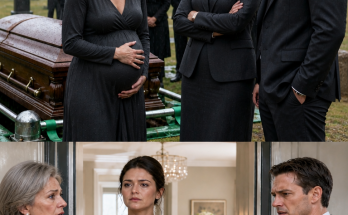
Instead, I found my daughter-in-law on my deck, wearing my apron, with her entire family spread through my rooms as if the house had finally ripened into the inheritance she thought she was owed.
For a few seconds, I just sat in the car and stared.
The ocean was right there beyond the dunes, silver and calm in the late afternoon light, but everything between me and that view looked wrong.
There were six cars in my driveway, two more tilted onto the grass, and a trail of flip-flops and beach toys scattered over the walkway I had lined with shells years ago.
That house had never been just property to me.
I bought it the year after my husband died, when the silence in our regular home had become too large to survive in every day.
The beach house was where I learned to breathe again, where I taught myself how to cook for one, sleep alone, and wake up without reaching for a man who would never answer.
Every chair, every curtain, every flower box on the porch existed because I put it there.
I chose the pale blue paint for the shutters, stitched the seat cushions myself, and planted the geraniums in memory of the ones my husband used to fuss over.
It was the one place in my life that did not ask anything from me.
Then I saw Megan.
She was standing on the back deck in my striped apron, a drink in one hand and my son’s sunglasses on top of her head.
She looked straight at me, turned to the crowd behind her, and said loudly enough for half the street to hear, “Why is that old leech here? There’s no room for her.”
The laughter that followed hit me harder than the insult.
It came from people I did not even know.
Her mother was sprawled in my wicker chair with her shoes off.
Her sister Veronica had her feet on my coffee table.
A man with a cooler tucked under one arm walked straight through my side door.
Someone inside had turned the music up so high the front windows were humming.
Children tore across my lawn as if it were a public park.
One little boy kicked a ball into my flower pots, and dirt burst over the porch steps.
Another child ran past with a sticky red popsicle and left a smear down the railing my husband had varnished by hand.
I got out of the car with my suitcase because standing still felt more humiliating than moving.
“Megan,” I said, and I was almost proud of how level my voice sounded, “this is my home.”
She smiled without warmth.
“Robert said we could stay as long as we wanted.”
“Robert does not own this home.”
She took a slow sip of her drink.
“You barely use it, Eleanor.
And honestly, you showing up like this is going to make everyone uncomfortable.”
Like this.
As though arriving at my own house with a suitcase on a Friday afternoon were some rude social breach.
I looked past her through the open sliding door and saw the damage multiplying by the second.
Wet towels covered my sofa.
Chip crumbs glittered in the rug.
The lamp beside the fireplace had been moved crooked.
From the kitchen came the bitter smell of something burned, and underneath it, the sour scent of beer and sunscreen and too many bodies in a place built for peace.
“Where is Robert?” I asked.
“At work,” Megan said.
Then, because cruelty was easiest for her when she had an audience, she added, “Unlike some people, he has real responsibilities.”
Her teenage niece snorted from the porch swing.
“Why doesn’t she just get a hotel?”
A few adults laughed again.
That was the moment something inside me went still.
Not numb.
Not broken.
Just cold in the way iron goes cold before it becomes useful.
I could have started shouting.
I could have reminded every one of them that my name was the only name on the deed, the insurance, the tax bill, the utilities, and the mortgage papers that had been paid off with years of my own work.
Instead I smiled, a small, tidy smile that made Megan relax because she mistook it for surrender.
“I understand completely, dear,” I said.
Then I put my suitcase back in the car, closed the door, and drove away.
In the mirror, Megan looked triumphant.
She raised her glass as if toasting herself.
She had no idea I was not leaving because I had lost.
I was leaving because I needed one private place to make one very important call.
I parked near a seafood shack three streets over and turned off the engine.
My hands shook so badly I had to lay them flat on the steering wheel for a moment before I reached for my phone.
I called Harold Finch, the attorney who had handled my husband’s estate and every legal document attached to that beach house since the day I bought it.
He answered on the second ring.
“Eleanor?”
“Harold,” I said, “I need you to tell me how quickly unwanted people can be removed from a house when the owner is standing outside and not one of them has permission to be there.”
There was a beat of silence.
“Who is in your house?”
I told him everything, and I do mean everything.
The cars.
The strangers.
Megan in my apron.
Robert giving permission he did not have the right to give.
The insult.
The laughter.
The smell of food burning in my kitchen while I stood in the driveway like an intruder.
When I finished, Harold let out one slow breath.
“Do not go back in alone,” he said.
“Did you give Megan or Robert written permission to use the property?”
“No.”
“Is Robert’s name on the deed?”
“No.”
“Then he had no authority to offer it.”
I closed my eyes and let that sentence settle in me.
He continued, more gently now.
“Eleanor, do you remember the message I left about your estate papers?”
Of course I remembered.
I had been avoiding it for weeks.
After my husband died, I kept meaning to update everything, but grief makes even small decisions feel like betrayals.
Then life kept happening.
Orders at my sewing shop.
Doctor visits.
Bills.
Holidays.
And in the middle of all that, Megan had started asking questions that felt rude but not quite alarming enough to call out.
Was the beach house fully paid
off?
Had I ever thought about putting Robert on the deed to make things easier later?
Wouldn’t it be smart to simplify things while I was still healthy?
At the time, I told myself she was just nosy.
Now, sitting in that parked car with salt air in my throat and humiliation still burning in my chest, I realized she had not been making conversation.
She had been taking measurements.
Of my age.
Of my boundaries.
Of how much she could get away with if she moved quickly enough and smiled while doing it.
“What do I need to do?” I asked.
“Meet me back at the house in forty minutes,” Harold said.
“I’m bringing Deputy Ruiz, a locksmith, and the paperwork we discussed.
You can decide today whether that house remains something your son’s wife can fantasize about owning, or whether you end that fantasy for good.”
I stared through the windshield toward a strip of blue water between two buildings.
For the first time since I had heard Megan call me a leech, I felt my breathing slow.
“Bring the papers,” I said.
When I met Harold in the parking lot behind his office, Deputy Dana Ruiz was already there in uniform, and a locksmith named Colin leaned against a van holding a ring of blank keys.
Harold had a leather folder under his arm and the steady look of a man who had handled family disasters often enough to know better than to dress his words up.
He opened the folder on the hood of my car.
“This is a trust transfer,” he said.
“You keep full lifetime control of the beach house.
No one gets access through Robert.
No one inherits it by assumption.
After you’re gone, it passes to Harbor House, the coastal retreat program we talked about for widows rebuilding after loss.
If you sign it, the property will never become a prize your daughter-in-law can circle like a vulture.”
I looked down at the papers and thought of my husband.
He had loved that house because it made me happy, not because it was valuable.
The idea of it helping women who had to learn what I learned after he died felt cleaner than letting it become the battleground Megan imagined.
“Does Robert know about this?” I asked.
Harold’s eyes softened, but he did not lie for my son’s sake.
“No.
And from what you’ve told me, he has been comfortable letting his wife behave as though your silence was permission.”
That hurt worse than the insult on the porch because it was true.
I laid my palm over the papers.
“Let’s do it.”
Harold uncapped his pen.
“You can sign now, or you can sign when we return to the house.
Legally, either works.”
I thought about Megan standing on my deck in my apron, smiling at strangers while they laughed at me.
I thought about the way she had said there was no room for me, as though age turned a woman into clutter.
“At the house,” I said.
“I want her to see exactly when the fantasy ends.”
By the time we turned onto my street again, the music had gotten louder.
A grill had been dragged onto the side patio, and smoke rolled across the yard.
My front door
stood open wide enough for the screen to bang against the frame in the wind.
Someone had parked so carelessly that one tire sat in the hydrangeas.
I pulled in first.
The patrol car came in behind me.
The locksmith’s van stopped at the curb.
Megan stepped onto the deck when she heard the engines.
Her smile flickered when she saw the uniform, but it came back quickly, thinner this time.
“Eleanor,” she called, as if we were simply resuming a normal conversation, “there’s really no need to be dramatic.”
I got out slowly, smoothing my skirt with hands that no longer trembled.
“You’re right,” I said.
“That’s why I brought people who don’t need drama at all.”
Harold moved to my side.
Deputy Ruiz adjusted her belt and looked up at the deck.
“Who’s in charge here?” she asked.
Megan laughed, too loudly.
“This is a family misunderstanding.”
“No,” I said.
“This is trespassing.”
That one word changed the air.
Several faces appeared behind the sliding door.
Her mother sat up in my wicker chair.
Veronica pulled her feet off the table.
The man with the cigarettes muttered something under his breath and set his beer down.
Megan came halfway down the steps, her sandals slapping hard against the wood.
“Robert said we could be here.”
Harold spoke before I had to.
“Robert is not an owner of this property.
He had no legal authority to grant use or occupancy.
Mrs.
Eleanor Turner has revoked any alleged permission.
Everyone here needs to gather their belongings and leave immediately.”
Megan blinked at him.
“Who are you?”
“Her attorney.”
That took some color out of her face.
Deputy Ruiz kept her tone flat.
“You do not have tenancy here.
You are not paying rent.
You were not invited by the legal owner.
I am instructing you to vacate the property now.
If anyone refuses, I can escalate this from a civil removal to trespass enforcement.
Let’s not do that.”
The words spread through the house faster than smoke.
People started talking over each other.
One of Megan’s brothers asked if this was a joke.
Her mother announced from the porch that decent people did not treat family like criminals.
Veronica cursed because she could not find one of her sandals.
Somewhere inside, a baby began to cry.
Megan turned back to me, and now the sweetness was gone.
“Are you seriously doing this in front of everyone?”
“You did it in front of everyone,” I said.
“Remember?”
For a second, anger burned so bright in her eyes that I could almost see the version of her she usually kept tucked behind fake politeness.
“You’re vindictive,” she hissed.
“It’s a stupid house that sits empty half the year.”
“It is not empty,” I said.
“It is mine.”
Just then another car pulled up so fast gravel sprayed.
Robert got out in his office clothes, tie loose, face drained white.
He looked from the patrol car to the locksmith to me, and then to Megan standing barefoot in my doorway.
“Mom?” he said.
“What is going on?”
I turned to him and asked the only question that mattered.
“Did you give your wife the key to my beach house?”
His mouth opened, then shut.
That alone was answer enough, but after a moment
he said, “I thought it was just for the weekend.”
“Without asking me?”
He rubbed a hand over his face.
“Megan said you weren’t coming down.
She said you almost never used it and that it would keep the kids busy.
I thought…
I thought it would be fine.”
“There are fourteen people here,” I said.
He looked past me at the yard and visibly flinched, as though he were only now seeing the full scope of it.
“I didn’t know all of them were coming.”
Megan snapped her head toward him.
“Don’t start acting innocent.
You told me yourself your mother can’t manage two houses forever.”
Robert stared at her.
“That is not what I said.”
“You said she’d have to make arrangements sooner or later,” Megan shot back.
Her voice climbed with panic.
“You said this place would be ours eventually anyway.”
The porch fell quiet enough to hear the ocean.
That was the sentence.
The one that peeled the skin off the whole lie.
Not a misunderstanding.
Not a crowded weekend.
Not careless entitlement in the moment.
A plan.
A future she had already moved into in her mind, one where I was either absent, dead, or small enough to be pushed out of my own doorway without consequence.
Robert looked sick.
“Megan…”
She realized too late what she had revealed and tried to redirect her fury at me.
“Oh, come on.
Everyone knows that’s what happens.
Parents get older.
Houses pass down.
You don’t need all this space.”
I took one step closer to her.
“My husband and I paid for that house with our own labor.
I bought it after I buried him.
I grieved in that kitchen, planted those flowers, and learned how to keep living on that porch.
You do not get to stand in my apron and tell me what I need.”
Harold quietly opened his folder.
I held out my hand, and he passed me the pen.
Megan frowned.
“What is that?”
“The end of your assumption,” I said.
I laid the papers flat on the hood of my car.
The salt wind lifted one corner.
Harold steadied it with his hand while I read the lines I had already decided on in the parking lot: full lifetime control retained by me; no beneficiary interest through Robert; transfer after my death to Harbor House, a retreat for women rebuilding after loss.
Clean.
Clear.
Final.
Then I signed.
My name looked sharp and steady across the page.
Harold signed as witness.
Deputy Ruiz signed where required.
Harold slid the papers back into the folder and looked directly at Megan.
“As of today, this property is placed in Mrs.
Turner’s trust under terms that do not pass ownership through her son.
There will be no future claim for you to rely on.
None.”
Megan actually laughed, but it came out broken.
“You can’t do that because you’re mad.”
“I just did,” I said.
Her mother rose from the wicker chair and came to the top of the steps, outraged.
“You’d cut out your own son over one little disagreement?”
I looked at Robert, then back at her.
“A disagreement is about where to eat dinner.
This was a woman trying to erase me from my own home while people laughed.”
Deputy Ruiz glanced
at her watch.
“You all need to start moving.
Now.”
What followed was loud, ugly, and entirely ordinary in the way consequences often are.
Coolers were slammed shut.
Wet swimsuits were yanked off my chairs.
Veronica hunted for her phone charger under the sofa cushions.
One of the men complained that the burger meat had not finished cooking.
The teenage niece who suggested I get a hotel would not meet my eyes when she carried out an armful of beach towels.
Megan stood frozen for nearly a minute, still wearing my apron, as if refusing to move might reverse what had happened.
Then Colin the locksmith walked past her carrying a new deadbolt set and asked, almost politely, whether she wanted to remove any personal items from the front hall before he changed the locks.
That broke something in her.
“This is insane,” she said.
“You’re humiliating us.”
I held out my hand toward the apron strings tied around her waist.
“Take that off.”
Her face flushed deep red.
For a heartbeat I thought she might refuse, just to force one more ugly scene.
Instead she jerked at the knot, yanked the apron free, and slapped it against the porch railing.
I picked it up, folded it once, and laid it over my arm.
Robert stepped closer then, quieter than he had been all afternoon.
“Mom, I’m sorry.” His voice cracked on the last word.
“I should have asked.
I should have stopped this the second I found out.”
“You should have known better before it started,” I said.
He nodded because there was nothing else he could do.
I took the spare key from his hand when he offered it.
That small piece of metal felt heavier than it had any right to.
“If you want a relationship with me after today,” I told him, “you come back as my son.
Not as a messenger for your wife.
Not as a man counting rooms in a house that isn’t his.
My door is not inheritance.
Do you understand?”
He swallowed hard.
“Yes.”
Megan called his name from the driveway, furious that he was standing there apologizing instead of rescuing her.
He turned toward her, then back to me, trapped between the woman he married and the mother he had failed.
I did not make the choice easier for him.
Some lessons only hold when they hurt.
Within twenty minutes the house emptied.
Colin changed the locks while Deputy Ruiz remained on site.
He handed me three new keys on a plain brass ring.
The click of the new deadbolt settling into place sounded almost holy.
When the last car finally pulled out, a silence fell so sudden it rang in my ears.
Then I stepped inside.
The living room looked like grief after a parade.
Sand ground into the rug.
Grease on the coffee table.
Sticky rings on the sideboard.
My throw blanket half outside, dragged toward the porch.
In the kitchen, a pan of blackened shrimp sat fused to the stove.
My favorite chipped mug was still on the shelf, untouched, and the sight of it nearly undid me.
Harold came in behind me and set his folder on the counter.
“You don’t have to clean this tonight,” he said.
“I know,” I answered, though I started picking
up plates anyway because sometimes moving your hands is the only way to keep your heart from bursting.
Deputy Ruiz gave me her card before she left.
Colin tested the new key one last time and told me to call if I wanted the side gate rekeyed too.
Then it was just me, the ruined calm of the house, and the sound of waves continuing out beyond the dunes as if none of it had happened.
I opened the windows.
I threw away the burned food.
I shook sand out of the cushions and set my apron back on its hook.
Then I boiled water, took down my chipped blue mug, and made tea.
By the time the sun started dropping orange over the water, I was sitting on my porch in clean silence, both hands wrapped around that warm cup.
The geraniums were bent, the railing needed scrubbing, and one cushion would never be the same.
But the house was mine again in the truest sense, because that afternoon I had stopped treating peace like something I had to politely defend from people determined to consume it.
Robert called three times that night.
I let it ring.
He called again two days later and left a message with no excuses in it.
Just the truth.
He said he had known Megan was getting too comfortable talking about the house.
He said he had laughed things off because confronting her was harder than avoiding the problem.
He said he had betrayed me long before he handed over the key, because he had watched entitlement grow in his own home and called it harmless.
That was the first honest thing he had done in weeks.
A month later, he came to see me alone.
He brought new geraniums and stood awkwardly in the yard until I opened the gate.
He did not ask to come inside.
He did not mention the trust.
He did not once say the word property.
He only said, “I want to help fix what I damaged, even if you never trust me the same way again.”
So I handed him a trowel.
We replanted in near silence.
Dirt under the nails.
Salt in the air.
The kind of silence that doesn’t pretend everything is healed, only that truth has finally arrived.
When we finished, we sat on the porch steps.
He looked out at the water the same way his father used to, and for a moment I saw the boy I had raised before convenience and cowardice taught him bad habits.
“Are you really giving the house away after…
after you’re gone?” he asked.
“I’m giving it where it will be respected,” I said.
“There’s a difference.”
He lowered his eyes.
“I deserved that.”
“This was never about deserving, Robert.
It was about boundaries.
People who love you should not have to lose access before they understand where the line is.”
He nodded, and I believe he understood me at last, not because I had shouted, but because I had acted.
Megan never came back.
She sent one long message through Robert accusing me of humiliating her in front of her family and turning a simple weekend into a public spectacle.
I did not answer.
A woman who can stand on another woman’s deck in
borrowed cloth and call her a leech has already explained herself fully.
Now, when I drive down to the beach house, I still carry my suitcase, my tea, and that same chipped mug.
The porch is quieter than ever.
The flower boxes bloom again.
And every time I slide my key into the new lock, I remember the exact weight of the old one in Robert’s hand and the exact moment I took it back.
Some people in the family still say I was too harsh.
They say cutting off an inheritance over one humiliating afternoon was extreme.
Maybe they believe mothers should absorb every insult and call it love as long as it comes wrapped in family language.
I don’t agree.
Because the cruelest thing that happened that day was not the laughter, or the mess, or even being called an old leech in my own driveway.
It was the assumption beneath it all.
The belief that a widow’s peace was available for takeover the moment someone younger wanted the view.