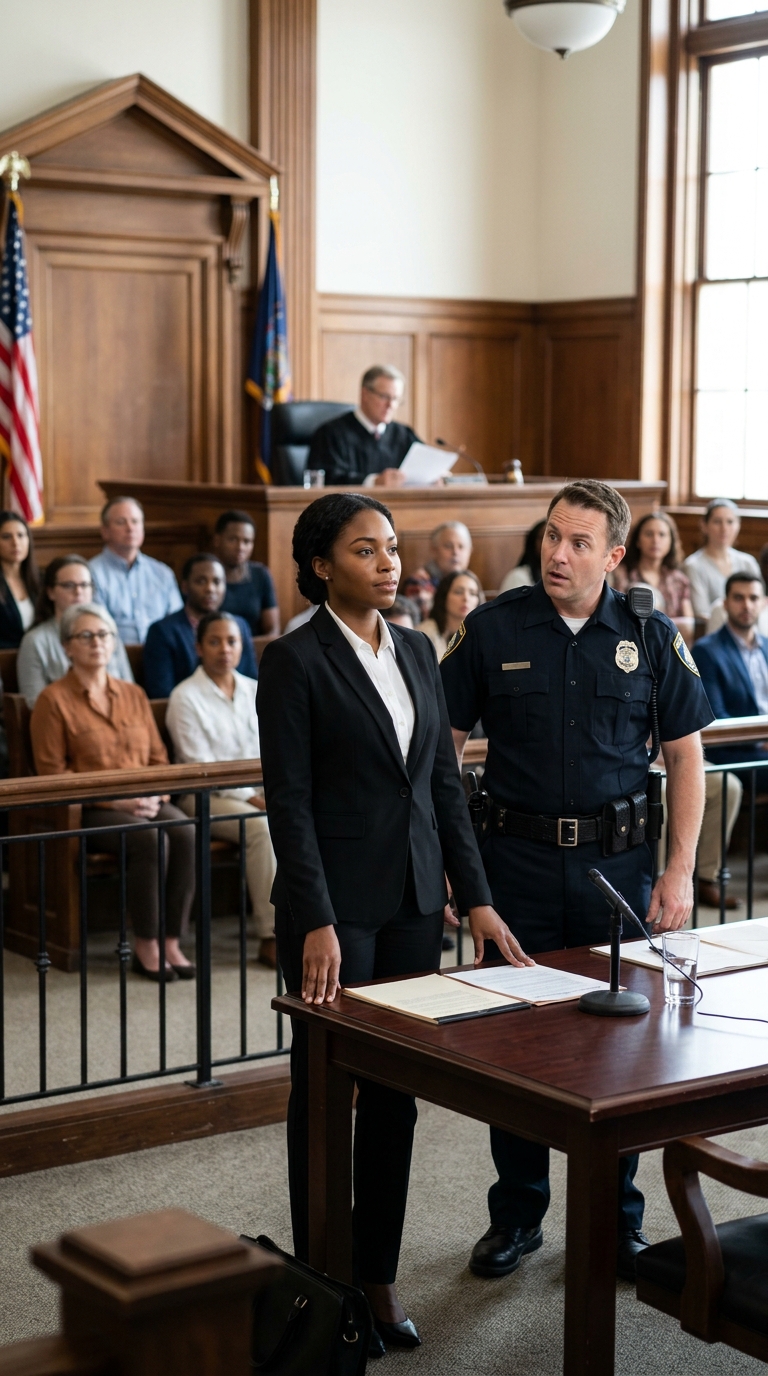
“Officer Kilroy, did you know my client is a high school math teacher at Booker Middle?”
His head jerked back slightly. “No, you didn’t ask.”
“No.”
“Did you ask him where he was coming from or going to?”
“No. Didn’t seem relevant.”
Zariah let that linger for a moment. “So, to be clear, the stop, the search, and the citation were all based on a rolling stop you couldn’t clearly see, a bag you didn’t identify, and a twitch you assumed meant he was hiding something.”
“All without asking him a single question about where he was coming from or who he was.”
Kilroy shifted. “That’s not exactly—”
“But it is,” she cut in, calm but firm. “You saw a young black man in a hoodie driving a used Camry and decided the story for him.”
He said nothing.
“You didn’t ask. You didn’t wonder. You didn’t think. Maybe this guy had a long day teaching sixth graders how to convert fractions.”
“You thought he fits the type. And that was all you needed.”
She turned to the judge again. “I’m not asking for pity. I’m asking for truth. This case isn’t about a stop sign. It’s about assumptions. Lazy ones. Harmful ones.”
The judge didn’t respond. He didn’t need to.
Zariah stood at last and addressed the gallery.
“Every inch of this courtroom runs on rules, legal procedure, evidence, discipline. So how is it that a man in uniform can toss all of that aside because of a feeling—and expect the rest of us not to notice?”
No one spoke.
She turned to Officer Kilroy one final time. “You’ve been doing this job for 23 years, but what concerns me most is how confident you were that no one would question the way you wrote that report… how certain you were that no one would hold you to your own department’s standards.”
The judge cleared his throat. “Miss Benton, you’ve made your point.”
She gave a brief nod. “No further questions, your honor.”
Kilroy stared straight ahead. His hands gripped the edge of the stand now. There was no smirk, no quiet laugh—just silence.
Zariah returned to her seat.
Her co-counsel leaned in and whispered, “That was lethal.”
She didn’t smile. “It was overdue.”
Behind them, someone in the gallery let out a low whistle.
The prosecutor asked to redirect, but only managed a few questions before the judge waved it off. “Move to closing arguments,” Judge Lennox said.
His tone was flat, but his eyes revealed everything.
By then, the energy in the room had already shifted. Everyone knew Zariah hadn’t just dismantled a case—she had exposed a system, quietly, precisely, completely.
Closing arguments were supposed to carry the drama. But the real impact had already landed—not with speeches, not with outrage, but with evidence.
Her closing wasn’t about spectacle. It was about clarity.
She stood slowly, took a sip of water, and looked directly at the jury.
“When you watched that body cam footage,” she said, “you didn’t see a threat. You saw a teacher driving home. You saw a man cooperate. You saw no search warrant, no probable cause.”
“You saw words that were meant to sound professional—but fell apart under pressure.”
She let that settle.
“Now, let’s talk about what you didn’t see,” she continued. “You didn’t see a man resisting. You didn’t see a traffic violation. You didn’t see any sign of criminal behavior.”
“All you saw—and all Officer Kilroy needed—was a feeling.”
Zariah paused, then stepped closer to the jury box.
“Feelings aren’t evidence.”
She glanced at Kilroy, then back at the jury.
“Feelings don’t give you permission to rewrite facts. They don’t justify skipping questions, skipping protocol, or skipping basic respect.”
She turned briefly toward the judge, then to the gallery.
“My client was profiled, humiliated, and cited because someone didn’t bother to ask who he was before deciding what he was.”
Another pause.
“And the most troubling part is this—if we weren’t here today, if we didn’t have footage, policy, records, and this platform, none of this would matter.”
“It would just be another closed file—with a fine and no explanation.”
She walked back to her table.
“This case isn’t about winning. It’s about telling the truth—and making sure someone finally listens.”
She sat down.
The prosecutor followed. His closing was brief, dry. Nothing landed. His words faded before they reached the jury.
Zariah didn’t even look at him.
Her client, Mr. Deon Riyals, turned to her and whispered, “You think we’ve got a shot?”
Zariah met his eyes. “They heard you,” she said. “That’s more than most people get.”
The jury didn’t take long.
Seventy minutes after deliberation began, they returned.
The foreperson stood. “We find the defendant not guilty of all charges.”
A wave moved through the room. Some gasped. Others sat in stunned silence.
Kilroy didn’t move. He stared forward, as if the moment hadn’t fully registered.
The judge spoke again. “Charges are dismissed. Court is adjourned.”
Zariah shook Deon’s hand, then rested a hand on his shoulder. He stood there blinking.
“Thank you,” he said, his voice breaking. “I thought this was going to bury me.”
Zariah smiled for the first time that day. “You’re standing. That means they lost.”
She packed her binder slowly. No rush, no celebration—just a quiet breath.
People were already whispering as she walked down the aisle—about her age, her delivery, her composure.
No one was laughing anymore. Not even Kilroy.
He stood at the back of the courtroom, hands on his hips, watching her leave, unsure whether to feel anger or relief.
Zariah pushed open the heavy courtroom doors and stepped into the sunlight.
Outside, a small group of local reporters waited. One stepped forward.
“Miss Benton, Zariah, how does it feel to win a case like this at your age?”
She didn’t pause.
“I’m not here to feel good,” she said. “I’m here to make things right.”
The reporter stumbled, searching for another question. Zariah kept walking.
What she didn’t know yet was that a clip of her closing argument had already reached social media—and by sunset, the entire country would know her name.
By 6:42 p.m., the clip had passed 280,000 views on Twitter.
Someone in the gallery had recorded her closing. The caption read:
“She’s 19. He’s been a cop for 23 years. Guess who came prepared?”
Replies flooded in.
“I’ve never seen someone dismantle a case like that without raising their voice.”
“This is what real courtroom power looks like.”
“Who is she? We need her running for DA in 10 years.”
At a café two blocks from the courthouse, Zariah sat across from Deon Riyals, who still hadn’t touched his coffee.
His hands were shaking—not from fear, but from the adrenaline.
“I thought they were going to find some way to spin it,” he said. “I’ve never seen anyone handle cops like that. Not even older lawyers.”
Zariah stirred her tea slowly. “It’s not about handling them. It’s about cornering them with their own words.”
Deon let out a laugh, more relief than humor. “You’ve done this before.”
“Only twice in person,” she said. “The rest were pro bono consults. Zoom stuff.”
He blinked. “That’s crazy.”
She shrugged. “I read fast.”
Her phone buzzed again—more notifications. Her name was now trending in Texas.
Someone had posted a side-by-side clip comparing her to the prosecutor. One sounded like a robot. The other like a razor blade.
She silenced her phone.
“I don’t care about going viral,” she said quietly. “I care about what happens next.”
Deon leaned back. “What does happen next?”
Zariah met his gaze. “Nothing. And that’s the problem. That officer goes back to work. The department calls it a misunderstanding. People move on—until the next one.”
Deon nodded slowly. “So why keep doing it?”
Zariah leaned forward. “Because every time I win one of these, it gets harder for the next cop to lie—and easier for the next person to fight back.”
Outside, more cameras were gathering. The courthouse press team had already requested a statement.
She declined.
She had nothing more to say—at least not to them.
That night, her inbox filled with requests—podcasts, interviews, speaking invitations.
She didn’t respond right away.
She didn’t want fame.
She wanted people to do their jobs right—and stop expecting her to fix what they kept breaking.
Across town, Officer Kilroy sat alone at a bar, watching a clip of himself on someone else’s phone.
“Didn’t she burn you up in court today?” the bartender asked with a half-laugh.
Kilroy didn’t answer. He finished his drink and left a tip.
The next morning, the Plano Police Department issued a statement:
“We take all public concerns seriously and will be conducting a formal review of the incident involving Officer Kilroy. We remain committed to community accountability and professional conduct.”
Zariah read it on her phone and shook her head. “Cut and paste.”
Her mom peeked into her room. “You good?”
Zariah smiled. “Yeah. Just thinking.”
“You’re all over the news,” her mom said, a mix of pride and concern. “I saw your clip on Facebook. Even Aunt Relle’s group chat is going wild.”
Zariah let out a small laugh. “It’s a weird day.”
Her mom leaned against the doorframe. “You want dinner?”
“Maybe later.”
Alone again, Zariah opened her binder and turned to a blank page.
She wrote at the top: “Future cases — What we missed today.”
But the truth was, even as she tried to move forward, something had shifted.
Not just in that courtroom—but in how people saw her.
Monday morning came quickly.
The courthouse buzzed—not with drama, but with attention. People wanted to see her—the girl in the oversized blazer and sneakers who dismantled a 23-year cop like she’d done it a hundred times.
But Zariah wasn’t there.
She was back in her apartment near the University of Texas at Dallas, sitting on her small gray couch, eating cereal from a mug, flipping through her handwritten notes.
No music, no television—just the quiet rhythm of her spoon tapping against the ceramic. Her phone buzzed again. Another message.
“Saw the vid. That was fire. I owe you one.”
It came from a man she had helped two months earlier—wrongfully arrested for “fitting the description.” His case never reached trial, but Zariah had torn through the report and had it dismissed in less than a week.
She never asked for gratitude—only the facts.
Her inbox now held 187 unread messages. Some from reporters, some from potential clients, others from high school girls saying she had given them hope.
She opened one.
It was from a mother in Amarillo.
“My daughter wants to go to law school now. She watched your closing five times. She said, ‘I didn’t know we were allowed to talk like that in court.’ Thank you.”
Zariah closed the email and sat quietly for a moment.
It wasn’t about praise. It never had been.
But she recognized the feeling—watching someone who looks like you do something you were told was never meant for you.
She picked up her phone and finally responded to a reporter who had asked how it felt to win.
She typed:
“It doesn’t feel like a win until the system stops giving officers like Kilroy the benefit of the doubt—and starts giving people like Devon the benefit of the truth.”
Then she hit send.
Across town, at department headquarters, Officer Kilroy’s body cam footage was under formal review. It wasn’t just about one case anymore. It was his language, his patterns, his record.
All the details he thought no one would ever notice were now being examined—line by line.
By Friday, he was placed on administrative leave.
No press conference. No applause. Just a quiet removal.
Meanwhile, Zariah stood in a classroom filled with high school juniors at a youth legal program in Arlington, leading a workshop titled What They Can’t Teach You in Law School.
She wore a T-shirt, jeans, and a pair of clean white sneakers.
“You’re going to walk into rooms where people think you don’t belong,” she told them. “Don’t waste time proving them wrong. Prove yourself right.”
One student raised her hand. “How do you stay calm when they laugh at you?”
Zariah smiled.
“Because they laugh when they feel safe. I don’t give them that.”
The room fell silent.
Then a boy muttered, “That’s cold.”
Zariah grinned. “It’s justice. It’s just dressed different.”
Later that night, back home, she paused to breathe. She looked out the window as lights flickered across the campus buildings.
She didn’t want fame.
She wanted change.
But if people were going to keep watching, she would give them something worth watching.
No theatrics. No sound bites. Just truth.
And one rule she had already written in permanent ink:
Never underestimate the one person in the room with something to prove—and nothing to lose.
Sometimes the people who laugh at you are just afraid of what you already understand.
You don’t need to shout.
You just need to show up prepared—and let the truth speak for itself.
If this story made you feel something, share it. Speak it. Challenge what feels normal.
Because silence has never changed anything.
But courage, backed by knowledge—that’s where justice begins.