The afternoon sun, usually a welcome companion, cast long, golden shadows across my living room floor, highlighting the dust motes dancing lazily in the air. I was engrossed in a particularly dense chapter of my historical fiction novel, a rare moment of quiet domestic bliss. The house was still, save for the gentle hum of the refrigerator and the distant chirping of birds. It was the kind of peace that felt hard-won after a busy week. My mind drifted briefly to the spectacular roast I’d prepared two weeks prior – a slow-braised beef, marinated for a full day in red wine and herbs, then cooked for seven hours until it practically melted off the bone, served with roasted root vegetables and a rich, velvety gravy. It was a dish of triumph, a labor of love that had earned rave reviews from Mark and a few close friends. A dish that required patience, foresight, and a generous allocation of time.
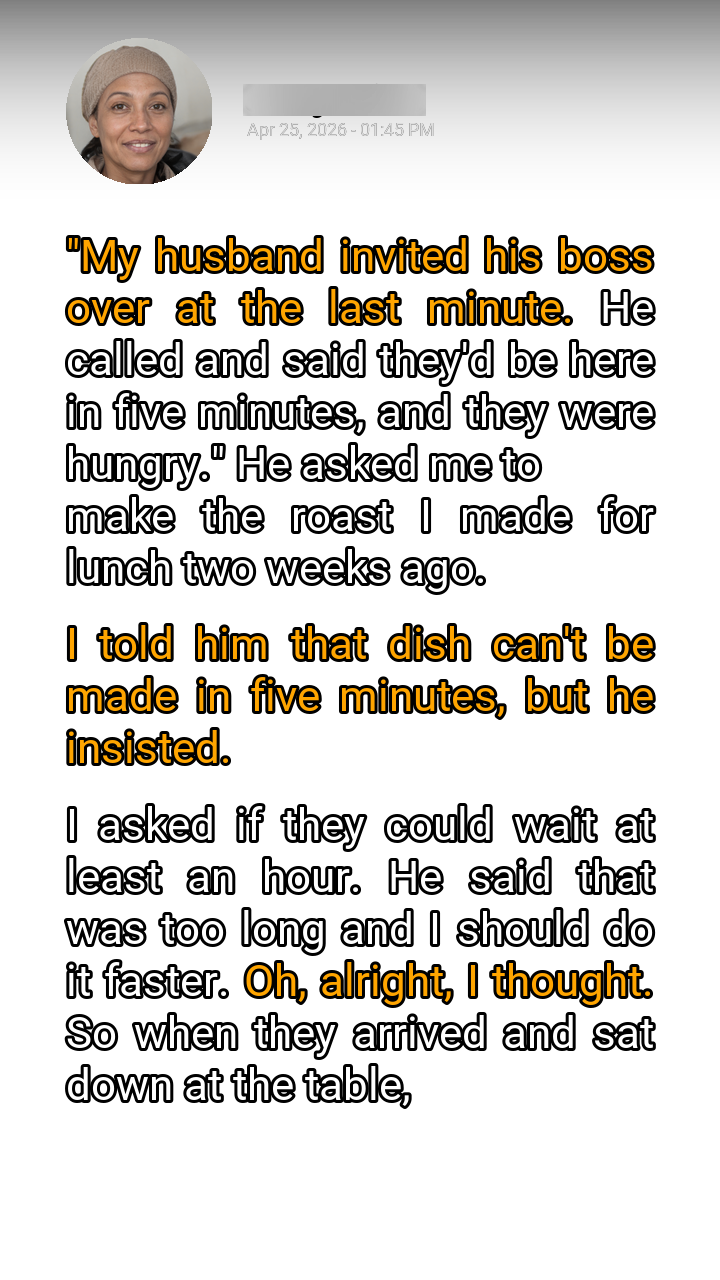
That tranquility was shattered by the shrill, insistent ring of my phone. It was Mark, my husband. Mark, a whirlwind of ambition and last-minute decisions, whose calls often heralded an imminent disruption to any semblance of order. His voice, when I answered, was a breathless torrent of urgency, a familiar panic-laced tone that immediately set my nerves on edge. “Sarah! You won’t believe it! Big news! Huge!” he rattled off, his words tripping over each other. I braced myself, knowing that ‘big news’ with Mark usually meant a significant upheaval for me.
The bombshell dropped with the force of a small meteor. “My boss, Mr. Harrison, he’s just left the office with me. We’re on our way over. He’ll be there in… five minutes! And he’s starving! He specifically mentioned how much he loved that incredible roast you made for lunch two weeks ago. Said he’s been dreaming about it!” My jaw tightened. “Mark,” I began, my voice a carefully controlled calm that masked a rapidly rising tide of incredulity, “that’s a seven-hour dish. You know that. It’s not something you whip up in five minutes, or even an hour. It requires hours of slow cooking, not to mention the prep and marinating time.”
His response was a dismissive wave of my entirely logical concerns, delivered with increasing agitation. “I know, I know, but he brought it up! This is massive for my promotion, Sarah! He’s the key! Just… make it faster! Can’t you just… do something? He’s really looking forward to it!” I suggested, perhaps they could wait an hour, grab a quick appetizer while I worked miracles with a simpler meal. “Absolutely not, Sarah, that’s too long! He’s hungry *now*. Just make it work, please!” The familiar knot of resentment, a tight coil of being taken for granted and put on the spot, tightened in my stomach. He hung up before I could argue further, leaving me with the impossible task.
I stood there, the dead phone still in my hand, the silence of the house once again engulfing me, though now it felt heavy, oppressive. The initial surge of panic and frustration began to recede, replaced by a cold, quiet resolve. “Oh, alright,” I muttered to myself, but it wasn’t a surrender. It was a decision. A glint, sharp and knowing, flickered in my eyes. I moved through the kitchen, not with the frantic, clumsy movements of a woman overwhelmed, but with a deliberate, almost surgical precision. The impossibility of the task, the sheer audacity of Mark’s demand, fueled a different kind of energy. I pulled out my largest, most impressive serving platter, a gleaming silver dome usually reserved for the grandest holiday feasts. Then, with a small, knowing smile playing on my lips, I headed straight for the freezer, my movements quick and quiet. I worked with an almost artistic flair, arranging things meticulously on the platter.
The crunch of tires on the driveway pulled me from my task. The car door slammed, followed by Mark’s boisterous, slightly nervous laughter. I took a deep breath, smoothing down my apron, and emerged from the kitchen, a picture of calm domesticity, a gentle smile fixed on my face. Mark, flushed with importance, stood beside a stern-faced man in a perfectly tailored suit – Mr. Harrison. The boss’s eyes briefly flickered with a hint of curiosity and expectation. “Sarah, darling, I hope this wasn’t too much trouble,” Mark said, giving my arm a quick, almost imperceptible squeeze, a silent, desperate plea for me to play along and save his career.
They settled at the impeccably set dining table, the silverware gleaming under the chandelier. Mark was beaming, practically vibrating with anticipation, already rehearsing the praise he expected Mr. Harrison to heap upon my culinary skills. Mr. Harrison leaned forward, his gaze fixed on the kitchen door, an expectant glint in his eye. I re-entered, carrying the enormous, gleaming silver dome, steam barely visible from beneath, adding to the illusion of a freshly cooked, substantial meal. The aroma, though faint, was… puzzling, certainly not the rich, savory scent of slow-cooked beef. I placed the heavy dish with a soft clatter in the exact center of the table. “Here we are, gentlemen,” I announced, my voice perfectly even, a hint of something unreadable in my eyes. Mark reached out, his hand hovering over the ornate handle of the lid, a triumphant smile already forming on his lips. “And now, for Sarah’s famous…” he began, his voice full of pride, as I slowly, deliberately, lifted the silver dome, revealing not the succulent, slow-braised beef, but…
…a meticulously arranged tableau: a solid, rectangular block of ice, perfectly centered on the platter, its surface glistening under the chandelier. Nestled beside it, a single, raw, unpeeled potato, still bearing flecks of dirt. A solitary sprig of fresh rosemary, vibrant green, lay across the ice, looking utterly out of place. The ‘steam’ was now clearly a faint, ethereal mist rising from the extreme cold, quickly dissipating into the warmer air of the dining room. There was no aroma of beef, only the crisp, clean scent of pure cold.
Mark’s hand froze mid-air, his triumphant smile collapsing into a look of utter bewilderment, then dawning horror. His mouth opened and closed soundlessly, like a fish out of water. Mr. Harrison, initially leaning forward with an eager anticipation, now sat back slowly, his brow furrowing in confusion. His gaze flickered from the icy centerpiece to my face, searching for an explanation. The silence that descended was thick and suffocating, broken only by the faint clinking of ice as it subtly shifted on the platter. Mark finally found his voice, a strangled whisper. “Sarah… what… what is this?”
I met his gaze, my expression unwavering, a faint, almost imperceptible curve to my lips. “Why, Mark, it’s exactly what you asked for,” I stated, my tone calm and utterly reasonable. “A ‘roast,’ prepared in five minutes, from the freezer, as you so emphatically insisted. This, gentlemen, is the raw material. The essence, if you will, of a roast – beef, potato, and herbs – presented precisely as it would appear if one were to pull it from the freezer and immediately attempt to serve it.” I gestured gracefully to the icy slab. “The beef, in its most pristine, unprocessed, and utterly unprepared form. The potato, still connected to the earth. The rosemary, fresh, but far from infused.”
Mr. Harrison’s eyes, which had been fixed on my face with a mixture of bewilderment and growing suspicion, suddenly widened. A slow smile began to spread across his stern features, a smile that started in his eyes and eventually reached his lips. He let out a low chuckle, then another, louder one. He leaned back in his chair, shaking his head, a genuine, hearty laugh escaping him. “Remarkable,” he murmured, wiping a tear from the corner of his eye. “Absolutely remarkable.” He looked at Mark, whose face was now a ghastly shade of white, a mixture of shame and terror. “Mark,” Mr. Harrison said, his voice now devoid of any pretense, “did you truly expect your wife to conjure a seven-hour slow-braised roast out of thin air in five minutes?”
Mark stammered, “No, sir, I… I just thought… she’s so clever… I thought she could do something…” His words trailed off into pathetic incoherence. Mr. Harrison, however, wasn’t looking at Mark. He was looking at me, a newfound respect shining in his eyes. “Sarah,” he began, “your ingenuity, your ability to deliver a message with such… elegant precision, is truly impressive. It takes a remarkable mind to respond to an impossible demand with such a perfectly executed, albeit inedible, demonstration of its absurdity.” He then turned back to Mark, his smile fading slightly. “Mark, while I appreciate your enthusiasm, this entire incident has been… enlightening. Perhaps a bit more foresight, and a greater respect for the realities of time and effort, would serve you well in your professional endeavors.”
The air crackled with unspoken implications. Mark, utterly deflated, could only nod mutely, his dreams of promotion visibly crumbling around him like an ill-constructed soufflé. Mr. Harrison, still chuckling softly, stood up. “I believe I’ve had quite enough to ‘eat’ for one evening. Sarah, thank you for a most memorable, if unconventional, dining experience. I daresay I won’t forget it.” He extended a hand to me, his grip firm and appreciative. As he walked towards the door, he paused. “Mark, perhaps we can discuss the feasibility of your proposals in the office tomorrow. With a slightly longer lead time.” He gave me a final, knowing glance before exiting, leaving Mark slumped in his chair, staring at the gleaming silver dome now covering a melting block of ice, a raw potato, and a sprig of rosemary – the perfectly sculpted monument to his own foolishness.
My lips finally allowed themselves a full, triumphant smile. The silence of the house settled once more, but this time, it was not oppressive. It was light, airy, and filled with the sweet taste of vindication. I began to clear the table, carefully lifting the dome once more, revealing the rapidly melting ice. The “roast” was indeed unmakeable in five minutes, but the point, as I had so meticulously ensured, had been made. And it was delicious.