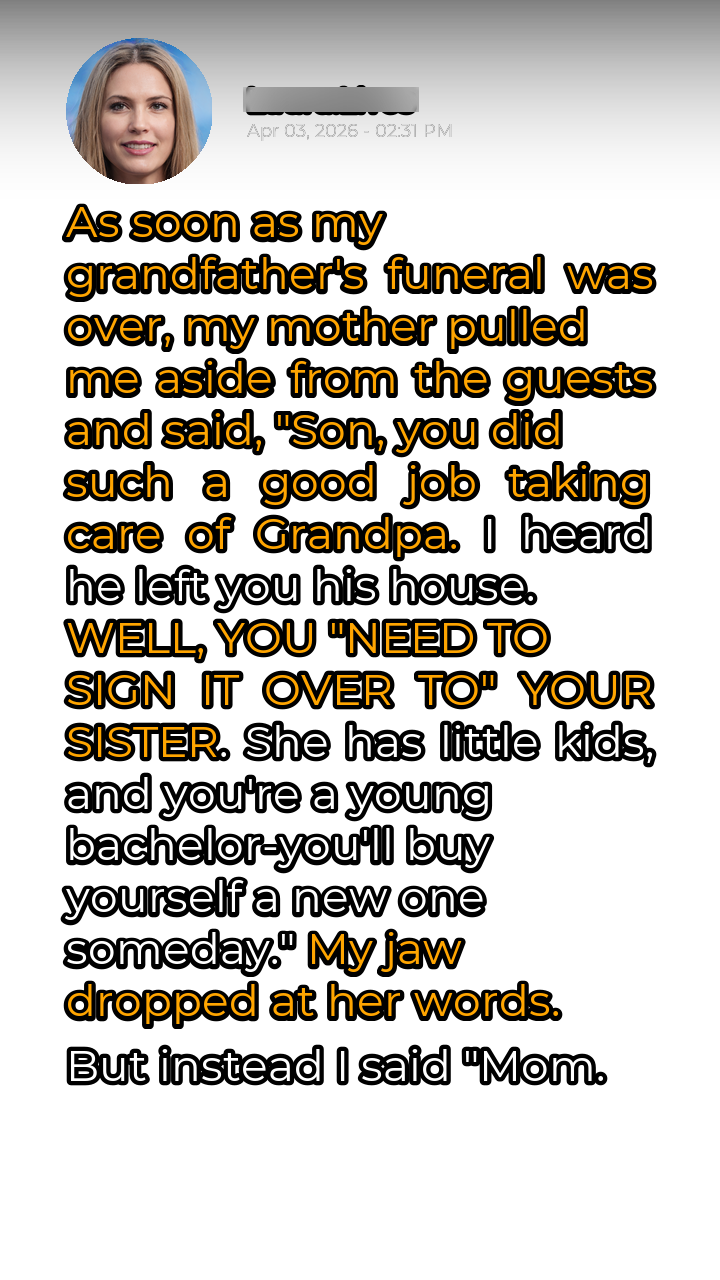
The silence after my mother’s pronouncement was deafening. The gentle hum of the refrigerator in the background suddenly amplified, each cycle a mocking reminder of the normalcy she was trying to impose on this utterly abnormal situation. “Mom,” I managed, my voice barely a whisper, “Grandpa just passed away. Can’t we talk about this later?” I needed time to process, time to grieve, time to understand the sheer audacity of her request. But she was insistent, her eyes fixed on mine with an unnerving intensity. She launched into a well-rehearsed speech about family, about responsibility, about the sacrifices she’d made over the years. My sister, apparently, was struggling. The kids needed a stable home, and a house from Grandpa would solve everything. Never mind that I had my own life, my own dreams, and that Grandpa, in his will, had specifically chosen me as the recipient of his beloved home. Was this about my sister? Or was it about her?
My grandfather’s house wasn’t just bricks and mortar; it was a repository of memories. I spent countless summers there, building forts in the backyard, learning to fish in the nearby creek, listening to his stories on the porch swing. It was the one place I felt truly at home, a sanctuary from the pressures of the world. The thought of handing it over, of erasing my own connection to that place, was unbearable. But I also felt the weight of my mother’s expectations, the years of conditioning to prioritize her needs above my own.
“Mom, I need time to think about this,” I finally said, trying to keep my voice steady. “This is a huge decision, and I can’t just make it on the spot.” I saw a flicker of annoyance in her eyes, but she relented, promising to call me in a few days. As she walked away, I felt a profound sense of unease, a feeling that this was just the beginning of a long and difficult battle. I knew my grandfather wanted me to have this home. He knew I’d love and care for it. He trusted me.
Days turned into a week, and the pressure mounted. My sister started calling, subtly hinting at her financial struggles, her voice laced with a mixture of desperation and resentment. My mother continued her campaign of guilt, reminding me of all the sacrifices she’d made for me, all the times she’d put my needs first. She knew how to play me, how to manipulate my emotions. But something had shifted inside me. The grief, the shock, the anger – it had all coalesced into a steely resolve. I wasn’t going to let them bully me.
I decided to visit the lawyer who handled my grandfather’s will. I needed to understand my rights, to get an objective perspective on the situation. The lawyer listened patiently as I poured out my heart, recounting my mother’s demands, my sister’s pleas, my own conflicted feelings. When I was finished, he leaned back in his chair and said, “Your grandfather was a wise man. He knew what he was doing when he left you that house. He trusted you to make the right decision.”
Armed with the lawyer’s support and my own newfound determination, I called my mother and sister. I told them that I had thought long and hard about their request, and that I had made a decision. I wouldn’t be signing over the house. My sister was furious, spewing insults and accusations. My mother was more measured, but her disappointment was palpable. She accused me of being selfish, of putting my own desires ahead of my family’s needs. But I stood my ground, calmly explaining that I needed the house, not for financial gain, but for the connection it gave me to my grandfather, to my past. I needed it to build my future. “I know this isn’t what you wanted to hear,” I said, “but this is my decision, and I hope you can respect it.” The line went dead. My mother hung up. It was over.