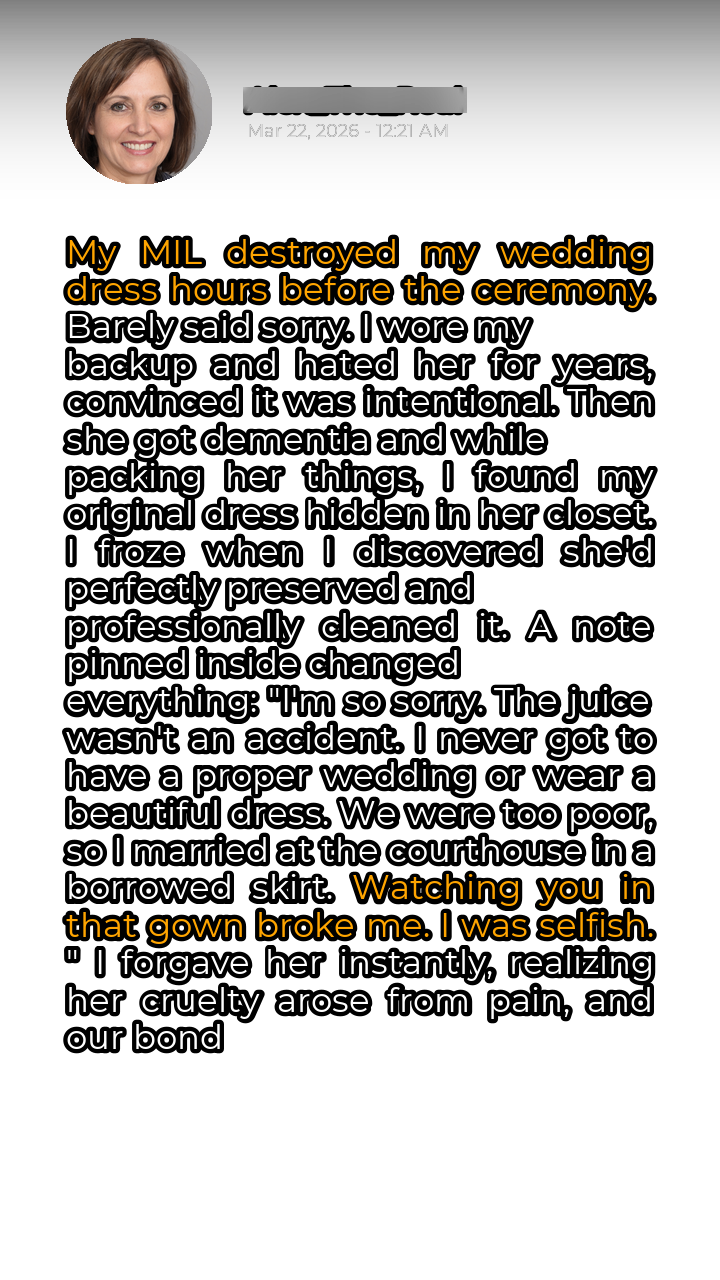
The day I found my wedding dress ruined remains etched in my memory as a tableau of pure, unadulterated horror. I remember the frantic phone calls, the desperate attempts to salvage the situation, and the crushing disappointment of having to settle for my backup dress – a simple, off-the-rack number that paled in comparison to the exquisite gown I had painstakingly chosen. My mother-in-law’s almost dismissive apology felt like a slap in the face, confirming my worst suspicions. It was a deliberate act, I was sure, fueled by jealousy or some twisted sense of rivalry. For years, a wall of ice separated us. Every holiday gathering, every family dinner, was punctuated by the unspoken tension between us. I couldn’t shake the feeling that she had robbed me of something precious, something irreplaceable. My husband tried to mediate, to bridge the gap, but the wound was too deep, the betrayal too profound. I saw her actions as a blatant display of disrespect, a calculated attempt to undermine my happiness.
Then, the cruel twist of fate: dementia. The woman I had resented for so long began to fade away, her memories blurring, her personality shifting. The sharp, sometimes acerbic, woman I knew was slowly being replaced by a confused, vulnerable figure. It was during this difficult period, as we were preparing her for a move to assisted living, that I stumbled upon the truth.
Hidden in the back of her closet, nestled amongst moth-eaten sweaters and forgotten trinkets, was a garment bag. My heart pounded in my chest as I unzipped it, my breath catching in my throat. There it was: my wedding dress, pristine and perfectly preserved. The stain was gone, the ripped seam meticulously repaired. It was as if time had stood still, as if the sabotage had never happened.
Pinned to the dress was a small, yellowed note, its edges frayed with age. With trembling hands, I unfolded it and began to read. The words, scrawled in my mother-in-law’s unmistakable handwriting, hit me like a tidal wave. “I’m so sorry,” it began. “The juice wasn’t an accident. I never got to have a proper wedding or wear a beautiful dress. We were too poor, so I married at the courthouse in a borrowed skirt. Watching you in that gown broke me. I was selfish.”
The world tilted on its axis. My years of resentment, my carefully constructed narrative of malice and spite, crumbled into dust. I realized, with a profound sense of shame and regret, that I had misjudged her, that I had failed to see the pain and vulnerability hidden beneath her sometimes-abrasive exterior. Her actions, however misguided, were not born of hatred, but of a deep-seated longing, a yearning for something she had never had.
In that moment, everything changed. The ice that had separated us for so long began to melt, replaced by a wave of empathy and understanding. I rushed to her side, tears streaming down my face, and wrapped her in a tight embrace. I told her that I understood, that I forgave her. The words, though inadequate, seemed to ease the burden she had carried for so long.
The remaining years were a period of healing and reconciliation. While her dementia continued to progress, our bond deepened, forged in the crucible of forgiveness and understanding. I learned to see her not as the woman who had ruined my wedding, but as a complex, flawed human being who had simply been trying to cope with her own pain. The wedding dress, once a symbol of betrayal, became a reminder of the power of forgiveness and the enduring strength of the human spirit.