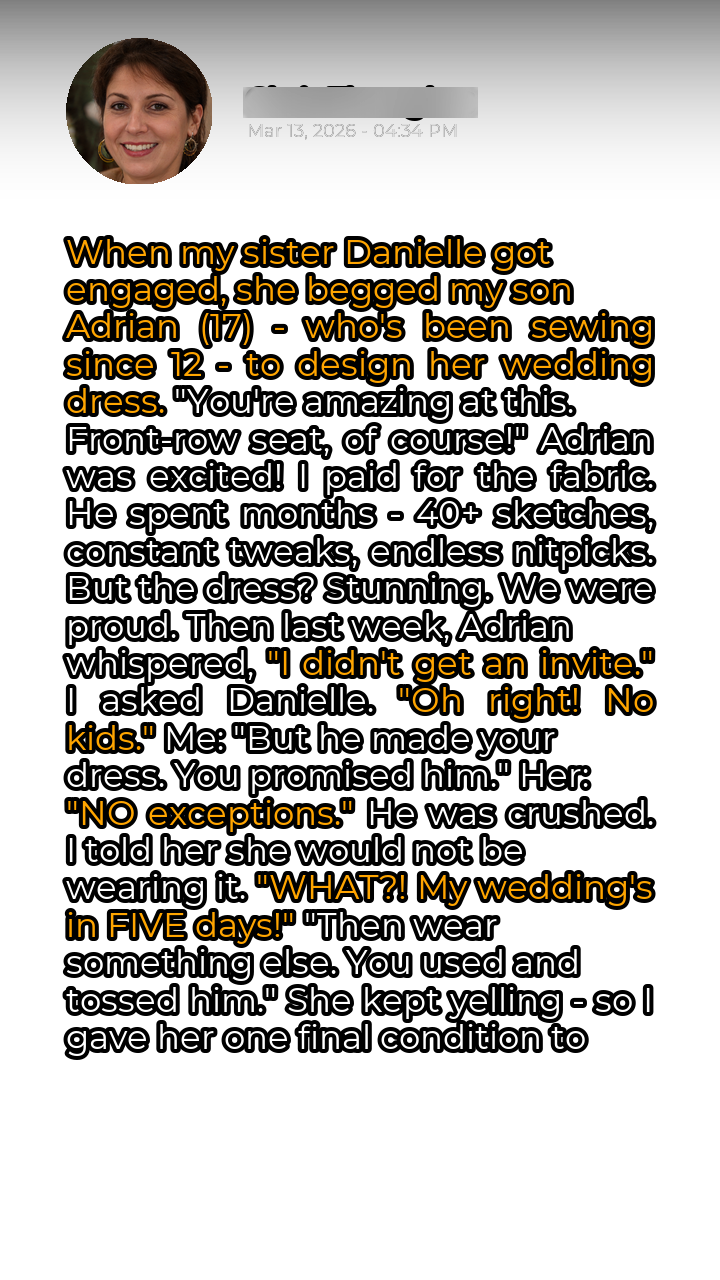
When my sister Danielle announced her engagement, the entire family was overjoyed. Danielle, always the center of attention, immediately started planning the “wedding of the century,” as she called it. However, amidst all the excitement, a peculiar request arose. She approached my son, Adrian, a remarkably talented 17-year-old who had been honing his sewing skills since the age of 12. Danielle, knowing Adrian’s passion and skill, begged him to design her wedding dress. “You’re amazing at this, Adrian! And of course, you’ll have a front-row seat!” she exclaimed, her eyes sparkling with wedding fever.
Adrian, usually reserved and quiet, was instantly captivated by the idea. The prospect of creating something so beautiful for his aunt’s special day filled him with excitement and a sense of purpose. Seeing his enthusiasm, I happily offered to pay for all the necessary fabrics and materials. Little did I know, this seemingly joyous endeavor would soon turn into a painful family drama.
For months, Adrian dedicated himself to the project. He poured over countless sketches, constantly tweaking and refining his designs. He researched different fabrics, experimented with various embellishments, and spent hours at his sewing machine, meticulously crafting each detail. The result was nothing short of spectacular. The dress was a masterpiece, a testament to Adrian’s incredible talent and dedication. It was a flowing, elegant gown with intricate lace detailing and a flattering silhouette that perfectly complemented Danielle’s figure. Both Adrian and I were immensely proud of his accomplishment.
However, the celebratory atmosphere took a sharp turn when Adrian casually mentioned that he hadn’t received an invitation to the wedding. A wave of confusion washed over me. Surely, this was a mistake. I immediately confronted Danielle, expecting a simple explanation and a quick fix. Her response, however, was far from what I anticipated. “Oh right! No kids,” she stated matter-of-factly, as if it were the most natural thing in the world.
I was floored. “But Danielle,” I protested, “he MADE your dress! You promised him a front-row seat! He poured his heart and soul into this!” Her reply was cold and unwavering. “NO exceptions,” she declared, her voice leaving no room for negotiation. I could see the devastation in Adrian’s eyes. He was utterly crushed, feeling used and unappreciated. He had poured his heart into creating something beautiful for her, only to be excluded from the celebration.
Fueled by anger and a fierce protective instinct for my son, I made a decision. I told Danielle that she would not be wearing the dress Adrian had designed. Her reaction was explosive. “WHAT?! My wedding’s in FIVE days!” she shrieked, her voice filled with disbelief and outrage. “Then wear something else,” I retorted, my voice firm and unwavering. “You used him and tossed him aside like he was nothing.” She continued to yell and protest, but I remained resolute. I refused to allow her to wear a dress that represented so much hard work and dedication from someone she had so blatantly disrespected.
Seeing her distress, I decided to offer her one final condition. “Danielle,” I said, my voice softening slightly, “Adrian will allow you to wear the dress if, and only if, you publicly acknowledge his contribution to your special day. You must tell everyone that he designed and created the dress, and you must apologize to him for excluding him from the wedding.” Danielle was silent for a moment, contemplating my offer. Finally, she reluctantly agreed. On her wedding day, Danielle, wearing Adrian’s stunning creation, addressed her guests and tearfully apologized to Adrian for her thoughtlessness. She praised his talent and thanked him for creating the dress of her dreams. Adrian, touched by her sincerity, forgave her, and the wedding proceeded without further incident. While the initial conflict had caused a great deal of pain, it ultimately led to a greater understanding and appreciation within the family.