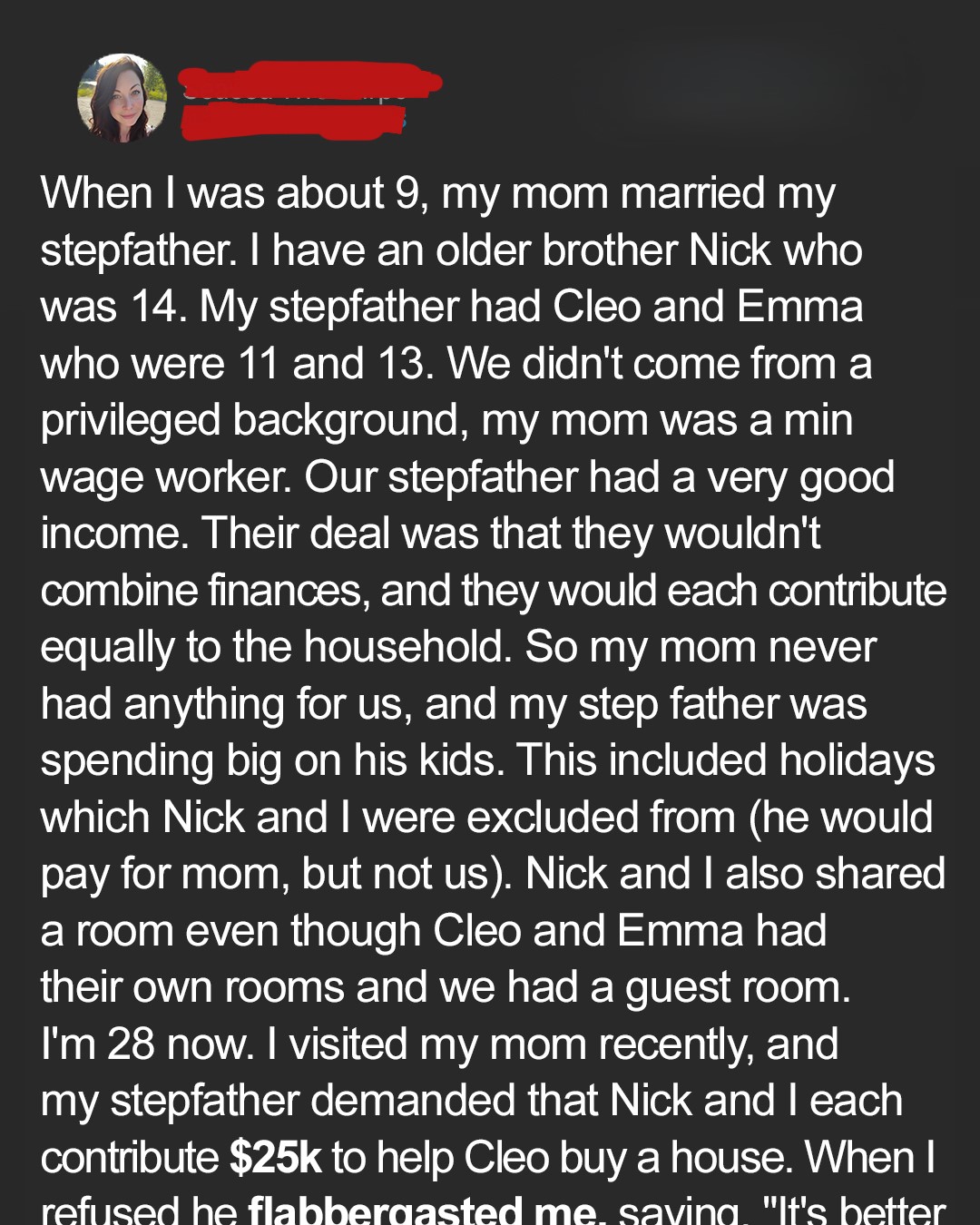
I still feel the ghost of that chill, even now, years later. It’s a cold that settled deep in my bones, a kind of betrayal I’ve kept locked away, unable to speak, until now. When I was nine, my world fractured. My mom, a perpetually exhausted minimum wage worker, married my stepfather. He was charming, at least on the surface, and he came with a wealth we’d never known. He had two daughters, Cleo and Emma, a year older and a year younger than my brother Nick. They seemed to float through life, draped in new clothes, their laughter echoing through the large house we now shared. Nick and I? We squeezed into one small room, while Cleo and Emma each had their own, and there was even a guest room that sat empty, a mocking monument to space we couldn’t have.
Their deal was simple, or so we were told: separate finances, equal contributions to the household. But the reality was a brutal, daily slap in the face. My mom had nothing left after her share, often cutting corners on our food, our clothes, our school supplies. My stepfather, though? He splashed out on his girls. New bikes, designer shoes, trips to amusement parks. We watched from the sidelines. Did he even see us? Did he care? The worst was the holidays. He’d pay for Mom to come along, but Nick and I were always left behind, parceled off to a bewildered aunt, because he wouldn’t pay for us. “It’s a family holiday,” Mom would say, her eyes shadowed with unspoken regret, but it was their family holiday. We were an afterthought, an inconvenience.
The years blurred into a silent struggle. Nick worked any odd job he could find from the moment he turned sixteen, saving every penny. I did the same, desperate to buy my own sense of dignity, to escape the crushing feeling of being perpetually second-class. Our stepsisters, meanwhile, glided through high school and into college, their paths paved by a father who never hesitated to open his wallet for them. We never asked him for anything. We knew better. The unspoken rule was clear: we were tolerated guests in their gilded cage.
I’m 28 now. Nick is 33. We’ve carved out our own lives, modest but ours. We rarely visit Mom anymore, the house a constant reminder of everything we never had. But a few weeks ago, I went. Just a quick stop, a cup of tea. That’s when my stepfather, lounging in his expensive armchair, dropped the bomb.
“Cleo’s looking to buy her first place,” he said, like it was a casual dinner conversation. “She needs a bit of a boost. Nick and I figure you two can each contribute $25,000.”
My tea went cold. My blood went colder. “$25,000?” My voice cracked. “For Cleo’s house? What are you talking about?” The audacity, the sheer nerve of him, after all these years of calculated exclusion.
He didn’t even flinch. His eyes, usually so dismissive, held a glint I couldn’t quite decipher. “Yes. It’s better.”
It’s better. The words hung in the air, heavy and loaded. Better for whom? Better than what? My mind reeled. Was this some twisted test? Was it a power play, demanding we acknowledge our inferior status by funding his favored child? I shook my head, disbelief warring with a rising fury. “Absolutely not. We have our own lives, our own debts. You never contributed to ours.”
He leaned forward, his calm voice a chilling whisper. “It’s better.” He repeated it, almost like a warning.
Then it hit me. A memory, cold and clear as ice. Years ago, after one of their huge, silent arguments, I’d overheard Mom on the phone, her voice hushed, frantic. “The debt… I can’t… he promised to help with the old one…” She’d mentioned a massive sum, something from her past, before she met him. She’d looked terrified for weeks after that. Nick and I had just thought she was upset about the usual financial strain.
But it wasn’t the usual. I suddenly understood. He wasn’t just a cheap stepfather. He wasn’t just favoring his own. The “equal contribution” was a façade. He had never truly contributed equally. He had engineered Mom’s poverty, not just by letting her struggle, but by trapping her. He hadn’t just ‘helped’ with an old debt; HE HAD BOUGHT HER. He had paid it off, not out of generosity, but to own her, to keep her bound to him, dependent and compliant.
And “It’s better”? It meant IT WAS BETTER THAT WE PAY, BECAUSE IF WE DIDN’T, HE WOULD CALL IN THE DEBT HE HELD OVER MOM, THE VERY DEBT HE’D USED TO SHACKLE HER FOR TWO DECADES, AND HE WOULD DESTROY HER. My mother wasn’t just a minimum wage worker who couldn’t afford us. She was a hostage, and Nick and I? We were just another piece of the ransom. We were paying for the bars of her cage, and the privilege of staying silent about his lifelong, calculated cruelty. And I knew, with a horrifying certainty, that he’d been planning this final demand, this final payment from us, all along.