Part 1

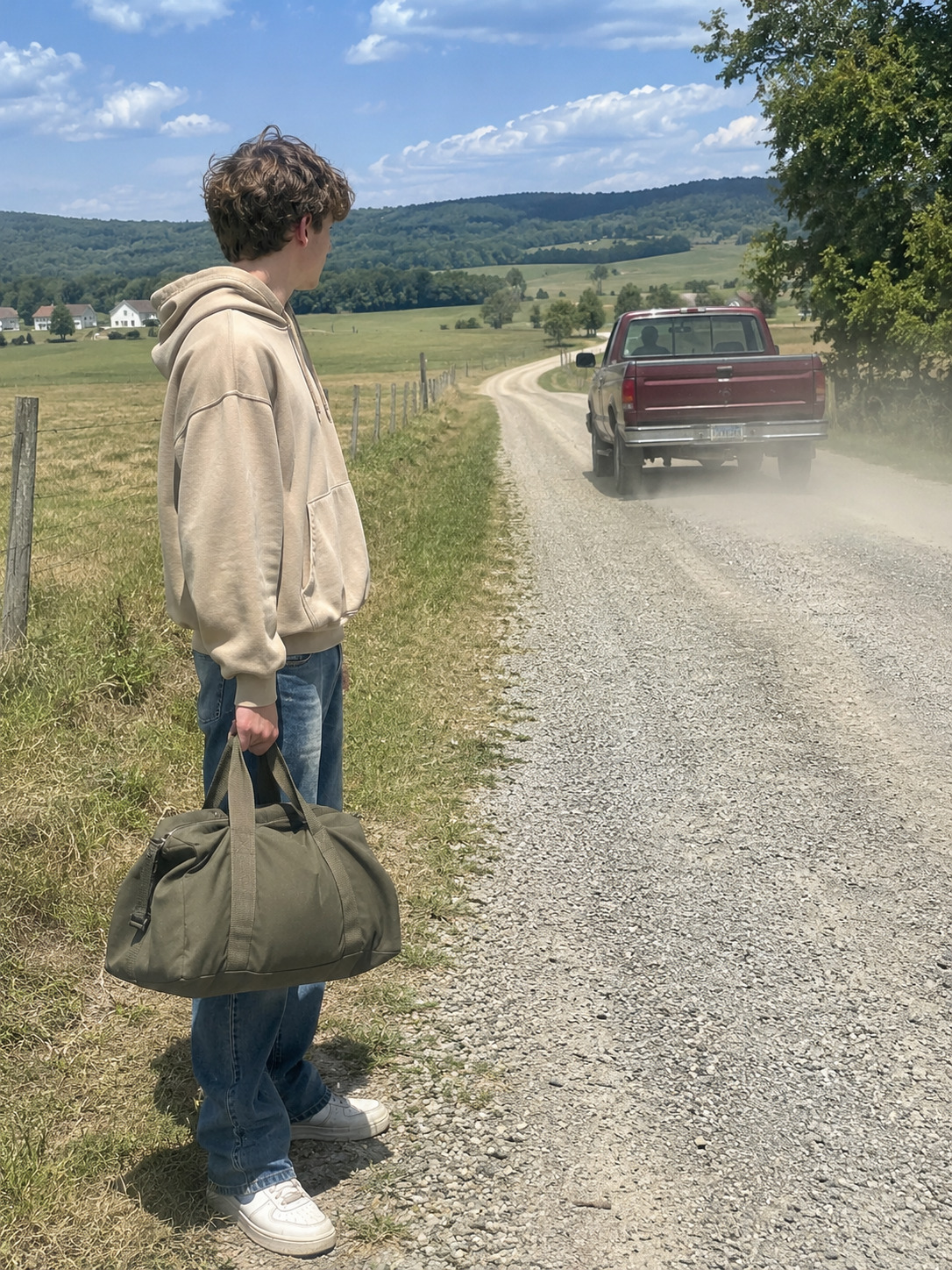
I was thirteen when my father pulled his truck onto an empty dirt road, ordered me out, and tossed my duffel bag onto the gravel.
“Walk home,” he said. “Maybe it’ll toughen you up.”
Then he drove away.
I stood there waiting for his truck to return. It never did.
Eighteen years later, a wedding invitation arrived from the family I’d never spoken to again. Inside was a second envelope marked, Please read this first.
What I found inside changed everything I believed about my childhood.
My name is Wesley. I’m thirty-one now, but I still remember that August afternoon.
My mother died of ovarian cancer when I was eight. She was only thirty-one, the same age I am today.
After her death, my father, Hank, raised me alone until he married Brenda two years later.
Hank worked as a roofer and believed boys needed harsh discipline to become men.
I was quiet, loved reading, and cried easily when I missed my mother.
He hated those things about me.
Brenda wasn’t openly cruel. She simply treated me like an unwanted reminder of my father’s previous marriage.
By twelve, I spent most weekends with my mother’s older sister, Aunt Colleen.
She lived near a lake and gave me something I rarely experienced at home: patience.
She helped with homework, taught me to cook, and listened when I talked.
My father resented her influence.
He claimed she was making me weak.
The day he abandoned me, he’d just picked me up after a two-week visit with Colleen.
We drove silently for forty minutes before he turned onto that deserted road.
When he told me to get out, I initially thought he was joking.
But his expression made it clear he wasn’t.
After his truck disappeared, I walked for nearly two hours until I reached a gas station.
The woman working there let me use the telephone.
I called Colleen.
She came immediately.
“You’re staying with me now,” she said.
The following week, she filed for emergency custody.
My father didn’t challenge it.
He signed the paperwork and let me go.
That was the last time I had any contact with him.
Colleen raised me, and I eventually built a small heating and air-conditioning company.
Today, I employ twelve people and have a stable life.
I still struggle with trust, but I’ve worked hard to build something good.
Colleen is my family.
I never needed Hank or Brenda to return.
I knew they had a daughter named Paige, my younger half-sister, but we’d never met.
Then, last Tuesday, I found an ivory envelope in my mailbox.
It was an invitation to Paige’s October wedding.
I nearly threw it away.
But underneath was a smaller envelope with a handwritten message.
Please read this first.
Inside were two letters.
One was from Paige.
The other was written on yellowed paper, folded so many times that the creases had nearly worn through.
I recognized the handwriting immediately.
It belonged to my mother.
My hands began shaking as I unfolded the pages.
She’d written the letter three months before she died, when she knew her treatment wasn’t working.
It was addressed to Aunt Colleen.
My mother explained that she wanted Colleen to raise me if she didn’t survive.
Then I reached a paragraph about a trust my grandparents had established for my care.
According to my mother, Hank had repeatedly talked about using those payments.
I read the paragraph again.
For years, I’d believed my father kept me because I was his son, even if he didn’t know how to love me.
Now I was staring at a letter suggesting there had been another reason.
And I still hadn’t opened the message from my half-sister explaining how she’d found it.
Part 2
I sat at my kitchen table with my mother’s letter spread out in front of me.
For eighteen years, I’d believed my father abandoned me because he couldn’t stand having a quiet, sensitive son. Now I knew there might have been something else behind his decision to keep me after my mother died.
My grandparents had established a trust that provided monthly payments for my care.
My mother had warned Colleen that Hank seemed more interested in those payments than in raising me.
I couldn’t prove what he’d been thinking all those years ago, but the possibility made my stomach turn.
Eventually, I unfolded the second letter.
It was from Paige, my twenty-three-year-old half-sister.
Part 3
Paige’s handwriting was neat and slanted, the kind you learn in a good school and keep for life.
Wesley,
You don’t know me, and you have no reason to read this. I’m sorry for the way it’s arriving. I didn’t know how else to get it to you.
Six weeks ago, I was helping Dad clear out his desk after his knee surgery. In the back of the bottom drawer, under old tax returns, I found a bank folder and an envelope addressed to someone named Colleen. The envelope was sealed. It was never mailed. I opened it. I’m not proud of that, but I’m glad I did.
The folder held statements from a trust account. Your grandparents set it up for you before your mother died. It paid $2,100 a month to “the child’s guardian.” Dad has been the name on that account since you were eight. The payments kept coming until the month you turned eighteen.
I’m an accountant, so I added it up. It comes to a little over $150,000.
You didn’t live with him for five of those years. He never told the trustee. He never told Aunt Colleen the trust existed. I don’t think she ever knew.
I put the page down and looked at my kitchen wall for a long time.
Colleen had paid for my braces with her tax refund. She had worked weekends at a dental office to cover my first year of community college. When I turned sixteen and wanted a car, she sold her wedding ring and never told me. I found out from the pawnshop receipt years later.
The whole time, there had been a fund with my name on it, and a letter from my mother telling her it was there.
I picked up Paige’s letter again.
I confronted him. He said it was “compensation” for everything he’d spent raising you. I asked what he’d spent on you after you left. He didn’t answer.
There’s one more thing. The trust has a second part. It was supposed to release the remaining principal to you at age thirty. The trustee’s law office has been trying to find you for a year. Dad gave them an old address and told them you’d moved overseas.
I’ve enclosed the lawyer’s name and number. I’ve also started a repayment plan from my own savings, which I know can’t undo anything. I’m not asking you to come to the wedding. I’m only asking you to let me tell you the truth, because nobody else was going to.
Paige
Part 4
I drove to the lake that night.
Colleen was on her porch with a mug of tea, the way she always was around dusk. She took one look at my face and put the mug down.
“Who died?”
“Nobody.” I sat beside her and handed her the yellowed pages. “Read it. Please.”
She read it twice. Her lips moved a little over my mother’s name. When she reached the paragraph about the trust, her hand went to her mouth.
“Your mother wrote to me,” she whispered. “I never got it. I always wondered if she’d left something. Hank told me there was nothing.”
“He kept it.”
“For eighteen years.” She folded the letter along the old creases, very gently, like she was closing a sleeping child’s door. “Wesley, I would have found a way. If I’d known there was money, I’d have put it all in a college fund.”
“You did that anyway,” I said. “You just used your own.”
She started crying then, quietly, and I put my arm around her. We sat there until the porch light came on by itself.
“Your mother knew me,” she finally said. “She knew I’d say yes before she even finished writing it.”
“You did say yes.”
“Thirteen years old,” Colleen murmured. “On the side of a road. And I said yes before you finished the sentence.”
Part 5
I called the trustee’s attorney the next morning. His name was Mr. Abernathy, and he sounded stunned when I gave him my full name.
“Mr. Pruitt,” he said. “We’ve been searching for you for fourteen months. Your father told us you’d relocated to Germany.”
“I live forty minutes from where he does.”
“I see.” He cleared his throat. “I’d like to meet in person, if possible. There are some documents you should review.”
The documents confirmed everything. The trust paid Hank $2,100 monthly, as long as the guardian of record remained in place. A change of guardianship would have halted the payments and triggered a review. When Colleen got custody, Hank signed the paperwork without a fight, because no one at the courthouse knew the trust existed. He never reported the change. The account stayed in his name, and the money kept flowing.
The remaining principal, just under four hundred thousand dollars, had been untouched. Even Hank hadn’t been able to access it, because it was locked until my thirtieth birthday.
“You turned thirty eighteen months ago,” Mr. Abernathy said gently. “I’m sorry we couldn’t reach you sooner.”
I thought about the road, the gravel, the sound of the truck pulling away.
I thought about how, on the day my father abandoned me, he had already been collecting those payments for five years. He hadn’t thrown me out because I was weak. He had thrown me out because he knew Colleen was starting to ask questions, and he wanted her to take me before she asked the right one.
I walked out of Mr. Abernathy’s office and sat in my truck for twenty minutes without turning the key.
Part 6
I called Paige that evening.
“Wesley?” Her voice shook. “I didn’t think you’d call.”
“I read your letter.”
“I’m so sorry.”
“You didn’t do it,” I said. “You found it. That’s different.”
She was quiet. “I wasn’t sure you’d believe me.”
“The bank statements helped.” I paused. “Why did you send it?”
“Because I’m getting married in three weeks,” she said, “and I realized I was about to stand in front of a hundred people who’d call that man my father, and I’d never even met my brother.” Her voice broke. “I didn’t want to start my marriage with that.”
I looked at the photo on my refrigerator, me at fifteen with Colleen at the lake, sunburned and laughing, a fish held up between us.
“I’ll come,” I said. “I’m bringing Colleen.”
“Oh.” She exhaled. “Okay. Yes. Of course.”
“I’m not coming for him.”
“I know,” Paige said. “I’m not asking you to.”
Final Part
The wedding was held in a small stone church outside Harrisburg, with a reception in a barn strung with white lights.
Colleen wore a dark blue dress and my mother’s pearl earrings, which she had kept in a velvet box for eighteen years. I wore a gray suit and stood beside her in the back pew. Paige found us before the ceremony started, walked straight down the aisle in her wedding dress, and hugged me. She was shaking.
“Thank you for coming,” she said into my shoulder.
“You’re welcome,” I said, and meant it.
Hank was seated in the front row. He had gotten heavy and gray. He leaned on a cane, and his face had the stiff, shuttered look I remembered. Brenda sat beside him, staring straight ahead.
He turned once during the ceremony and saw me. His jaw tightened. Then he looked away.
At the reception, he came to our table.
“Wesley.” He didn’t offer his hand. “I see you’ve been busy.”
I stood. I was taller than him now, which I hadn’t expected.
“I’ve been busy for eighteen years,” I said.
“That trust was meant to cover raising you.”
“I wasn’t in your house for five of those years, Hank.”
He opened his mouth. Nothing came out.
“You told me to walk home so I’d get tough,” I said, quiet enough that the next table couldn’t hear. “I want you to know that it worked. I’m tough. Just not because of you. Colleen did that. She just did it by showing up.”
Colleen put her hand on my arm.
“Thomas Hank Pruitt,” I said, and that was the name my mother had given me, and I watched his face change as he heard it. “I’m not here to scream at you. I’m not here to forgive you either. I’m here because my sister is getting married, and she deserves to have her brother in the room.”
Hank looked at Colleen. For a second, I thought he might say something real.
“Diane,” he said. Then he stopped. “Colleen. I…”
“Don’t,” she said gently. “Not today. Let the girl have her wedding.”
He nodded once and walked away.
Paige came by later and sat beside me while the band played.
“He’s agreed to the repayment plan,” she said. “The lawyer says there’s enough documentation that he didn’t have a choice. But I wanted you to hear that I’m not doing it to make up for anything. I’m doing it because it’s right.”
“I know.”
“I’d like to keep knowing you,” she said shyly. “If that’s okay.”
I looked at her. She had my mother’s chin, and I’d never noticed it until that moment.
“I’d like that,” I said.
Six months later, the repayment began, and the trust principal came through. I did three things with it.
I paid off Colleen’s mortgage in full. She argued with me for an hour, and I told her I’d already sent the check. She hung up on me, called back ten minutes later, and cried for the rest of the call.
I put a hundred thousand dollars into a scholarship fund at the community college where she’d driven me every morning at six, for students raised by relatives who aren’t their parents. We named it the Elaine Fund, after my mother.
And I bought two plane tickets to Maine, because Colleen had spent her whole life saying she wanted to see the ocean from a lighthouse, and had never once spent money on herself.
On our last evening there, we stood at the top of a white tower, wind pulling at our jackets, the Atlantic spread out below us in the late gold light.
“You know,” Colleen said, “your mother used to say that you were the bravest person she knew.”
“I was eight.”
“Exactly.” She smiled and wiped her cheek. “She’d be proud of the man you became.”
I looked out at the water for a long moment.
When I was thirteen, I’d stood on a gravel road waiting for a truck to come back. It never did. I had spent eighteen years thinking that moment defined me, that I was the boy who had been left.
But I had been wrong about what the moment was.
It wasn’t the day I was abandoned.
It was the day someone drove forty minutes with her heart pounding to pick me up, and never once let go.
THE END