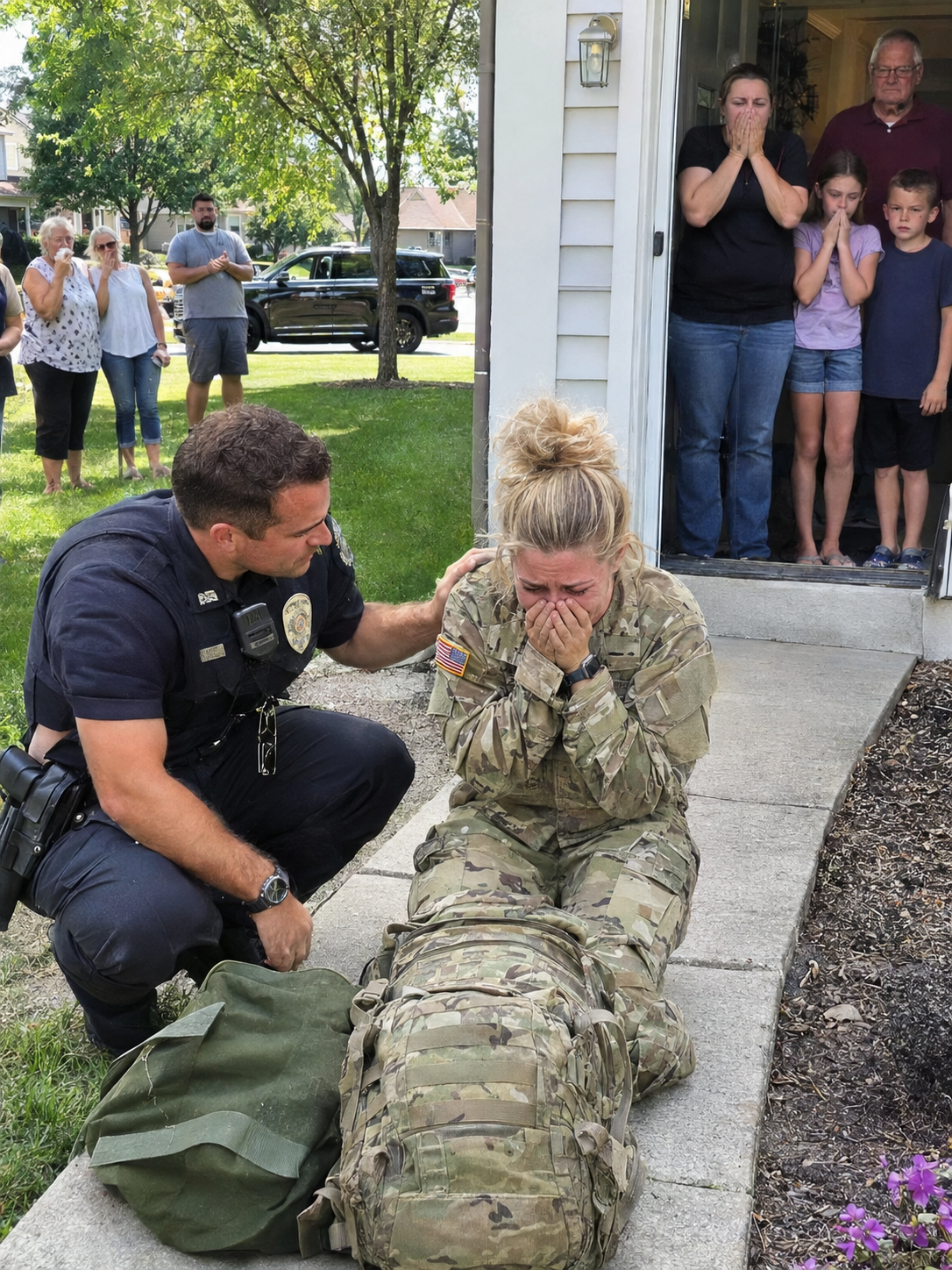
When I finally returned home in uniform, the mailman who had been forwarding my letters contacted the local news. Within hours, the entire town gathered outside our house. My parents took one look at me and immediately locked their…
Part 1

“Don’t get out of the truck,” Mr. Abbott said, locking the doors with trembling fingers. “Your mother just called 911 and told them an escaped convict is standing on her lawn.”
The lock clicked so loudly inside that cab it sounded like a verdict. Heat shimmered off the cracked driveway. My uniform collar rubbed against the sunburn on my throat, and my boots still carried a powdery line of Kuwait sand in the seams. Through the windshield sat the house I had carried in my mind for four years: white porch, blue shutters, chipped ceramic angel by the mailbox, the same porch swing with one rusted chain.
No sign.
No yellow ribbons. No neighbors holding flags. No mother crying into her hands because her daughter had survived. Just curtains pulled tight across every window like the house itself was ashamed to look at me.
My duffel sat on my lap, heavier than it had felt in any airport. My DD-214 was folded in my chest pocket. My military ID was tucked behind it. Four years of mail, missed birthdays, desert heat, and 3:17 a.m. calls from a satellite phone had all been reduced to one sentence my mother had sold this town: Frances Whitaker went to prison.
That was the lie.
My parents had always known how to make a story sound holy. Mom could turn a sigh into a sermon. Dad could stand beside her with one hand on her shoulder and make silence look like dignity. When I enlisted, I gave them my APO address, my emergency contact forms, and the kind of trust only a daughter still hoping to be loved gives away for free. They used every piece of it to make my absence convenient.
A uniform can prove service, but it cannot undo a lie by itself.
The first patrol car came around the corner hard enough to make gravel jump. Then another. Then a third. Behind them came neighbors with damp hair and slippers, teachers I had not seen since graduation, women from church still wearing flour on their aprons, and Pastor Wells stepping off the curb with his Bible pressed flat against his chest.
The local news van rolled in last, white and blue, the side door sliding open before the tires even stopped.
Mr. Abbott’s face went gray. He had been our mailman since I was nine years old. He had seen my report cards, my Christmas cards, my first Army envelope. He had also seen my parents refuse every letter I sent home, month after month, until he started forwarding them to my unit chaplain’s office and keeping copies of the postal return slips in a rubber-banded stack beneath his kitchen calendar.
“What did she say?” I whispered.
He swallowed so hard I heard it. “She said you were violent. She said you’d been released early from prison. She said nobody should believe your uniform.”
My stomach went cold in a way the desert never managed. Not fear. Not even surprise. Something cleaner. Something that made my fingers go still on the duffel strap because if I moved too quickly, I did not know what I would break.
Then the front door cracked open.
My mother stood there in a pale cardigan, one hand pressed to her throat like she had practiced grief in a mirror. My father stood behind her, red-faced and stiff, holding the brass chain across the door with two fingers.
“Frances,” my mother called, loud enough for the whole street to hear, “please don’t make this worse.”
The cameraman turned toward me.
Sheriff Landry stepped out of his car and lifted both hands. “Ma’am, I need you to stay calm.”
“I am calm,” I said, though my voice split straight down the middle. “I’m Sergeant Frances Whitaker. I just got home from deployment.”
The crowd shifted. Mrs. Thorne, my fifth-grade teacher, covered her mouth. Pastor Wells took one step forward and stopped. Someone behind the mailbox whispered, “But she was in prison.”
My mother pointed at me. “That uniform is part of the act. She has always been manipulative.”
There are families that hit you with fists, and there are families that make the whole world hold the door while they do it with words. The second kind leaves fewer bruises. That is why they get invited to church.
I reached into my chest pocket for my ID. “Sheriff, please.”
Before I could hand it over, Dad shouted, “Don’t touch anything she gives you!”
The street went silent.
A bicycle lay on its side in Mrs. Thorne’s yard, the front wheel still spinning. A dog barked once and then seemed to remember it was supposed to be afraid. The news producer lowered her phone. Three neighbors stared at my boots instead of my face. Pastor Wells looked at my mother, then at the closed curtains, then at the ground like the truth might be written in the dust.
Nobody moved.
Mr. Abbott opened the truck door and climbed out with both hands visible. “That girl wrote home every month,” he said, his voice shaking but loud. “I forwarded every letter after her parents refused them. I have the USPS refusal notices. I have the postmarks. APO Kuwait. Fort Carson processing. Every one.”
My mother’s face changed for half a second.
Not fear.
Rage.
Dad yanked her backward and slammed the door shut. A deadbolt clicked. Another. Then another, each one dropping into place like he could lock the truth out if he made enough noise.
From inside the house, my father yelled, “If she wants the truth so badly, show them what she buried!”
The upstairs window flew open.
A black duffel bag dropped onto the porch.
It hit the boards with a dead, heavy thud. Dust puffed from the canvas. My name was written across the side in block letters I had made with a laundry marker before basic training.
FRANCES WHITAKER.
My knees almost gave out. I had packed that bag myself four years ago with wool socks, an extra photo of my grandmother, and a cracked St. Michael medal Mr. Abbott had given me on his route the morning I shipped out. I had not seen it since the day I left.
Sheriff Landry turned toward the porch. “Everybody back up.”
My father shouted through the door, “Open it!”
Mr. Abbott whispered, “Frances, don’t.”
I did not move. I kept my hands where everyone could see them. The brass zipper had been pulled halfway open, and something inside shifted against the canvas with a small metallic scrape.
Sheriff Landry stepped onto the first porch stair.
The zipper gave.
Something metal hit the porch with a sharp little clink.
Then a folded paper slid after it, face-up, stamped with my full name and one word Sheriff Landry read out loud before his hand moved toward his holster.
Part 2: My Parents Told the Whole Town I Was in Prison, Then I Came Home in Uniform and Their Lie Collapsed on the Front Lawn
For four years, Frances Whitaker’s hometown believed she was in prison.
Not rumored. Not suspected. Believed, the way a town believes something when a grieving mother says it in the right voice in the right places often enough that it stops being information and becomes just the way things are.
Marilyn Whitaker had said it in grocery aisles and church hallways and parent-teacher nights and prayer circles, always with the same soft, carefully calibrated grief. A tissue pressed under one eye. A pause that invited sympathy without inviting questions.
“She made terrible choices,” Marilyn would say.
People rarely asked for details after that. Grief spoken politely tends to make cowards out of decent people. They nod and change the subject and feel virtuous for not prying, and in doing so they hand the liar exactly the silence she needs.
Frances was not in prison.
She was in uniform.
She had shipped out with the U.S. Army, moved through processing at Fort Carson, and spent most of the next four years overseas or on assignment, writing letters home whenever the mail tent was open and the heat did not feel like it was pulling the skin from her hands. She wrote to her mother first. Then to her father. Then, when the replies stopped coming, she wrote to both of them together, because some part of her still believed that families could be reached if you found the right words and kept trying.
The first letter came back with Refused stamped across the front in red ink.
The second came back the same way.
After the sixth, Mr. Abbott stopped pretending it was a normal family problem.
He had sorted mail in that town for thirty-one years. He had watched Frances grow from a solemn girl with scuffed sneakers into a woman with a government haircut and a soldier’s posture, and he understood things about families that he rarely said aloud because it wasn’t his place and most people didn’t want to hear them anyway. But refused letters from a deployed soldier were not something he could file under normal and move on.
He kept the envelopes. He copied the postmarks. He forwarded what he could through the unit chaplain’s office because a refused letter could still carry a daughter’s hope inside it and that seemed worth protecting. He was not a dramatic man.
He sorted mail and waved at dogs and remembered who needed packages left under the porch in the rain. But he understood that every lie leaves a paper trail if someone patient enough keeps looking.
That was how he became the only person in town who knew Frances Whitaker had not disappeared into a prison system. She had disappeared into service.
The day Frances came home, she expected quiet disappointment more than celebration. That was the kind of expectation her parents had trained into her over a lifetime of conditional warmth and moved goalposts. Still, she had allowed herself to imagine small things.
A porch light left on. Maybe a late hug. Maybe her mother crying first and explaining later. She had imagined the version of her parents that might still exist somewhere underneath the version she had grown up with.
Mr. Abbott picked her up from the bus depot because her parents hadn’t answered her messages.
The closer they got to the house, the tighter his hands became on the steering wheel.
“Don’t step out of the truck,” he said when they turned onto her street.
His voice sounded wrong. Thin. Afraid in a way that made Frances’s chest go tight.
He locked the doors with shaking fingers and looked toward the white house with the blue shutters.
“Your mother just called 911 and told them an escaped convict is on her lawn.”
Frances stared at him.
For a long moment, the sentence didn’t enter her body. She could hear the old vents hissing. She could smell the vinyl dashboard warming in the sun. She could feel the stiffness of her uniform collar against her neck and the familiar weight of the duffel strap under her palm.
Through the windshield, the house sat exactly where her memory had left it. White porch. Blue shutters. Cracked driveway. The ceramic angel beside the mailbox with one wing chipped from a hailstorm when Frances was fifteen.
All the little details had survived. Only her name hadn’t.
Three patrol cars arrived within minutes.
Behind them came neighbors and teachers and church members and a local news van, because Mr. Abbott had made one phone call before he picked Frances up from the depot.
Not to humiliate anyone. He had called because he understood something Frances was still working out: if a lie had been performed in public for four years, the truth had to arrive with witnesses or it would simply be denied.
Sheriff Landry stepped out first, palms lifted. He had known Frances when she was a teenager who stocked canned goods for church drives and ran errands for Mrs. Thorne after her hip surgery. Now he looked at her like a man forced to compare a memory with an emergency dispatch call.
Frances opened her mouth before fear could close it.
“I’m Sergeant Frances Whitaker,” she said. “I just got home from deployment.”
Someone gasped at the curb. Someone whispered that Marilyn had said prison. The cameraman raised his camera and the red recording light came on.
The front door cracked open.
Marilyn appeared in a pale cardigan with one hand at her throat. She looked smaller than Frances remembered but not weaker. There was calculation in the way she stood half inside the doorway, giving the cameras just enough of her face to read suffering and not enough to read fear.
“Frances,” she called, loud enough for the whole street. “Please don’t make this worse.”
Gordon Whitaker stood behind her holding the brass security chain. His face was red. His jaw was locked. He looked less like a frightened parent than a man trying to keep a stage curtain from rising before he was ready.
Frances reached for her military ID.
“Don’t touch anything she gives you!” Gordon barked from behind the door.
The street went completely still.
Mrs. Thorne stood with one hand over her mouth. Pastor Wells clutched his Bible against his chest. The news producer lowered her phone and looked from Marilyn to Frances with the expression of someone watching a story change shape in their hands.
That was the first crack.
Mr. Abbott climbed out of the truck with both hands visible and walked to the hood. He opened an old postal satchel and lifted out a stack of documents. Photocopies. Return slips. Envelopes arranged in date order from 2019 through 2023.
“That girl wrote home every month,” he said. “I forwarded every letter after her parents refused them.”
Marilyn’s face changed for half a second, fast enough that only someone looking directly at her would have caught it. Not grief. Not confusion.
Rage.
Frances saw it, and something inside her settled into a cold, clear place. A uniform could prove service. It could not undo a lie by itself. A lie had to be cornered.
Gordon pulled Marilyn back and slammed the door. The first deadbolt clicked. Then the second. Then the third. From inside, Gordon shouted, “If she wants the truth so badly, show them what she buried!”
The upstairs window flew open.
A black duffel bag dropped from it and hit the porch boards with a heavy thud.
Frances recognized it before she read the name. The canvas was faded at one corner. The left handle had been repaired with gray tape. She had done that repair herself the week before she shipped out. Across the side, in block laundry-marker letters, was her name.
FRANCES WHITAKER.
She had packed that bag with wool socks and a family photograph and the St. Michael medal Mr. Abbott had pressed into her palm the morning she left. She had not seen it since.
Sheriff Landry told everyone to move back.
Frances kept her hands visible because every instinct she had developed in uniform told her to make herself as nonthreatening as possible when frightened civilians were watching and a camera was running. The zipper was already half-open. Something shifted inside the bag as it lay on the porch boards.
Then metal touched wood.
A revolver slid out, wrapped in a faded dish towel with blue flowers along the edge. Marilyn’s pattern. Frances had grown up eating breakfast beside that dish towel on the kitchen counter.
Sheriff Landry’s hand moved toward his holster.
Then a folded paper followed the revolver and landed face up on the porch. Across the top was a county evidence label with Frances’s full name typed into the line designated for suspect identification.
The sheriff bent slightly, read the first line, and went still.
The document referenced the St. Luke’s Benevolence Fund burglary. That burglary had happened four years earlier, three days after Frances shipped out.
The church office had lost thousands in cash donations, a ledger, and an old revolver that the previous pastor had foolishly kept in a lockbox after a string of rural break-ins. The town had been told Frances was involved. Not formally. Never in a way that required a courtroom or a charge or any evidence that could be examined and challenged.
Just enough whispers. Just enough of Marilyn pressing a tissue under her eye. Just enough of Gordon shaking his head outside the feed store, saying he had tried to raise his daughter right. People filled in the rest themselves, because people often prefer a completed lie to an unfinished question, and a church burglary with a convenient villain is easier to process than a family that would do what this family had done.
Pastor Wells stepped forward when he saw the report.
“Gordon,” he said toward the locked door, his voice breaking. “Why is the church file in her Army bag?”
Gordon didn’t answer.
The back door slammed.
A deputy ran around the side of the house.
From inside, Marilyn screamed, “Gordon, don’t you dare leave me with this!”
That sentence did what no speech could have done. It told everyone on that street that she knew. Whatever she had been performing for four years in grocery aisles and prayer circles, she had known from the beginning what was in that bag and what it meant.
Gordon made it as far as the old side gate before Deputy Pruett caught him by the arm. He struggled once, then stopped when he understood the news camera had followed.
Men like Gordon were brave only in rooms where they controlled the story. On a public sidewalk with a sheriff reading evidence and a camera recording every breath, he looked suddenly old.
Sheriff Landry called for an evidence tech. He asked Frances for her military ID and discharge paperwork while standing in full view of the crowd. Her hands shook only once as she handed them over.
Her DD-214 unfolded in the sheriff’s hands. Her service record was clean. Her deployment dates covered the entire period during which Marilyn had been telling the town she was incarcerated. The county jail had no booking record. The state database had no conviction. Fort Carson confirmed her status before the evidence van arrived.
The truth did not arrive as one single explosion. It came in documents. A service record. A postal refusal slip. A church theft report. A county evidence label. A 911 recording in which Marilyn had identified her own daughter as an escaped convict while Frances was sitting in a locked mail truck in uniform with her hands empty.
By sunset, the porch was taped off.
By the next morning, deputies had a warrant.
Inside the house, in an upstairs closet behind winter coats, they found a cardboard file box. It contained Frances’s letters from Kuwait, still sealed, never opened. It contained photocopies of her driver’s license and Social Security card.
It contained three handwritten drafts of statements Marilyn had practiced for church members, different versions of the same story, tested and refined and delivered with appropriate pauses for effect.
It contained the missing St. Luke’s ledger.
And it contained a receipt from a storage locker Gordon had rented under Marilyn’s maiden name three days after the burglary.
In that locker, investigators found old donation envelopes, a broken cash box, and a stack of letters Gordon had written but never sent, each one attempting to arrange the narrative so that Frances would remain the convenient criminal in a story that needed one.
He had never needed her in an actual prison. He had only needed the town to believe she was there, and a town that trusted a grieving mother with a tissue under her eye had done the rest without being asked.
The first official interview lasted four hours. Gordon blamed Marilyn. Marilyn blamed panic. Both of them blamed Frances for leaving, for enlisting without their permission, for abandoning the family. Sheriff Landry told Frances about that part later with a bitterness he didn’t try to conceal.
“They said you abandoned them,” he told her.
Frances almost laughed. Instead she looked at the floor of the interview room and thought about all the nights she had sat on a cot overseas writing to people who were using her silence as raw material for their story.
Mr. Abbott sat with her in the hallway when the first round of questioning ended. He had changed out of his postal shirt but the smell of sun-warmed paper still seemed to follow him.
“I should have said something sooner,” he told her.
Frances shook her head. “You did.”
He looked at her.
“You kept the proof,” she said.
Pastor Wells came to the motel where Frances was staying before the week ended. She couldn’t sleep in the Whitaker house and wouldn’t step inside it until the investigators were done, so she was in a room at the edge of town with a window that looked out over a gas station and a field. He stood in the doorway with his Bible in both hands and cried before he said a single word.
“I believed your mother,” he said.
Frances understood why. Believing Marilyn was easier than questioning her. Churches could become dangerous places when politeness mattered more than truth, when grief performed correctly could buy years of unexamined loyalty.
She asked him one question.
“Did you ever ask where I was incarcerated?”
His face crumpled. “No.”
That was the answer that stayed with him. Three Sundays later he stood in front of the congregation and said Frances’s name without lowering his eyes. He told the church that rumor had been allowed to masquerade as compassion.
He told them that silence had protected thieves. He told them that prayer was not a substitute for courage when a person’s life was being dismantled in front of you.
Mrs. Thorne came up after the service and handed Frances a fifth-grade class photo. On the back, in purple pen, young Frances had written that she wanted to be a soldier because soldiers came home brave.
Frances looked at the handwriting for a long time.
She had come home brave. She had not come home safe.
The case took months, which is how most justice actually works. Not in a single dramatic public moment but in paperwork and dates and signatures and someone finally reading the line everyone else skipped.
Gordon pled guilty to theft, evidence tampering, obstruction, and filing a false report connected to the staged accusations. Marilyn entered a plea to conspiracy and false reporting after prosecutors presented the closet drafts and the 911 recording. The revolver was traced to the church lockbox.
The ledger matched the missing deposits. The forged statements fell apart under basic handwriting review.
Frances did not stay in town long after sentencing. She sold what little property still tied her to the Whitaker house and donated part of the proceeds to the St. Luke’s fund. Not because she owed the church anything. Because she refused to let her parents be the last people to decide what her name meant there.
Mr. Abbott retired the following spring. At his party, Frances gave him the St. Michael medal back on a new chain. He tried to refuse it. She closed his fingers around it.
“You carried me when my own family tried to mail me out of existence,” she said.
He cried openly and without apology.
The local news station ran one final follow-up the week Gordon was transferred to state custody. They used a clip from the first day, the moment Frances stood beside the mail truck with dust on her boots and her hands visible while her mother called 911 from behind a locked door. The anchor called it a story about stolen honor.
Frances didn’t think that was exactly right.
Honor hadn’t been stolen. It had been buried under other people’s cowardice and dug out again by records and witnesses and one mailman who understood that refused letters still carried something real inside them and that something worth protecting.
What her parents had tried to steal was simpler and more fundamental than honor. They had tried to steal her name from her own town. They had tried to make her into a story that explained their choices and excused their theft and required no one to look too closely at who had actually done what.
They had needed a criminal. Frances had been convenient. She was gone, she was silent, and she couldn’t defend herself from wherever they had sent her in the telling of it.
What they hadn’t accounted for was Mr. Abbott and his postal satchel and his thirty-one years of knowing which families had secrets and which ones had wounds.
One bright morning before she left for good, Frances walked up the cracked driveway to the house. She lifted the ceramic angel from the dirt beside the mailbox. The one with the chipped wing from the hailstorm when she was fifteen. It had watched everything and protected nothing, and it didn’t belong to anyone who was still living there.
She put it in a trash bag and set it at the curb.
Then she stood on the porch where the duffel had fallen and looked at the blue shutters one last time. She thought about the letters she had written in Kuwait and Fort Carson and wherever else the Army had sent her, and the stamps on the return envelopes, and the way her handwriting had stayed the same while everything else changed.
Her parents had spent four years telling anyone who would listen that Frances was locked away somewhere.
They had been right about one thing only.
A prison had existed in that story.
They had built it themselves.
And she was finally standing on the outside of it in the morning sun with her name clean and her record clear and her whole life in front of her, waiting to be filled with something they could no longer touch.