PART 1

A month before his college graduation, my grandson suddenly stopped answering my calls. When I finally reached him, he said something I never imagined hearing from the boy I’d raised since he was four.
“Grandma, I don’t want to talk to you anymore. Please leave me alone.”
Then he hung up.
My name is Winifred Dunmore, although everyone calls me Winnie. I’m seventy-six years old, and for eighteen years, my grandson Toby had been the center of my life.
His parents, my son Gordon and daughter-in-law Pamela, died in a terrible accident on an icy February night near Toledo, Ohio.
Toby was staying with me when a state trooper knocked on my door. He was asleep beneath an old green blanket, unaware that his parents would never come home.
I was fifty-eight then, already widowed and working in a high school cafeteria. Some relatives thought I was too old to raise another child.
My sister Beverly suggested sending Toby to his aunt in Arizona, where he would have a younger guardian and a larger home.
But I couldn’t imagine letting him go.
“He’s staying with me,” I told her.
Supporting us wasn’t easy. I worked at the school cafeteria during the day and cleaned offices downtown at night.
My neighbor, Mrs. Castellano, watched Toby while I worked. By the time I returned home, it was usually almost midnight.
Although Mrs. Castellano always put him to bed, Toby would sneak downstairs and curl up beneath my mother’s green afghan on the living room couch.
Whenever I opened the door, he’d move aside and smile sleepily.
“Grandma, I saved you the warm spot.”
I’d sit beside him, exhausted from work, while he climbed into my lap. We’d share the blanket for a few quiet minutes before I carried him upstairs.
We didn’t have much money.
Most of his clothes came from thrift stores, and expensive birthday presents were beyond my budget. When he wanted a PlayStation for his tenth birthday, all I could afford was a used Game Boy.
He thanked me anyway.
But Toby excelled at school. His teachers recognized his talent for mathematics, and he eventually earned a place in advanced classes.
During high school, he worked weekends at a grocery store and insisted on giving me half his wages. I quietly saved every dollar for him.
His dream was to study mechanical engineering at Ohio State.
When his acceptance letter arrived, I cried harder than he did.
A few months later, another letter brought even better news.
Toby had received the Gordon and Pamela Dunmore Memorial Scholarship, covering his tuition, housing, and other college expenses.
He was astonished to see his parents’ names attached to the award.
I hugged him and told him how proud I was.
Before leaving for college, he made me promise something.
“Grandma, you’ll sit in the front row when I graduate, right?”
“Nothing could keep me away, sweetheart.”
For nearly four years, Toby called almost every evening. Sometimes he discussed his classes; other times he simply wanted advice about laundry.
Then, during his final spring break, he came home to retrieve his birth certificate for a new engineering job.
I told him it was inside the cedar box in my bedroom closet.
He stayed in that room much longer than necessary.
When he emerged, his face looked strangely pale, and he barely spoke.
The next morning, he returned to college earlier than planned.
Within days, his nightly calls stopped.
I didn’t know it then, but something inside that cedar box had changed the way my grandson saw our entire life together.
PART 2
For eighteen years, Toby had been the one person I could always count on hearing from. Now, with graduation approaching, he wouldn’t even answer my phone calls.
At first, I blamed his final exams.
He was finishing his degree and had already accepted a position at Honda’s plant in Marysville. I knew his last semester must be demanding.
But I couldn’t forget how strangely he’d behaved after searching my bedroom closet.
On Monday evening, I called at our usual time, seven-thirty.
Voicemail.
Tuesday was the same, and so was Wednesday.
I sent a message wishing him luck on his exams and reminding him that I loved him. He didn’t respond.
By the second week, I was hardly sleeping.
I kept replaying his spring break visit, wondering whether I’d said something hurtful without realizing it.
We’d cleaned the gutters together, repaired a leaking faucet, and shared our usual Friday-night pepperoni pizza.
Everything had seemed perfectly normal until he opened that cedar box.
Finally, on a Sunday evening, I tried calling again.
This time, he answered.
“Toby? Honey, I’ve been so worried. Did I do something…”
“Grandma, I don’t want to talk to you anymore. Please leave me alone.”
The line went dead.
I sat at the kitchen table holding the phone, the same table where I’d helped him with fractions and signed every permission slip. I did not cry that night. I felt hollowed out, as if someone had removed something from inside me and left the shell standing.
The next week, I mailed him a graduation gift: a watch I’d saved nearly a year to buy, with Saved you the warm spot engraved on the back. I wrapped it in the same green paper I’d used for his birthdays.
Four days later, the package came back. The tape hadn’t been touched. Across the front, in his handwriting, was one word: Refused.
I put it on the shelf in the hallway and stared at it for a long time.
My neighbor Mrs. Castellano, who was eighty-one now and still checked on me every morning, found me there.
“Winnie, you have to ask someone. Call his roommate.”
“I don’t have his number.”
“Then call the university.”
“He’s a grown man,” I said. “If he wants me out of his life, I have no right to chase him.”
But she wasn’t wrong, and I knew it. I called the engineering department and asked, in my most polite cafeteria voice, whether there was a way to confirm the graduation date and time. A cheerful young woman gave me the details. Saturday, May 10th, at ten in the morning, at Ohio Stadium.
“Would you like to reserve guest tickets?” she asked. “Graduates have to claim them.”
“No, thank you,” I said. “I’ll find a way.”
That night I went through the closet myself.
The cedar box sat on the top shelf, exactly where I’d told him it was. I took it down and set it on my bed. It held papers I’d kept for decades: Toby’s birth certificate, Gordon’s baby shoes, my wedding ring from my husband Walter, and a manila envelope I hadn’t opened in many years.
The envelope was open now. The flap had been unstuck.
I slid out the contents.
There was a letter on yellowed stationery, in Gordon’s handwriting, dated three weeks before the accident. Underneath it was a folded form from the scholarship foundation. And under that, a small notebook I didn’t recognize at all, the kind of black spiral pad you’d buy at a drugstore.
I read Gordon’s letter first.
Mom,
If you’re reading this, something has happened to me and Pam, and I hope it was long after we meant it to. I’m writing this because I’ve been a coward about it.
Pam and I have set money aside for Toby’s education. It’s in a trust, and the lawyer, Mr. Aldridge, knows what to do with it. But I don’t want you to know about it until Toby is old enough for college. I know you, Mom. If you knew there was money, you would never take a dime of it for yourself, and you’d wear yourself to the bone before you touched it. I’m asking you to let Toby be taken care of in a way that doesn’t cost you your whole life.
I also want to ask you something I’ve never been brave enough to say out loud. I’m not an easy son. I left home angry and I stayed gone too long. But you never once stopped answering the phone. If Toby ever needs a place to land, I hope it’s with you. I think it would make him the kind of man I wish I’d been.
Love, Gordon
My hands were shaking by the time I reached the end. I’d known about the scholarship. I’d never known it had been Gordon’s money all along, quietly arranged years before. I’d thought it was a coincidence, some foundation’s generosity. I had cried over a stranger’s kindness, and it had been my son’s.
I picked up the black notebook.
On the first page, in a hand I didn’t recognize, was a name: Prescott Aldridge, Esq. And beneath it, a list of dates and dollar amounts, stretching back eighteen years.
I squinted at the entries. March: $350 to Winifred Dunmore, per Gordon’s instruction. April: $350. May: $350.
The payments continued, month after month, year after year.
I sat down on the edge of my bed.
Every month for eighteen years, a check from a law firm had arrived in my mailbox with a note that said Survivor benefit, Dunmore estate. I’d assumed it was a small insurance policy from Gordon’s job. I’d spent it on groceries and school shoes and Toby’s braces.
Gordon had arranged it. The notebook showed that he’d instructed Mr. Aldridge to send the money quietly, in amounts small enough not to alarm me, and never to tell me where it came from.
I had spent eighteen years believing I was doing it all alone.
At the bottom of the notebook, I found something else: a single line in a different, shakier hand, underlined twice.
Toby has read this.
I closed the notebook and sat very still. I understood, slowly, that my grandson had learned this in my bedroom the previous March. But I couldn’t understand why it had made him cut me off. I thought of his face as he walked out of that room.
Was he ashamed that I’d been poor when there was money all along? Was he angry that I hadn’t known and had let him wear thrift-store clothes? Had he imagined that I’d kept it from him?
I didn’t know. And the more I turned it over, the more it felt like a door I couldn’t open from my side.
That Saturday, I pulled my good navy dress out of the closet. I curled my hair, which I hadn’t done since Walter’s funeral. I took two buses to Columbus, carrying my purse and a single tissue.
I couldn’t get a ticket. I hadn’t reserved one. But the stadium had a standing area behind the last row of the upper deck, and a young usher in an Ohio State sweatshirt took one look at my face and said, “Ma’am, you can stand right here. I’ll find you a chair.”
He found me a folding chair.
I sat in the very back of that enormous stadium, among strangers and empty bleachers, a tiny figure far above the field. The graduates were a sea of scarlet and gray. I couldn’t pick out Toby. I held my tissue in one hand and the program in the other.
PART 3
The ceremony was long.
The president spoke, then a dean, then a student speaker whose words I didn’t hear. I kept my eyes on the engineering section, where rows of young people sat in black gowns, fidgeting and whispering.
Names were read, hundreds of them, in a rolling, pleasant voice.
I almost missed it when they called his.
“Tobias Gordon Dunmore, Bachelor of Science in Mechanical Engineering, summa cum laude.”
I leaned forward and pressed my hand to my chest.
He crossed the stage in his gown, taller than I remembered, his hair cut shorter. He shook the dean’s hand and accepted the folder. For a moment I thought that was it, that I would go home with only this, one last glimpse of him.
But he didn’t leave the stage.
He walked to the microphone at the edge of the platform.
A murmur went through the crowd. A woman in the row ahead of me looked at her program. “That’s not on the schedule.”
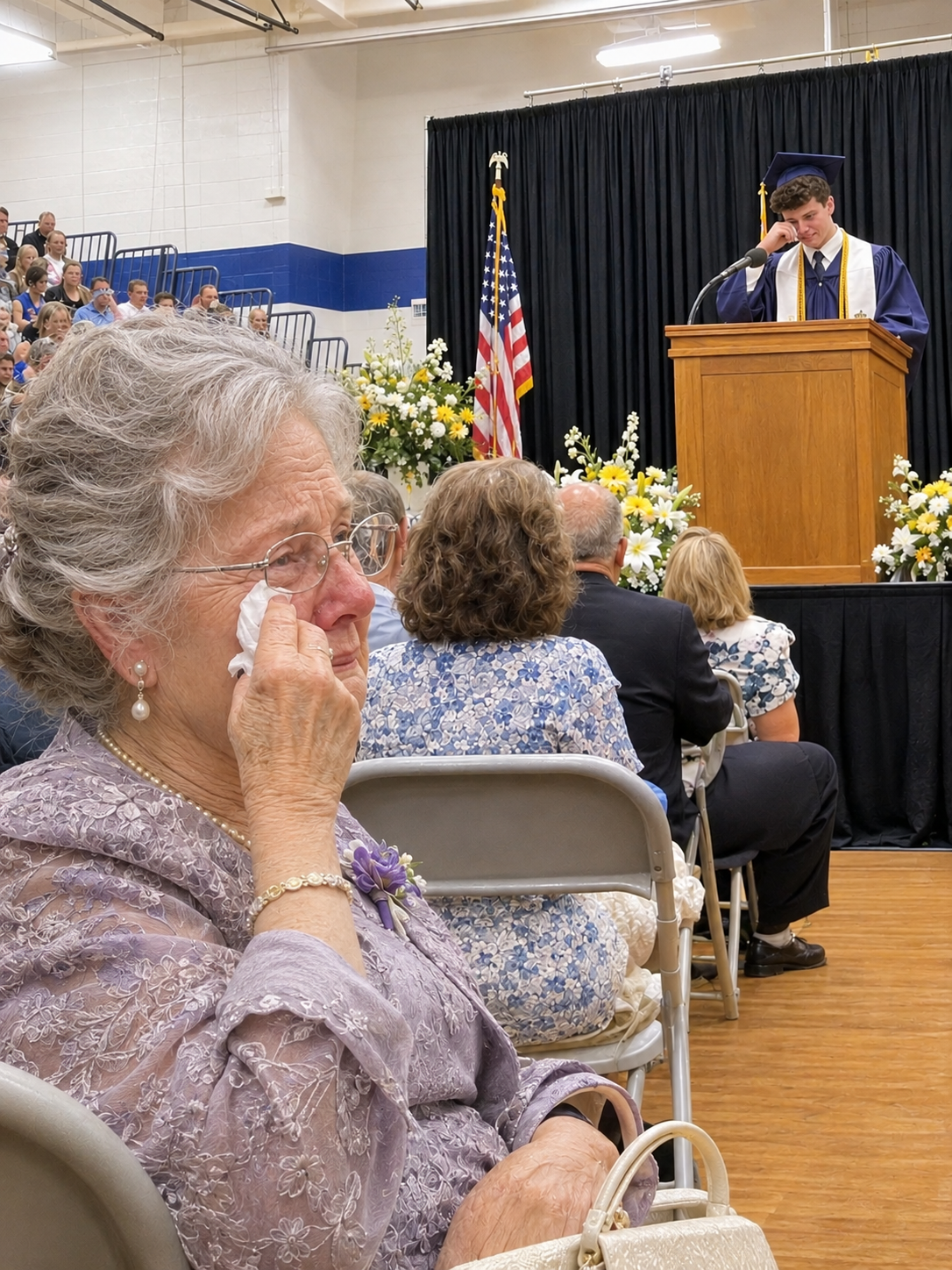
“Excuse me,” Toby said. His voice carried over the entire stadium, steady and clear. “I know this isn’t how it’s usually done. The dean was kind enough to let me say a few words. I promise it won’t take long.”
Laughter rippled through the seats.
“I want to tell you about the warm spot.”
My breath caught.
“When I was four years old, my parents died. I don’t remember much about that night. I remember a green blanket and a policeman’s hat. I remember my grandmother’s hands. She was fifty-eight, she worked in a school cafeteria, and she cleaned office buildings after dark.”
I put my hand over my mouth.
“Every night, she came home near midnight. And every night, I’d sneak down to the couch and wait for her under her mother’s afghan. When she walked in, I’d say, Grandma, I saved you the warm spot. I thought it was the most generous thing a person could offer. I was a kid. I didn’t understand that she was the one giving me everything.”
The stadium had gone quiet.
“Last spring, I found out something I hadn’t known. My father arranged, before he died, for a small amount of money to be sent to my grandmother every month. And for most of my life, I believed she’d done it all alone, with nothing, out of love. That’s still true. But I learned something else too.”
He paused. His voice shook.
“I learned that she never once spent that money on herself. I found her bank records. I found a notebook of every payment, and next to it, every receipt. Braces. Shoes. A school trip to Washington, D.C. A used Game Boy. Eighteen years of her own wages, and every dollar of Dad’s money, and she had saved all of it beyond what I needed. Every month. In an account in my name.”
I stared at the figure on the stage.
“There’s two hundred and eleven thousand dollars in that account,” Toby said. “My grandmother has been living on a cafeteria pension and the Social Security she earned, and she has never touched it. She never told me. She was going to hand it to me one day and tell me it was from my father.”
I hadn’t known the number. I had never added it up. I had just put money aside month by month, a little here and a little there, for years. It had never felt like a fortune. It had felt like what a person did.
“I was angry,” he said. “I’m going to be honest. When I read that notebook, I was furious, and I didn’t know why. I think it was shame. I’d been embarrassed about thrift-store jeans, and about a Game Boy, and about the days when she’d come home too tired to talk, and she had been quietly building me a future with her bare hands. I couldn’t stand how much I owed her.”
His voice broke on the last word.
“So I stopped calling. I told myself I was giving her space, that I’d return when I’d figured out how to be worthy of it. But I realized something three weeks ago, standing in my apartment looking at a package she sent me, a watch with our blanket engraved on the back. I realized you can’t earn your way out of being loved. You can only accept it.”
He turned and looked up into the stands, shading his eyes against the sun.
“Grandma, I know you’re here. You promised me the front row. I know they don’t hand those out to people who didn’t claim a ticket. I’m sorry I put you in the back.”
The crowd gasped. A few heads turned, scanning the upper deck.
“I’m sorry I said what I said on the phone. I don’t want you to leave me alone. I never did. I just didn’t know how to tell you that I was scared.”
By then, I was crying so hard I couldn’t see.
The usher beside me touched my shoulder. “Ma’am,” he said gently. “I think he’s looking for you.”
I stood up. My legs were shaking. A woman in the row ahead helped me to my feet, and then she was walking me down the steps, and another stranger took my other arm, and somehow, across what felt like a mile of concrete and aisles, the whole stadium parted. I heard applause. I heard someone whisper, that’s her.
By the time I reached the field, Toby had run down from the stage. He was standing at the gate in his cap and gown, tears running down his face.
He wrapped me in his arms, and I felt eighteen years fall away. He was not a graduate. He was four years old again, curled beneath a green blanket in the dark.
“Grandma,” he said into my hair. “I saved you the warm spot.”
“I know, baby,” I said. “I know.”
He took my hand and walked me up the steps, in front of ten thousand people, and sat me in a chair beside the dean on the stage. The president of the university came over and shook my hand. Someone brought me a glass of water. Toby stood beside me, his hand on my shoulder.
“This is my grandmother, Winifred Dunmore,” he told the crowd. “She’s the reason I’m here.”
The applause lasted a long time.
Afterward, in the parking lot, we sat on the tailgate of the car he’d borrowed from a friend, and he gave me back the watch. He’d opened it after all, and he’d read the back.
“I couldn’t send it back,” he admitted. “I kept it in my desk for a week. I looked at it every day.”
“You wrote Refused on the package,” I said.
“I know.” He gave a shaky laugh. “I wrote it, and then I took the package out of the mailbox before the mail carrier came. I wrote it so I could pretend I was angry. But I couldn’t actually send it.”
I slid the watch onto his wrist. It fit perfectly.
“That money is yours,” I said. “Your father’s, and mine. I want you to use it.”
“Part of it,” Toby said. “I’m going to use it to pay off the house. And the rest…” He hesitated. “I want to start a scholarship. In your name. For kids raised by their grandparents. They’re not rich, and some of them are afraid to ask for help, and they might end up in the back row somewhere.”
I couldn’t speak.
“The Winifred Dunmore Warm Spot Scholarship,” he said, smiling.
“Oh, Toby, no. That’s far too much fuss.”
“Grandma,” he said. “Just this once, let me make a fuss.”
That September, he started at Honda. He rented an apartment twenty minutes from my house and showed up every Sunday for dinner, bringing laundry he didn’t need me to do. He paid off my mortgage over my objections, then fixed the leaky porch roof himself, badly at first, and then well.
The scholarship launched in January. The first recipient was a quiet sixteen-year-old named Marisol, being raised by her grandmother in a two-bedroom apartment in Dayton. She came to our house for a visit with her grandmother, a wiry woman in a church hat, and the two of us sat at my kitchen table drinking tea while Toby and Marisol argued happily about calculus.
“She’s brilliant,” the grandmother said to me, low. “I don’t know how I’ll ever repay…”
“You don’t repay it,” I said. “You just keep showing up.”
That winter, on a cold night in February, I came home late from a church dinner and found my front door unlocked.
Toby was on the couch, wrapped in my mother’s green afghan, fast asleep with a book open on his chest. He was twenty-two years old and six feet tall, and his feet hung off the end.
I stood in the doorway and watched him for a long moment.
Then he stirred, blinked, and looked up. He smiled the same sleepy smile he’d had at four.
He shifted over.
“Grandma,” he said. “I saved you the warm spot.”
I sat down beside him and pulled the blanket over both of us.
For a few quiet minutes, neither of us said anything at all.