PART 1

The last thing I remember is Colin’s hand tightening around my throat.
Then my mother-in-law whispered in his ear:
“Not the face this time.”
After that, everything went black.
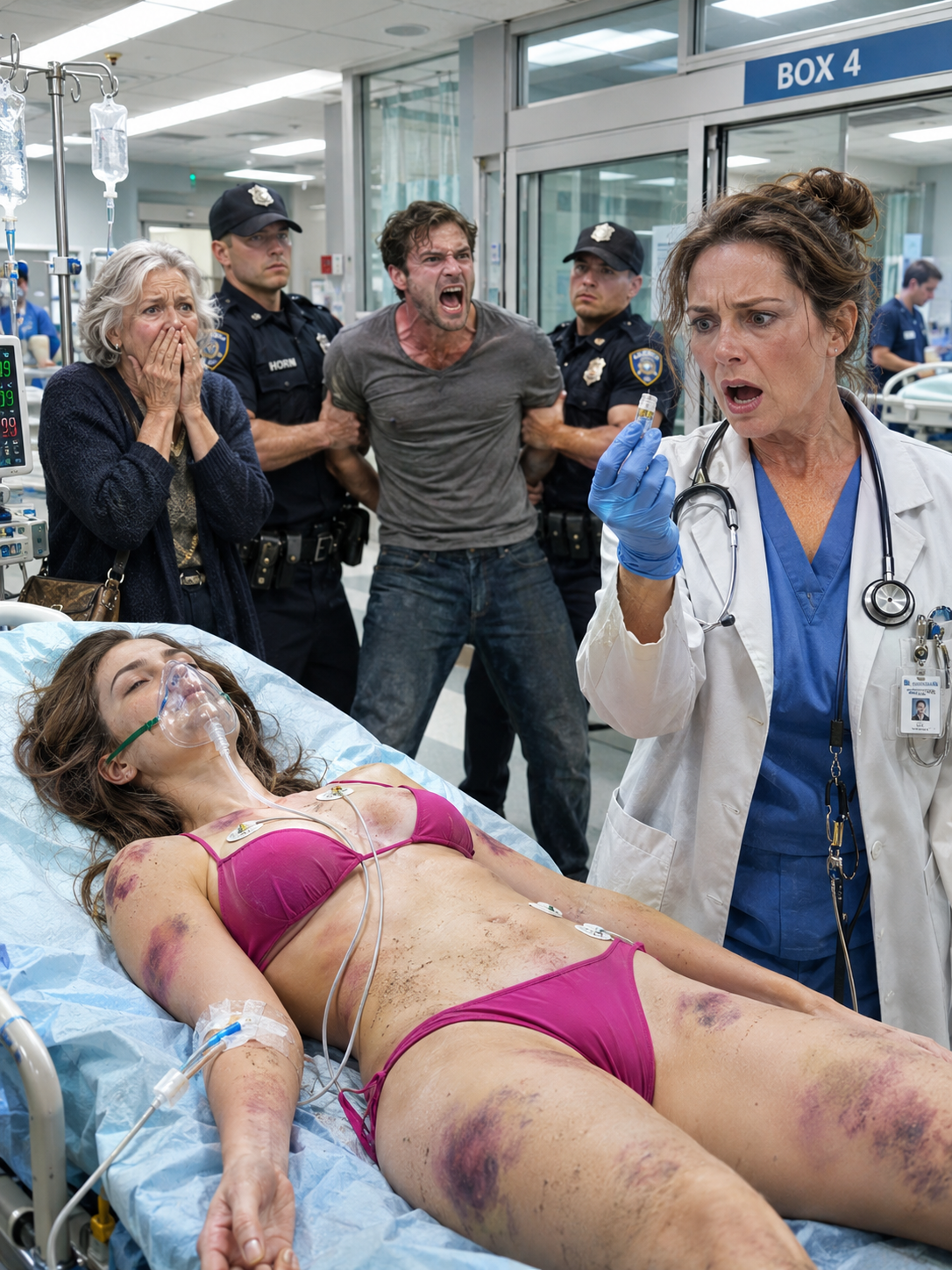
When I woke up, I was lying in the freezing rain outside the emergency room at St. Matthew’s. Water streamed into my eyes, mixing with the blood on my face.
My husband stood a few feet away, calmly telling the police that I had attacked him first.
His mother, Gwendolyn, stood beside him with a look of counterfeit compassion.
“She becomes violent when she’s in the middle of a mental episode,” she told the officers. “Those bruises around her neck? She did that to herself.”
I wanted to scream.
I wanted to tell them I hadn’t done anything wrong.
But every attempt to breathe sent a stabbing pain through my chest. My ribs were fractured. One eye was so swollen I couldn’t open it. There were finger-shaped bruises around my neck.
Colin looked at me with the perfect expression of concern he had been rehearsing for years.
“I begged her to get treatment,” he told the police. “But she wouldn’t listen.”
I stared at the man who had promised to protect me on our wedding day.
And for the first time, I understood that the most terrifying lies aren’t always the most elaborate ones.
Sometimes they’re told by people who know exactly whom to fool into believing them.
Then Dr. Rena Morris began examining my injuries.
Carefully, she lifted the medical tape beneath the collar of my shirt.
Suddenly, she stopped.
“Wait… what is this?”
Beneath the tape was a tiny recording device.
Colin’s expression changed.
Only for a second.
But I saw it.
Dr. Morris immediately placed the device inside a sealed evidence bag.
I struggled to lift my head; my throat burned so badly that every word felt like broken glass.
“I… put it there.”
Three weeks earlier, I had discovered what Colin and Gwendolyn were planning.
They had forged psychiatric reports, documented the medications I supposedly took, and prepared the paperwork needed to have me declared mentally incompetent.
Their goal wasn’t simply to control my life.
They wanted to take the software company I had inherited from my father.
A company worth hundreds of millions.
They believed they had erased every trace of their plan.
They believed that once everyone accepted that I was mentally unstable, nobody would question the documents they filed.
But they had made a catastrophic mistake.
Ten years earlier, I had built the cybersecurity division of that very company.
I understood how data was stolen.
How fraudsters hid their tracks.
And, most important, I knew how to build a backup system that not even someone with top-level access could secretly erase.
Every file Colin and Gwendolyn had opened had already been copied to an encrypted server controlled by my attorney.
And the recorder I wore beneath my blouse?
It had been running since dinner.
Officer Reyes watched Colin slowly backing toward the exit.
“Sir, stay where you are.”
Gwendolyn raised her voice at once.
“My son is the victim here!”
Dr. Morris examined the bruises around my throat.
Then she looked at the sealed evidence bag.
“We’ll let the evidence decide who the victim is.”
For the first time that night…
Colin stopped pretending to cry.
The look of suffering vanished from his face, exposing the rage he had lived with for years.
Because somewhere inside that tiny device was something he never expected anyone to hear.
His own voice.
I’m not denying the attack. You’re not accusing me. And then, calmly, exactly what he and Gwendolyn intended to do once they had made everyone believe I was mentally ill.
I looked at him.
He looked at me.
And for the first time in years, there were no lies left between us powerful enough to protect him.
But just as Officer Reyes was about to play the recording, Dr. Morris suddenly asked him to stop.
She had noticed a small line of text on the device.
A line showing that the recording hadn’t simply been saved to its internal memory.
It had also been transmitted to another address.
When the officer checked the address, his expression changed instantly.
Because the person receiving everything Colin said…
Wasn’t my attorney.
And it wasn’t the police.
It was someone whose name appeared on the very same forged documents Colin and Gwendolyn had prepared.
Someone who, according to his own paperwork…
Had been dead for six years.
PART 2
By dawn, the rain had stopped, leaving the windows of St. Matthew’s Hospital coated in dull gray enamel.
From my bed, through the reinforced glass window of my room, I watched Colin turn the hospital corridor into a stage. He was talking to two homicide detectives, displaying three small, shallow scratches on his left wrist. Gwendolyn stood beside him, dabbing at her tears, and handed the officers a manila envelope.
I couldn’t hear what they were saying, but I knew the script by heart. They were handing over the forged psychiatric reports.
My attorney, Priya Raman, slipped into my room at 6:15 a.m., bringing with her the scent of cold morning air and expensive espresso. She set her leather briefcase on the nightstand, pulled up a chair, and looked at my neck brace with an expression of protective fury.
“The offsite server caught everything, Fiona,” Priya whispered, leaning close so the officer posted outside wouldn’t hear. “The fake evaluations, the asset-transfer forms, even the emails between Colin and a corrupt doctor in Westbrook discussing how to sedate you before the court hearing.”
“The recorder?” I asked, my voice rough as crushed gravel.
“Reyes delivered it directly to the State Police Digital Forensics Unit,” Priya said with a cold smile. “The chain of custody is spotless. Colin’s very expensive lawyers can’t touch it.”
I closed my one working eye and leaned my head back against the pillow. “Let them keep talking. Let them cling to the lie.”
Out in the corridor, Colin was already pulling out his phone. Believing I was incapacitated and facing imminent arrest, he was making the final move of his plan.
He called an emergency meeting of the Board of Directors of Aegis Software.
From the hospital hallway, Colin logged into the secure board portal on a tablet, projecting his face onto the screen in the high-ceilinged conference room at our downtown headquarters. He presented the forged psychiatric petition to our eight board members, claiming I had suffered a catastrophic breakdown and had tried to kill him in our home.
“My wife is not medically fit to manage the administration of this company,” Colin announced through the screen, his voice cracking with overplayed drama. “As her spouse and healthcare proxy, I’m demanding temporary voting control of her fifty-one percent stake to protect the company from market instability.”
Priya set her phone on my blanket and put the board meeting audio on speaker.
For a long moment, the directors sat in total silence. Colin mistook their stillness for obedience.
Then our board chairman, Samuel Price, adjusted his wire-rimmed glasses and leaned toward the camera.
“Mr. Vale,” Samuel said, his voice completely flat. “Are you aware that Fiona amended the company bylaws six months ago during our annual compliance audit?”
Colin frowned at the screen. “She never mentioned any amendment.”
“She wasn’t obligated to,” Samuel replied evenly. “Article nine, section four states that any attempt by an immediate family member to gain emergency control of a voting stake through allegations of mental incapacity automatically triggers an immediate, independent forensic audit of the claimant’s personal and corporate finances. It also instantly suspends the spouse’s access to all company assets.”
Gwendolyn’s shrill voice rang through the tablet’s microphone from the hospital corridor. “That’s absurd! She’s insane! She attacked my son!”
Samuel ignored her completely. “Your building access credentials have been revoked, Colin. State police officers are at headquarters right now securing your office computer.”
The screen went black as Colin cut the call.
Ten minutes later, my hospital room door flew open. Colin stormed in, the mask of grief entirely abandoned, replaced by the wild, desperate rage of a cornered animal. Gwendolyn shoved aside the nurse behind him and slammed the heavy door shut.
“You think one little recording is going to save you, Fiona?” Colin hissed, leaning over my bed, his face inches from mine. “You were unconscious when the ambulance came! Nobody can prove I caused those injuries! I’ll tell the court you fell down the stairs during a psychotic rage!”
Gwendolyn leaned over the other side of the bed, her perfume cloying and suffocating. “Sign the temporary transfer papers right now, Fiona. Drop the accusations, or we’ll have you committed before the week is out.”
I looked up at the small black dome of the security camera blinking softly near the ceiling of the hospital room.
I forced my swollen lips into a cold, triumphant smile.
“You should have checked whether this room records audio,” I whispered.
Colin’s head snapped toward the ceiling camera.
Behind him, the heavy door opened again. Officer Reyes stood in the doorway, flanked by two plainclothes detectives holding open handcuffs.
“Actually, Mr. Vale,” Officer Reyes said as he stepped into the room, “she should thank you for repeating the extortion threat on camera.”
PART 3
Colin didn’t run. That was the strangest part. For three full seconds he simply stood there with his mouth slightly open, as if the sentence he needed was on the tip of his tongue and might still arrive if he waited.
“This is a family matter,” Gwendolyn said at last, her voice climbing. “You have no right to be in here. My son is a victim of this woman’s illness!”
“Ma’am, step back,” one of the detectives said.
“I will not step back! Do you know who my husband was? Do you know who we…”
“Mrs. Vale,” said Officer Reyes, almost gently, “you just told a woman with a broken neck brace that you’d have her committed unless she signed away her company. Everything you said was recorded on a hospital security system, in a room you entered uninvited.” He nodded to the detectives. “Both of them.”
The handcuffs closed with two small, ordinary clicks. Gwendolyn kept talking all the way down the hall, her voice growing thinner with every door. Colin said nothing. He looked back at me once over his shoulder, and I understood that he was finally doing the math on how long I had been planning for this.
The answer was ten years. He just hadn’t been paying attention.
Priya let out a long breath and pressed the heel of her hand to her forehead. “Okay,” she said. “Okay. Now let me tell you about the dead man.”
She pulled a tablet from her briefcase and set it on the bed beside me.
“Dr. Alistair Crane,” she said. “Board-certified psychiatrist. Practiced in Westbrook for thirty years. Died of a stroke six years ago. His license was never formally surrendered, and his credentials sit in a state database that nobody audits. Somebody has been using his name and license number to sign forged psychiatric evaluations ever since. They’re the signature on yours.”
“I know,” I said. My voice was a little stronger now. “That’s why I built the trap.”
Priya blinked. “You built it?”
“I found Crane’s name on the first forged report three weeks ago,” I said. “I traced the signature back to an email account tied to a hosting service that doesn’t ask many questions. The account belonged to a man who sells fake credentials to people who need them. Colin found him online. I just got there first.”
I told her the rest slowly, because speaking was still expensive.
I hadn’t had the authority to shut the account down, and I hadn’t wanted to. A shut account would have warned them. So I’d done something quieter. Using a vulnerability I recognized from my own old code, I had slipped into the mailbox and set it to mirror every message in and out, in real time, to a federal drop server. Then I had called an old contact at the FBI’s cyber division, a woman named Agent Torres, and told her I was about to hand her a forger and wanted her to keep her hands off until I said so.
The recorder under my collar had been configured with one more instruction. If a file ever fell below a certain size, which would happen if someone physically destroyed the device, it would upload its contents over a cell connection to the first address on its list.
The first address was the dead doctor’s mailbox.
“Because that’s where Colin would never look,” I said. “And because the forger would see the file arrive, panic, and try to move the account. He’d have to log in from a real machine.”
Priya stared at me for a long time. Then she started to laugh, a short, startled sound she tried to swallow. “That’s the most paranoid thing I’ve ever heard.”
“I used to run a cybersecurity division,” I said. “Paranoia was in the job description.”
Agent Torres called at noon.
“We have him,” she said, and I could hear the satisfaction in her voice even over the speaker. “Leonard Pruitt. Forty-four years old, lives in a two-bedroom in Dayton. He logged in at 8:41 this morning from his own laptop, in his own kitchen, trying to delete the Crane account after the audio hit his inbox. Our team walked in while the cursor was still blinking. He was running credential fraud for at least nine other clients, including two insurance schemes and a probate case in another state. Mrs. Vale’s son was only his most recent customer.”
“And Dr. Crane?”
“Still dead,” Torres said. “But he’s about to have a very bad week in the afterlife.”
I laughed, and it hurt, and I did it anyway.
The recording itself was played for the first time two days later, in a small conference room at the State Police headquarters, with Priya, Samuel Price, and two prosecutors in attendance. The audio had been enhanced by forensic technicians, but it hardly needed it. The dinner table. The clink of silverware. Gwendolyn’s calm voice, laying out the timeline like she was planning a holiday schedule.
“Once the board sees the evaluations, nobody will question it. We file for guardianship by Friday.”
Colin: “She’ll fight.”
“Then we make sure she doesn’t have the strength to.”
A long silence. Then Colin again, very quietly: “I’m not denying what I’m going to do tonight. You’re not accusing me. I just need her to stop looking at the servers.”
Then the sound that none of us would forget: a chair scraping back, a short struggle, a choked cry that took me a moment to recognize as my own.
One of the prosecutors, a woman who had probably heard a thousand recordings, reached over and paused the audio. She sat very still. Then she said, in a voice I wouldn’t have thought a prosecutor was allowed to use: “I’m sorry, Ms. Vale.”
“Don’t be,” I said. “Play the rest. They should be sorry in the right order.”
She played the rest.
There was a great deal of it. The plan to sedate me before the competency hearing. The names of the corrupt doctor in Westbrook and the notary who would witness the transfer. A specific discussion of how long they’d wait before selling the company to a competitor who had already, it turned out, been approached through back channels. Colin had been negotiating the sale of my father’s life’s work before he’d ever put his hands on my neck.
The state filed charges within the week: attempted murder, aggravated assault, kidnapping, conspiracy, forgery, and fraud. The federal government added wire fraud, identity theft, and conspiracy to commit extortion. Colin’s lawyers, who billed by the hour and had been so confident, withdrew from the case one by one after hearing the audio. His new public defender asked for a plea deal before the first hearing.
He got twenty-six years.
Gwendolyn insisted on trial. She told the jury through tears that she was a grieving mother who had been manipulated by an unstable woman, and for about an hour, a few jurors looked at her with something like sympathy. Then the prosecution played the dinner recording, and the sympathy drained out of the room like water from a basin. The jury returned in ninety minutes. She was convicted on every count and sentenced to nineteen years. At sentencing she turned to look for her son, but he was being held in a separate facility, and the seat beside her was empty.
The Westbrook doctor lost his license and took a plea. The notary cooperated. Leonard Pruitt, the man behind Dr. Crane, received fifteen years, and the dead doctor’s family, who had been horrified to learn that their father’s name had been used to steal six years of other people’s lives, thanked me in a letter I kept.
Samuel Price’s forensic audit of Colin’s finances turned up something I hadn’t expected. For three years, Colin had been quietly siphoning money out of our joint accounts into a private shell company. Not millions, but nearly six hundred thousand dollars in total. The court ordered every cent returned.
Recovery was slower than any court case.
My ribs took eight weeks to knit. The bruises on my throat faded from violet to yellow to nothing, but my voice stayed hoarse for months, and sometimes, in the dark, I woke up with my hand at my collar. My therapist, a patient woman named Dr. Abernathy, told me this was normal, that the body keeps its own records. I told her I understood that better than most people.
I went back to Aegis in the spring.
The board had voted unanimously to keep me as CEO, and when I walked into the conference room on my first day, I didn’t know what to expect. Samuel Price stood first. Then the rest of them. No one made a speech. Samuel just straightened his wire-rimmed glasses and said, “Welcome back, Fiona. The bylaws held up.”
“I wrote them that way,” I said.
“Yes,” Samuel said, a faint smile at his mouth. “We noticed.”
I spent that summer rebuilding. I commissioned an independent audit of every system Colin had touched. I hired a new chief of security. I started a small program inside the company, funded from my own pocket, that offered free cybersecurity consulting to domestic violence shelters, helping them lock down their data so abusers couldn’t track the women they’d driven out. The first shelter we helped was in Dayton, about ten minutes from Leonard Pruitt’s old kitchen.
In September, I received a card with no return address. Inside was a single line of handwriting I didn’t recognize.
I saw you on the news. I had the same dinner table. Thank you for not staying quiet.
I put it in my desk drawer, next to my father’s old fountain pen.
One evening that autumn, I stood on the balcony of my new apartment as rain started to fall. It wasn’t a storm, just a soft, steady rain, the kind that smells like pavement and wet leaves. For a moment, I braced for the old terror.
It didn’t come.
I thought about the night I’d woken on the cold ground outside the emergency room, bleeding, listening to the two people I trusted most calmly describe me as a madwoman. I thought about how close they’d come. A dozen things could have gone differently. The tape could have been found early. The board might have believed him. The recording might have been lost.
But I had spent ten years building systems designed to survive the people who wanted to destroy them. And somewhere along the way, without quite noticing, I had built one for myself.
The rain kept falling, quiet on the rooftops.
Colin had counted on a world where the loudest liar wins. He’d forgotten that some of us were trained to keep the records.
I stepped back inside, closed the balcony door, and turned off the light.