PART 1

My name is Josephine Hale. Everybody calls me Josie. I’m 58. I’ve waited tables at the Harbor Diner in Oceanside, California, for twenty-two years.
Oceanside is a Marine Corps town. Camp Pendleton is right up the road. We see a lot of uniforms.
Nine years ago, on November 11th, an old man came in at 7 a.m. and sat down in Booth 4.
Gray crew cut. Marine Corps ball cap. A Vietnam service ribbon pinned to his jacket.
“Two coffees, please, ma’am,” he said. “Black.”
I brought them. He slid one across the table to the empty seat. He didn’t touch it.
He sat there for three hours. Staring out the window. Drinking his one coffee.
When he got up to pay, his hands were shaking.
I told him it was on me.
“Thank you for your service, sir,” I said.
He looked at my name tag for a long time. Then he said, “Thank you, Josephine,” and left.
He came back the next Veterans Day. And the next. Every year. Same booth. Same two coffees. Same untouched cup.
His name was Mr. Walter Briggs. That’s all he ever told me.
Every year, I sat with him for five minutes. Every year, I paid his bill.
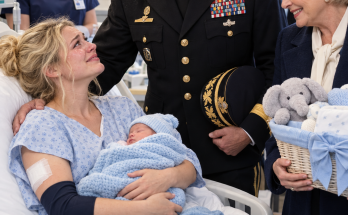
My father was a Marine too. He was killed in Vietnam when I was three months old. I never knew him. I have one photo of him, holding me in a hospital blanket, in his uniform.
Maybe that’s why I always sat with Mr. Briggs.
Last spring, the owner of the diner retired. His son, Brent, took over.
Brent is thirty-one. He wears a headset and talks about “table turnover.”
This Veterans Day morning, I set up Booth 4 like I always do. Two cups. A pot of coffee.
Brent saw it.
“Who’s that for?”
“Mr. Briggs. He comes every year.”
“The old guy who sits for three hours and orders two coffees? I heard about him.” Brent rolled his eyes. “Three hours. One booth. Zero tip. That’s a cheapskate, Josie, not a customer.”
“I pay his bill.”
“That’s the problem.” He crossed his arms. “This is a restaurant, not a museum for old soldiers. If he comes in, he orders food or he leaves. And you’re not paying for anybody. That’s coming out of your paycheck from now on.”
I didn’t argue.
I’ve worked for a lot of managers. Most of them don’t last.
I just poured the coffee and waited.
7 a.m. came. Then 7:30. Then 8.
Mr. Briggs didn’t come.
At 8:15, the bell over the door rang.
A young man walked in. Tall. Early twenties. Marine Corps dress blues. White cover tucked under his arm. Every button shining.
The whole diner went quiet.
He looked around until he saw my name tag. Then he walked straight to me.
“Ma’am, are you Josephine Hale?”
“Yes.”
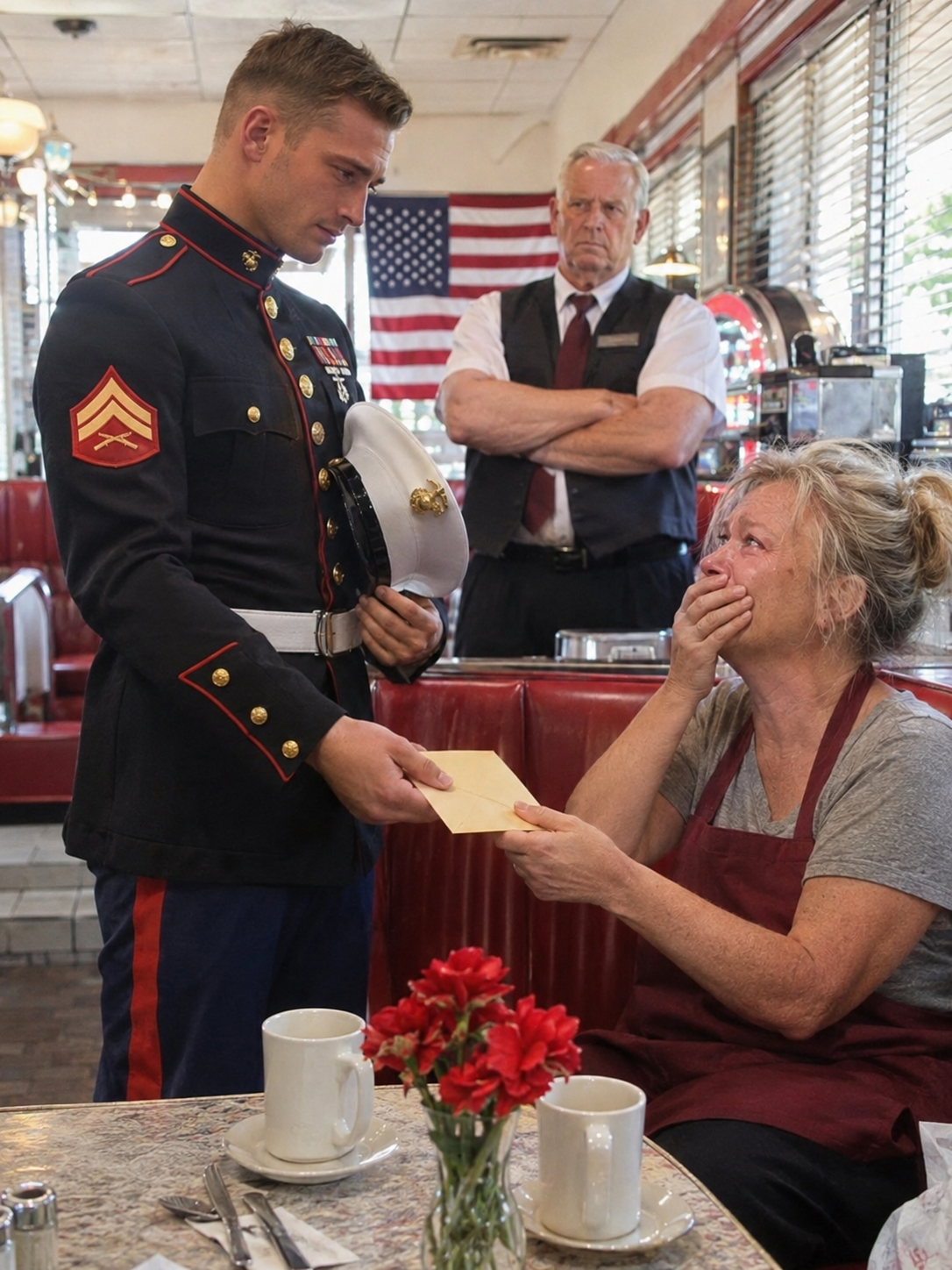
“I’m Corporal Ryan Briggs. Walter Briggs was my grandfather.”
Was.
“He passed away in September,” he said gently. “He made me promise to come here today. In uniform. And to give you this.”
He held out a thick, worn envelope. My name was written on the front in shaky handwriting.
Brent walked over, smiling his manager smile.
“Sir, we have a fifteen-minute booth limit during the holiday rush.”
The young Marine didn’t even look at him.
“Ma’am,” he said to me. “My grandfather told me something before he died.”
“He said you’d want to know who the second coffee was for.”
PART 2
My hands were shaking when I opened the envelope.
Inside was an old black-and-white photograph, soft at the corners from being handled. Two young Marines in jungle fatigues, arms around each other’s shoulders, squinting into the sun. Somewhere hot. Palm trees behind them.
One of them was a young Walter Briggs.
The other one had my nose. My chin. My crooked smile.
I’d seen that face my whole life, in the only photo I had of my father. I had never once seen him laugh. In this picture, he was laughing so hard his eyes were shut.
On the back, in faded ink: Walt and Tommy. Hue City. Jan. 1968.
“Ma’am,” Ryan said softly, “would you like to sit down?”
I didn’t answer. My legs made the decision for me. I sat in Booth 4, in the seat I’d taken for five minutes every November for nine years, and Ryan slid in across from me, into the seat where the second coffee always went. The cup was still there, still full, still going cold.
There was a letter, four pages, folded in thirds. I unfolded it on the table and smoothed it flat with both hands.
“Dear Josephine,
I should have told you this nine years ago. I was a coward. I’m sorry.
Your father, Private First Class Thomas Hale, was my best friend. We met on the bus to boot camp in San Diego, and he talked the whole way. By the time we got off, I knew his hometown, his mother’s maiden name, and the name of every girl who’d ever turned him down. There were a lot of them. He thought that was hilarious. We went through boot camp together. We shipped out together.
On February 4th, 1968, in Hue City, I was shot in both legs crossing a street. I couldn’t move. Rounds were hitting the pavement around me, and I remember thinking, so this is how it goes. Your father ran out into the open and dragged me behind a wall. He didn’t even stop to think about it.
Then he looked at me and said, ‘Stay put, Walt.’ As if I had a choice.
He went back for another man.
He didn’t make it back the second time.
The night before, he’d shown me a picture of his baby girl. Josephine. Three months old, wrapped in a hospital blanket. He said, ‘If anything happens, Walt, you check on her.’ I told him nothing was going to happen. I was twenty years old, and I believed it.
I came home that spring with a Purple Heart and a limp, and I couldn’t make myself pick up the phone. What do you say to a woman whose husband died holding the door open for you? I told myself I’d go see you when I felt worthy. That day never came. Years went by. Then decades. Every year the shame got heavier, and every year it got easier to put off.
After my wife passed, I finally went looking. It took a lot of phone calls and a patient young woman at the county records office. It took me forty-nine years to find you. When I did, I drove to Oceanside, parked across the street, and saw you through the window of this diner, pouring coffee. You had his smile. I sat in that car for two hours and couldn’t make myself walk in and say who I was.
So I came on the one day a year I thought I had a right to.
The second coffee was always for Tommy. He never could stand anything but black. He said it made him look tough. I told him it only made him look like he was suffering.
Every year, you sat with us. You didn’t know it, but you sat with your father.
I wanted to tell you a hundred times. Every November I’d practice the words in the truck. Then you’d say, ‘Thank you for your service, sir,’ and I’d think: it isn’t me you should be thanking. And I’d lose my nerve again.
Thank you for paying my bill, sweetheart. It was always his treat.
Semper Fi,
Walt”
I read it once. Then I read it again, slower, because the words kept sliding away from me. You sat with your father. Nine years. Nine Novembers of five-minute breaks and small talk about the weather, and the whole time, the man across from me had been carrying my father’s last words around like a stone in his pocket.
I looked at the untouched coffee. I thought about every year I’d asked him, kindly, if his friend was running late. He’d just smile that tired smile and say, “He’s always late.”
I put my hand over my mouth.
The diner was silent. I hadn’t noticed how silent. Nobody was eating. A table of old veterans by the window had taken off their caps, every one of them, and they held them against their chests like it was the Pledge of Allegiance. The cook had come out from the kitchen in his apron and stood by the pass-through with a dish towel hanging from his hand.
Brent stood beside the booth. He’d read part of the letter over my shoulder. His face had gone the color of skim milk.
“Josie,” he said quietly. “I didn’t know.”
“You didn’t ask,” I said.
He opened his mouth, then closed it. For once, he had no talking points.
Ryan stood up. He wasn’t loud about it, and he wasn’t unkind. He just stood there in his dress blues and looked at Brent for a long moment.
“Sir,” he said, “my grandfather sat in this booth for nine years. He wasn’t taking anything. He was visiting a friend.”
“I understand that now,” Brent said. His voice cracked a little. “I really do.”
“Yes, sir. I think maybe you do.”
Ryan sat back down. He reached into his jacket and took out one more thing, a small velvet box, worn pale at the edges. He set it on the table between us, next to the cold coffee.
“Open it, ma’am.”
Inside, on faded blue satin, was a Bronze Star medal with a small V device on the ribbon.
“My grandfather received that for the day your father saved him,” Ryan said. “Except he never believed it was his. He kept it in a drawer for fifty years. Every November, he’d take it out and set it on the kitchen table, and he’d say, ‘This belongs to Tommy.’ He made me promise to bring it to you.”
I lifted it out of the box. It was lighter than I expected. Fifty-eight years of not knowing, and it weighed almost nothing.
“There’s something else,” Ryan said. “He left instructions. He didn’t want you to feel like you owed him anything, so he put it in writing.” He pulled a folded paper from his breast pocket. “He said to tell you the only thing he ever wanted was for somebody to sit across from him and let him say your father’s name out loud. And you did that, every year, without even knowing it.”
I was crying by then. I hadn’t felt it start.
“Tell me about him,” I said. “Your grandfather. And my father. Did he ever tell you anything about my father?”
Ryan smiled for the first time, and I saw it, the same tired kindness that had been in the old man’s face.
“All the time, at the end. He said Tommy was the bravest man he ever knew, and the funniest. He said Tommy drank his coffee black because he thought it made him look tough, and that he hated every sip. He said Tommy used to sing out of tune on purpose to annoy the sergeant.” He paused. “And he said Tommy never stopped talking about you. You were three months old, and he already had your whole life planned out.”
I laughed. It came out as half a sob, and then I couldn’t stop either one. Behind me, somebody at the counter blew their nose. One of the old vets by the window wiped his face with the back of his hand and looked away, embarrassed.
I stayed in Booth 4 for the next three hours. Ryan told me stories, and I listened to every one. He told me how his grandfather had kept a small wooden box on his dresser, and how in the last week of his life, he’d asked Ryan to open it. Inside was a newspaper clipping, yellowed and brittle, with a one-paragraph notice about a fallen Marine from Oceanside named Thomas Hale, survived by a wife and infant daughter. Under it was a second clipping, much newer, from our local paper, about a waitress who’d been at the Harbor Diner for twenty years.
“He cut that one out himself,” Ryan said. “He carried it in his wallet.”
I asked him how long he was staying in town. He said just the weekend, and I told him he was eating at my table, and I didn’t care what anybody said about the booth limit. Nobody said a word.
Brent kept his distance for most of the morning. I saw him standing near the host stand, staring at the framed Marine Corps flag his father had hung there decades ago, one he’d walked past every day for months without looking. Around noon, he came over and stood at the end of the booth, hands in his pockets, no headset.
“Can I say something?”
I looked at him. I was tired, and I was raw, and I didn’t owe him a thing. But I nodded.
“I’ve been running this place for six months,” he said, “and I’ve been treating it like a spreadsheet. Tables per hour. Dollars per seat. I never once asked who anybody was.” He swallowed. “I’m sorry. I’m sorry to you, and I’m sorry to Corporal Briggs, and I’m sorry to your dad. I don’t know how to fix it. But I’d like to try.”
“Start by tearing up that paycheck deduction,” I said.
“Already done.” He pulled a crumpled sheet from his back pocket and tore it in half right there, then in half again. “And Josie? Take as long as you need. Take the whole week.”
“I’m working tomorrow,” I said. “Somebody has to open.”
For the first time all day, he almost smiled.
Brent made another announcement that afternoon, in front of the entire staff, and this one wasn’t about turnover. He said Booth 4 was coming off the reservation system permanently. He said that every Veterans Day, from now on, it would be held for anyone who needed it, and that the coffee would be free all day for anyone who had ever worn a uniform. Then he walked into the back and came out ten minutes later with a hammer and a small brass plaque he’d had the sign shop make on a rush order. I don’t know how he pulled that off on a holiday. I didn’t ask.
He screwed it into the wall above the table himself, crooked on the first try, then straightened it.
Booth 4. Reserved for Walt and Tommy. Coffee’s on the house.
That night, after close, I sat at my kitchen table with the photograph and the Bronze Star and the letter, and I took down the only picture of my father I’d ever owned, the one in the hospital blanket, and set it beside the one from Hue City. Same young man. Same crooked smile. In one picture he held a baby. In the other he held his best friend, and he was laughing.
I framed them together and hung them over the fireplace. For the first time in fifty-eight years, my father looked like someone I knew.
Last week, Ryan called. He’d been promoted to sergeant, and he wanted me to be the first to know. He said his grandfather would have loved that. I told him he should come back for the holidays. He said he would. He said he’d bring his mother, too, who’d never gotten to hear the whole story.
And this Veterans Day, he walked through the diner door at 7 a.m. sharp, in dress blues, white cover under his arm, and sat down across from me in Booth 4.
I poured three coffees.
One for him. One for me.
And one for the two Marines who started it all.