PART 1

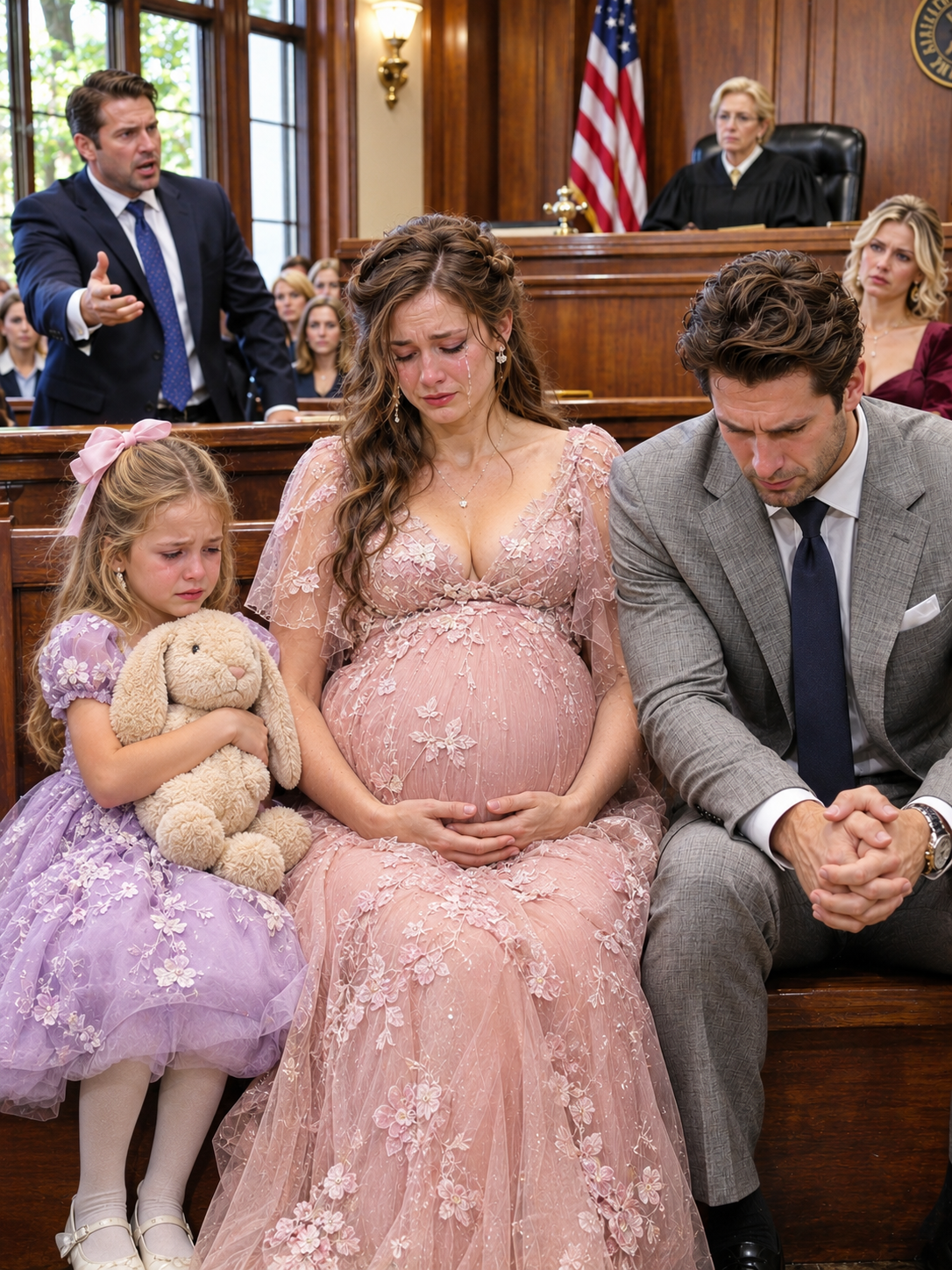
Eight months pregnant, I stood before a Missouri judge and surrendered our house, savings, cars, and every dollar of my husband’s business while his mistress laughed at me. Julian thought he’d finally gotten rid of me without losing a cent. But when the judge called our six-year-old daughter into the courtroom to explain what Daddy and the “mean lady” had done, my husband’s face turned white.
My name is Audrey Vance.
Seven years ago, I walked into that same courthouse believing Julian would love me forever.
Now I stood there with one hand protecting my unborn daughter, begging only to be free.
Across the courtroom, Julian wore an expensive navy suit. His wedding ring was already gone.
Beside him sat Clara Sterling.
His mistress.
She leaned close, whispered something, and smiled.
Judge Norris adjusted her glasses.
“Mrs. Vance, you’re surrendering the marital home, joint savings, both vehicles, and your husband’s business interests?”
“Yes, Your Honor.”
My attorney shifted uncomfortably.
“Everything?” the judge asked.
“Everything.”
Clara laughed.
A sharp, ugly sound that echoed through the courtroom.
Julian smirked.
The judge’s expression hardened.
“Ms. Sterling, one more interruption and you’ll be removed.”
I swallowed the burning lump in my throat.
“I don’t want the house where he brought her while I was at prenatal appointments. I don’t want the money he spent buying her jewelry.”
My voice cracked.
“I just want my baby to grow up somewhere she won’t have to watch her mother being humiliated.”
Julian jumped to his feet.
“She’s manipulating everyone! She’s unstable!”
“Sit down, Mr. Vance!”
He obeyed.
I looked directly at the man I’d once loved.
“You already took everything that mattered.”
Clara rolled her eyes.
Then something unexpected happened.
Judge Norris closed the divorce file.
“Before I make any ruling, there’s another matter this court must address.”
Julian frowned.
“What matter?”
The judge ignored him.
“Earlier today, I encountered a little girl crying near the hallway vending machines.”
My heart tightened.
“She told me something deeply troubling about her father and a woman she called the mean lady.”
Julian stopped moving.
Clara’s smile disappeared.
The judge turned toward the bailiff.
“Please bring the child inside.”
“No,” Julian whispered.
I heard him.
So did Clara.
For the first time that morning, she looked frightened.
The courtroom doors opened.
A little girl stepped inside wearing a yellow cardigan, clutching a worn stuffed rabbit.
My knees nearly gave way.
“Rosie?”
My six-year-old stepdaughter.
Julian’s little girl.
She looked at me first.
Then at her father.
Her lower lip trembled.
“Daddy,” she whispered, “am I supposed to tell them what happened?”
Julian gripped the table.
“Rosie, don’t…”
“Mr. Vance!” the judge warned.
Rosie hugged her rabbit tighter.
Then she looked toward Clara.
And whatever she was about to say made her reach desperately for Julian’s hand.
PART 2
Clara’s fingers closed around Julian’s hand.
It was a small movement, almost instinctive, but I saw it clearly. So did Judge Norris.
“Let go of him, Ms. Sterling,” the judge said.
Clara released Julian at once.
Rosie stood beside the bailiff, clutching her stuffed rabbit beneath her chin. Her eyes moved from her father to Clara, then finally back to me.
I wanted to run to her…
I wanted to gather that trembling little girl into my arms and tell her she didn’t have to be frightened anymore.
But something in her expression stopped me.
She wasn’t simply scared.
She was carrying a secret.
And whatever that secret was, Julian already knew it.
Judge Norris spoke gently.
“Rosie, sweetheart, you are not in trouble. You don’t have to answer questions here in front of everyone.”
Rosie shook her head.
“But I have to tell somebody.”
The judge glanced at the attorneys.
After a brief discussion, she arranged for a child-welfare specialist to speak with Rosie privately, rather than requiring a six-year-old to describe frightening events in open court.
Before Rosie left, she turned toward me.
“Mama?”
My eyes filled with tears.
“Yes, sweetheart?”
“Please don’t give Daddy our house.”
Julian’s chair scraped against the floor.
“Rosie!”
The judge immediately ordered him to remain silent.
But Rosie wasn’t finished.
“Because it’s not Daddy’s house anymore.”
A terrible silence settled over the courtroom.
I stared at her.
“What do you mean, baby?”
She hugged her rabbit tighter.
“The mean lady said she was going to sell it. And she said you and the baby could sleep in your car.”
Clara’s face turned crimson.
“That’s completely ridiculous!”
Judge Norris looked directly at her.
“Ms. Sterling, leave the courtroom until you’re called.”
Clara opened her mouth to protest.
Then she saw the judge’s expression.
She stood and walked toward the doors.
For the first time since our marriage collapsed, Julian looked genuinely afraid.
And I was beginning to understand why.
An hour later, my attorney, Margaret Ellison, asked to speak with me privately.
We sat inside a small conference room while Rosie remained with the child-welfare specialist.
Margaret placed a folder on the table.
“Audrey, I need you to listen carefully.”
My hands were trembling.
“Is Rosie okay?”
“She’s safe. But what she reported raises serious concerns.”
I pressed a hand against my pregnant belly.
“What did she say?”
Margaret hesitated.
“She described conversations she overheard between Julian and Clara. According to Rosie, they were planning to transfer ownership of several properties before the divorce was finalized.”
I stared at her.
“What properties?”
“Our house,” Margaret said. “And possibly two commercial buildings connected to Julian’s company.”
I shook my head.
“That can’t be right. Julian told me the business was nearly bankrupt.”
Margaret opened the folder.
“That’s what he told us, too.”
Inside were copies of financial documents.
Bank statements.
Property records.
Business transfers.
Numbers I barely understood.
Then Margaret pointed to one transaction.
“Three weeks ago, a company connected to Clara received a substantial payment from Julian’s business.”
“How much?”
“Four hundred and eighty thousand dollars.”
My breath caught.
“Four hundred and eighty thousand?”
Margaret nodded.
“And that’s only one transaction.”
I remembered Julian sitting across from me at our kitchen table, telling me there wasn’t enough money to pay our mortgage.
He’d said the business was failing.
He’d blamed the economy.
He’d told me that if I demanded anything in the divorce, his employees would lose their jobs.
I’d believed him.
I’d even offered to surrender my share of the company because I thought it might save other families from financial hardship.
Now I realized I’d been making sacrifices based on a story that might never have been true.
But Margaret wasn’t finished.
“There’s something else.”
She slid a second document toward me.
It was a photograph of a handwritten note.
The writing was childish, uneven, and unmistakably Rosie’s.
At the top were four words.
MAMA’S IMPORTANT PAPERS.
Underneath was a drawing of a brown envelope.
“Rosie told the specialist she saw Clara removing documents from your bedroom,” Margaret explained.
My stomach tightened.
“What documents?”
“She’s not certain. But she remembered the envelope because it had your name written on it.”
I closed my eyes.
There had been a brown envelope.
My father had given it to me shortly before he died.
Inside were copies of the documents relating to the money he’d left me.
Money I’d used to help Julian start his business.
Money Julian had always promised to repay.
And suddenly, I remembered something else.
Two months earlier, I’d searched everywhere for that envelope.
Julian told me I must have misplaced it.
Clara had laughed and suggested that pregnancy was making me forgetful.
I’d believed them both.
The divorce hearing was postponed.
The court ordered further financial disclosure, and Margaret began working with a forensic accountant.
Meanwhile, Rosie stayed with my sister, Beatrice, and me under an approved temporary care arrangement while the appropriate authorities reviewed the concerns surrounding her welfare.
Julian was furious.
He called repeatedly.
Sometimes he shouted.
Sometimes he begged.
And sometimes he spoke so softly that I almost recognized the man I’d married.
“Audrey, please. We can fix this.”
But I had spent seven years trying to fix things Julian refused to acknowledge.
I wasn’t going to do it again.
One evening, he left a voicemail.
“You’re destroying our family over something a little girl thinks she heard.”
I listened once.
Then I saved it for my attorney.
Because Rosie hadn’t destroyed anything.
She’d simply spoken when the adults around her expected silence.
Three weeks later, Margaret called with news that changed everything.
“Audrey, we found the trust documents.”
I was sitting at Beatrice’s kitchen table, folding tiny baby clothes.
My hands stopped moving.
“Where?”
“Among records obtained during the financial review.”
I could barely breathe.
“What did they say?”
Margaret took a moment before answering.
“Your father placed money into a trust for your benefit. The documents indicate that some of those funds were used in connection with Julian’s business, but the underlying ownership arrangements were never properly disclosed during the divorce.”
I stared at the wall.
My father had worked for forty years as a carpenter.
He’d never been wealthy.
But he’d saved carefully, lived modestly, and invested wisely.
Before he died, he’d held my hands and said, “Audrey, I can’t protect you from every disappointment. But I can leave you something that belongs to you.”
I’d used much of that inheritance to help Julian pursue his dream.
He’d promised we were building a future together.
Now I was learning that he had tried to erase my contribution entirely.
Margaret continued.
“The court will have to determine how these assets should be treated. But Julian cannot simply pretend your financial interest never existed.”
For the first time in months, I felt something stronger than fear.
Hope.
The most painful discovery came a week later.
Rosie was sitting on the living room carpet, arranging her dolls in a circle.
I sat beside her, resting one hand on my belly.
“Mama?”
“Yes, sweetheart?”
“Are you going to have the baby soon?”
“Very soon.”
She smiled.
“Can I help pick her clothes?”
“Of course.”
Then her expression changed.
“Can I ask you something?”
“Anything.”
She looked down at her stuffed rabbit.
“Did Daddy stop loving you because you got a baby?”
My heart broke.
“Oh, Rosie. No.”
“But the mean lady said you ruined everything when you got pregnant.”
I took a slow breath.
“Sometimes adults make hurtful choices, sweetheart. But none of this happened because of you or your baby sister.”
Rosie considered that.
Then she whispered, “Daddy told me you weren’t my real mama.”
I closed my eyes.
Rosie’s biological mother had died when she was only eight months old.
I’d entered her life shortly afterward.
I was there for her first steps.
Her first day of preschool.
Her first lost tooth.
Every birthday.
Every nightmare.
Every ordinary Tuesday when she needed someone to hold her hand.
And now Julian was using biology to threaten the only maternal relationship she’d ever known.
I gently took her hands.
“Rosie, I love you. Nothing about what Daddy and I are going through changes that.”
She leaned against me.
“Even when the baby comes?”
“Especially then.”
She wrapped her arms around my belly.
“Good,” she whispered. “Because I already love her.”
The following month, my daughter arrived.
It happened earlier than expected.
I was in Beatrice’s kitchen when a sudden contraction made me grip the counter.
My sister rushed toward me.
“Audrey?”
I nodded.
“I think it’s time.”
The hospital staff moved quickly, and after several exhausting hours, I heard the most beautiful sound in the world.
My baby crying.
The nurse placed her in my arms.
She had dark hair, tiny fingers, and the sweetest little face I’d ever seen.
I named her Iris.
My father had loved irises.
He used to plant them along the fence every spring, telling me they were proof that beautiful things could return after the hardest winters.
When Rosie visited the next morning, she approached the hospital bed cautiously.
“Is that my sister?”
I smiled.
“Yes.”
She climbed onto the chair beside me.
“She’s so little.”
“She’s brand new.”
Rosie studied Iris for a long moment.
Then she gently touched one tiny hand.
“Hi, Iris. I’m your big sister.”
The baby moved her fingers.
Rosie’s eyes widened.
“She held my hand!”
I laughed through my tears.
“She did.”
Rosie looked at me.
“Mama, can I tell her something?”
“Of course.”
She leaned toward the baby.
“Don’t worry. I’ll always tell somebody if you need help.”
I pulled both my daughters close.
And for the first time since the divorce began, I believed we might truly be okay.
The financial proceedings continued for months.
Investigators reviewed Julian’s business transactions, and the court examined the evidence of concealed assets.
The accountant discovered that Julian had moved substantial sums through companies connected to Clara.
There were also discrepancies involving property valuations and documents submitted during our divorce negotiations.
Julian’s attorneys challenged several findings.
Margaret responded with records, testimony, and independent financial analysis.
It was exhausting.
But the process gradually revealed how misleading Julian’s original financial disclosures had been.
The judge ultimately rejected the proposed settlement that would have left me with nothing.
Instead, the court considered the verified assets, my financial contributions, and the applicable legal requirements.
The final agreement was nothing like the one Julian had expected.
I received a fair financial settlement, including funds that allowed me to establish a stable home for my daughters.
Julian also faced separate consequences relating to the financial misconduct uncovered during the investigation.
As for Clara, she disappeared from our lives shortly after the proceedings intensified.
I later heard that she and Julian had ended their relationship.
I didn’t ask why.
For once, I genuinely didn’t care.
But there was still one matter more important than money.
Rosie.
Because I was her stepmother, the legal arrangements surrounding her care required special consideration.
Margaret helped me pursue the appropriate legal avenues, and child-welfare professionals assessed what would best support Rosie’s safety and emotional well-being.
I attended meetings.
Completed evaluations.
Answered difficult questions.
And waited.
Some nights, after both girls were asleep, I sat alone at the kitchen table wondering whether everything I’d done would be enough.
I could lose the mansion.
I could lose the cars.
I could lose every expensive possession Julian had ever bought me.
But the thought of losing Rosie was almost unbearable.
Then one afternoon, Margaret called.
“Audrey, we have an update.”
My heart raced.
“What happened?”
“The court has approved a longer-term arrangement allowing Rosie to remain in your care, subject to the required reviews and protections.”
I covered my mouth.
“Really?”
“Yes. There are still legal steps ahead, but this is a significant development.”
I started crying.
Not because I’d defeated Julian.
But because Rosie would have stability while the adults continued working through the legal process.
When I told her, she looked at me seriously.
“So I can stay with you and Iris?”
I nodded.
“Yes, sweetheart.”
She thought for a moment.
“Can I keep my butterfly curtains?”
I laughed.
“Of course.”
Then she threw her arms around my neck.
“Good. Because this is my home.”
A year later, we moved into a modest white house with a blue front door.
It had three bedrooms, a sunny kitchen, and a backyard filled with wildflowers.
Nothing about it resembled Julian’s mansion.
And I loved every inch.
Rosie chose lavender paint for her bedroom.
Iris had a pale-yellow nursery.
And I planted irises along the front walkway in memory of my father.
One Saturday afternoon, Rosie helped me carry small flowerpots onto the porch.
“Mama?”
“Yes?”
“Do you remember the day we went to court?”
I stopped.
“Yes, sweetheart.”
She looked at her shoes.
“I thought Daddy would be mad forever.”
I sat beside her.
“Sometimes adults feel angry when things change. But you were never responsible for managing his feelings.”
She nodded.
“Was I brave?”
I smiled gently.
“You were brave to ask for help. But I wish you hadn’t needed to carry such a big worry.”
Rosie leaned against my shoulder.
“I’m not scared anymore.”
I wrapped an arm around her.
“I’m glad.”
She looked toward the backyard, where Iris was playing on a blanket.
“Can we plant more flowers?”
“Absolutely.”
“Enough for the whole yard?”
I laughed.
“We can try.”
Two years after the divorce, I received an unexpected invitation.
A local women’s support organization was holding an event for people rebuilding their lives after difficult marriages.
They asked whether I’d share my experience.
At first, I refused.
I didn’t want to become known as the woman whose husband had betrayed her.
But then I thought about the person I’d been that morning in court.
Eight months pregnant.
Terrified.
Prepared to surrender everything because I believed I had no other choice.
And I wondered how many women were sitting in their own kitchens feeling exactly the same way.
So I agreed.
I stood before a small audience and told them what I’d learned.
“I used to think being a good wife meant sacrificing whatever was necessary to keep my marriage together,” I began.
My voice trembled.
“I thought if I gave enough, forgave enough, and stayed quiet enough, everything would eventually get better.”
I paused.
“But love isn’t supposed to require you to disappear.”
Several women nodded.
“I nearly signed away my financial security because I was exhausted and afraid. I didn’t understand that I could ask questions, seek independent advice, and take time before making decisions that would affect my children’s future.”
I glanced toward the back of the room.
Beatrice sat there holding Iris.
Beside her, Rosie was coloring quietly.
“I learned that starting over isn’t always dramatic. Sometimes it’s filling out paperwork. Going to appointments. Asking for help. Getting through one difficult day and then another.”
I took a breath.
“And sometimes it’s realizing that the children watching us need more than a perfect-looking family.”
My voice softened.
“They need a safe one.”
When I finished, the room filled with applause.
But the moment that stayed with me came afterward.
A woman approached me with tears in her eyes.
“I’ve been afraid to speak to a lawyer,” she admitted.
I gently encouraged her to seek qualified advice and support.
She nodded.
“Thank you. I think I’m ready to ask some questions.”
And I realized my story could mean something beyond the pain I’d endured.
That evening, I returned home to find Rosie waiting in the living room.
She was eight now, with longer hair and a smile that reminded me of the little girl I’d first met years earlier.
In her hands was a folded piece of construction paper.
“I made you something.”
I sat beside her.
“What is it?”
“A picture.”
She unfolded it.
There were three figures standing in front of a white house.
One tall woman.
One little girl.
One toddler.
Above them was a bright yellow sun.
Underneath, Rosie had written:
OUR FAMILY IS ENOUGH.
My eyes filled with tears.
“It’s beautiful, sweetheart.”
She smiled.
“Do you know why I made it?”
“Why?”
“Because at school, someone asked why I don’t live in a big house anymore.”
I felt a familiar ache.
“What did you say?”
Rosie shrugged.
“I told them our old house was bigger, but our new house is happier.”
I pulled her close.
She rested her head against my shoulder.
Then she whispered, “Mama, are you happy now?”
I looked around our living room.
There were toys scattered across the carpet.
A basket of laundry sat beside the couch.
Iris was sleeping upstairs.
The kitchen needed cleaning.
And tomorrow morning, I’d have bills to pay and work to finish.
Life wasn’t perfect.
But it was peaceful.
“Yes,” I whispered. “I really am.”
Sometimes I still think about that courtroom.
About Julian’s expensive navy suit.
About Clara’s laughter.
About the papers I was ready to sign.
I remember how small I felt standing before the judge, convinced that surrendering everything was the only way to escape.
And then I remember Rosie.
A frightened six-year-old girl in a yellow cardigan, holding a worn stuffed rabbit.
She didn’t understand property law.
She didn’t understand business accounts or financial disclosures.
She certainly didn’t understand how complicated the months ahead would become.
But she understood that something was wrong.
And she found the courage to ask for help.
Her words didn’t magically solve everything.
Professionals still had to investigate.
The courts still had to review evidence.
Our family still had to rebuild.
But her willingness to speak opened the door to truths I’d been too overwhelmed to uncover alone.
And through everything that followed, I learned something I’ll carry for the rest of my life.
A marriage can end without ending your future.
A beautiful house can be lost without losing the meaning of home.
And sometimes the greatest victory isn’t watching the people who hurt you face consequences.
It’s waking up one morning and realizing their choices no longer control your happiness.
Last spring, I stood in our backyard watching Rosie teach Iris how to plant flowers.
Iris was three, stubborn and curious.
Rosie was nine, patient and protective.
They were both covered in dirt.
Rosie held up a small purple iris.
“Mama! Look!”
I walked toward them.
“It’s beautiful.”
She grinned.
“Just like the ones Grandpa used to grow, right?”
I nodded.
“Exactly.”
Then Iris reached for my hand.
“Mommy, help!”
I knelt beside my daughters.
Together, we placed the flower into the soil.
The sun was warm.
The birds were singing.
And somewhere inside our little white house, the washing machine was running.
It was an ordinary afternoon.
The kind of afternoon I once thought I’d never experience again.
Rosie leaned against me.
“Mama?”
“Yes?”
“Do you think Grandpa would like our garden?”
I looked at the flowers.
Then at my daughters.
And finally at the home we’d built from everything that remained after our lives fell apart.
“I think he’d love it.”
Rosie smiled.
Then she took Iris’s hand and ran toward the porch.
I watched them go.
And I understood that the most precious things in my life had never been the mansion, the cars, or the money.
They were the two little girls laughing beneath the afternoon sun.
The peace inside our home.
And the knowledge that I no longer had to surrender myself to deserve love.
Julian thought he’d taken everything when our marriage ended.
But the day my six-year-old daughter walked into that courtroom, I began discovering everything I still had.
And that turned out to be more than enough.