Part 1

The family courtroom in Knoxville, Tennessee, seemed even colder than the January weather outside.
I sat beside my eight-year-old daughter, Willa, at a narrow wooden table.
Her legs were too short to touch the floor, and her feet swung nervously beneath her chair.
I’d dressed her in her nicest jeans, freshly cleaned winter shoes, and a faded navy shirt with a little embroidered moon.
I’d washed that shirt countless times, but a few dark marks refused to disappear.
Still, Willa loved it, and I hadn’t wanted to make her wear something else.
Across the room sat my former husband, Reid Hadley.
His charcoal suit fit perfectly, his shoes gleamed, and an expensive silver watch shone on his wrist.
He looked like a successful businessman.
Certainly not like a father who repeatedly claimed he couldn’t afford to support his own child.
Beside him was Vaughn Mercer, an attorney whose fees were probably more than I earned in months.
I had no lawyer.
Only a folder packed with receipts, financial records, and messages showing how often Reid had broken his promises.
Those papers were all I had to defend myself.
Mercer rose and addressed the judge.
“Your Honor, we don’t question Mrs. Hadley’s affection for her daughter. But loving a child doesn’t excuse an unstable financial situation or potentially unsuitable living conditions.”
My fingers tightened around the table’s edge.
He held up a large photograph.
It showed Willa leaving school three days earlier.
She was wearing her favorite navy shirt, with noticeable stains across the front.
Her hair was messy, and she looked tired after spending the day in class.
To me, it was a perfectly ordinary photograph of a child coming home from school.
But Reid’s lawyer described it as evidence of neglect.
“A licensed investigator obtained this image,” Mercer explained. “It confirms our client’s concerns regarding the girl’s everyday care.”
He gestured toward the stained fabric.
“The child frequently wears soiled clothing. Her mother works irregular hours, struggles financially, and lives in an apartment unsuitable for raising her.”
Willa stared down at her lap.
Her cheeks turned red.
Seeing my little girl embarrassed in front of strangers while her father sat smiling was almost more than I could bear.
What made it worse was knowing that Reid had deliberately contributed to the very difficulties his lawyer was describing.
For months, he’d been making it harder for me to provide for Willa.
Now he was presenting those struggles as proof that I shouldn’t have custody.
Two years earlier, Reid had ended our marriage and walked away from our family.
Before leaving, he took our expensive coffee machine, the bedroom television, and most of the valuable things we owned.
Then he moved into a large townhouse.
He initially promised we’d work out the finances privately, without involving attorneys.
But three months later, he stopped answering my messages.
I was left paying nearly everything Willa needed.
Eventually, my mother, Gwen, moved into our small apartment above a bakery to help us.
Every morning, I served breakfast at a local diner.
In the evenings, I cleaned offices downtown.
The cleaning work paid better than my restaurant job.
With both incomes, I could cover our rent, groceries, and Willa’s school expenses.
I was constantly tired, but at least we were managing.
Then Reid interfered.
Through someone he knew from golfing who managed the office building, he arranged for an anonymous complaint accusing me of misconduct at work.
The claims were false.
But I lost my evening cleaning contract anyway.
That was our most dependable source of income.
Reid also paid our landlord to describe the apartment as dirty and inappropriate for a child.
He was manufacturing evidence against me while pretending to be concerned about Willa’s welfare.
Every financial setback he helped create became another argument his attorney could use in court.
Meanwhile, he continued enjoying his expensive lifestyle.
I did everything possible to keep Willa from worrying.
But children notice more than we think.
One night, she found me sitting at our kitchen table with overdue bills spread around me.
“Mom, are we going to be okay?”
I turned the papers over and forced a smile.
“Of course, sweetheart. I’m just deciding which bills to handle first.”
She climbed onto the chair beside me and studied the envelopes.
“When I’ve got lots of homework, I do the easiest one first. Maybe that would help with the bills.”
I nearly cried.
I hugged her, wishing our financial problems were as simple as her school assignments.
Four months before the custody hearing, Willa’s birthday was approaching.
Money was especially tight after I’d lost the cleaning job.
But I wanted her to have something special.
So I went to a pawn shop.
I sold my grandmother’s antique gold locket, the last valuable keepsake I’d inherited from my family.
Giving it up broke my heart.
But the money was enough for a small birthday cake and a children’s book about constellations.
Then, while looking through a nearby clearance section, I noticed something else.
A soft navy shirt with a tiny silver moon stitched above the pocket.
Willa had always been fascinated by stars and planets.
The moment I saw it, I knew she’d love it.
For once, I wanted her to receive a brand-new piece of clothing, something chosen especially for her rather than handed down or donated.
Her face lit up when she opened the gift.
Soon, that shirt became her favorite.
She wore it so often that its color began fading.
And despite all my washing, a few stains eventually became permanent.
Now, four months later, Reid’s attorney was using that birthday present to accuse me of neglect.
As Mercer continued speaking, I remembered standing in the pawn shop, surrendering my grandmother’s necklace so my daughter could enjoy her birthday.
I’d given up something precious to see her smile.
And Reid was turning that sacrifice against us.
I glanced at my ex-husband.
I hoped, foolishly, that he might feel ashamed.
Instead, he sat comfortably in his chair, looking completely satisfied.
The judge studied the photograph.
My stomach twisted.
Without an attorney to challenge the accusations, I feared Reid’s expensive legal team might convince the court to separate me from my little girl.
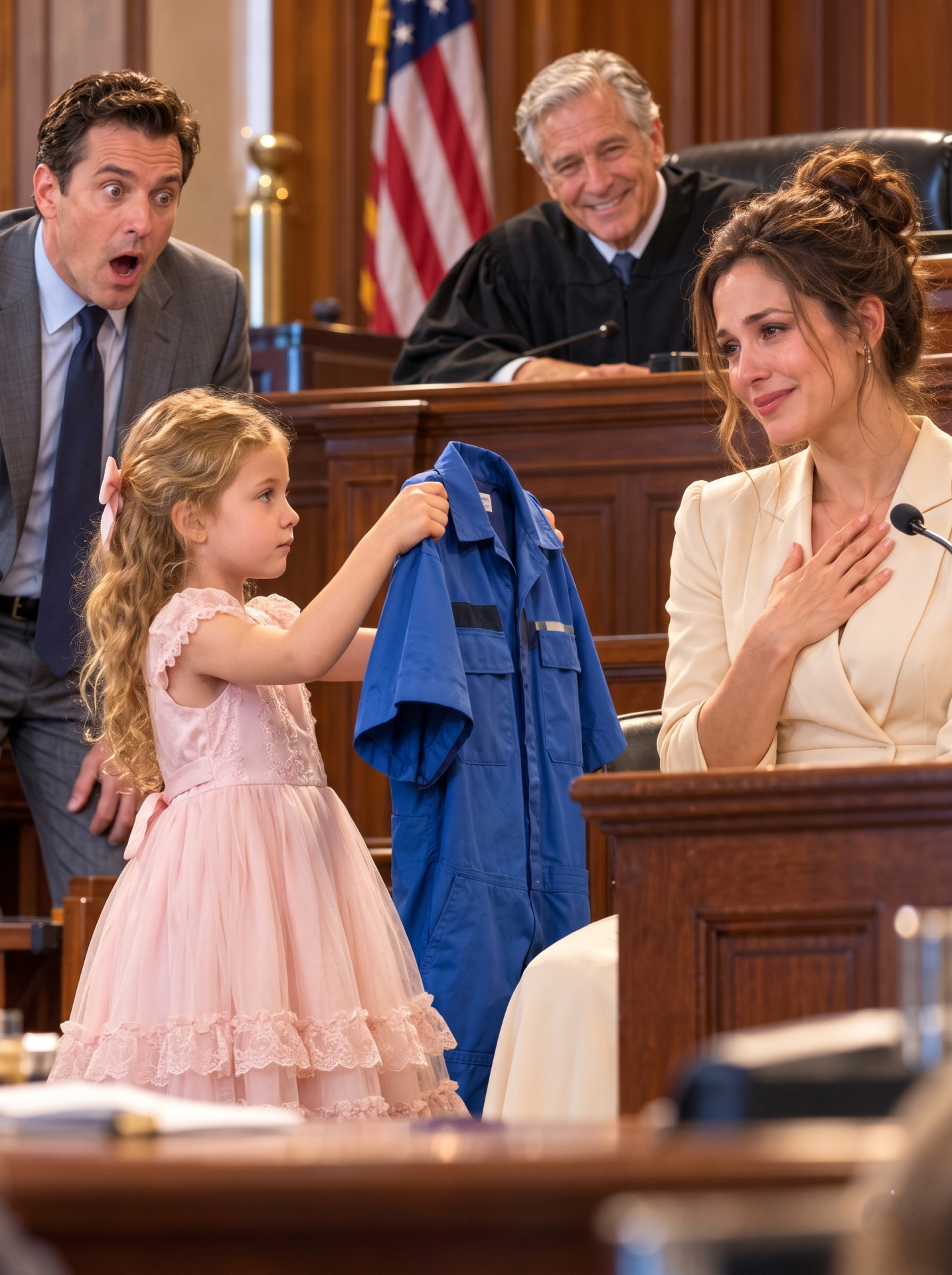
Then Willa moved beside me.
She’d remained almost completely silent throughout the hearing.
Her small hands had rested in her lap while the adults discussed where she should live.
But now she sat up straighter.
She looked directly toward the judge.
Something in her expression had changed.
The embarrassment was gone.
In its place was a seriousness I had rarely seen in my eight-year-old daughter.
Slowly, she reached for the front of her navy shirt.
Then she began lifting the fabric.
I watched, confused.
Her fingers moved toward the tiny embroidered moon.
She examined that part of the shirt carefully, as though there was something about it I didn’t understand.
My heart started racing.
What was Willa trying to show the court?
Across the room, Reid continued smiling.
He seemed completely unaware that his own daughter was about to challenge the photograph his lawyer had used against us.
But as Willa raised the shirt and prepared to reveal what was hidden near that little silver moon, I saw the first sign of uncertainty appear on her father’s face.
Whatever Willa knew, it was something Reid had never expected her to reveal.
Part 2
Willa slid her hand under the hem of the navy shirt, and I finally saw what my mother had done.
On the inside, directly behind the little embroidered moon, was a pocket no bigger than a playing card. Gwen had stitched it there in October while I was at the diner. She’d told Willa every brave girl needs a place for important things, and Willa had taken that very seriously.
She pulled out a small, bright purple device with a cracked corner.
“Excuse me,” she said to the judge. Her voice was small but steady. “May I say something?”
Vaughn Mercer turned around. Reid’s smile didn’t disappear all at once. It stiffened and thinned out like something left in the sun.
Judge Helen Whitaker, a gray-haired woman who had not smiled once all morning, took off her reading glasses.
“What’s your name, honey?”
“Willa Hadley. I’m eight.”
“Willa, children don’t usually speak in open court.”
“I know,” Willa said. “But that picture is about me. And it’s not true.”
“Your Honor,” Mercer said, rising, “the child is obviously under strain. Anything she says will reflect her mother’s influence.”
“Mr. Mercer,” the judge said without looking at him, “I’ll decide what reflects what.” She turned back to my daughter. “Go ahead. Stay right next to your mom. If you want to stop, you can.”
Willa nodded and looked at the poster board, at the photograph of herself walking out of school.
“That’s from Monday,” she said. “After I came back from Dad’s.”
The radiator hissed by the window.
“The stains aren’t from Mom’s house. They’re from Dad’s. I wore this shirt Friday because it’s my lucky shirt. On Saturday, Dad’s girlfriend made spaghetti and I spilled it. Then I got chocolate milk on it too. I asked if I could wash it.”
She looked across the aisle.
“Dad said no. He said to leave it exactly like that.”
I turned to Reid. His hand had stopped halfway to his water glass, and the silver watch caught the light as it trembled.
“Then he got in the car and made a phone call,” Willa said. “He didn’t know I was recording.”
She held up the purple device.
“It’s a spy recorder. Grandma gave it to me for my birthday. It’s for bird sounds, but it works on anything. I put it in my pocket because I wanted to hear what Dad sounded like when he wasn’t talking to me.”
The silence in that courtroom was total. I could hear the court reporter’s fingers hover above her keys.
“I listened to it in the bathroom with the door locked,” Willa said. “And I got scared. He said mean things about Mom that aren’t true. So I didn’t tell anyone. I put it back in the secret pocket.” Her chin wobbled. “Grandma says the pocket is for important things. I think this is important.”
She walked it across the floor herself and set it in the bailiff’s palm like she was handing over something fragile.
“Thank you, Willa,” Judge Whitaker said quietly. “That took courage. Please sit down with your mother.”
Willa climbed back into her chair. She was shaking. I wrapped both arms around her and didn’t let go.
“We’ll take a recess,” the judge said. “Counsel and the parties, in my chambers. And someone please find this young lady a hot chocolate.”
Part 3
Judge Whitaker’s chambers were small and warm, lined with books and a framed photo of two golden retrievers. Willa stayed in the hallway with a court-appointed guardian and a coloring book about national parks. Reid sat by the window with Mercer beside him, his briefcase clutched on his lap like a life preserver.
A clerk plugged the recorder into a laptop.
There were dozens of files. Bird calls. The squeak of a neighbor’s gate. A recording of Willa explaining the planets to her stuffed rabbit in a solemn whisper.
Then one that was nineteen minutes long, dated Sunday evening.
The judge pressed play.
A car engine hummed. A turn signal ticked. Then Reid’s voice, relaxed and cheerful, the voice that had charmed a courthouse full of strangers for years.
“Yeah, Frank, it’s me. Tomorrow’s perfect. She goes back to her mother’s after school, and I’ll make sure she’s wearing that shirt.”
There was a pause.
“No, I’m not washing it. That’s the whole point. Get the shot when she comes out of the building. Close up. Make it look bad.”
Someone in the room drew a sharp breath. It might have been me.
“And Vaughn’s going to want the cleaning-job paperwork. Did Whitmore write it up the way I asked?” Reid laughed. “Desk drawers, missing items, whatever. It doesn’t have to be true. It just has to be on paper. She can’t afford a lawyer. Nobody’s going to check.”
Another pause.
“The landlord’s covered. Pruitt took the five hundred and wrote the letter. Unsanitary, not suitable for a minor. Her mother irons the dish towels, Frank. It’s ridiculous. But it’ll look great in a binder.”
Then, softer, almost bored:
“Two more weeks. I get the kid, I stop paying support, and Marnie can go back to waiting tables.”
From the back seat, very faintly, a small voice said, “Dad, who are you talking to?”
“Nobody, sweetheart,” Reid said. “Look at the lights.”
The recording ended.
No one spoke. Mercer had gone the color of old paper. Reid stared at the laptop as though it had insulted him personally.
Judge Whitaker folded her glasses and set them on the desk.
“Mr. Mercer,” she said. “Were you aware of any of this?”
“No, Your Honor.” His voice was hoarse. “I was not.”
“I’m going to need to speak with my client,” he said, standing, “and then with my firm.”
Reid looked at me. For the first time in two years, he actually looked at me.
“Marnie,” he said. “I can explain.”
“No,” I said. “You can’t.”
It was the calmest I had felt in months.
Part 4
When we filed back into the courtroom, Willa was waiting at our table with chocolate on her upper lip and a half-finished drawing of Old Faithful.
“Did I do it right?” she whispered.
I knelt and took her face in my hands. “You did it perfectly. You were the bravest person in this whole building.”
Judge Whitaker took the bench and waited until the room was still.
“I have reviewed a recording made by the minor child, without anyone’s knowledge, during a visitation drive. It appears to establish that the photograph marked Exhibit C was deliberately staged. It appears to establish that the respondent arranged false statements to the petitioner’s employer, and that he paid the petitioner’s landlord for a false report.”
Mercer was already closing his briefcase. “Counsel has asked to withdraw,” the judge said, “and I am granting that request.” His associates gathered their binders. None of them looked at Reid.
“The petition for full custody is denied. Primary physical and legal custody remain with Mrs. Hadley. Mr. Hadley’s visitation is suspended pending review, and any future visits will be supervised.”
I felt Willa’s hand slide into mine under the table.
“The court is also curious,” the judge continued, “about a man who wears a watch worth more than ten thousand dollars while reporting that he can afford two hundred dollars a month for his child’s support.”
Reid tugged his sleeve down over his wrist.
“I am ordering complete financial disclosure within thirty days. Tax returns, bank statements, business records, and an independent accounting. Support will be recalculated, and back support will run to the date of separation. I am also referring this matter to the Knox County District Attorney.”
She set down her pen and looked at my daughter.
“I’ve been on this bench nineteen years. I have never seen better proof of a mother’s love than a little girl standing up in that shirt to tell the truth.”
Part 5
In the hallway, Willa finally cried.
Not the careful, quiet crying she did at home so no one would worry. Big, ragged sobs, her face pressed into my coat. My mother knelt and gathered us both in, and people walked around us, lawyers and clerks, and the bailiff, who paused to rest one hand briefly on her hair.
“Are you mad at me?” Willa asked when she could speak.
“Mad? Why would I be mad?”
“I had the recording for five days. I didn’t tell you.”
I sat down on the hallway floor so we were eye to eye. “Why not, baby?”
She wiped her nose on her sleeve. “Because you were already so sad. You cried in the bathroom with the water running. I heard you. I didn’t want to make it worse. I didn’t know if the recording would help or if it would just make you cry more.”
“When did you know?” my mother asked gently.
Willa looked down at the stained front of her shirt, at the little silver moon.
“When that man held up my picture and said Mom couldn’t keep me clean.” Her voice dropped. “Mom bought me this with the money from Great-Grandma’s locket. I heard you and Grandma talking. It’s not a dirty shirt. It’s the most important shirt I have.”
I couldn’t answer. I just pulled her into my lap on that cold courthouse floor.
Reid came out a few minutes later, alone. No lawyer, no associates. He walked toward the elevator, then stopped.
“Willa,” he said.
She pressed against my side.
“I’m sorry, sweetheart. I’m really sorry.”
She didn’t answer.
He looked at me, then at the shirt. “I didn’t know about the locket.”
“You never asked,” I said.
He stood there a moment longer. Then the elevator doors opened, and he stepped inside, and they closed. For the first time in two years, I felt like I could breathe.
Part 6
The weeks that followed felt like waking from a long fever.
A legal aid attorney named Monica Reyes called two days later. She had heard about the hearing from a clerk and offered to handle the rest of my case for free. “Honestly,” she said, “I want to meet that kid.”
Reid’s financial disclosure arrived on day twenty-nine. Monica spread the pages across her desk and whistled.
“He told the court he earned forty-two thousand a year. He earned more than a hundred and eighty, mostly in commissions routed to a business account nobody mentioned during the divorce.”
The new support order was eleven times what he’d been paying. Back support came to just over thirty-eight thousand dollars. The judge also ordered him to cover my legal costs and reimburse the income I’d lost when the cleaning contract disappeared.
The District Attorney charged Reid with fabricating evidence and soliciting false statements. Clay Whitmore, the building manager, faced charges too. Our landlord, Mr. Pruitt, was charged with filing a false report and moved to Georgia within two weeks.
The cleaning company called to apologize and offer my contract back. They had reviewed the original complaint, they said, and found it had been submitted without a single witness.
Reid’s girlfriend phoned me in February. I almost didn’t pick up.
“I didn’t know why he wanted the shirt left dirty,” she said, crying. “He told me you’d make a fuss over laundry and it would be funny. I’ve moved out. I just wanted Willa to know I’m sorry about the spaghetti.”
“I’ll tell her,” I said.
Supervised visits began in March at a family center on Kingston Pike. One hour, every other Saturday. The first time, Willa refused to go. The second time, she went but said nothing. The third time, Reid brought a book about the solar system and asked her to show him her favorite planet.
They read together for the whole hour.
In the car afterward, Willa was quiet for a long time. “Dad didn’t know Saturn’s rings are made of ice,” she said at last. “I had to tell him.”
“How did that feel?”
She thought about it seriously. “Kind of good.”
Part 7
In April, Willa asked if we could visit the pawn shop.
“Honey, it’s been months,” I said. “Mr. Harmon sold it a long time ago.”
“He said he’d hold it,” she said. “I heard you tell Grandma.”
I didn’t want her disappointed. I didn’t want to stand in that shop and remember sliding my grandmother’s locket across the counter. But my mother looked at me over Willa’s head and said, “Let’s go.”
Walt Harmon recognized me the moment the bell rang over the door.
“Well, look who it is,” he said, coming around the counter. He glanced at Willa, who was wearing the navy shirt with the silver moon. She’d insisted. “And you must be the young lady from the newspaper.”
He pulled a folded copy of the Knoxville News Sentinel from beneath the register. Page three: Eight-Year-Old’s Recording Exposes Father’s Custody Scheme. No names, but the moon shirt and the secret pocket were right there in the second paragraph.
“I knew it was you,” Walt said. “You told me about that shirt when you pawned the locket.”
He unlocked a glass case behind the counter and reached inside. When he turned around, he was holding my grandmother’s gold locket, the little paper tag still tied to the chain.
I couldn’t speak.
“I said I’d hold it as long as I could,” Walt said. “Turned out I could hold it a good while.”
“I can’t afford it yet,” I managed. “Not until the back support comes through.”
Willa reached into her jeans pocket and pulled out a plastic sandwich bag of crumpled dollar bills, a few fives, and a great many quarters. She set it on the counter.
“Sixty-three dollars and seventy-five cents,” she said. “Grandma helped me count. I did chores and sold my old Legos at school.” She looked up at him. “Is that enough to start?”
Walt looked at the bag. Then at my mother, who was crying. Then at me, who was crying harder.
“Young lady,” he said, “that’s exactly enough.”
He put the locket in her small hand.
“Mr. Harmon, it was worth far more than that,” I protested. “I took a hundred and eighty.”
“You know what this shop is called?” he asked.
“Second Chances,” Willa said.
“That’s right. And this girl stood up in a courtroom and told the truth when every grown-up in the room was lying. I’d say she’s earned one.”
Willa turned to me, holding up the locket. “Mom, can I give it to you on Mother’s Day? I want to wrap it.”
I knelt on the floor of that pawn shop and hugged her until she squeaked.
Final Part
On Mother’s Day, Willa handed me a box wrapped in blue paper covered in silver stars she had drawn herself. Inside was my grandmother’s locket, polished with my mother’s jewelry cloth until it gleamed.
The two old wedding photographs were still there, my grandparents in 1952, young and holding on to each other. Behind them, tucked into the narrow space, was a scrap of notebook paper cut very small. In her careful handwriting, it read:
Mom loves me more than all the stars. That’s the truth. I checked.
I read it three times. Then I folded it back, closed the locket, and fastened it around my neck. I haven’t taken it off since.
It has been a year now. I cut back to three nights a week at Riverview Tower, because with the support Reid pays, I no longer need more. I’m taking night classes at Pellissippi State to become a paralegal, and Monica says she’ll hire me when I graduate. We moved out of the apartment above the bakery last summer, not because anything was wrong with it, but because Willa needed her own room and my mother needed a real bed. Our little rented house has a backyard and a big oak tree. Mrs. Kessler still sends a box of cinnamon rolls every Saturday. She says the bakery is too quiet without us.
Reid’s criminal case ended with probation and community service. He sold the townhouse. He sold the watch, too. His visits are no longer supervised, and last month he took Willa to a star party at the observatory, where they looked at Saturn through a telescope. She talked about it for three days.
“Dad says he’s sorry about the shirt every single time,” she told me. “Do you think he means it?”
“What do you think?”
She considered it the way she considers everything, slowly and seriously. “I think he’s trying. I think being sorry takes practice.”
The navy shirt doesn’t fit her anymore. She grew three inches this year, and the sleeves stop at her elbows. The stains never came out, and she wouldn’t let me give it away. So my mother took it to the living room with her sewing kit and worked all weekend. When she finished, the shirt had become a small pillow, the silver moon right in the center, the faded stains still visible. On the back, in silver thread, she’d stitched three words.
Not dirty. Loved.
The pillow sits on Willa’s bed now, beside her stuffed rabbit and the glow-in-the-dark constellation book. The secret pocket is still there, behind the moon.
Last night, I went in to check on her after she fell asleep. The paper stars on her ceiling glowed faintly. Her pillow had slipped to the floor, and when I picked it up, I felt something in the pocket.
I know I shouldn’t have looked. But I did.
It was a folded slip of paper in her handwriting, a little neater than last year’s.
Important things:
Mom.
Grandma.
Telling the truth even when you’re scared.
Saturn’s rings are made of ice.
I put it back exactly where I’d found it and tucked the pillow under her arm. Then I sat on the edge of her bed in the dark for a long time, one hand on my grandmother’s locket, watching my daughter breathe.
Reid had tried to prove I couldn’t take care of my child. But the smallest person in that courtroom knew the truth all along. She had carried it in a pocket behind a little silver moon, and when it mattered, she stood up.
THE END