Part 1

My name is Adelaide Rowan, and at twenty-nine, I was running out of hope. My mother’s kidneys were failing, her treatment bill was due in seven days, and I had already sold everything valuable I owned.
Four years earlier, I’d buried my father, a gentle man who had been deaf since birth. He taught me sign language before I could read, showing me that silence didn’t mean someone had nothing to say.
That morning, I stood shivering at a bus stop in a mended blue dress and secondhand shoes. My lunch was two boiled eggs and bread, and my résumé was tucked inside a folder repaired with yellow tape.
The job interview was at Desmond Ashcroft’s mansion, a place so enormous it barely looked like a home. Desmond, thirty-five, owned a shipping empire and had buildings bearing his name in six cities.
But money hadn’t saved his wife, Rosalind, who died two winters earlier. Since then, Desmond had buried himself in work while his little daughter, Pearl, slowly disappeared into silence.
Doctors called it grief and trauma, telling him to give her time. A year passed without a single word, and every failed attempt left him more helpless.
His older sister, Vivian, had moved in after Rosalind’s death, determined to honor her promise to protect Pearl. Beneath her sharp manners was, or so it seemed, a frightened woman who desperately wanted someone to help her niece.
At ten sharp, a maid led me across gleaming marble beneath an enormous chandelier. Vivian sat beside the staircase, examining my clothes as though I’d tracked dirt into her world.
“No degree? No agency references?” she demanded, flipping through my folder. Then her eyes dropped to my shoes, and she laughed.
“Did you think this was a charity house?”
My cheeks burned, but I remembered my mother’s hospital bill and forced myself to stay calm. “I love children, ma’am, and I’m willing to work harder than anyone.”
“Gratitude won’t raise an Ashcroft,” she snapped.
Before I could respond, footsteps echoed behind us. Desmond appeared, his exhausted eyes revealing a sadness his expensive suit couldn’t hide.
Then I noticed the little girl standing at the top of the curved staircase.
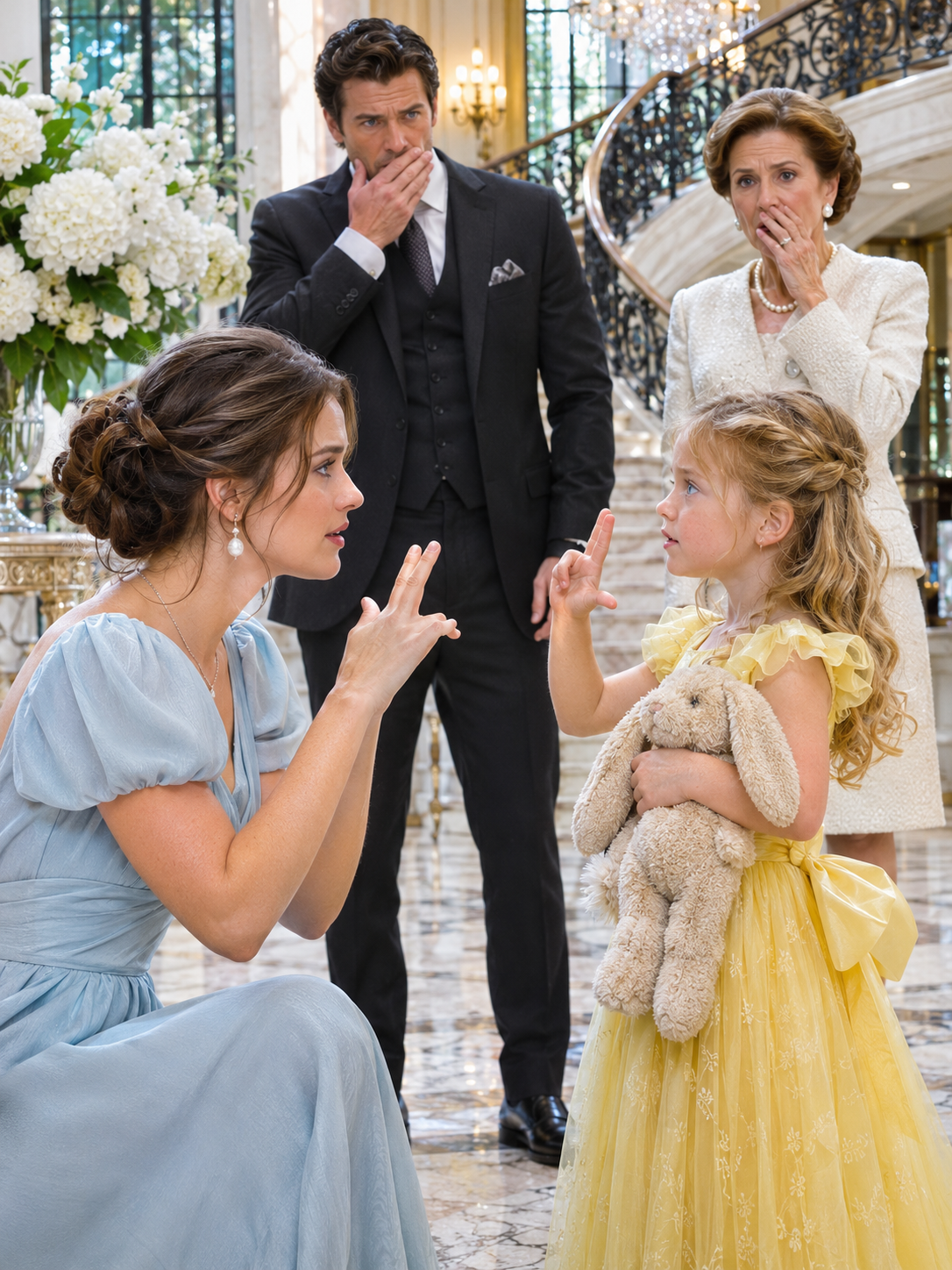
Pearl wore a yellow dress and clutched a worn stuffed rabbit against her chest. Her expression was distant, but her eyes followed every movement in the room.
“That’s my daughter,” Desmond said quietly. “She hasn’t spoken a word in a year.”
Something tightened in my chest as I watched Pearl’s fingers shift against the rabbit’s fur. They moved in a small, deliberate pattern that reminded me of childhood evenings with my father.
I slowly lowered myself to my knees, careful not to frighten her. Then, without speaking, I lifted both hands and signed a simple greeting.
Pearl’s eyes widened.
Behind me, Vivian gasped, and Desmond stepped forward. But I barely noticed them because Pearl had suddenly released her rabbit with one hand.
Her tiny fingers began moving in response.
And just as I recognized what she was trying to tell me, I noticed a small security camera blinking in the corner above the stairs.
Chapter 2: The Audit of the Hidden Chamber
By two in the morning, the top-floor executive suite of Ashcroft Logistics Tower in downtown Chicago was under a strict lockdown.
Outside the private elevators, a dozen security operators in charcoal suits guarded every corridor. In a rest suite down the hall, six-year-old Pearl lay asleep on a velvet sofa under a cashmere blanket, her stuffed rabbit tucked beneath her chin, watched over by two pediatric nurses.
In a high-backed armchair nearby, holding a mug of chamomile tea, sat Adelaide Rowan-Ashcroft. The mended blue dress was gone. In its place she wore a dark emerald suit that made her stand straighter than she ever had in her life.
In the central study, around a long black granite table, sat Desmond Ashcroft, senior corporate prosecutor Bridget Colton, his head of security Gideon Pike, and two federal forensic accountants.
In a steel chair in the corner, under the eye of two guards, sat thirty-eight-year-old Vivian Ashcroft. Her designer dress was torn, her hair disheveled, and her eyes were wide with the horror of someone who had just watched a four-year plan collide with a wall.
Bridget opened three red-sealed binders and slid ledgers, wiretap logs, and toxicology reports across the granite.
“Desmond, Adelaide,” she said, crisp and fast. “The forensic audit into Vivian Ashcroft, her accomplice Lawson Crane, and the Rowan Maritime Trust fraud is complete.”
Desmond stood at the glass wall overlooking Lake Michigan, jacket off, sleeves rolled to the elbow, his gray eyes hard. “Explain it.”
Bridget tapped the first binder.
“The Rosalind Ashcroft file. Exhumation toxicology and recovered medical records show that Vivian gave your late wife small, repeated doses of arsenic over roughly six months. The goal was control of the family estate and of this household.”
Desmond didn’t move. I watched his knuckles whiten on the window ledge.
“The second file is the Rowan Maritime Trust,” Bridget continued. “Adelaide’s father, Walter Rowan, was the sole beneficiary of a family shipping trust he walked away from decades ago, because he wanted a quiet life. He never touched it. Four years ago, after his death, Vivian and Lawson Crane used forged trustee documents to divert about one hundred and fifty million dollars into shell accounts in Panama.”
“My father didn’t know,” I said quietly. “He never knew it existed.”
“No,” said Bridget. “And neither did you. But you are his sole heir, and under the original charter, that makes you the controlling owner of the logistics network Vivian’s accomplice was about to absorb. The one at tomorrow’s assembly.”
The room was very quiet.
Vivian thrashed weakly in her restraints. “Desmond, listen to me! She was a penniless nanny! She tricked that child! I did everything for this family!”
“You did nothing for this family, Vivian,” Desmond said, walking toward her until his shadow covered her chair. “You killed my wife. You frightened my daughter into a year of silence. And you stole from a woman who didn’t even know she’d been robbed.”
His voice was almost gentle, which was worse.
“Tomorrow, it ends.”
Chapter 3: The Assembly at the Grand Concourse
At ten the next morning, the mahogany assembly hall on the fortieth floor of the Chicago Financial Center was packed.
More than four hundred real estate developers, shipping directors, judges, and board members had gathered beneath crystal chandeliers for the annual Midwest Logistics and Heritage Assembly.
Near the head of the raised table, in a navy suit with a silver pen in his hand, sat Lawson Crane, Vivian’s partner in the scheme. Beside him sat his legal counsel, smirking, as they prepared to sign the buyout documents that would fold the Rowan shipping berths into Crane Equity.
“Gentlemen,” Lawson announced into the microphone, his voice smooth, “today we ratify the consolidation of the Rowan Berths into Crane Equity, in light of Mr. Ashcroft’s regrettable family instability…”
The heavy oak doors flew open.
Four hundred conversations died at once.
Down the red-carpeted aisle came Desmond Ashcroft, flanked by Gideon Pike and four federal marshals. He wore a charcoal suit, and he walked with a calm that dropped the temperature of the room.
Beside him, on his arm, in dark emerald, her hair falling in waves over her shoulders, walked me.
And between us, holding both our hands, in a matching yellow dress with a cream ribbon, walked six-year-old Pearl.
Around my neck hung my father’s emerald signet pendant, the only thing from his family he had ever kept.
Lawson Crane dropped his pen. It clattered across the mahogany and rolled onto the floor.
“What is this?” he stammered, backing toward the stage. “This is an interruption! She is just a nanny!”
“She isn’t just a nanny, Lawson,” Desmond said, his deep voice carrying cleanly across the hall. “She is the chairwoman of the Rowan Maritime Trust, my wife, and the owner of everything you came here to steal.”
Bridget Colton stepped forward and placed a thick stack of court-stamped documents in Lawson’s shaking hands.
“A federal order enforcing the Rowan Trust deeds and restoring full control to Adelaide Rowan-Ashcroft,” she read. “Arrest warrants for Lawson Crane and Vivian Ashcroft on charges of murder, conspiracy, wire fraud, and embezzlement. And an immediate freeze on every asset held under Crane Equity.”
“This is unlawful!” Lawson shouted, as two marshals stepped forward with handcuffs. “Desmond, you can’t do this for a nanny!”
“I’m not doing it for a nanny,” Desmond said, putting an arm around my waist. “I’m doing it because my wife was robbed, and because she gave my daughter back her voice.”
The cuffs clicked. Lawson cried out for lawyers who were already edging toward the exits. Vivian, brought in through a side door in her own restraints, said nothing at all.
News cameras caught every step as they were led from the hall.
Chapter 4: What Pearl Told Me
I should explain how I got from a bus stop in a mended dress to that aisle.
It began on that first morning, kneeling on the marble, with Pearl’s small hand moving in the air.
My father had taught me that sign language isn’t just words. It’s expression, rhythm, the shape of a face. Pearl’s signs were rough and halting, the signs of a child who had learned a little from a book and then been afraid to use it.
Hello, she signed. Then, quickly, with her eyes flicking up to the camera: Don’t say.
Her fingers trembled.
Don’t say what I say.
I kept my face calm, the way my father had taught me to when strangers stared at him in the street. I signed back slowly: Okay. Our secret.
Pearl’s eyes filled with tears. She let out a breath that seemed to come from somewhere very deep.
“What is she doing?” Vivian demanded from behind me. “Is she making gestures? Desmond, this woman is upsetting her.”
I turned. Desmond was staring at his daughter’s hands as though he’d seen a miracle.
“She’s signing,” I said carefully. “She isn’t unable to communicate, Mr. Ashcroft. She’s choosing not to speak.”
“The specialists said it was trauma,” Vivian said sharply. “Selective mutism. It has nothing to do with sign language.”
“Both can be true,” I said. “But she’s trying to talk. Someone just needs to listen.”
Desmond looked at his sister. Then at me.
“You’re hired,” he said.
Vivian’s face went rigid. “Desmond…”
“She’s hired, Vivian.”
I got the job that morning. That night, after Pearl’s bath, I sat on the floor of her room with the lights low, and she told me everything, one slow sign at a time.
Her mother had been sick for months. Aunt Vivian made her a special tea every afternoon, and Pearl had once seen her stir a gray powder into the cup. When Pearl asked what it was, her aunt had knelt in front of her, smiled, and said something Pearl would never forget.
If you tell anyone, they’ll take you away too. Just like Mommy.
So Pearl stopped talking. She had decided, in the only way a four-year-old could, that silence was the safest place to be.
I held her until she fell asleep. Then I sat in the hallway, shaking, with my hand over my mouth.
I didn’t go to Desmond right away. I’d learned from my father that a deaf man who accuses a powerful person without proof is not believed. I was a nanny in shoes held together with glue. Vivian was the lady of the house.
So I did the only sensible thing. I called a security consultant whose card I’d seen on the hall table: Gideon Pike.
He listened to me for an hour. Then he made a call to Bridget Colton, and two days later, a forensic team was quietly reviewing the estate’s files.
I never told Pearl how much it mattered that she trusted me. She just kept signing, a little more every day. By the end of the first month she had stopped looking at the camera. By the end of the second, she spoke her first word aloud, a whisper in the dark.
“Addie.”
I sat on the edge of her bed and cried until the sheets were damp.
Chapter 5: The Cost of a Kidney
My mother’s treatment bill came due on day seven.
I’d told Desmond nothing about it. But Gideon, who missed very little, found out, and quietly mentioned it to his employer. The next morning, an envelope waited beside my breakfast tray with a check for the full amount.
I carried it back to Desmond’s study and set it on his desk.
“I can’t take this.”
“It isn’t charity,” he said. “It’s an advance. You’re the only person who’s gotten my daughter to say a word in a year.”
“Mr. Ashcroft…”
“Adelaide.” His voice was low, tired, and entirely sincere. “My wife died, and I buried myself in work, and my daughter went somewhere I couldn’t reach. You went where I couldn’t. Let me do something for you.”
I looked at the check. I thought of my mother in her hospital bed, counting the days.
“I’ll pay it back,” I said.
“If you insist.” The corner of his mouth lifted. “Over thirty years, with no interest.”
I laughed for the first time in weeks.
My mother, Maureen, received her transplant evaluation that month. A donor match came through in October, a stranger’s gift, and Desmond waited with me in the hospital corridor for eleven hours without leaving.
When the surgeon came out smiling, I turned and, without thinking, hugged him.
He went completely still. Then he put his arms around me, carefully, like someone handling something rare.
“Thank you,” I said into his shoulder.
“You did that,” he said quietly. “Not me.”
I think that was the moment I stopped being his daughter’s nanny, and he stopped being my employer.
Chapter 6: The Wife
I did not marry Desmond Ashcroft for his money. I want that on the record.
By the time it happened, I already knew that I was an heiress, which was a strange sentence to say aloud. Gideon’s investigation had turned up the Rowan Maritime Trust in January. It took Bridget two months to confirm it was real, and another to explain, gently, that my father had been the last in a line of shipping owners.
“Your family built this empire,” she told me. “Your grandfather left it to Walter in a trust. Walter walked away and lived a quiet life. Vivian found the paperwork when she married into the Ashcroft family and saw an opportunity.”
“He never said a word,” I whispered.
“He told you something else, though, didn’t he?” Bridget said. “That silence doesn’t mean someone has nothing to say.”
I cried for an hour. Then I asked her to start the paperwork.
Desmond proposed on the second of June, in Pearl’s room, with Pearl sitting on the floor in her yellow pajamas, holding a small velvet box she had insisted on carrying herself.
“Say it,” she whispered to him, loud enough for the whole house to hear.
Desmond knelt, looking half amused and wholly terrified.
“Adelaide Rowan,” he said. “I don’t want to marry you because you saved my daughter. I want to marry you because I can’t imagine a morning without your voice or your hands in it. Will you?”
Pearl signed it for him, in case I missed the point.
Say yes, Addie.
“Yes,” I said, and signed it too.
We married in August, in the garden, with my mother in the front row in a wheelchair, glowing and furious that she wasn’t allowed to dance.
It was only afterward, in the weeks before the Assembly, that Gideon and Bridget told us what the audit had really found.
Chapter 7: Pearl’s Voice
Pearl’s testimony was never going to be easy.
She was six. She had seen something no child should see. But the prosecutors worked carefully, with a child psychologist named Dr. Okonkwo, and decided she would give her account in a small, quiet room with only a few people present, with me beside her interpreting if she wished.
She wished.
For the first twenty minutes, she signed. Slowly, in small gestures, with her stuffed rabbit in her lap. I translated aloud, my voice steady.
Then, in the middle of a sentence, she stopped. She looked at me. She looked at the judge, a woman with silver hair and a patient face.
She opened her mouth.
“Aunt Vivian said the tea was medicine,” she said. Her voice was small, hoarse, and perfectly clear. “But Mommy got more sick every time. I saw the powder. I told Mommy, and Mommy said not to worry. Then she went away.”
The judge didn’t move. Dr. Okonkwo wiped her eyes.
“Thank you, Pearl,” the judge said gently. “That was very brave.”
Pearl nodded. Then she turned to me, put her hand on my cheek, and said, “Addie, I did it. I talked.”
“You did,” I said, my voice breaking. “You did it, sweetheart.”
Her father was waiting in the hall. She ran into his arms and said her second sentence aloud for the first time in two years.
“Daddy, I’m not scared anymore.”
Desmond picked her up and held her without a word. He stood there in the hallway of a Chicago courthouse with his daughter in his arms and tears running openly down his face, and nobody who passed looked away.
Final Part
The trial lasted five months.
Vivian Ashcroft was convicted of murder, conspiracy, and fraud, and sentenced to life without parole. Lawson Crane received thirty-four years. Almost all of the one hundred and fifty million dollars was recovered, and returned to the Rowan Maritime Trust, where it belonged.
I didn’t celebrate. I hadn’t wanted a courtroom victory. I’d wanted Pearl to sleep without the hall light, my mother to walk again, and a life that didn’t require me to count coins on a bus.
I got all three, eventually.
My mother recovered steadily and learned to garden in the backyard of the house Desmond and I bought in Evanston, a smaller place than the mansion, with a porch swing and a maple tree. She named every tomato plant after one of her doctors. Pearl named every one of them again, in her own system, and the two of them argued about it every Saturday.
I used part of the recovered trust to create the Walter Rowan Fund, which provided interpreters, sign language classes, and speech therapy to families of deaf and nonspeaking children, free of charge. Its first office was a converted brownstone on the north side. Above the door was a small brass plaque that read, in raised letters and in sign:
Silence doesn’t mean someone has nothing to say.
Pearl cut the ribbon herself, with a pair of oversized scissors, on a bright October morning.
“Is that right, Addie?” she asked, holding them up.
“That’s exactly right.”
She snipped. The crowd applauded, and she turned and signed a small, solemn thank you to all of them, as she’d learned to do. A number of people in the audience signed it back.
Later, when the crowd had thinned, Desmond found me at the back of the room, studying the plaque.
“He’d be proud of you,” he said.
“He wouldn’t have wanted a plaque.”
“He’d have wanted this.” He nodded toward Pearl, who was teaching a roomful of children how to sign “banana.” “He’d have wanted you to carry it on.”
I took his hand.
I thought of the girl I’d been that morning at the bus stop. The mended dress. The shoes held together with glue. The two boiled eggs and the folder repaired with yellow tape. I thought of how certain I’d been that nothing I knew was worth anything in a house like that.
I’d been wrong. The one thing I’d carried in with me, the small, quiet thing my father had given me before I could read, had been the only thing anyone in that house needed.
“Mommy!” Pearl called, running over, breathless. She skidded to a stop in front of us and looked up with enormous eyes.
Mommy.
It was the first time she’d said it to me. I had been waiting for it, and also trying very hard not to.
I knelt in front of her.
“Say it again,” I signed, laughing and crying at once.
She grinned. Then she lifted both hands and signed it, slowly, in my father’s language, a word I would remember for the rest of my life.
Mommy. Mine.
I pulled her into my arms, and Desmond’s arms came around both of us, and from somewhere across the room, my mother’s laughter rang out over the whole bright, noisy, beautiful room.
My father had been right.
Silence had never meant there was nothing to say. It had only meant that someone was waiting for the right person to listen.
THE END