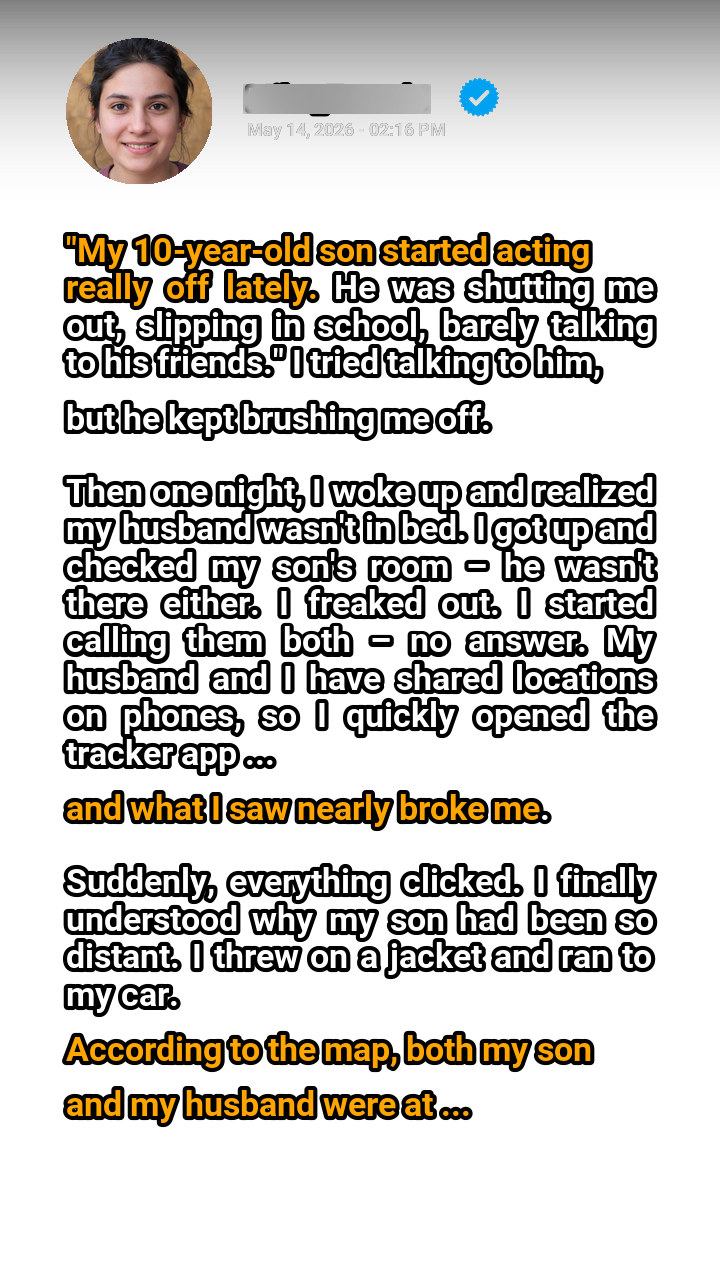
The change in Leo wasn’t a sudden, jarring jolt, but a slow, insidious creep, like a fog rolling in to obscure the vibrant landscape of my son’s personality. At ten, Leo was supposed to be a whirlwind of boundless energy, perpetually sticky-fingered from some illicit snack, his freckled face perpetually alight with the thrill of discovery. He was the kid who narrated his elaborate Lego battles at dinner, the one who left a trail of half-finished drawings and discarded superhero capes in his wake. But over the past few months, that Leo had begun to fade. The boisterous laughter echoing through the house dwindled to polite, almost hesitant chuckles. His bright, inquisitive eyes, once so eager to meet mine, now darted away, fixed on some invisible point beyond my shoulder.
I tried everything. I baked his favorite chocolate chip cookies, which he picked at absently. I suggested movie nights, which he’d agree to with a shrug before disappearing into his room, ostensibly to “read.” I even bought him the latest edition of his beloved space exploration encyclopedia, hoping to spark a conversation about nebulae and distant galaxies – a topic that used to ignite a passionate, hour-long monologue from him. He thanked me, smiled a small, distant smile, and placed it on his desk, unread. My heart ached with a dull, constant throb. He was shutting me out, not with defiance or anger, but with an unsettling, quiet resignation that felt far more profound and heartbreaking. His grades, once a source of pride, started to slip, marked by careless errors and unfinished assignments. His friends, boisterous bundles of pre-teen energy, would knock on the door, only to be met with Leo’s mumbled excuses about being “tired” or “busy.” The vibrant hum of my home was slowly being replaced by an unnerving quiet, a silence that felt heavy with unspoken words.
My attempts to bridge the growing chasm between us were met with polite stonewalling. “Is everything okay, sweetie?” I’d ask, trying to keep my voice light, non-threatening. He’d shrug, a familiar gesture that had become a wall between us. “Yeah, Mom. Just tired.” Or, “Nothing’s wrong, really.” I’d press gently, “You seem a little sad, or maybe worried. You know you can tell me anything, right? Anything at all.” His eyes would flit to mine for a fleeting second, a flicker of something unreadable – fear? Guilt? – before he’d look away again. “I’m fine, Mom. Really.” He’d retreat further, leaving me standing in the hallway, clutching at the frayed ends of our connection, a knot of worry tightening in my stomach. Was it puberty? Bullying? Something I’d done? The possibilities swirled in my mind, each more agonizing than the last. I even tried talking to Mark, my husband, hoping he could shed some light, but he just dismissed it as “kid stuff,” a phase. “He’s just growing up, honey,” he’d say, oblivious to the growing chasm.
Then came the night the world tilted on its axis. It was late, well past midnight. A cold draft snaked its way across our bed, rousing me from a fitful sleep. I instinctively reached for Mark, expecting to feel the familiar warmth of his body beside me, but my hand met only empty sheets, cool and undisturbed. My eyes fluttered open in the darkness. The space beside me was vacant. Mark wasn’t in bed. A flicker of unease, then a small wave of concern. He sometimes got up for a glass of water, or to check on a late email. I tried to push the rising anxiety down, telling myself it was nothing.
But the unease persisted, gnawing at me. My internal clock, finely tuned to the rhythms of our family, knew something was off. I threw back the covers, the chill of the room raising goosebumps on my arms, and padded silently across the hallway to Leo’s room. His door was slightly ajar, a sliver of darkness visible. I pushed it open gently, my heart already hammering against my ribs. The moon cast long, eerie shadows across the room. His bed was perfectly made, the duvet smoothed, the pillows untouched. Leo wasn’t there either.
Panic, cold and sharp, clawed its way up my throat. My breath hitched. “Mark? Leo?” I whispered, my voice barely a tremor in the silence. No answer. The house was utterly still, the kind of still that screams emptiness. I stumbled back to our bedroom, grabbing my phone with shaking hands. I called Mark first, the dial tone ringing hollowly in the quiet house, then Leo’s old, non-data flip phone – a relic we’d given him for emergencies. Both went straight to voicemail. My heart was a frantic drum against my ribs, each beat a frantic plea for an answer. My husband and I had always shared locations on our phones, a simple safety measure for peace of mind. Without thinking, my thumb fumbled for the tracker app, my vision blurring slightly at the edges. I tapped the icon, the small blue circle spinning endlessly as it tried to locate them. The seconds stretched into an eternity, each tick of the clock amplifying the terror coiling in my gut. And then, the map loaded. Two distinct blue dots, side by side, appeared on the screen. **And what I saw nearly broke me.**
Suddenly, with an agonizing jolt, everything clicked into place. The hushed whispers I’d sometimes overheard, quickly silenced when I entered the room. The way Mark had been so quick to dismiss my concerns about Leo. The late nights he’d claimed to be working in his home office, the door always closed. The strange, almost furtive glances he’d sometimes give Leo, a silent conversation passing between them that excluded me entirely. The peculiar smell of stale metal and damp earth I’d occasionally caught on Leo’s clothes, despite him claiming he’d just been “playing outside.” It all converged into a horrifying clarity, a mosaic of suspicion forming a single, devastating image. My son’s distance, his withdrawn demeanor, his sudden detachment from everything he loved – it wasn’t just him growing up. It was a secret. A shared secret. And I was not a part of it. A wave of nausea washed over me, hot and cold at once. I finally understood why my son had been so distant, so quiet, so painfully isolated from me. He wasn’t just troubled; he was complicit.
A primal surge of adrenaline coursed through me, overriding the shock and the burgeoning heartbreak. I had to get to them. I had to know. My hands moved on instinct, grabbing the first jacket I could find, a thick, worn denim one Mark had left draped over a chair. I fumbled with my keys, my fingers clumsy and unresponsive, before bursting out the front door, the cold night air a sharp slap to my face. The car started with a roar, a welcome burst of mechanical purpose in the silence of the suburban street. My eyes were glued to the phone, perched precariously on the dashboard, the glowing map a beacon to my unraveling world. The two blue dots, side by side, shimmered mockingly in the dark. According to the map, both my son and my husband were at… **the old Henderson Sawmill, a place abandoned for decades, its dilapidated structure looming like a skeletal monument on the outskirts of town, known locally as a haunt for trespassers and a magnet for trouble.**
The old Henderson Sawmill. The name itself was a cold, bitter taste in my mouth, conjuring images of rust, rot, and forgotten dangers. My foot pressed the accelerator, the car a blur on the deserted back roads, the speedometer needle dancing precariously high. Each curve in the road felt like a tightening knot in my stomach. My mind, usually a fortress of calm, was a maelstrom of horrifying conjectures. Was Mark involved in something illicit? Was he putting Leo in danger? The man I married, the steady, reliable Mark, couldn’t possibly be leading our son into some dark, abandoned ruin in the dead of night. But the map, stark and unforgiving, showed their two blue dots, unwavering, at that precise, terrifying location. The cold certainty of the GPS data warred with the desperate hope that it was all a terrible mistake, a glitch, a nightmare I would soon wake from.
The glow of the city lights dwindled behind me, swallowed by the oppressive darkness of the rural road. Eventually, the familiar landmarks of the town’s forgotten edge began to emerge from the gloom: the skeletal remains of an old water tower, a dilapidated barn leaning precariously. And then, through a sparse stand of skeletal trees, I saw it. The Henderson Sawmill. It wasn’t just old; it was a hulking, monstrous silhouette against the faint glow of the distant horizon, its broken windows like vacant eyes staring into the void. A rusted corrugated iron fence, half-collapsed, marked its perimeter, doing little to deter anyone. A narrow, unpaved track, barely visible in the darkness, led off the main road towards the main structure. My stomach clenched tighter.
I swerved onto the track, the tires crunching loudly on gravel and dry earth, and killed the engine a hundred yards from the main building, plunging the car into an absolute, suffocating darkness. The silence that followed was even more deafening than the roar of the engine, broken only by the frantic thumping of my own heart. My eyes strained, adjusting to the gloom. And then I saw it: a familiar dark sedan, Mark’s car, tucked partially behind a collapsed wall, almost completely hidden from the road. The sight was a punch to the gut, confirming my worst fears. There was no mistake. They were here. A faint, flickering light, a weak yellow glow, emanated from a gap in the sawmills’ ancient timber walls, like a dying ember in the belly of a beast.
Adrenaline surged, hot and cold, through my veins. I grabbed my phone, its screen now my only tether to sanity, and fumbled for the flashlight. Every instinct screamed at me to turn back, to call the police, to flee. But the primal need to find my son, to understand this horrifying betrayal, propelled me forward. I crept out of the car, my footsteps tentative on the uneven ground, the air thick with the smell of damp earth, decaying wood, and something metallic and acrid. The closer I got, the more the building seemed to loom, a monument to forgotten industry and lingering secrets. I skirted the broken fence, my eyes fixed on the sliver of light, my breath catching in my throat as I heard a faint, rhythmic clang, like metal on stone, echoing from within.
I found a gaping hole in the side of the building, where a large section of the wall had rotted away, offering a direct, horrifying view into the sawmill’s cavernous interior. My heart hammered, threatening to burst from my chest. I peered through, my breath held captive in my lungs. The scene that unfolded before me was a tableau of utter disbelief and shattering despair. In the center of what must have been the main processing floor, illuminated by a single, battery-powered lantern casting long, dancing shadows, stood Mark and Leo. They weren’t just exploring; they were *working*. Leo, his face smudged with dirt and grease, was intently prying at a loose floorboard with a crowbar, while Mark, his brow furrowed in concentration, was carefully brushing away layers of grime from a rusted metal box half-buried beneath it. The air was thick with the scent of old earth and the metallic tang I’d noticed on Leo’s clothes. My husband, the man who dismissed my concerns, who claimed to be working late, was here, in this dangerous, derelict place, teaching our ten-year-old son to unearth a hidden treasure.
My mind raced, connecting the dots of the past months. The whispers, the secrecy, Leo’s distance, Mark’s evasiveness – it wasn’t a phase, it wasn’t puberty. It was an obsession. A shared, secret obsession that Mark had carefully cultivated, drawing Leo into his clandestine world, making him an accomplice in a dangerous game, and systematically shutting me out. My son, my innocent, curious Leo, was learning to break into abandoned buildings and dig up buried secrets with his father, under the cover of darkness. The realization was a searing, agonizing blade to my very core. It wasn’t just the danger, or the illegality of it all; it was the profound betrayal, the deep chasm of trust that had opened between us, the cruel exclusion from their shared world. My family, as I knew it, was a lie.
A sob escaped my lips, a ragged, involuntary sound that was swallowed by the vast, echoing space of the sawmill. Both Mark and Leo froze, their heads snapping up, their faces pale in the lantern light, eyes wide with shock and guilt. The crowbar clattered to the floor, the sound impossibly loud. Mark’s gaze met mine, a flicker of something unreadable – fear? shame? – before his face hardened into a mask of defiant resignation. Leo, however, looked utterly devastated, his eyes, once so bright and full of life, now brimming with a mixture of terror and sorrow. He looked not at his father, but at me, his mother, the one he had been taught to deceive. In that moment, standing in the ruins of the Henderson Sawmill, surrounded by the ghosts of a forgotten past, my world crumbled. I finally understood why my son had been so distant, so quiet, so painfully isolated from me. He wasn’t just troubled; he was complicit. And the man who was supposed to be my partner had orchestrated it all, leaving me utterly, irrevocably broken.