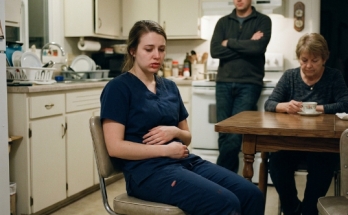
The sterile scent of the hospital clung to us, a persistent, unsettling reminder of Leo’s fragile state. Nine years old, with a mop of unruly blonde hair and eyes that sparkled with an almost impossible optimism, even after weeks of agonizing tests and frightening procedures. Leo, my stepson, had been diagnosed with an aggressive form of acute myeloid leukemia, a diagnosis that had ripped through our lives like a Category 5 hurricane, leaving a trail of devastation and despair. My husband, Mark, Leo’s biological father, had visibly aged ten years in as many days, his normally robust frame now stooped with worry, his usually vibrant eyes shadowed with a profound, soul-crushing fear. We, along with other close family members, had all undergone the extensive tissue typing, clinging to the desperate hope that one of us, anyone, would be a match for a bone marrow transplant – Leo’s only real chance at survival. I tried to project an image of calm support, but deep down, a cold knot of dread tightened in my stomach with each passing hour.
The call came on a Tuesday, a day I will forever remember with a visceral shudder. Mark’s phone rang, its cheerful chime a stark contrast to the grim news we’d been anticipating. His face, etched with anxiety, morphed first into disbelief, then a flicker of desperate hope. “They found a match,” he whispered, his voice cracking. My heart, against my own cynical nature, gave a small leap. Relief, pure and unadulterated, washed over me. Then, the nurse’s next words, relayed by Mark with a dawning horror, landed like a physical blow: “It’s you, Sarah. You’re the only perfect match.” The air in the room seemed to solidify, pressing in on me, stealing my breath. Me? The stepmother, the outsider, the woman who had always kept a carefully constructed emotional distance from this child of another woman, was now the sole key to his future. The universe, it seemed, had a cruel and twisted sense of humor, placing the heaviest burden on the shoulders least willing to bear it.
Panic, cold and sharp, immediately began to claw at my throat. I could feel Mark’s eyes on me, wide with a nascent, fragile hope that I instinctively recoiled from. He didn’t understand. No one did. They saw a simple act of altruism, a heroic gesture. I saw a terrifying invasion, a violation of my own body, a sacrifice of my own well-being. I knew enough about bone marrow donation to understand it wasn’t a simple blood draw. It was a painful, invasive procedure, often requiring general anesthesia, with a recovery period that could last weeks, involving significant discomfort, fatigue, and potential complications. My health, my career as a freelance graphic designer that demanded sharp focus and long hours, my carefully cultivated independence – all of it felt suddenly vulnerable, threatened. “He’s not even mine,” the thought screamed inside my head, a desperate, selfish mantra that I clung to, even as the image of Leo’s pale, small face flickered through my mind.
The pressure mounted instantly, a suffocating weight. Mark, his voice thick with a raw, pleading desperation, started talking about Leo’s chances, about how much he loved me, how this was our chance to save him. The doctors spoke of the urgency, the rarity of a perfect match. Other family members, their eyes wide with expectation, looked at me as if I were already a saint. But all I could hear was the clamor of my own fear, the insistent voice reminding me of the risks, the pain, the disruption to *my* life. I pictured the needle, thick and hollow, boring into my hip bone, the days of aches, the potential for infection, the anesthesia complications. My resolve hardened. My life, my body, my choices. Steeling myself, I met Mark’s gaze, which had begun to dim with dawning comprehension. “I’m not risking my health for a kid who isn’t even mine,” I stated, each word sharp and deliberate, cutting through the thick, hopeful silence of the room. The air crackled with the shock of my declaration, leaving an indelible scar.
The silence that followed was deafening, a vacuum where hope had once resided. Mark’s face crumpled, a mask of profound grief and utter betrayal replacing the fragile hope that had briefly flickered there. He didn’t yell, he didn’t argue; he simply stared at me, his eyes now completely devoid of light, reflecting a pain so deep it felt like a physical wound in the room. I felt a fleeting pang of something akin to guilt, quickly suppressed. My decision was made. I couldn’t, wouldn’t, sacrifice myself for a child I had no biological connection to, a child I had never truly allowed myself to love unconditionally. Without another word, I turned, gathered my purse, and walked out of that suffocating hospital room, leaving behind not just Mark and Leo, but the shattered remnants of whatever semblance of a family we had pretended to be.
Back home, the house felt cold, hollow. My hands trembled slightly as I pulled a worn duffel bag from the back of the closet. Each item I packed – a few changes of clothes, my laptop, my most essential toiletries – felt like a deliberate act of severance. Mark remained eerily silent throughout, his presence a heavy, unmoving shadow in the living room, a ghost of the man who had once loved me. He didn’t try to stop me, didn’t utter a single plea, didn’t even look at me as I zipped the bag closed. His silence was more damning than any accusation. As I pulled out of the driveway, the tires crunching on the gravel, I didn’t look back. I told myself I needed space, time to think, time for them to understand that my decision was firm. I imagined Mark consumed by Leo’s care, too busy to call, too heartbroken to reach out. I convinced myself that this distance was necessary, a temporary reprieve from an impossible situation.
Two weeks bled into each other, a blur of anonymous hotel rooms and restless nights. I tried to lose myself in work, in the impersonal hum of city life, but a persistent unease gnawed at me. No calls, no texts from Mark. Not a single word. The silence, initially a relief, had gradually transformed into an oppressive weight, heavier than any argument could have been. A strange, morbid curiosity began to fester, mingling with a faint, almost imperceptible tremor of regret. Had they found another match? Was Leo… okay? Finally, unable to bear the unanswered questions any longer, I drove back, the familiar route feeling alien under the afternoon sun. My stomach tightened as I pulled onto our street, the quiet residential road seeming unnaturally still. The house stood before me, familiar yet forbidding, its windows dark, its porch light off. A shiver traced its way down my spine. The key turned with a soft click in the lock, and I pushed the heavy oak door inward, stepping into an unsettling, pristine silence. My stomach dropped when I found the house stripped bare of any trace of Leo’s vibrant presence – no crayon drawings on the fridge, no small shoes by the door, no familiar medical paraphernalia, just an unnerving, pristine silence, and a single, stark white envelope left precisely in the center of the kitchen island.
My heart hammered against my ribs, a frantic drumbeat in the sudden, oppressive silence of the house. The air was cold, stale, thick with the scent of absence. I walked slowly towards the kitchen island, each step echoing eerily on the polished hardwood, the sound magnified in the unnaturally empty space. The envelope, stark white and pristine, seemed to glow under the recessed lighting, a beacon of impending dread. My name, “Sarah,” was written across the front in Mark’s familiar, precise hand. My fingers trembled as I picked it up, the paper feeling unnervingly heavy, cold against my skin. There was no stamp, no return address, just the simple, finality of my name. I tore it open, the crisp rip of the paper sounding like a gunshot in the stillness.
Inside, there were two documents. The first was a letter, several pages long, again in Mark’s handwriting, neat but with a slight tremor I recognized from when he was deeply distressed. The second was a set of legal papers, folded precisely, clearly divorce proceedings. My eyes blurred for a moment, the words on the first page of the letter swimming before me, but then my vision sharpened, focusing on the opening lines. There was no greeting, no “Dear Sarah,” just a blunt, concise statement: “I tried to understand, Sarah. I really did. For two weeks, I tried to rationalize the words you said, the choice you made. But there are some things a person just can’t forgive.”
The letter continued, each sentence a carefully sharpened blade. Mark described the agonizing days after I left, the frantic search for another donor, the crushing weight of every passing hour as Leo’s condition deteriorated. He wrote about the miracle that had occurred, a desperate plea to an international bone marrow registry yielding a partial match, enough to buy Leo more time, enough for the doctors to try an experimental new treatment. He didn’t thank me, didn’t condemn me further, but the subtext was clear: Leo was alive, but not because of me. He was recovering, slowly, painfully, in a specialized facility out of state, a place where Mark had relocated their lives, severing all ties to our shared existence. He detailed the sale of the house, the division of assets – all handled by his lawyer while I was gone – and his request for an immediate, uncontested divorce, citing irreconcilable differences.
My breath hitched, a painful, ragged gasp escaping my throat. The world tilted on its axis. Not only had I lost Mark, lost our marriage, but I had lost Leo, too – a child I hadn’t wanted to save, but whose survival without my intervention now felt like the most profound rejection. The emptiness of the house was no longer just physical; it mirrored the cavernous void that had opened up inside me. The carefully constructed walls of my independence, my self-preservation, crumbled, revealing a terrifying landscape of isolation. My career, my health, my freedom – the things I had prioritized above all else – suddenly felt meaningless, hollow victories in a war I hadn’t realized I was fighting against my own humanity.
I sank onto the cold floor, the letter rustling in my trembling hands, the legal documents sliding to rest beside me like tombstones. The silence of the house pressed in, no longer just unnerving but suffocating. There were no sounds of a child’s laughter, no clatter of Mark’s cooking, no familiar hum of life. Just the stark, echoing emptiness. My decision, once so firm, so logical, now felt like an act of profound, irreversible self-mutilation. I had protected my body, my health, but at what cost? I had traded a temporary discomfort for an eternal ache, a fleeting risk for a permanent, soul-deep wound.
Hours passed, blurring into the long, lonely afternoon. The sun dipped below the horizon, casting long, mournful shadows across the bare walls. I didn’t move, couldn’t move, paralyzed by the enormity of what I had done, what I had lost. The life I had so carefully curated, the one I had prioritized above all else, was now a desolate wasteland. There would be no more shared dinners, no more quiet evenings on the couch, no more arguments or reconciliations. Only the deafening silence, a constant reminder of the choice I had made, the line I had drawn, the family I had abandoned.
The finality of it all settled over me like a shroud. I was alone. Truly, utterly alone. The risk I had refused to take for a child who wasn’t “mine” had cost me everything that *was* mine – my husband, my home, and any chance of redemption. The image of Leo’s hopeful, innocent face, now far away and recovering, haunted me. He had been saved, yes, but by the kindness of a stranger, not by the woman who had once claimed to be his stepmother. The victory I had sought in protecting myself had turned into the bitterest defeat, leaving me with nothing but the chilling echo of my own words: “I’m not risking my health for a kid who isn’t even mine.” And now, there was no one left to risk it for, or for whom it would even matter. The house, stripped bare, was a monument to my ultimate, crushing solitude.