The world fractured into a million glittering shards the day Mom died. I was ten, a fragile age where the lines between childhood whimsy and adolescent dread began to blur, and suddenly, the safety net beneath me was shredded. Her laughter, once the very soundtrack of our home, faded into an echoing silence that Dad and I tried desperately to fill. He, a man built of quiet strength and unwavering love, became a ghost in his own house, his eyes perpetually shadowed, his movements heavy with a grief that mirrored my own. For two years, it was just us, navigating the vast, empty rooms, clinging to each other like shipwrecked sailors to the last plank of wood, our shared sorrow a silent, binding force.
Then came Cheryl. She arrived like a burst of artificial sunshine, all bright smiles and effusive compliments that felt, even to my young heart, a shade too practiced. Dad, drowning in his loneliness, seemed to grasp at her vivacity as if it were a lifeline. She was beautiful, in a sharp, angular way, with eyes that sparkled when she laughed and a voice that could charm birds from trees. She cooked elaborate meals, filled the house with the scent of fresh flowers, and listened to Dad’s stories with an attentive grace that slowly chipped away at his formidable wall of grief. I watched, a silent observer from the periphery, as my father, once so utterly broken, began to smile again, a genuine, unburdened smile I hadn’t seen since Mom’s passing. I wanted to hate her, but how could I, when she brought a flicker of light back into his desolate eyes?
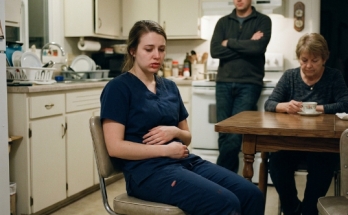
The public Cheryl, the one Dad saw, was a masterpiece of warmth and domestic bliss. The private Cheryl, however, was a venomous serpent coiled beneath a velvet glove. The transformation was insidious, a slow, calculated erosion of my sense of self and belonging. It started subtly: a dismissive wave of the hand when I spoke, a ‘playful’ jab about my clumsiness, a sigh of exasperation when Dad wasn’t looking. Soon, my cherished possessions began to disappear, only to resurface in the charity pile, attributed to my ‘lack of tidiness.’ My room, once a sanctuary filled with Mom’s memory, became a cold, unwelcoming space, its walls echoing with Cheryl’s hushed, cutting remarks about my ‘ungrateful nature’ or my ‘morbid attachment to the past.’ I learned to read the subtle shifts in her facial muscles, the tightening of her lips, the glint in her eyes that signaled an impending ambush of emotional manipulation.
Five years crawled by, each day a tightrope walk across Cheryl’s volatile moods. I mastered the art of invisibility, a ghost in my own home, speaking only when spoken to, retreating into books and the solitary comfort of the sprawling backyard. Dad, perhaps blinded by the illusion of domestic peace she so meticulously crafted, or simply too weary from years of grief to truly see, remained oblivious to the silent war waged within his walls. He’d often tell me, his hand warm on my shoulder, how lucky we were to have Cheryl, how she’d brought joy back into our lives. Each time, a part of me recoiled, a bitter taste rising in my throat, knowing the truth of the barbed remarks and cold shoulders she reserved for me, the instant his back was turned. I lived for the day I could escape, counting down the months until I turned eighteen, clinging to the faint hope that Dad would, one day, truly see.
But that day never came. Instead, the world shattered again, more violently this time, leaving no hope for repair. Dad’s sudden, unexpected death – a massive heart attack that stole him in his sleep – was a cruel, final blow. The grief that ripped through me was a familiar, agonizing tide, but this time, it was laced with a terrifying new element: absolute, utter vulnerability. My protector, my last link to a life of love and safety, was gone. The funeral was a blur of hushed condolences and the cloying scent of lilies, Cheryl a tearful widow, clinging to sympathetic neighbors, her public performance flawless. I stood apart, a solitary figure, feeling the vast, cold expanse of my orphaned future stretching before me.
Cheryl, however, wasted no time in shedding her mourning veil. Two days after Dad was laid to rest, the ink barely dry on his death certificate, she cornered me in the living room, her eyes devoid of any lingering grief, hard as polished stone. “Well,” she declared, her voice chillingly devoid of emotion, “that’s that. You’re not family anymore. You never really were. Get out.” The words, delivered with surgical precision, plunged into my chest like a shard of ice. There was no discussion, no plea, no argument to be made. My duffel bag, hastily packed with the few clothes I owned and the worn photograph of Mom, felt impossibly heavy as I walked out the front door, leaving behind every memory, every comfort, every fragment of the life I once knew.
I spent that night on a park bench, the cold concrete a harsh reminder of my new reality, the city lights blurring through unshed tears. My mind, a whirlwind of shock and despair, kept returning to one particular box I’d left behind – a small, wooden chest Mom had given me, filled with trinkets and letters only she and I knew about. It was the last tangible piece of her, and I couldn’t bear to lose it. The next morning, fueled by a desperate, defiant resolve, I walked back to the house, the familiar path now feeling alien and menacing. As I rounded the corner onto our street, my breath caught in my throat. Parked haphazardly along the curb, like a predatory pack, were five sleek, black SUVs, their tinted windows reflecting the morning sun like dark, unblinking eyes. The front door, usually locked tight, was ajar. Pushing it open cautiously, I stepped inside, the house eerily silent, until a figure emerged from the shadows of the hallway. It was Cheryl, her face drained of all color, her eyes wide with a terror I had never seen before, her usually composed features twisted into a mask of pure, unadulterated fear. She looked utterly, terrifyingly… exposed.
Her eyes, those same eyes that had once held such calculating contempt, now swam with a raw, animalistic fear that sent a shiver down my spine. Her perfectly coiffed hair was slightly askew, a stray strand plastered to her clammy forehead, and her expensive silk robe hung loosely, as if she’d lost weight overnight. “You!” she gasped, her voice a reedy whisper, utterly devoid of its usual cutting edge. “What are you doing back here?! Get out! You can’t—”
Her frantic whisper was abruptly cut off by a firm, authoritative voice that emanated from the shadowed archway leading to the living room. “Actually, she can.” From the dimness stepped a woman of formidable presence, dressed in a impeccably tailored charcoal suit, her silver hair pulled back in a severe bun. She was flanked by two burly men whose expressions were unreadable, their stance suggesting a quiet, watchful power. The woman’s gaze, sharp and unwavering, swept over me before settling on Cheryl, who visibly flinched. “Ms. Cheryl Hayes, I presume?” the woman stated, her voice resonating with an unyielding clarity. “I am Eleanor Vance, attorney for the estate of Mr. Robert Hayes. And these gentlemen are private investigators.”
The air in the house crackled with an unspoken tension, thick and suffocating. Cheryl’s pallor intensified, her lips trembling as if she were about to crumble. Eleanor Vance, however, showed no mercy. She held up a thick manila envelope. “It appears, Ms. Hayes, that Mr. Hayes had… foresight. Shortly after his remarriage, he established a separate trust, meticulously detailing the distribution of his assets, with very specific conditions. Furthermore, it seems he had concerns regarding certain… discrepancies in his financial records, which led him to engage our services for a comprehensive audit. An audit, I might add, that has uncovered some rather alarming findings, particularly concerning a significant transfer of funds made just days before his untimely passing.”
Cheryl let out a choked sound, a desperate, trapped animal noise. “No… that’s impossible! He wouldn’t… He trusted me!” Her eyes darted wildly, searching for an escape, but the two silent men subtly shifted, blocking her path. My heart, which had been a frozen lump in my chest, began to thrum with a strange, fierce hope. Dad hadn’t been completely blind after all. He had seen something, felt something, and had acted to protect his legacy, and perhaps, me. The truth of Cheryl’s terror became terrifyingly clear: she wasn’t just losing the house; she was losing everything, and potentially facing legal repercussions for what she’d done.
Eleanor Vance’s expression remained impassive, almost glacial. “Mr. Hayes also updated his will, posthumously retrieved from a secure vault, which explicitly revoked any prior provisions made to you, Ms. Hayes, in the event of your attempting to disinherit or remove his biological child from the family home. It seems, in his final days, he sought to ensure his daughter’s security above all else.” She paused, allowing the words to sink in, each one a hammer blow to Cheryl’s carefully constructed façade. “As of this moment, you are legally obligated to vacate these premises within the hour. Any attempt to remove items not proven to be solely yours will result in immediate arrest. We have already alerted the local authorities regarding the discovered financial irregularities.”
The color drained completely from Cheryl’s face, leaving it a ghastly white. Her shoulders slumped, and the venomous serpent I had known for five years transformed into a withered, pathetic shell. The silence that followed was deafening, broken only by the muffled sounds of the investigators already moving through the house, systematically documenting everything. I stood there, an unexpected witness to her spectacular downfall, feeling a strange mix of vindication and profound sadness. My father, even in death, had protected me. He had seen through the charade, a glimmer of his old self breaking through the grief-induced haze.
As Cheryl was led away, her once-proud posture now stooped, her eyes wide and defeated, she shot me one last look. It wasn’t hatred or anger, but a hollow, empty despair that reflected her utterly ruined world. I watched her go, then turned to Eleanor Vance. “My mother’s chest,” I began, my voice trembling slightly. “It’s small, wooden. It means everything to me.” The attorney nodded, a rare, almost imperceptible softening in her gaze. “We’ve already secured it. It’s in the car, along with a sealed letter from your father addressed to you. He truly loved you, my dear.”
The weight in my chest finally lifted, replaced by a bittersweet lightness. The house, once a prison, now felt like a mausoleum of broken dreams, but also a monument to a father’s enduring love. With Mom’s chest safe, and a letter from Dad clutched in my hand, I walked out of that house for the last time, not with a duffel bag and a shattered heart, but with the promise of a future, finally untethered from Cheryl’s toxic shadow. The black SUVs, once symbols of impending doom, now represented a stern, unyielding justice, paving the way for a new beginning. I didn’t know what lay ahead, but for the first time in years, I felt a flicker of hope, a fragile, trembling flame in the vast, open expanse of my own, reclaimed life.