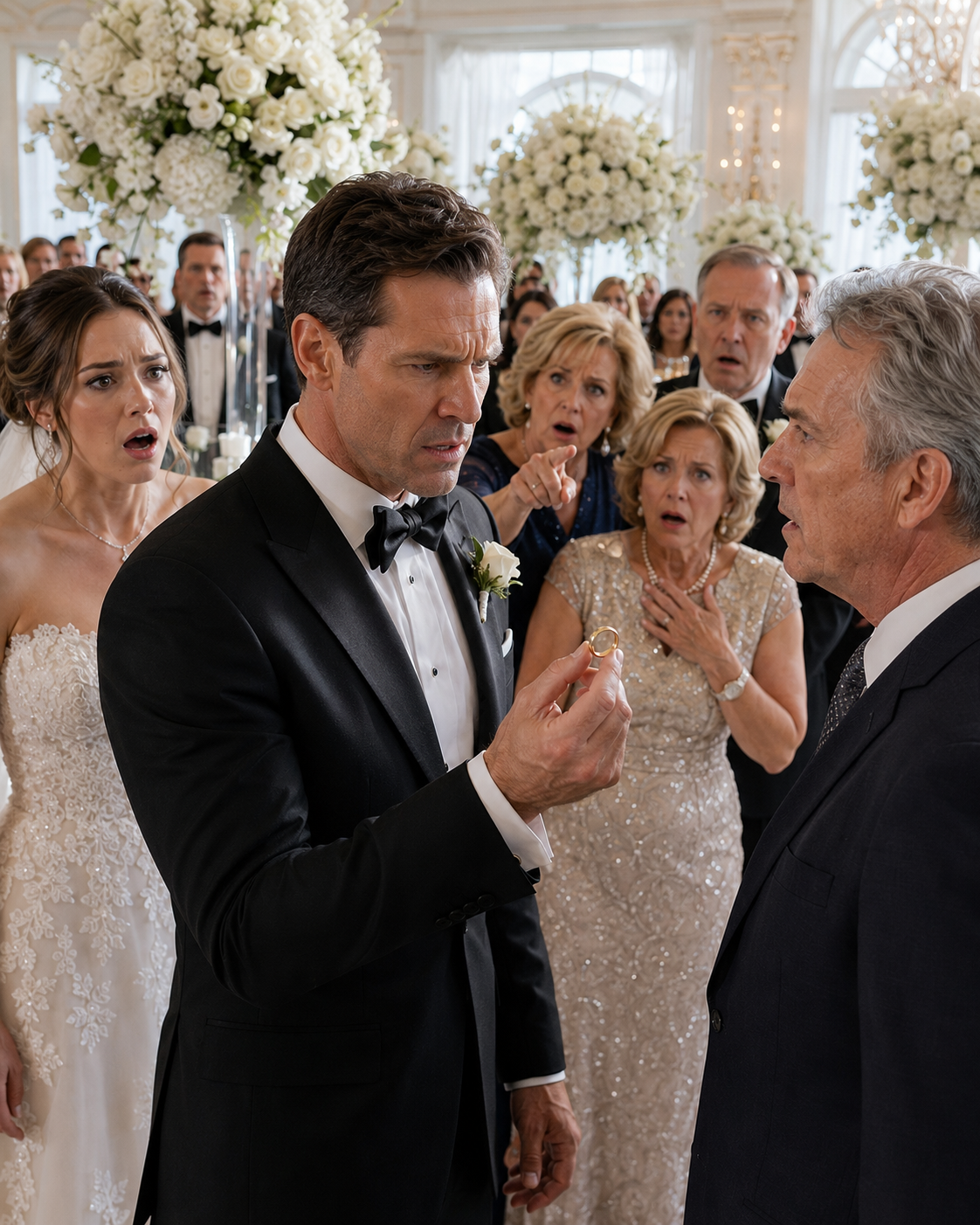

“That man isn’t a father. He’s trash someone forgot to drag out through the service entrance.”
Margaret Whitfield’s voice rang through the microphones inside the grand ballroom of Rosewood Estate in Charleston and crashed over five hundred guests like a plate breaking in the middle of Sunday service.
No one moved.
Not the waiters carrying trays of champagne. Not the string quartet. Not the guests who had spent two hours pretending to be impressed by the imported floral arrangements from France.
My father stood at the back of the ballroom beside a column wrapped in white flowers. He wore a dark gray suit I knew better than almost anything. The same suit he had worn to my college graduation. The same suit he had altered three separate times because, as he always said, “It still has one more battle left in it.”
His shoes were polished, but old. His navy tie had belonged to my grandfather. And those hands—rough, scarred, weathered—were the same hands that had cooked eggs and beans for me every morning before work since I was six years old.
Charles Whitfield, my future father-in-law, lifted his champagne glass from the stage.
“Before we officially welcome Ethan into our family, I believe everyone deserves to know where he comes from,” he said with a smile that carried no warmth—only teeth.
A few guests laughed quietly.
I looked at Madison, my fiancée.
I expected embarrassment. Anger. Anything.
Instead, she covered her mouth with one hand to hide a laugh.
“Mom, stop,” she whispered. “You’re going to make him feel bad.”
Something inside me went cold.
At first, it wasn’t rage.
It was clarity.
I slowly stood from the head table. The whispers spread through the ballroom like a shaken nest of hornets.
“Ethan, sit down,” Madison hissed, digging her freshly manicured nails into my wrist.
I removed my engagement ring and placed it beside my untouched dinner plate.
“The wedding is over.”
The ballroom exploded into murmurs.
Charles shoved his chair back so hard it fell over.
“Do you have any idea how much this wedding cost?”
“Yes,” I said. “Enough for you to think you could humiliate my father and buy my silence.”
Margaret gave a dry laugh.
“Don’t be dramatic. A man like you will never get another chance with someone like Madison.”
I walked to my father.
His head was lowered, not because the insult had hurt him for himself—but because of what it had meant for me.
“Let’s go, Dad.”
Outside, rain slammed against the stone steps.
Behind us, I heard Madison shouting my name, followed by photographers rushing after us like vultures in designer suits.
My father stopped beneath the stone archway.
“Son,” he said in a strangely calm voice, “there’s something I should have told you years ago.”
At that moment, six black SUVs rolled through the wrought-iron gates.
Their headlights cut through the rain.
Several men with umbrellas hurried out. One of them approached my father and bowed his head respectfully.
“Mr. Frank, the board is assembled. They’re waiting for your instructions.”
I stared at my father.
The humble man I thought I had known my entire life took a deep breath.
“Ethan,” he said, “I’m a billionaire.”
And as Madison, her parents, and half the wedding guests watched from behind the ballroom’s glass doors, I realized the humiliation of that night was only the beginning.
I couldn’t believe what was about to happen…
Inside the lead SUV, my father handed me a tablet.
A familiar name appeared on the screen—one I had seen in business newspapers, magazine covers, and advertisements for massive development projects.
Meridian Holdings.
“That’s mine,” my father said.
I didn’t know how to answer.
Meridian Holdings owned investments in energy, hospitals, transportation, housing, regional banks, and industrial development. Its wealth was so enormous that my mind could not connect it to the image of my father eating reheated soup in our tiny kitchen in South Chicago.
“Why did you hide all of this from me?”
My father closed his eyes.
“Because money destroyed my family before you were born. Your mother and I agreed that you would grow up understanding the value of work—not arrogance.”
He explained that every job he had taken as a mechanic, construction worker, and site supervisor had been real.
He entered his own companies without revealing who he was, just to see how employees treated people when there were no cameras and no executives watching.
Then a woman in a black suit, attorney Rebecca Hayes, opened another file.
“The Whitfield family has been trying to secure a financial bailout for the last eight months,” she said. “Their construction company is on the edge of collapse.”
My stomach tightened.
“What does that have to do with my father?”
Rebecca swiped across the screen.
“The bank that loaned them the money belongs to Meridian Holdings. And the investment fund they were relying on to save them belongs to us as well.”
My father clenched his jaw.
“They never knew I was behind either one.”
Then private messages from Madison appeared on the screen.
“There’s something about the old man. He isn’t as poor as he looks. Marry Ethan first. Ask questions later.”
Another message appeared, this one from Margaret:
“Make Ethan believe marrying into our family is the only chance he’ll ever get. If the old man is worth anything, we’ll already have the key.”
I stared at those words until they stopped looking like letters and started looking like knives.
Madison hadn’t laughed because she was nervous.
She had laughed because she thought she was above me.
The next day, the Whitfield family tried to rewrite the story.
Charles told the press I had suffered “an emotional episode.”
Margaret claimed my father had manipulated me.
Madison cried in front of television cameras and insisted I had abandoned her for no reason.
A few hours later, she sent me thirty text messages.
First, she insulted me.
Then she said she loved me.
Finally, she asked if we could meet “like adults.”
I agreed.
But not at her house.
Not at a restaurant.
I invited her to my office, where every word could legally be recorded.
Madison arrived wearing oversized sunglasses, expensive perfume, and carrying a red folder.
“Sign this,” she said. “A confidentiality agreement, a waiver of any benefits connected to your father, and a public apology. If you cooperate, my family might forgive you.”
I looked at her without blinking.
“You mocked him because you thought he was poor.”
She smiled.
“And now that we know he isn’t, we need to be practical.”
Behind the one-way glass, Rebecca and two investigators listened to every word.
Madison had just admitted, all by herself, exactly what she had tried so hard to hide.
But the worst was still coming.
Three days later, Charles summoned us back to the same estate where he had humiliated my father.
He thought we were coming to make peace.
He had no idea I was carrying a file that could bring all of them down.
Charles Whitfield welcomed us into the estate’s private dining room beneath a chandelier that looked heavier than an entire house.
He wasn’t smiling anymore.
Margaret sat beside him, stiff as stone.
Madison sat across from me, her eyes red and her lips pressed into a thin line. She still wore the engagement ring on a chain around her neck, as if that could earn her sympathy.
My father walked in behind me wearing the same gray suit as always.
Charles gave a bitter laugh.
“Still dressed like a driver, Frank?”
No one answered.
Attorney Rebecca Hayes placed a thick file on the table.
Beside her sat two bank attorneys, an outside auditor, and a private investigator.
For the first time, Charles looked genuinely confused.
“What kind of circus is this?”
I slid the file toward him.
“It isn’t a circus.”
“It’s your accounting.”
His expression changed.
“You don’t know anything about that.”
“I’m a forensic accountant,” I said. “I don’t spend my days reviewing dull insurance claims like you told your friends. I trace fraud, shell companies, and illegal money transfers for financial litigation.”
Madison opened her mouth but couldn’t find a single word.
“Your construction company inflated the value of five properties in Ohio and Pennsylvania,” I continued. “It hid supplier debts through three companies created by your brother-in-law. And part of your investors’ money paid for this wedding.”
Margaret pressed a hand to her chest.
“That’s a lie.”
Rebecca opened another file.
“We also have fake invoices, altered tax filings, and transfers into Mrs. Margaret’s personal accounts.”
Charles slammed his fist onto the table.
“This is blackmail!”
“No,” Rebecca replied. “This is a formal notice. The bank is ending all bailout negotiations and forwarding this file to the proper authorities. Mr. Frank recused himself from the decision. Everything was reviewed by an independent board.”
My father remained silent.
That irritated Charles more than anything.
“Frank, think carefully,” he said, lowering his voice. “We’re family. Ethan marries Madison, we merge our interests, and everyone wins.”
My father looked at him with quiet sadness.
“You called me trash when you thought I had nothing.”
“Now you call me family because you know what I have.”
He paused.
“That isn’t respect, Charles.”
“That’s an invoice finally coming due.”
Madison began to cry.
But her tears no longer reached me.
“Ethan, please. We made a mistake.”
“You didn’t make a mistake,” I replied.
“You placed the wrong bet.”
She stood and grabbed my hand.
“I really do love you.”
I pressed a button on my phone.
Her own voice filled the dining room.
“And now that we know he isn’t, we need to be practical.”
Madison pulled her hand away as if she had been burned.
Margaret lunged toward my phone, but the investigator stopped her.
Charles began screaming at his daughter.
Madison blamed her mother.
Margaret yelled at Charles, accusing him of promising their accounts were protected.
In less than five minutes, the family that believed they were untouchable tore itself apart right in front of us.
And my father didn’t celebrate.
He simply stood.
“Let’s go, son.”
Months later, Whitfield Construction entered bankruptcy proceedings.
Charles was charged with bank fraud and money laundering.
Margaret was convicted of concealing assets and tax evasion.
Madison avoided prison by cooperating with investigators, but she lost her event planning business after clients discovered she had used their deposits to cover her family’s debts.
They tried to sue me for canceling the wedding.
The judge dismissed the case in a brief hearing.
Every contract had been signed by them.
Every decision had been made by them.
And every video clearly showed who had started the humiliation.
Margaret’s words went viral—but not the way she expected.
For weeks, people across social media repeated the same line:
“The man they called trash ended up sweeping away all their lies.”
I didn’t feel victorious.
Victory born from betrayal doesn’t arrive with music.
It arrives in silence.
A year later, my father took me to the rooftop of a newly completed apartment complex on the outskirts of Charleston.
It was one of Meridian Holdings’ developments, but unlike the others.
Half the apartments had been reserved for working families at affordable rents.
Below us, a woman carried moving boxes while two children ran through the brand-new hallways.
A man embraced his wife in front of a freshly painted door.
My father still wore the same gray suit.
“With all your money, you could buy a better one,” I said.
He smiled faintly.
“This suit helped me discover who my son really was when no one was watching.”
I didn’t say anything.
For a long time, I believed my father had hidden a better life from me.
Later, I realized he had protected me from an emptier one.
Madison offered me luxury, a respected last name, and a doorway into a world that glittered on the outside while rotting within.
My father gave me something far harder to earn:
Dignity.
That day, I lost a wedding in front of five hundred people.
But I gained the certainty that no love is worth keeping if it requires you to lower your head while someone humiliates the person who spent a lifetime lifting you up.
The last time I saw Madison was in a small café in Chicago.
She no longer wore designer labels or oversized sunglasses.
She walked over to my table and said,
“If I had known who your father really was, everything would have been different.”
I looked at her calmly.
“That was exactly the problem.”
I didn’t say another word.
She walked away without saying goodbye.
Sometimes life doesn’t take something away from you.
It tears off the blindfold.
And when you can finally see, the hardest truth to accept is that some people never loved your heart.
They loved the door they thought you could open.
My father appointed me Director of Financial Integrity at Meridian Holdings after an independent board approved the position.
Not because I was his son.
Not as an inheritance.
Not as a reward.
But because he knew I could spot lies before they grew into empires.
Every time I review a case file, I remember the look in my father’s eyes that night.
Not the look of a billionaire.
The look of a man who had worked his entire life so his son would understand one simple truth:
Money can buy grand ballrooms, flowers, orchestras, and famous last names.
But it can never buy the right to trample someone simply because they’re humble.
And you—would you have called off the wedding in front of everyone to defend your father?