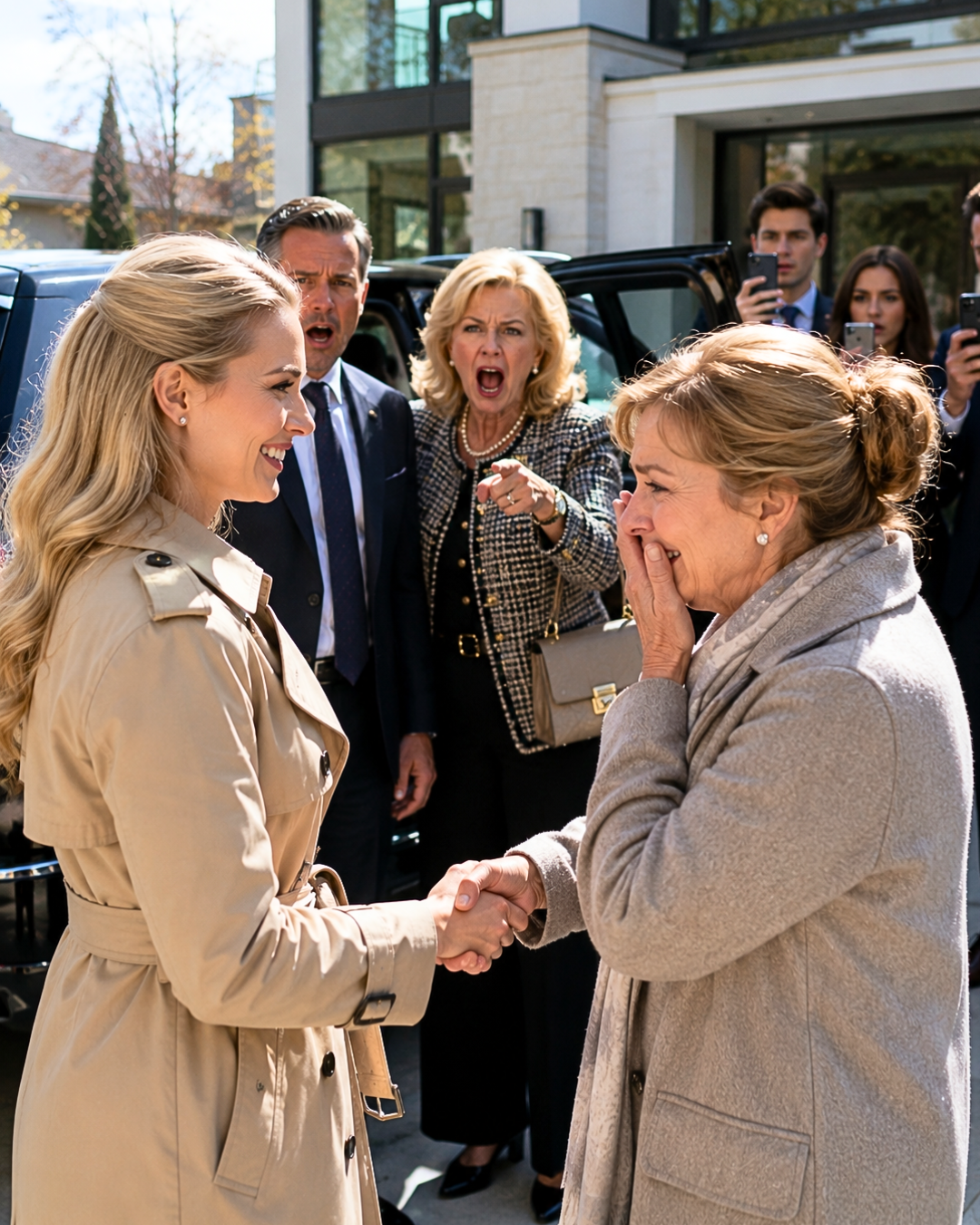

As soon as I pushed open the front door, a wave of cold slammed into me like water pouring from an old basement pipe.
My parents’ home in Ohio had always carried the scent of cinnamon candles, worn carpeting, and the expensive detergent my mother insisted on buying. But that Thanksgiving morning, the air smelled only of metal and dust. The thermostat mounted in the hallway flashed forty-nine degrees. I could see my breath drifting in front of me.
A yellow sticky note rested on the kitchen counter in my mother’s tidy handwriting.
We’re in Cancun. Your flight got in first, so you handle Grandma. Back Sunday. Don’t make a scene.
I stood there silently, staring at it.
My grandmother, Evelyn Whitaker, was eighty-two, healing from a broken hip, and barely able to stand without her walker. She stayed in the downstairs guest bedroom because my father insisted she “was safer with family.” I let my suitcase fall and sprinted.
“Grandma?”
Nothing.
Her bedroom was vacant. The bed was partly made, the sheets tangled, her cardigan lying on the floor. Her walker had tipped over beside the bathroom entrance.
Then I heard it.
A faint scraping noise from the living room.
I discovered her lying on the hardwood floor beside an unplugged space heater, wrapped in a blanket that had slipped from her shoulders. Her lips were colorless. Her fingers shook against the wooden floor. The lamp remained dark. The curtains stayed closed. Her phone had disappeared from the small table where she always left it.
“Grandma,” I whispered, dropping beside her. “Oh my God.”
Her eyes slowly opened, cloudy yet alert. “Mara?”
“It’s me. I’m calling 911.”
I reached for my phone, but her hand rose with startling strength and locked around my wrist.
“Don’t tell them yet,” she whispered.
“Grandma, you’re freezing.”
“Listen.”
Her fingers slipped something small and solid into my hand. A flash drive. Black, wrapped with a strip of blue tape.
My stomach knotted. “What is this?”
“The reason they left me here,” she breathed. “The reason they took my phone.”
I glanced toward the deserted hallway, suddenly noticing how unnaturally silent the house had become.
“They wanted me to sign,” she said. “I wouldn’t.”
“Sign what?”
Her eyes filled with tears, though her voice remained firm. “Power of attorney. The house. My accounts. Your father said I was confused. Your mother said no one would believe me.”
My fingers tightened around the flash drive.
The emergency dispatcher answered. I gave our address, explained that my grandmother had fallen, that the house had no heat, and that she was awake but trembling. I never mentioned the flash drive.
While we waited, Grandma held tightly to my sleeve.
“When they come back,” she whispered, “don’t be alone with them.”
They returned three days later, sunburned and cheerful, pulling rolling suitcases through the very doorway they had walked out of after leaving her there to d!e.
When my parents came home, the first thing my mother noticed was the ambulance report lying across the kitchen table, not me.
I had left it there on purpose, next to the unplugged space heater and Grandma’s missing phone, which I had discovered wrapped inside a towel at the bottom of the laundry basket. For three days, I had cleaned nothing, rearranged nothing, touching only the items I photographed beforehand.
My father, Richard Whitaker, paused in the doorway with his rolling suitcase still gripped in one hand. His vacation tan looked almost offensive beneath the dull gray winter sky.
“Mara,” he said carefully. “What happened?”
I stood beside the sink, holding a mug of untouched coffee. “Grandma fell.”
My mother, Celeste, slipped off her sunglasses. “Is she okay?”
“She has mild hypothermia, bruised ribs, and a sprained wrist.” I studied her expression closely. “The hospital admitted her.”
Celeste pressed her lips into a narrow line. It was not fear. It was annoying.
“Well,” she replied, “Evelyn always overreacts.”
“She was lying on the floor.”
“She probably tried standing without her walker.”
“The heater had been unplugged.”
My father shifted his jaw. “It overloads the breaker. I warned her not to use it.”
“The furnace was turned off too.”
“We lowered it because nobody was home.”
“To forty-nine degrees?”
No one spoke.
My younger brother, Nolan, came in behind them wearing a Cancun resort sweatshirt. At twenty-six, unemployed once again, he carried the faint scent of airport whiskey. He glanced at the ambulance report before looking at me.
“You called 911?” he asked. “That seems a little dramatic.”
I let out one short laugh because the other option was scre:aming.
Dad lowered his suitcase to the floor. “Where is she now?”
“Safe.”
“That’s not what I asked.”
“I know.”
Celeste stepped closer. Her voice softened, which always meant she was preparing to lie. “Honey, you don’t understand how difficult this has been. Your grandmother has become paranoid. She hides things. She accuses everyone. She claimed Nolan stole from her after she misplaced cash inside her robe pocket.”
Nolan avoided my eyes.
I opened my hand and set Grandma’s old phone on the counter.
Celeste went completely still.
“Why was this inside the laundry hamper?” I asked.
Dad’s eyes shifted toward Mom before returning to me. “Maybe she hid it there.”
“Wrapped inside a towel?”
“Mara,” he said, using the same tone from when I was sixteen and found motel receipts inside his glove compartment, “you need to calm down.”
I nodded. “That’s what you told Grandma too, wasn’t it? When she refused to sign?”
Celeste’s face changed first. Her eyebrows lifted, not from innocence but calculation. Dad glanced toward the living room windows, silently measuring distance, neighbors, and risk.
Nolan muttered, “You should’ve just waited until Sunday.”
The silence afterward felt enormous.
My mother rounded on him. “Shut up.”
But the damage had already been done.
I slipped my hand into my back pocket and pressed the side button on my phone. The screen lit up, still recording. It had been recording ever since they walked through the door.
Dad noticed immediately.
His face became hard.
“You have no idea what you’re doing,” he said.
I remembered Grandma’s trembling hand placing the flash drive into mine. I remembered everything stored on it: scanned bank statements, recorded conversations, footage from her bedroom camera, and a drafted petition declaring her mentally incompetent.
“Yes,” I answered. “I do.”
The first thing my father did was smile.
It was not a kind smile. It was the one he wore inside conference rooms, at church charity banquets, and before people who believed an expensive coat reflected an honest conscience.
“Mara,” he said, “put the phone down.”
“No.”
My mother’s expression tightened. “You’re making this far uglier than necessary.”
“It became ugly when Grandma spent Thanksgiving lying on the floor in the dark.”
Dad took one slow step toward me.
I stepped backward and raised the phone higher. “Come any closer and I’ll call the police again.”
“You’ve already dragged strangers into family business,” he said.
“Family business?” I repeated. “You mean elder neglect? Fr@ud? Coercion?”
Nolan let out a snort, pretending to be bored, but his hands were trembling. He had always been the weakest part of every lie. As kids, he could steal cookies and still leave crumbs across his own shirt.
Celeste slowly moved toward the kitchen table where the ambulance report rested. “Where is Evelyn?”
“With someone who actually cares whether she wakes up tomorrow morning.”
My father’s smile v@nished.
He had expected tears, pan!c, a daughter des.per.ate for explanations. He had never expected me to stay calm. He had never imagined Grandma had prepared in advance.
That was his mistake. He believed old automatically meant helpless.
Grandma had spent most of my life quietly, but she had never been foolish. She survived a v!olent first marriage before marrying my grandfather. She worked payroll at a manufacturing company for thirty years. She understood numbers. She understood signatures. She understood exactly when money v@nished from one account and quietly appeared inside another.
The flash drive she pressed into my hand contained six folders.
One was labeled BANK.
Another was labeled AUDIO.
A third was labeled RICHARD.
Inside were bank statements showing repeated transfers from Grandma’s savings account into a shared household account controlled by my father. Every withdrawal looked harmless: four hundred dollars, seven hundred, nine hundred and fifty. Never large enough to raise immediate suspicion. Across two years, the total exceeded sixty-three thousand dollars.
There were emails between Dad and an attorney named Peter Larkin discussing “accelerating incapacity documentation.” There was also a scanned document granting Dad complete financial authority over Grandma’s accounts, still unsigned.
The flash drive contained audio recordings too.
In one, my mother’s voice came through clearly.
Evelyn, nobody is trying to hurt you. But you are not managing well. Richard has carried this family for years. Signing this is the respectful thing to do.
Then Grandma answered, her voice quiet but unwavering.
I will not sign away my house.
Another recording caught Nolan laughing in the hallway.
Just unplug it. She’ll get cold and stop being stubborn.
My mother answered sharply, Don’t say things like that out loud.
The first time I listened to that recording, sitting in my car outside the hospital while Grandma rested beneath heated blankets, I gripped the steering wheel until my fingers ached.
Now they stood in front of me, freshly returned from white beaches and tropical cocktails, acting as though they had merely misplaced an elderly woman the way someone misplaces a set of keys.
Dad stared at my phone. “Whatever you think you found, it won’t stand up.”
“Maybe,” I replied. “The police can decide that.”
Celeste inhaled sharply. “Police?”
“Yes.”
Dad narrowed his eyes. “You want to destroy your family?”
“No. You already did.”
For the first time, fear crossed my mother’s face.
Not guilt. Fear.
The difference mattered.
She picked up the ambulance report and folded it carefully once. “Your grandmother has always man!pulated you. She knew exactly what to say to turn you against us.”
“She was hypothermic.”
“She’s dramatic.”
“She could have d!ed.”
Celeste opened her mouth, then shut it again.
Nolan leaned against the refrigerator. “It wasn’t supposed to get that cold.”
His words shattered the silence like dropped glass.
Dad turned toward him. “Nolan.”
“What?” Nolan’s voice climbed higher. “I’m just saying. We checked the forecast. It said low thirties, not that the house would become a freezer.”
I kept my expression steady, even though my pulse pounded inside my ears.
“Who checked the forecast?” I asked.
Nobody answered.
My phone kept recording.
Dad lunged.
Not exactly toward me, but toward the phone. His hand slammed against my wrist hard enough to send the device flying. It struck the tile floor before sliding underneath the table.
I stumbled backward into the cabinet.
For one brief second, everyone stood motionless.
Then the doorbell rang.
Three crisp chimes.
My father’s head whipped toward the front hallway.
That was when I smiled.
“That would be Detective Alvarez.”
Celeste whispered, “You already called them?”
“Grandma did.”
Every trace of color disappeared from Nolan’s face.
The doorbell sounded again.
Dad looked at me as though I had become a stranger standing inside his kitchen. Maybe I had. I was no longer the daughter who came home for holidays and swallowed every insult with mashed potatoes. I was no longer the girl who protected family secrets because my mother insisted privacy meant loyalty.
I walked past him and opened the front door.
Detective Lena Alvarez stood on the porch beside a uniformed officer. She was in her forties, dark hair tucked beneath a knitted cap, her eyes sweeping once across my face, my wrist, and the room behind me.
“Mara Whitaker?”
“Yes.”
“Is everyone inside?”
“Yes.”
She stepped across the threshold, bringing the winter cold inside with her.
My father instantly transformed. His shoulders loosened. His voice softened with concern. “Detective, I’m Richard Whitaker. There seems to be a misunderstanding. My daughter is emotional. My mother has experienced cognitive problems—”
Detective Alvarez raised one hand. “Mr. Whitaker, we’ll speak in a moment.”
He stopped talking.
Men like my father hated being interrupted by someone they could not intimidate.
The officer retrieved my phone from beneath the table and handed it back. The screen was cracked, but the recording never stopped.
Detective Alvarez glanced toward it. “Did he h!t you?”
Dad answered quickly, “I was only trying to stop her from making things worse—”
“Yes,” I said.
The detective turned back toward him. “Do not interrupt her again.”
Celeste lowered herself into a dining chair.
Nolan folded his arms, then immediately unfolded them.
What happened afterward was not dramatic in the way films portray justice. Nobody delivered a sweeping confession. No one was immediately led away in handcuffs while emotional music played. Real life unfolded through paperwork, interviews, silences, denials, and conflicting stories.
Detective Alvarez separated each of us.
I gave my statement in the living room beneath the family portrait where my parents smiled behind Grandma’s wheelchair. I handed over copies of every file from the flash drive that I had already uploaded into a secure folder. I showed the Thanksgiving morning photographs: the thermostat, the unplugged heater, the phone hidden inside the laundry, and the bru!ses running along Grandma’s arm.
From the kitchen, I heard Dad raise his voice once.
Then Detective Alvarez replied with something too quiet for me to hear, and he fell silent.
Nolan lasted twenty-two minutes.
I know because I kept watching the clock above the mantel.
At 3:14 p.m., he insisted Grandma had been “fine when we left.”
By 3:36 p.m., he was crying.
He admitted Dad was buried in debt. Serious debt. Business loans, maxed-out credit cards, and a failed investment in a gym franchise he had hidden from Mom until collection agencies started calling the house. Grandma refused to sell her Pennsylvania home, refused to add Dad onto her investment account, and refused to sign the power-of-attorney paperwork.
According to Nolan, the Cancun vacation had been Celeste’s idea. Not because they wanted a getaway, but because they wanted to frighten Grandma. Leave her alone long enough to convince her what “needing family” really meant. They never expected me to arrive early. My original flight had been booked for Friday morning, but I changed it after my office closed ahead of schedule.
That single small decision saved her life.
By that evening, my father had been arrested for as:saulting me and was later charged with elder neglect and financial exploitation. My mother was not arrested that night, but she received a protective order preventing her from contacting Grandma. Nolan gave a recorded statement, then called me six different times from the driveway after the police left.
I never answered.
Grandma remained in the hospital for four days. When I entered her room after everything had happened, she was sitting upright with a blanket over her shoulders and a cup of tea cradled in both hands. A nurse had brushed her hair, and color had finally returned to her cheeks.
“You opened it?” she asked.
“The flash drive? Yes.”
She nodded. “Good.”
I sat beside her. “Why didn’t you tell me earlier?”
Her mouth trembled. “Because I kept hoping my son would remember he was my son.”
I had nothing to say.
Outside the window, snow drifted across the hospital parking lot, soft and ordinary, covering car roofs and the dark pavement beneath.
Inside, Grandma stared quietly into her tea.
“I heard Nolan,” she whispered. “That night. Before they left. He told your father the cold would make me sign faster.”
My throat tightened.
Then she looked at me. “I was angry enough to stay alive.”
The legal process lasted for months.
Dad’s attorney tried portraying Grandma as confused.
That argument coll@psed when her primary physician testified she was mentally competent and had independently managed her medications, finances, and appointments until my parents started isolating her.
Mom claimed she believed the furnace was still operating.
That defense failed after investigators uncovered text messages exchanged between her and Dad.
One message read: She’ll cave by Saturday.
Another read: Take her phone before she calls Mara.
Nolan accepted a plea agreement in exchange for his testimony. He cried during court and insisted he never intended for Grandma to be hurt. Grandma never once looked at him while he spoke.
Dad was convicted of financially exploiting an elderly adult, neglect, and as:sault. The sentence was shorter than I had hoped, but it was real.
Prison. Restitution. Probation after his release.
Celeste avoided prison, but she received probation, community service, and a permanent stain on the polished reputation she had spent her entire life protecting. Friends stopped inviting her to lunch. The church charity board quietly removed her name from the winter fundraiser.
For my mother, that became its own punishment.
Grandma sold the Ohio house.
She did not need the money. She simply said she wanted those walls to belong to strangers.
She moved into a small accessible condominium near me in Columbus, with wide doorways, dependable heat, and neighbors who checked on one another without being asked. She listed my name as her emergency contact, not owner, not controller, not guardian. That distinction mattered deeply to both of us.
On the first Thanksgiving after Cancun, we never cooked a turkey.
Grandma ordered Chinese takeout. I brought pumpkin pie from a local bakery. We ate around her small round table while a football game played quietly in the background.
At one point, she glanced at the empty third chair and quietly said, “I miss who I thought he was.”
I knew she meant my father.
“I’m sorry,” I told her.
She gently shook her head. “Don’t be. Grief is not always reserved for the de:ad.”
Later that evening, she handed me another flash drive.
I stared at it. “Grandma.”
She smiled faintly. “Relax. This one contains recipes.”
I laughed until tears rolled down my face.
And for the first time in years, the house around us felt warm.

