
Surviving in a hostile combat zone is never just about body armor and covering fire.
It is a constant, brutal test of the mind, the spirit, and the will to keep moving when fear tries to hollow you out. As a Special Forces Sergeant in the United States Army, I had learned the mathematics of danger, the discipline of violence, and the quiet power of faith.
But nothing in my training prepared me to fight enemies overseas, only to come home and find the most dangerous threat had been living under my own roof.
My name is Ethan. For eight months, my world had been reduced to a burning, dust-covered forward operating base in Iraq. The air tasted like diesel, concrete, and old metal. Every day required vigilance. Every night required prayer. But no matter how far I was from home, my mind kept returning to a two-story colonial house in the quiet suburbs of Maryland.
One night, I knelt beside my cot in the temporary housing unit, the generators roaring outside, my small Bible open beside me.
“Lord, be my shield and my fortress,” I whispered. “Protect my mother while I’m gone. And protect Natalie. Keep her heart faithful and steady.”
My mother, Ruth, was seventy-six and stronger than most people half her age. She had raised me alone after my father passed, teaching me duty, honesty, and faith before I ever put on a uniform. Six months before I deployed, she had suffered a mild stroke. Her body weakened, so she sold her own house and moved into mine. She was also the sole beneficiary of a large family trust, though her mind remained sharp.
At least, that was what I believed.
Later that evening, I got a short encrypted video call. Natalie appeared on the tablet screen, her blonde hair perfect, her smile soft, her voice trained to sound caring. To everyone else, she was the ideal military wife—active in support groups, kind to neighbors, always polished. But over the past three months, something cold had crept into her words.
“Don’t worry about us, baby,” she said. “Your mom is just slipping faster than we expected. The doctor says the delusions are getting worse. Sometimes she doesn’t even recognize the living room.”
I leaned closer.
“She sounded fine last month. Did the neurologist change her medication?”
Natalie waved the question away.
“It’s a new specialist, a civilian psychiatrist. He’s excellent. Don’t stress, Ethan. Focus on the mission and let me handle your mother.”
I nodded, but my instincts sharpened.
In my line of work, you learn to read people. You learn to see the tiny signs most people miss. A twitch near the eye. A tightness around the mouth. A smile that comes half a second too late.
Natalie was lying.
And I had already noticed that several family antiques had vanished from the background during our recent calls.
“I love you, Ethan,” she said.
“I’ll be safe,” I answered. “Out here.”
The call ended.
Before I could shut the tablet down, a bank alert appeared. Twenty thousand dollars had just been wired from one of my mother’s accounts to a company I didn’t recognize. The authorization signature belonged to Ruth—the same woman Natalie had just claimed could barely recognize a room.
In the Army, we talk about the fatal funnel: a doorway or hallway where you are most exposed during a breach. Walking through my own front door three weeks later felt exactly like that.
My unit was rotated home early because of a classified operational blackout. No one back home knew I was coming. I didn’t call Natalie. I didn’t email. If something was waiting for me, I wanted surprise on my side.
I arrived in Maryland under a thick morning fog. From the street, my house looked peaceful—clean lawn, quiet windows, perfect lie.
I unlocked the door and stepped inside silently. The air smelled like lavender candles and something chemical underneath.
I moved through the living room, kitchen, and study with tactical quiet. The house seemed empty.
Then I heard it.
A faint thumping from below.
I followed the sound to the basement door. It was locked, not with an ordinary lock, but with a heavy exterior deadbolt.
My stomach turned cold.
I used a lock-picking tool from my belt. Ten seconds later, the lock opened.
The smell that rose from the basement hit me like a wall—damp concrete, dirty fabric, and fear.
“Mom?” I whispered.
At the bottom of the stairs, I found the pull chain and switched on a single harsh bulb.
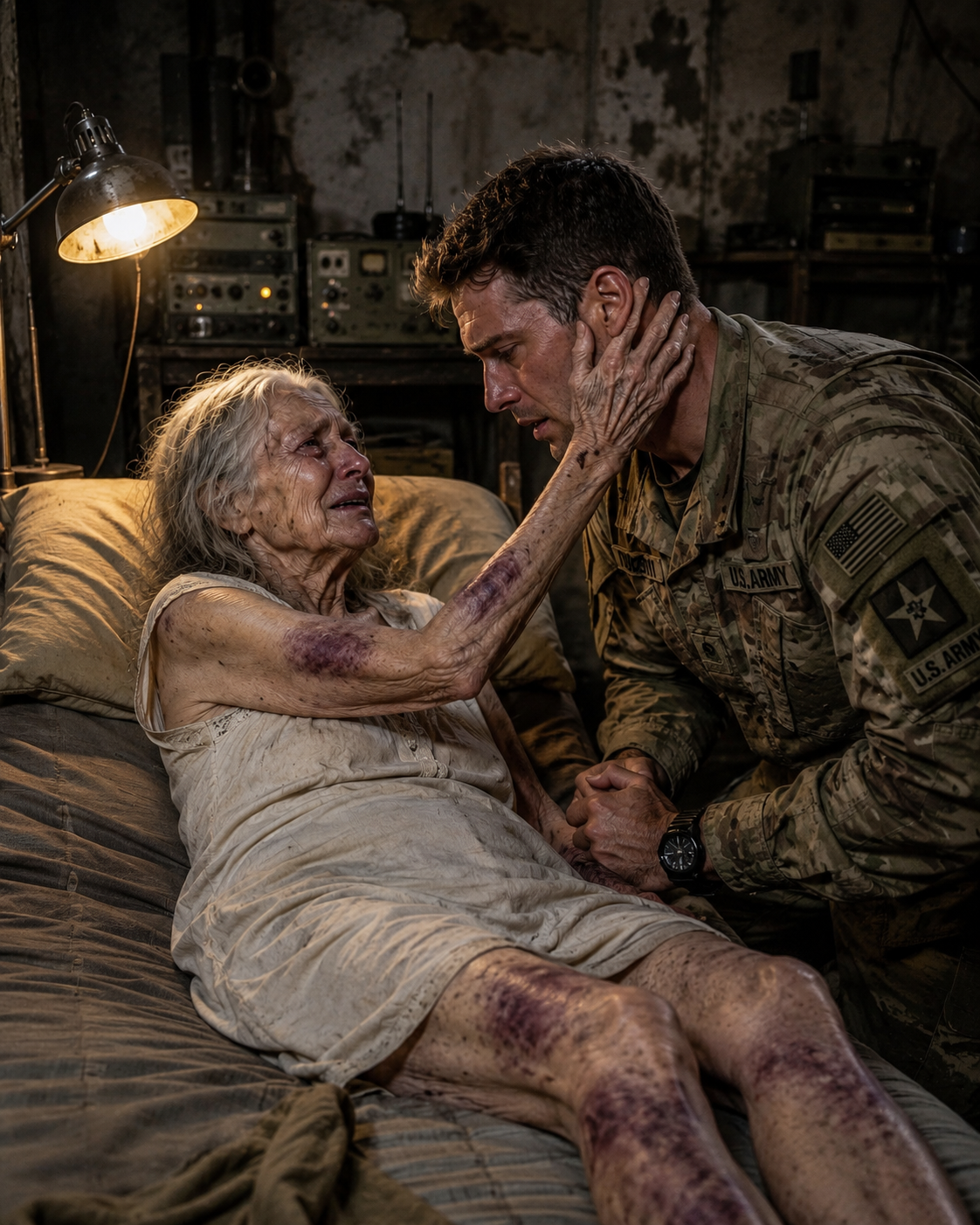
In the far corner, on a stained mattress, my mother was curled beneath a thin blanket. Her silver hair was tangled. Her face was thinner than it should have been.
“Mom!”
She flinched and raised her arms to protect her face.
Then she saw me.
“Ethan,” she sobbed, grabbing my uniform with shaking hands.
When the blanket slipped from her shoulders, I saw the dark purple marks on her arms. Finger-shaped marks. The kind left by someone who had gripped too hard and dragged too roughly.
“They won’t stop until everything is gone,” she whispered. “The house, the trust… the doctor says I’m crazy. They’re taking it all, my boy.”
Rage burned through me so hard I could barely breathe.
Then footsteps sounded above us.
Natalie came down carrying a tray with a paper cup of water and two pills. When she saw me kneeling beside my mother, she froze.
For one second, her real face showed.
Then the mask returned.
“Oh my God, Ethan! You’re home early!” she gasped, dropping the tray. “She locked herself down here again. I was just coming to help her. Her decline is getting worse. She’s becoming dangerous. The psychiatrist says we need to commit her today, for her own safety.”
I looked at the marks on my mother’s arms.
Then I looked at my wife.
Every instinct in me wanted to end the threat right there. But if I lost control, Natalie would win. I would be arrested, and my mother would be left at her mercy.
So I breathed.
“Even though I walk through the darkest valley, I will fear no evil,” I recited silently.
Then I let my shoulders drop. I made my face empty. I became the exhausted husband who couldn’t understand what was happening.
“You’re right,” I said quietly. “Set up the appointment. Today.”
Natalie’s eyes flashed with victory.
“I’ll call Dr. Reed now,” she said. “I’m so sorry you came home to this, baby.”
As she hurried upstairs, I held my mother carefully.
“Stand fast, Mom,” I whispered. “The ambush is set.”
What Natalie didn’t know was that I hadn’t arrived home that morning.
I had been stateside for three days.
That bank alert in Iraq had changed everything. During a stop at Fort Liberty, I used an old security backdoor I had installed on our home network years earlier. I cloned Natalie’s phone.
What I found was worse than betrayal.
Natalie was having an affair with Dr. Marcus Reed, a wealthy psychiatrist known for helping rich families declare inconvenient relatives mentally incompetent. Together, they were building a legal trap around my mother.
I spent three days moving like a ghost through my own city. I rented an anonymous car. I watched Natalie meet Dr. Reed at a luxury hotel. I photographed them together. I traced bank transfers, shell accounts, fake medical notes, and messages discussing how to overmedicate my mother so she would look confused in front of a notary.
By the time I walked into that basement, I already had the evidence.
That night, in a cheap motel room, I built the file that would destroy them.
Photos. Bank records. Metadata. Audio. Messages. Offshore account numbers. A complete target package.
I laid one hand on the leather folder and prayed.
“Lord, let their own wickedness become the snare that catches them. Vengeance is Yours. Make me the instrument of exposure.”
The next morning, I played my role perfectly.
Natalie hummed while helping my terrified mother into a sweater.
“The clinic is expecting us in an hour,” she said. “I know this is hard, but Dr. Reed is the best. He’ll make sure she’s comfortable in the memory care ward.”
I nodded like a broken man.
Then I picked up my military pack, feeling the heavy folder inside.
The Reed Psychiatric Institute sat on the top floor of a sleek glass building in Arlington. Everything about it was designed to make families feel small and desperate.
Dr. Marcus Reed greeted us in a white coat over a designer suit. He shook my hand with polished sympathy and obvious contempt.
“Sergeant Ethan,” he said, “thank you for your service. I’m sorry we’re meeting under such tragic circumstances. Natalie has kept me fully informed.”
“Thank you, sir,” I said.
My mother sat trembling beside me, staring at the floor. She was terrified, but she was also playing her part.
Dr. Reed leaned forward.
“This is an aggressive progression of post-stroke vascular dementia. Keeping her at home is no longer safe. She requires locked-ward supervision.”
Natalie squeezed my knee.
“I’ll handle the finances, honey. The estate transfers, the bills. You just serve your country. I’ll take care of the home front.”
Dr. Reed slid a stack of legal documents across the desk.
“Granting Natalie full medical and financial power of attorney today is the safest option.”
The gold pen rested on the signature line.
I looked at it.
Then I unzipped my pack.
The sound was loud in the quiet office.
“I appreciate your assessment, Doctor,” I said, my voice changing. “But before I sign away my mother’s life, I brought a report of my own.”
I slid the leather folder across the desk, directly over his documents.
Dr. Reed smirked.
“Sergeant, whatever internet research you’ve done on dementia cannot replace medical expertise.”
Then he opened the folder.
His smile disappeared.
On the first page was a timestamped photograph of him and Natalie together in the hotel suite.
His face turned pale.
He flipped the next pages and saw the offshore transfers, IP logs, audio transcripts, and messages about drugging my mother.
“What is this?” he whispered.
Natalie leaned over.
“Marcus, what are you—”
She stopped breathing for a second.
She looked from the folder to me, panic filling her eyes.
I stood, walked to the office door, and locked it with the deadbolt. I had taken the master key from reception on the way in.
“God sees everything done in the dark, Doctor,” I said. “And today, so do the Army CID and the FBI.”
Sirens rose outside the building.
Natalie lunged toward the door, screaming. Dr. Reed sank back into his chair, finally understanding that he was no longer the predator in the room.
The raid was controlled chaos.
Federal agents and Army investigators entered the office minutes later. I stood by the window with my arms around my mother while Dr. Reed was handcuffed in front of his own staff and patients.
Natalie turned on him almost immediately.
At the federal building downtown, I watched through thick glass as she paced a holding cell, crying and pointing toward the next room where Reed was being questioned. She tried to claim she was lonely, manipulated, and vulnerable because of my deployment.
Then the agent placed my evidence package on the table.
The audio proved she was not a victim.
She was the architect.
I felt no joy watching her collapse. The end of a marriage, even one built on lies, still leaves wreckage. I felt only the tired relief a soldier feels after surviving a firefight.
The threat was neutralized.
But the battlefield was still scarred.
I turned away from the glass and walked outside.
My mother was waiting in my truck.
When I opened the passenger door, she looked up at me. The fear was gone from her eyes. The woman who raised me had returned.
“You saved me, my brave boy,” she whispered, touching my cheek.
I kissed her forehead.
“The Lord was our overwatch, Mom,” I said. “I just followed His coordinates.”
A year later, sunlight poured through the stained glass windows of the military base chapel. Ruby and sapphire light spread across the wooden pews.
I sat near the front in my Army Service Uniform, the brass buttons polished, my new Master Sergeant rank resting on my shoulders.
Beside me, my mother stood tall, holding a hymnal and singing with a clear, strong voice. Her arms were healed. The fake “dementia” was gone. She had rebuilt her life and placed her wealth into a secure trust supporting housing for disabled veterans.
Natalie was appealing a ten-year federal sentence for elder abuse, wire fraud, and conspiracy. Dr. Reed had lost his medical license, his assets, and his freedom. He was serving fifteen years.
They were living inside the kind of captivity they had planned for an innocent woman.
As the chaplain gave the final blessing, peace settled over me.
I had walked through the valley of the shadow of death. I had survived betrayal inside my own home from the person I trusted most. But I had not broken.
The fire did not destroy me.
It burned away the lies.
It taught me that true strength is not just the ability to fight. It is the discipline to let justice strike the final blow.
When the service ended, I offered my arm to my mother. Together, we walked down the aisle into a room filled with friends, soldiers, faith, and light.
As Master Sergeant Ethan stepped through the chapel doors into the bright morning sun, I smiled.
Because enemies may cross the wire, and traitors may hide inside your own camp.
But a man armed with faith, truth, and discipline will always hold the key to victory.