
“If you tell me no one one more time, I swear you’ll regret ever having me.”
When my son Connor said those words in our kitchen in a quiet suburb outside of Springfield, Missouri, I tried to convince myself it was only another angry episode, just one more excuse I had held onto for months because I was not ready to admit what had become painfully clear.
But that night, I was no longer seeing a lost, confused boy.
I was seeing a twenty three year old man who had learned how to turn disappointment into fear.
Connor had always been tall and broad, the kind of person who seemed to take up space the moment he entered a room.
As a child, he had been loving, full of energy, and curious about everything, frequently running into the house with dandelions from the backyard to declare them treasure.
Somewhere over the years, that little boy vanished.
At first, I blamed the divorce when his father, Simon, moved away after our marriage ended.
Then I blamed college when Connor dropped out after just one year, then I blamed his job problems when he kept losing one position after another, and finally I blamed heartbreak when his girlfriend left him.
Eventually, there were no excuses left for me to rely upon.
The truth was much harder to face than any of my fabricated stories.
Connor had grown furious at the world, and he expected everyone around him to carry the weight of that dark, heavy fury.
He especially expected that from me.
I defended him for much longer than I should have, explaining away the shouting, the insults, and the nights he came home drunk and staggering.
I explained away the shattered dishes and the holes punched into walls, the missing money, and every cruel thing he said because I kept telling myself the little boy I loved was still somewhere underneath it all.
Sometimes mothers mistake love for endurance, convincing ourselves that if we absorb enough hurt, the person hurting us will eventually remember who they used to be.
I believed that lie for years until the night everything finally changed.
I came home drained after a long shift at the elementary school library where I worked, my feet aching and my back feeling as though it might snap under the pressure.
The mortgage payment was due in a week, and the electric bill sat unopened on the counter, a constant reminder that for years, I had stretched every paycheck as far as it could go just to keep a roof over our heads.
When Connor came into the kitchen, he did not ask how my day had gone, nor did he ask whether I was all right.
He simply asked for money.
“Need three hundred bucks,” he said casually as he leaned against the island.
I looked at him, feeling a sudden surge of weariness, and asked, “For what?”
He shrugged his shoulders, dismissing my question as he replied, “Does it matter?”
“Yes,” I insisted, feeling my voice grow firmer.
He rolled his eyes and snapped, “Just give it to me.”
“No,” I said, and the word came out before I had time to soften it.
Connor went still, his expression hardening as he asked, “No?”
I repeated myself, “Yes, I mean no.”
His jaw tightened and he took a threatening step toward me, “Since when do you get to tell me no?”
I laughed bitterly, feeling a strange sense of detachment, “Since I am the one paying for this house, Connor.”
His eyes darkened with an intensity that made me shiver, “That is funny.”
“No, Connor, what is funny is that you are twenty three years old and still acting like a child,” I retorted.
The kitchen fell into a heavy silence, and I knew at once that I had crossed a line, but for the first time in my life, I did not care.
“I am done,” I said quietly, meeting his gaze directly.
“I am not giving you money anymore, not for alcohol, not for parties, and not for whatever nonsense you are wasting it on,” I added.
He stared at me for a long moment, and then he smiled in a way that felt cold and unfamiliar.
“Don’t talk to me like that,” he commanded, his voice dropping to a low, dangerous register.
“I am talking to you the way I should have years ago,” I replied, standing my ground.
His face hardened instantly, and he spat out, “Learn your place.”
I never saw it coming, but the slap cracked across my cheek so sharply that for a second, my mind could not understand what had happened.
The pain was not even the worst part of that moment.
The worst part was the chilling silence that followed as I stood motionless beside the counter, listening to the refrigerator hum and the clock tick while a neighbor’s dog barked outside.
Connor looked at me, not with regret or guilt, but only with irritation, as though I had forced him to do it.
He shrugged his shoulders as if he were annoyed by a minor inconvenience and walked upstairs to his room.
A moment later, his bedroom door slammed shut, echoing through the empty house.
I stayed where I was, one hand pressed against my stinging cheek, finally understanding something truly terrifying.
I was not safe in my own home.
At 1:17 in the morning, I picked up my phone and stared at Simon’s number for almost five minutes.
We had been divorced for eleven years and spoke only on birthdays, holidays, or during family emergencies, so I hated the thought of calling him.
However, I hated what had just happened in my kitchen even more, so I finally pressed dial and waited.
He answered on the third ring, his voice thick with sleep as he asked, “Rebecca?”
I opened my mouth, but no sound came out, so I forced the words through the painful lump in my throat.
“Connor hit me,” I whispered.
There was a total silence on the line for several seconds, and all I could hear was his ragged breathing.
Then his voice came back, calm, controlled, and dangerously steady, “I am coming.”
The call ended, and I did not sleep at all.
Instead, I cleaned, I cooked, and I thought about the life I had allowed to unravel.
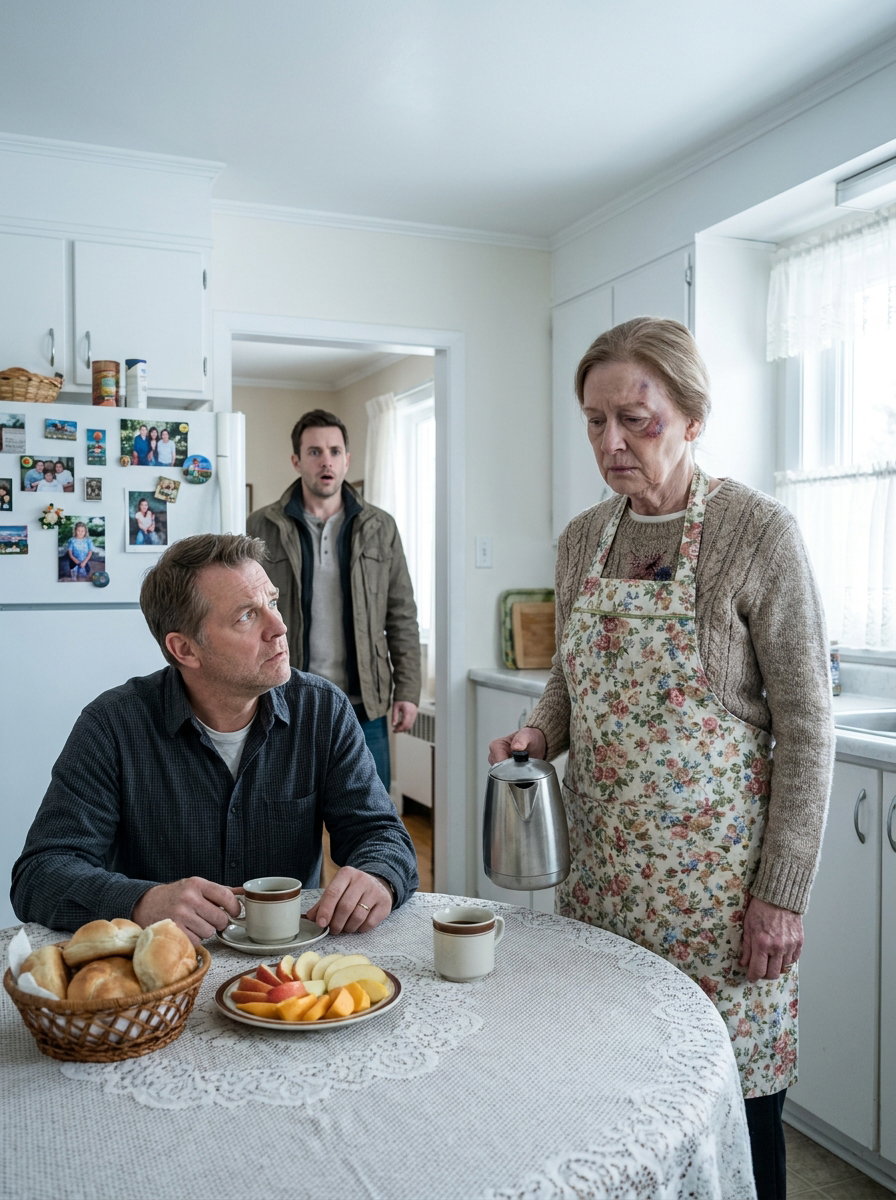
By four in the morning, bacon was sizzling in a skillet, eggs were staying warm in the oven, and fresh biscuits were cooling on the counter while coffee filled the kitchen with a rich, dark smell.
I took the embroidered tablecloth from the hall closet, the expensive one saved for holidays and special occasions, and I polished the silverware, set the plates, and carefully folded the napkins.
Everything looked perfect because this was a special occasion, not a celebration, but a turning point.
Just before six, headlights crossed the front windows, and I knew Simon had arrived.
His hair was grayer now, his shoulders seemed broader, and his expression was harder than I remembered from our years together.
He stepped inside carrying a leather folder, and one look at my bruised face told him everything he needed to know.
His jaw tightened as he asked, “Where is he?”
“Upstairs,” I replied, feeling my hands shake slightly.
“Is he asleep?” he asked.
I nodded, and Simon placed the folder on the table, his eyes moving over the carefully prepared breakfast.
“You only do this when something important is happening,” he observed.
I swallowed hard and said, “It ends today.”
He studied me for a long moment, his eyes searching mine, and then he nodded, “Good.”
He opened the folder to reveal documents, legal papers, program brochures, and protection order forms, all of which were resources I had been too frightened to look at before.
“Are you sure about this?” he asked, his voice softening just a fraction.
I closed my eyes and remembered Connor at six years old, at ten, and at fifteen, but then I remembered the sickening sound of that slap.
I opened my eyes and said, “Yes, I am sure.”
Simon nodded once and stated, “Then we do this properly.”
A few minutes later, footsteps sounded overhead and the stairs creaked as Connor began to make his way down.
He was awake, and he had no idea what was waiting for him in the kitchen.
He entered the room yawning, his hair messy and his confidence fully intact, until he saw the breakfast, the tablecloth, and the elaborate spread.
A grin spread across his face as he said, “Well, look at that, you finally figured it out.”
He reached for a biscuit, but then his eyes landed on Simon, and the biscuit slipped from his fingers.
“What is he doing here?” Connor demanded.
Simon stayed seated and said, “Sit down, Connor.”
“What are you talking about?” Connor asked, confused.
“Sit,” Simon repeated firmly.
Something in Simon’s tone made him obey, and Connor dropped into a chair while muttering, “This is ridiculous.”
Simon slid the folder toward him and said, “No, what is ridiculous is hitting your mother and thinking nothing is going to change.”
“I didn’t hit her,” Connor lied, his voice rising.
“You did,” Simon stated flatly.
“It was just an argument,” Connor countered.
“You hit her,” Simon insisted, his eyes narrowing as he added, “Do you even hear yourself?”
Connor turned to me and asked, “So this is what we are doing now?”
“Yes,” I said, feeling my voice gain strength.
“Seriously?” he asked, looking around the kitchen in disbelief.
“Yes,” I repeated.
Simon opened the folder and explained, “This is a temporary protection order.”
Connor laughed, clearly unbothered, “You are kidding me, right?”
“No,” Simon said, continuing, “This revokes all access to your mother’s accounts.”
He pointed to another document and said, “This removes you from the vehicle insurance policy.”
He laid out another paper and added, “This outlines the specific conditions under which you may return to the property.”
Then he placed a brochure on top, “This is a residential treatment program.”
Connor stared at the brochure and sneered, “You think I am crazy?”
“No,” I said quietly, “I think you have become dangerous.”
Those words struck him harder than any slap could have, and he stood suddenly, knocking his chair back.
“I am the problem now?” he shouted.
“Yes,” I affirmed.
“You have any idea what I have been through?” he asked, gesturing wildly.
Simon stood up as well, his presence filling the room as he said, “You do not get to use your pain as permission to hurt other people.”
Connor looked from him to me, and I could see his confidence starting to crack.
For the first time, uncertainty appeared in his eyes, followed by shame, and then a profound, hollow fear.
“What if I don’t go?” he asked, his voice barely a whisper.
Simon answered immediately, “Then your mother files criminal charges.”
The room went silent, and I forced myself to speak clearly, “I won’t protect you anymore.”
His face collapsed as he asked, “You would really do that to me?”
“I should have done it years ago,” I replied.
For several moments, no one moved, and then Connor turned around, his shoulders slumped in defeat.
Without saying another word, he walked upstairs, and I watched after him, feeling a strange mix of sorrow and relief.
“What happens now?” I whispered to Simon.
He kept his eyes fixed on the staircase and said, “Now he has to decide.”
Ten minutes later, Connor came back down, a duffel bag hanging from his shoulder.
It was the same bag he had carried on his high school football trips years ago.
For one brief second, I saw the little boy again, but then the moment passed, and he set the bag beside the door.
“I am not doing this for him,” he muttered, glancing at Simon.
“You don’t have to do it for me,” Simon replied calmly.
Connor looked at me, really looked at me, maybe for the first time in years.
Suddenly, his anger looked smaller, and beneath it, I saw exhaustion, regret, and deep, aching pain.
“Will you ever let me come back home?” he asked.
The question almost broke me because it was not truly about the house, but about whether I still loved him.
I drew in a deep breath and said, “That depends on what happens next for you.”
His eyes filled with tears, and so did mine.
“I never meant for things to get this bad,” he admitted.
“But they did get this bad,” I reminded him.
He nodded slowly and said, “Yes, I know.”
Simon picked up the car keys and said, “We need to leave now.”
Connor closed his eyes for a moment, and then he whispered the words I thought I might never hear, “I will go.”
There were no dramatic speeches, no instant miracles, and no perfect reconciliation.
There was only the truth, which is sometimes harder to face, but it lasts much longer than any lie.
I watched them drive away, and then I walked back inside my quiet home.
The silence felt different now, not empty, but peaceful.
For the first time in years, I could actually breathe inside my own house.
The weeks that followed were incredibly hard as I changed the locks, started therapy, filed the legal paperwork, and learned to use words I had avoided for years like abuse, boundaries, accountability, and recovery.
Six weeks later, a letter arrived in the mail.
The handwriting was unmistakably Connor’s, so I opened it carefully.
Inside, he had written, “I don’t know if I deserve another chance, and maybe I don’t, but for the first time in my life, I am not blaming anyone else for what I did. I hit the person who loved me most, and I became someone I never wanted to be. If I ever come home again, I want you to feel safe when you see me.”
I cried as I read those words, not because everything was repaired, for it was not.
Recovery does not move in a straight line, forgiveness does not happen automatically, and trust can take years to build again.
But for the first time, truth had entered our family.
Once truth takes a seat at the table, fear loses its place.
Sometimes love is not about enduring everything, but about drawing a clear line.
Sometimes the most loving thing a parent can do is refuse to become the place where someone else pours out their darkness.
That morning, sitting alone at a beautifully arranged table covered with an embroidered cloth and surrounded by untouched breakfast, I finally understood something I should have understood years earlier.
A mother can love her child with her whole heart, and still demand better for both of them.
And sometimes, that is exactly what saves them both.
THE END.