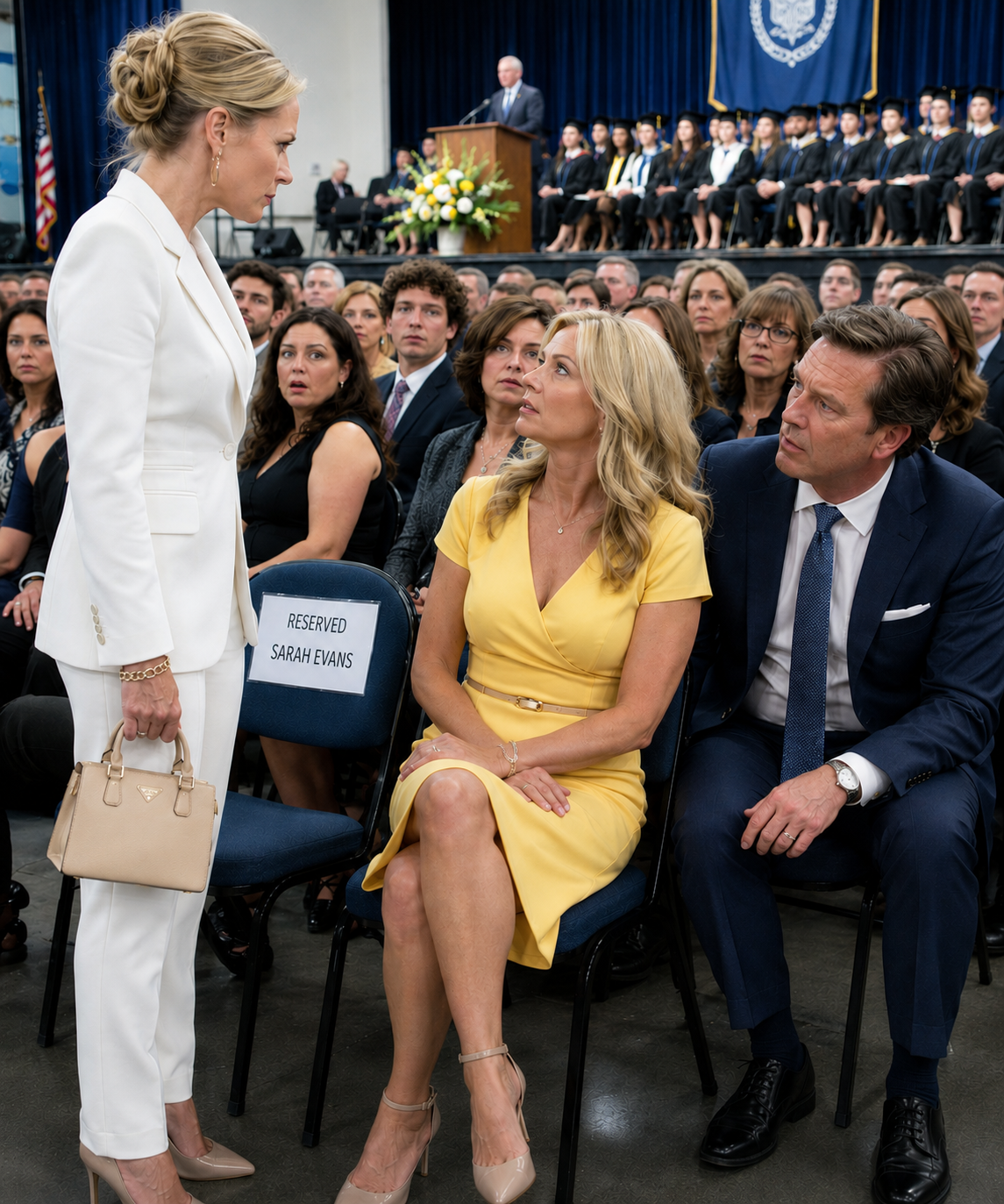
The usher, looking barely out of high school, had a name tag that read Leo, and he struggled to meet my gaze.
“Ma’am, I’m truly sorry, but those seats right at the front are no longer available. You’ll need to stand back here.”
I tightened my grip on the graduation program. From the auditorium’s rear, I could distinctly see Row B. Two chairs. Two reserved name cards. I had watched my son, Julian, place them there himself earlier that morning after embracing me in the parking lot.
“Front row, second seat from the aisle,” he had declared with a bright smile. “I saved the perfect spot for you.”
Now the cards were gone. Not entirely vanished. One lay beneath the row ahead, precisely torn in half. My name, Eleanor Vance, written in Julian’s meticulous blue marker, ripped straight down the middle.
“Those were my seats,” I stated quietly. “My son specifically reserved them.”
Leo shifted uncomfortably.
“The woman in the blue dress mentioned there was a seating error.”
I followed his line of sight. There sat Seraphina, my ex-husband Marcus’s third wife, twenty-eight years old, clad in an expensive cobalt-blue dress, occupying the exact center of Row B as if it were her rightful place.
She turned slowly, noticed me standing at the back, and offered a smile. It was not a welcoming smile. It was the kind of smile that silently proclaimed, I know precisely what I’ve done.
Then she raised her phone and angled it toward me. She was recording. Before I explain what transpired next, you must grasp the eighteen years that preceded it. Otherwise, you might conclude I was weak for not marching down that aisle and reclaiming my seat. I was not weak. I was strategic. And from an outsider’s perspective, strategy often appears precisely like weakness.
Marcus departed when Julian was six years old.
He arrived home one Tuesday afternoon and informed me he had “outgrown” me. That was his precise terminology. Outgrown. As though I were an old garment he no longer wished to wear. He had encountered someone new at work. He desired the house. He guaranteed he would be generous with financial support. That night, Julian stood in the hallway wearing Spider-Man pajamas, watching me weep on the kitchen floor. I lifted him and told him we were embarking on a new adventure. He wrapped his arms around my neck and clung tightly.
He always clung tightly. For two months, we resided with my sister Gemma. Following that, I rented a tiny apartment situated above a Vietnamese restaurant. The heating barely functioned. The bathroom door never properly closed. Julian received the bedroom. I slept on the pullout couch. Funds were perpetually scarce.
Marcus seldom paid what the court mandated. There was always an excuse. A business complication. A financial setback. A delayed payment. Eventually, I ceased anticipating assistance. I worked mornings cleaning medical offices and spent evenings sewing alterations for supplementary income. Some nights I toiled until two in the morning. Some nights until three.
I forfeited vacations. I forfeited new attire. I forfeited everything except what truly mattered.
Julian. He never owned the most expensive footwear. He never possessed designer jackets. But he always had books. He always had school supplies. And he always had a mother who consistently showed up.
Every game. Every parent-teacher conference. Every achievement. Julian was exceptionally brilliant. By elementary school, he was reading years beyond his grade level. Educators noticed. Physicians noticed. Everyone noticed. I drove him forty minutes each way to a specialized magnet school. I took him to robotics competitions, intensive science camps, and demanding math tournaments. Marcus attended exactly two significant events in twelve years. One science fair. One graduation ceremony. Both times he remained just long enough for photographs.
That was his particular forte. Photographs. He missed the fevers. He missed the late-night homework meltdowns. He missed the bullying. He missed the struggles. But he never missed a picture. That is precisely why, years later, when Seraphina usurped my seat at Julian’s graduation, I remained exactly where I was. Because eighteen years of quiet resilience held more significance than one moment of public fury. I refused to become entertainment for someone else’s social media post. So I stood beneath the exit sign. And I waited. What Seraphina did that day was not novel. It was merely the latest maneuver in a much longer, calculated game.
Ever since she married Marcus, she had dedicated years to attempting to insinuate herself into every facet of Julian’s life. Social media posts. Passive-aggressive remarks. Subtle actions designed to render me invisible. None of them were substantial enough to provoke a scene. But collectively, they established a clear pattern. My attorney even assigned a designation for it. The Seraphina File. By graduation day, it spanned over eighty pages. That morning, Julian had hugged me in the parking lot.
“I love you, Mom,” he stated.
Then he paused.
“No. I mean truly. I acknowledge everything you’ve sacrificed for me.”
I recall gazing at him. He was not typically sentimental.
“Don’t cry today,” he advised.
“Why would I cry?”
“Because today is going to be a good day.”
I did not understand what he meant. Not yet. An hour later, I found myself standing at the back of the auditorium while Seraphina sat in my seat. Gemma was furious.
“She stole your place,” she whispered.
“Not today,” I told her. “We’re not ruining this day for Julian.”
So I stayed silent. Then the principal walked onto the stage.
“And now,” he announced, “it is my honor to introduce this year’s valedictorian… Julian Evans.”
The auditorium erupted. People stood. Teachers cheered. Students screamed. Marcus immediately rose to his feet, clapping proudly as if he deserved some of the credit. Seraphina lifted her phone to record. Julian walked onto the stage. But he did not look at Marcus. He did not look at Seraphina. He looked directly toward the back of the auditorium. Toward me. Then he unfolded his prepared speech, looked at it, folded it again, and slid it into his pocket.
“I prepared a speech,” he said into the microphone. “But I’m not giving it.”
Six hundred people stopped moving.
“I was going to thank everyone who helped me get here.”
His eyes shifted briefly toward Seraphina.
“But this morning, someone in this room did something I can’t ignore.”
Seraphina lowered her phone. Julian pointed directly at her. The entire auditorium turned.
“You thought nobody saw what you did. You thought money made you untouchable.”
Then he held up the torn name card. My name. Split in half.
“I have the security footage,” he said.
The room exploded with whispers.
“My mother worked two jobs for eighteen years to get me here.”
His voice cracked, then steadied.
“She cleaned offices before sunrise. She worked late into the night. She never missed a parent meeting. Not once.”
He pointed toward the back of the auditorium. Toward me.
“I’m standing here because of her.”
The entire audience turned around. For the first time, six hundred people saw me. Not Seraphina. Not Marcus. Me. And standing there beneath the exit sign, I realized something. Every sacrifice had been worth it. Every early morning. Every sleepless night. Every struggle. We had made it. And my son had made sure the whole room knew exactly who deserved the front-row seat.