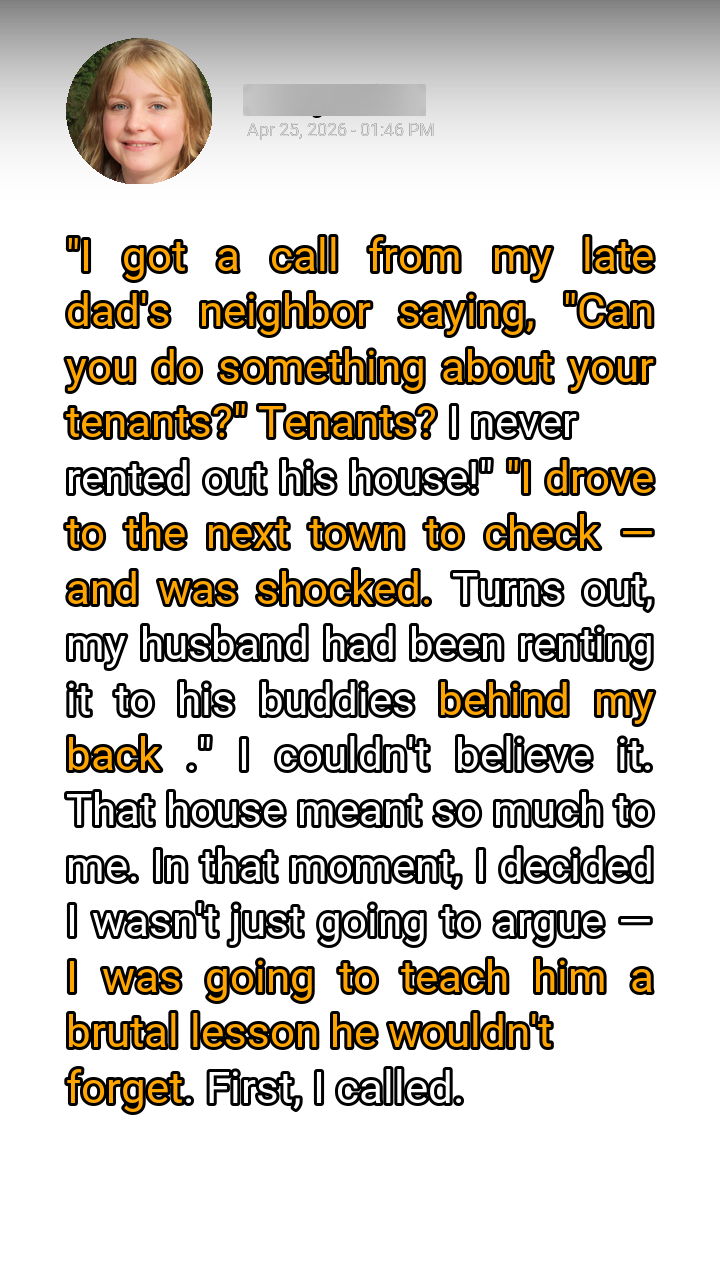
The shrill ring of my phone sliced through the quiet afternoon, startling me as I sorted through another box of my late father’s belongings. It was a number I recognized instantly – Mrs. Gable, Dad’s next-door neighbor for forty years, a woman whose voice was usually a comforting blend of gossip and garden advice. Today, however, her tone was sharp, laced with an unfamiliar edge of exasperation. “Elara, honey, I hate to bother you, especially with everything you’ve been through,” she began, her usual preamble, “but it’s gotten completely out of hand. Can you *please* do something about your tenants? They’re making a right mess, and frankly, they’re a menace.”
My hand, holding a faded photograph of Dad and me on his fishing boat, froze midway to the box. Tenants? The word echoed in the sudden silence of my living room, a surreal, nonsensical sound. “Tenants, Mrs. Gable?” I repeated, my brow furrowing in confusion. “I… I don’t have any tenants. Not for Dad’s house. I haven’t rented it out.” A cold tendril of dread began to snake around my heart. Dad’s house wasn’t just a property; it was a sanctuary, a monument to a life well-lived, a place I had spent countless weekends and holidays, where every scratch on the doorframe held a memory of my childhood height, every rose bush in the garden a testament to his green thumb. After his passing six months ago, I’d been meticulously planning its restoration, pouring over architectural magazines, dreaming of transforming it into a peaceful retreat, a legacy. The thought of strangers inhabiting it, let alone being a “menace,” was utterly alien and deeply unsettling.
Mrs. Gable, bless her, didn’t mince words. “Honey, they’ve been there for months! Big, loud fellows, always got some beat-up truck in the driveway. Parties late into the night, trash cans overflowing, and just last week, one of them nearly took out my prize-winning hydrangeas backing out of the driveway! I thought maybe you’d decided to rent it after all, but I figured you’d at least tell me. And honestly, they don’t seem like the kind of people you’d approve of.” Her voice trailed off, a hint of genuine concern now replacing the exasperation. “I know you’re busy, dear, but someone needs to deal with them before the whole street complains to the association.”
The phone clicked back into its cradle, but the unsettling silence it left behind was far more deafening. My mind raced, trying to reconcile Mrs. Gable’s words with my reality. *Tenants? Months?* It was impossible. I was the sole heir, the only one with keys, the only one with authority. A sickening knot tightened in my stomach. There was only one person on the face of the planet who might have access, who might even *dare* to make such a decision without my knowledge. A wave of ice-cold realization washed over me, instantly replacing confusion with a burgeoning, volatile anger. My husband, Mark. He had a spare set of keys, given to him when Dad was ill, for emergencies. But this wasn’t an emergency. This was… a betrayal of monumental proportions.
Without a second thought, I grabbed my car keys, the photograph of Dad still clutched tightly in my hand. The 45-minute drive to the next town, usually a scenic route filled with nostalgic thoughts, became a blur of simmering fury and growing dread. Every mile felt like a transgression, every passing tree a silent witness to a potential deceit. What would I find? Would it be as bad as Mrs. Gable described? Or worse? The image of my father, a man of meticulous order and quiet dignity, flashed in my mind, and the thought of his beloved home being disrespected, defiled even, by strangers – by *Mark’s* strangers – sent a jolt of adrenaline through me.
When I finally pulled onto Linden Street, the familiar, tree-lined avenue that led to Dad’s house, my breath hitched in my throat. Mrs. Gable hadn’t exaggerated. The usually pristine lawn, Dad’s pride and joy, was overgrown in patches, dotted with what looked suspiciously like discarded beer cans. A rusty, mud-splattered pickup truck with oversized tires sat parked half on the grass, half on the cracked driveway, next to a motorcycle I’d never seen before. Loud, discordant music thumped from inside, vibrating the very ground beneath my feet. The front door, once a welcoming shade of forest green, was scuffed and marred, and a cheap, plastic outdoor chair lay overturned on the porch. This wasn’t just tenants; this was a frat house. This was a desecration.
My vision blurred with unshed tears, but the pain quickly morphed into a searing rage. My father’s home, the repository of so many cherished memories, reduced to this. And Mark, my husband, the man I trusted, had done this behind my back. The sheer audacity, the callous disregard for my feelings, for my father’s legacy, for *our* shared future plans for the house, was a blow that resonated deeper than any argument we’d ever had. In that moment, standing before the wreckage of what should have been a sacred space, a cold, hard resolve crystallized within me. I wasn’t just going to confront him. I wasn’t going to argue, or cry, or even simply demand answers. He had crossed a line, a fundamental boundary of respect and trust that could not be uncrossed with mere words. I was going to teach him a brutal lesson, one so profound and unforgettable, it would echo through every corner of his life, just as his betrayal now echoed through every room of my father’s house. The first step was clear, an immediate, surgical strike that would begin to dismantle his elaborate lie. With trembling fingers, but a mind sharper and colder than it had ever been, I pulled out my phone and dialed the number of the one person who could begin to reclaim what was mine, immediately and irrevocably. The phone rang once, twice, before a gruff, familiar voice answered on the third. “Hey, Elara, what can I do for you?” It was Mr. Henderson, the only locksmith in town, who had been servicing my family’s locks for over thirty years. “Mr. Henderson,” I began, my voice steady despite the storm raging inside me, “I need you to come to my father’s house. Right now. And I need you to change every single lock.”
“Mr. Henderson,” I began, my voice steady despite the storm raging inside me, “I need you to come to my father’s house. Right now. And I need you to change every single lock.” There was a beat of silence on the line, then Mr. Henderson’s familiar, gruff voice, tinged with a hint of surprise. “Elara? Everything alright, dear? That’s a sudden request.” “No, Mr. Henderson,” I replied, my gaze sweeping over the desecrated lawn, the overturned chair, the blaring music, “everything is decidedly *not* alright. It’s an emergency. I’ll pay double, triple, whatever it takes. Just please, be here as fast as you can.” He didn’t argue further, just promised to be there within fifteen minutes, recognizing the urgency in my tone. I hung up, my fingers still trembling, but the cold resolve in my heart solidified. I wouldn’t wait inside. I would stand guard, a sentinel of my father’s memory, until help arrived.
True to his word, Mr. Henderson’s beat-up Ford pickup, laden with tools, pulled up to the curb a quarter of an hour later. The loud music still throbbed from within the house, a defiant heartbeat of the betrayal. He took one look at my pale, determined face, then at the chaotic scene on the lawn and driveway, and his expression, usually jovial, hardened with understanding. “Say no more, Elara,” he murmured, pulling out a heavy-duty toolbox. “Let’s get these locks changed.” As he began assessing the front door, the screen door suddenly creaked open, and a burly man with a tangled beard and a stained tank top emerged, a beer can in his hand. He blinked at me, then at Mr. Henderson, a slow, confused grin spreading across his face. “Well, hello there, pretty lady! Lost your way?”
My voice, when it came, was a low, dangerous whisper that cut through the blaring music. “You have exactly ten minutes to gather your belongings and vacate this property. Every last item. If anything remains, it will be discarded. This house is not for rent, and you are trespassing.” The man’s grin faltered, replaced by a scowl. “What the hell are you talking about? Mark said this was cool! We’re paying tenants!” “Mark,” I spat, the name tasting like ash, “is not the owner of this house. I am. And you are not tenants. You are squatters. And you are leaving. Now.” Just then, two more men, equally unkempt, appeared in the doorway, drawn by the confrontation. Their initial bravado quickly evaporated under my unwavering stare and Mr. Henderson’s silent, steady presence. The locksmith, without a word, had already dismantled the cylinder of the deadbolt, the metallic rasp a stark counterpoint to the fading music, which one of the men had, surprisingly, turned down. The message was clear: my patience had run out. Within minutes, they were scrambling, grumbling curses as they began to haul overflowing duffel bags and boxes out to the rusty pickup. The entire scene was a chaotic, humiliating exodus, but I stood unmoving, watching every single item leave the house, ensuring no trace of their profane presence remained.
As the last of their belongings were tossed into the truck and the engine sputtered to life, spewing a cloud of acrid smoke, I felt a strange sense of liberation. The truck rumbled away, leaving behind a sudden, profound silence, broken only by the rhythmic click and whir of Mr. Henderson expertly installing the new, gleaming brass locks. He worked methodically, replacing every external lock on the house – front door, back door, shed, even the old garage. Each click of a new lock cylinder falling into place felt like a small victory, a reclaiming of what was rightfully mine. The house itself seemed to breathe a sigh of relief, shedding the oppressive weight of its recent occupants. When he was done, Mr. Henderson handed me a heavy ring of new keys. “Nobody’s getting in here without your say-so now, Elara,” he said, his voice gentle. “I’m so sorry this happened, dear.” I thanked him, my throat tight with emotion, and watched him drive away, a lone figure of silent support in my moment of crisis.
Alone in the quiet, once-again-sacred space, I walked through each room. The faint smell of stale beer and cheap air freshener still lingered, but it was fading. The walls, though scuffed, were still standing. The memories, though momentarily obscured, were still there. I pulled out my phone, my thumb hovering over Mark’s contact. This was it. The true beginning of the lesson. I took a deep breath, steeling myself, and dialed. He picked up on the second ring, his voice cheerful, oblivious. “Hey, Elara! What’s up? I was just about to call you, actually. Big game tonight, thought we could order some pizza…”
“Mark,” I interrupted, my voice devoid of emotion, “I’m at Dad’s house.” A pause. His cheerfulness evaporated. “Oh? Uh, yeah, I was gonna tell you, I, uh, I let a couple of guys stay there for a bit. Just helping them out. They were gonna pay me back. Don’t worry, it was all above board, just a temporary thing.” His voice was a pathetic scramble for justification. “Above board?” I scoffed, a bitter laugh escaping me. “They were running a frat house, Mark. They nearly destroyed Mrs. Gable’s hydrangeas. And they’ve been there for months. Months! Behind my back. In my father’s house.” My voice rose slightly, the tremor of rage finally breaking through. “I just had Mr. Henderson change every single lock. They’re gone, their trash is gone, and you, Mark, are next.”
There was stunned silence on the other end, then a sputtering, “What? Elara, what are you talking about? Next? That’s ridiculous! You can’t just… I mean, we’re married! That’s our house!” “It was my father’s house, Mark. And it is now *my* house. And your complete disregard for my feelings, for my father’s memory, for our marriage, makes it clear you don’t belong in it. Or in *our* house. Or in *my* life.” I paused, letting the words sink in, each one a hammer blow. “Consider this your eviction notice, Mark. Not just from this house, but from our home. I’m filing for divorce first thing in the morning. And believe me, when I’m done, you’ll understand exactly what ‘brutal’ means. You won’t just lose a place to stash your buddies; you’ll lose everything you took for granted. This isn’t an argument, Mark. This is a consequence. And it’s one you will never, ever forget.” I didn’t wait for his response, didn’t need to hear his frantic protests. With a finality that resonated through my very bones, I pressed the ‘end call’ button, severing the connection, and with it, the last frayed thread of a broken trust. The brutal lesson had begun.