Elmwood Lane had always been my sanctuary, a picture-perfect tableau of manicured lawns, blooming hydrangeas, and the comforting hum of suburban life. My small, meticulously tended cottage, with its cheerful window boxes and a porch swing that invited contemplation, was my haven. Then, Adrian Thorne moved in, and the carefully constructed peace of my world began to unravel. He wasn’t overtly menacing, not at first. Just… silent. He was a bulky man, true, with broad shoulders that seemed to perpetually slump, and a face that could have been carved from granite – expressionless, unyielding. From the moment his moving truck rumbled down the street, he was an enigma. He never acknowledged my tentative waves, never returned my friendly “hellos.” His blinds remained perpetually drawn, a dark, unblinking stare that seemed to absorb all light and warmth. Any attempt at neighborly outreach, whether a fresh-baked pie or a simple offer of help, was met with a swift, almost aggressive retreat behind his heavy oak door. The initial curiosity quickly curdled into a simmering unease.
The whispers began, as they always do in close-knit communities. No one knew where he’d come from, what he did for a living, or if he even had a family. He was a phantom, occasionally glimpsed retrieving his mail or disappearing into the vast, dark interior of his house, always alone, always in a hurry. I found myself watching him from my kitchen window, a strange fascination mingling with a growing sense of dread. There were no late-night parties, no boisterous laughter, no signs of life beyond the bare necessities. Only the occasional, unexplained flicker of light in an upstairs window at odd hours, or the faint, almost imperceptible scrape of something heavy being dragged across a floor in the dead of night, sounds that my overactive imagination began to twist into sinister possibilities.
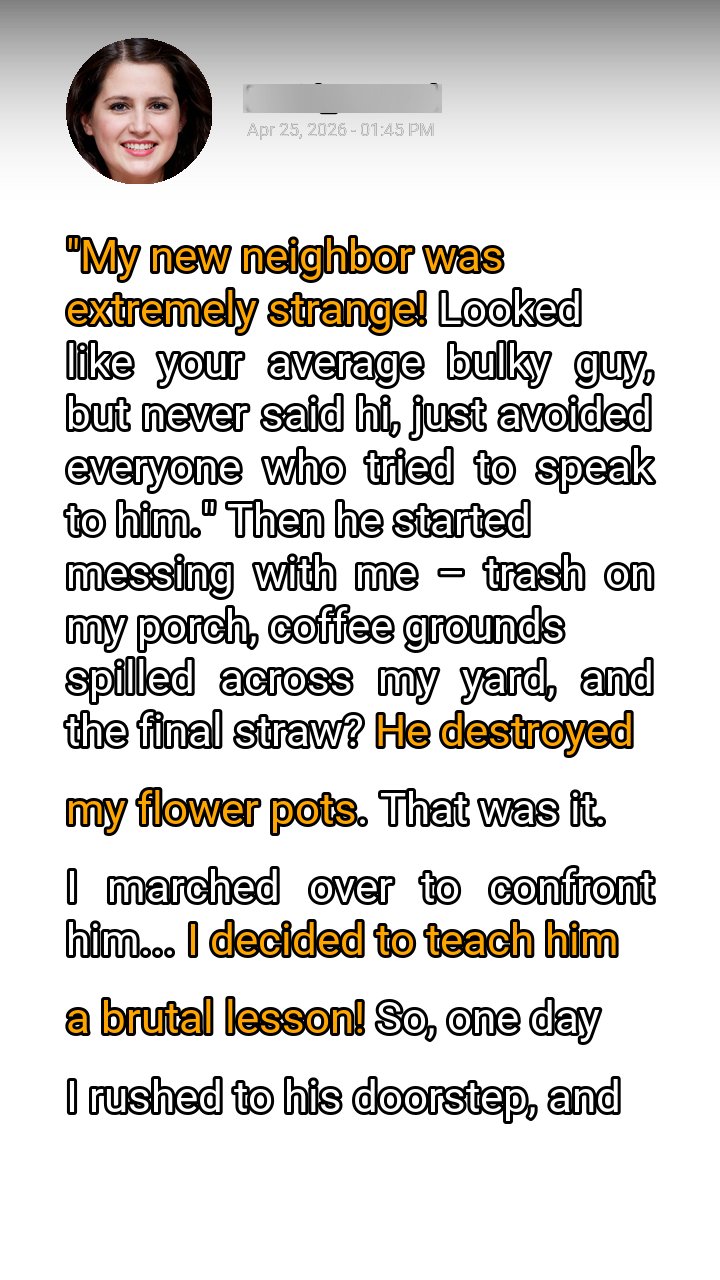
It started subtly, like a slow-burning fuse. One morning, I discovered a crumpled fast-food bag, greasy and half-eaten, resting not on my lawn, but deliberately placed on the cushion of my porch swing. It wasn’t accidental; it was a statement. I dismissed it as a prank, perhaps a stray gust of wind, though a prickle of irritation began to fester. A few days later, a faint, bitter aroma led me to the edge of my meticulously edged lawn. There, a thin, dark line of spent coffee grounds had been meticulously spilled, tracing the exact boundary between my property and the sidewalk. It was too precise to be random, too intentional to be overlooked. My annoyance sharpened into a quiet fury. This wasn’t mere eccentricity; this felt like a deliberate, passive-aggressive invasion, a silent declaration of war on my well-ordered existence. I cleaned it up, my hands trembling with a mixture of anger and a strange, cold dread, trying to rationalize it away, but the unsettling feeling lingered like a bad taste.
But the final straw, the act that shattered my carefully maintained civility and ignited a blazing inferno of rage, came with the destruction of my flower pots. They were my pride and joy – a vibrant collection of petunias, cheerful marigolds, and delicate fuchsias, each nestled in a hand-painted terracotta pot, arranged in a riot of color on my front steps. They were a testament to life, to beauty, to the simple pleasures I held dear. That morning, as the first rays of sunlight touched my porch, I found them. Not merely knocked over, but utterly, maliciously smashed. Clay shards lay scattered like shrapnel across the steps, soil churned and scattered, petals ripped and bruised. It was an act of pure, unadulterated vandalism, a visceral assault on something I cherished, something innocent. This wasn’t an accident; this wasn’t a warning. This was a direct, personal attack, a violation of my sanctuary.
A hot, blinding fury surged through me, eclipsing all reason, all restraint. My hands clenched into fists, nails digging painfully into my palms. All the bottled-up frustration, the gnawing unease, the subtle provocations, the blatant disrespect—it all coalesced into a singular, burning resolve. He had crossed a line, one etched in the very clay of my broken pots and the soil spilled upon my steps. My patience, my civility, my attempts at understanding, were utterly obliterated. I wasn’t just going to confront him; I was going to teach him a lesson, a brutal one, that he wouldn’t soon forget. This wasn’t about seeking an apology; it was about retribution, about showing him that Elmwood Lane, and specifically *my* property, was not a playground for his twisted, silent games.
I didn’t bother to change out of my gardening clothes; the smudges of dirt on my cheek and the streak of green on my shirt felt like a battle uniform. My heart pounded a frantic rhythm against my ribs, a relentless drumbeat of righteous anger. Each step across my lawn, then onto his, felt deliberate, powerful, driven by a raw, primal urge. My gaze was fixed on his front door, a dark, unyielding slab of oak that seemed to mock my rising fury. There was no hesitation, no second-guessing, just a singular, burning purpose. I reached his porch, the wood creaking faintly under my weight, and my hand, trembling slightly with adrenaline, shot out, ready to pound on the heavy door, to demand an explanation, to unleash the torrent of fury that had been building inside me for weeks. But as my knuckles hovered mere inches from the cold, unforgiving surface, a faint, almost imperceptible sound drifted from within the silent house. A low, guttural moan, followed by a soft, rhythmic thud. It wasn’t the sound of someone watching TV, or even moving furniture. It was something deeper, something unsettling, something that seemed to vibrate through the very floorboards beneath my feet. And then, the unmistakable, metallic tang of something foul, something visceral, seeped from beneath the door, assaulting my nostrils and instantly chilling the blood in my veins.
The metallic tang intensified, thick and cloying, a coppery whisper of decay that bypassed my senses and struck directly at the primal core of my being. My hand, poised to deliver a righteous assault on the heavy oak, faltered, then dropped. The furious pounding in my chest transformed from a drumbeat of anger to a frantic, terrified flutter. The guttural moan came again, louder this time, a sound scraped from the very depths of agony or madness, followed by the sickening *thud-drag… thud-drag* that now resolved itself into something being heavily, methodically pulled across a floor, punctuated by what sounded disturbingly like splintering wood. Every instinct screamed at me to flee, to retreat back to the sunlit sanctuary of my own property, but a morbid, irresistible curiosity, laced with a growing dread, rooted me to the spot. My “brutal lesson” felt suddenly childish, insignificant, utterly eclipsed by the chilling tableau unfolding just beyond this impenetrable door.
I pressed my ear against the cold wood, straining to discern more. The moans were irregular, ragged, like a creature in severe distress. The rhythmic thudding seemed to originate from the rear of the house, perhaps a basement or a back room. The smell, though, was everywhere, permeating the very air, a cocktail of blood, something fecal, and an indescribable sweetness that made my stomach churn. My gaze darted around the porch, searching for an alternative. A single, grimy window, half-obscured by a tattered curtain, was visible to the left of the door. With trembling hands, I tried the doorknob. To my horror, it turned with a soft, almost welcoming click. Adrian Thorne, the phantom of Elmwood Lane, hadn’t even bothered to lock his door.
A thin, cold sliver of light, reflecting off dust motes dancing in the stale air, was all that greeted me as I pushed the door open just a crack. The stench immediately intensified, assaulting my nose with brutal force, making me gag. The entryway was dark, a heavy velvet curtain drawn across the main living room window, plunging the space into perpetual twilight. A chaotic mess of overturned furniture, scattered papers, and what looked like dried mud stained the threadbare rug. But it was the silence, now that the door was open, that was most unsettling. The moaning had stopped. The thudding had ceased. Only the oppressive quiet, thick with the smell of decay, remained. My heart hammered against my ribs, a frantic hummingbird trapped in a cage. I took a hesitant step inside, the wood floor groaning faintly under my weight, each creak echoing ominously in the suffocating stillness.
“Adrian?” My voice was a choked whisper, barely audible, utterly devoid of the righteous fury that had propelled me here moments before. There was no reply, only the deafening silence. I advanced slowly, my eyes struggling to adjust to the gloom. The living room was a disaster zone: books torn from shelves, empty take-out containers piled high, a broken lamp lying shattered on the floor. It was the lair of someone deeply, profoundly unwell. And then I saw it. A dark, viscous trail, glistening faintly in the meager light, snaked across the floor, leading from the living room towards a hallway that disappeared into deeper shadows. It was the color of dried blood, and it pulsed with the source of that metallic tang.
My breath hitched in my throat. Every fiber of my being screamed at me to turn back, to run, to forget everything I had seen. But the trail, a silent accusation, drew me forward. I followed it, my steps hesitant, my gardening boots squelching slightly on the sticky floor. The hallway was even darker, the air heavier, colder. The trail led to a half-open door at the very end, from which a faint, unnatural glow emanated. As I approached, the low, guttural moan started again, closer now, a raw, animal sound that vibrated through the floorboards. It was coming from *that* room. My hand reached for the doorknob, cold and clammy, pushing it open slowly, dreading what I would find.
The sight that greeted me in the room beyond was a tableau of utter, unspeakable horror that would forever be seared into my memory. It was a makeshift operating theater, bathed in the sickly green glow of a single bare bulb hanging precariously from the ceiling. In the center of the room, on a blood-stained tarp, lay Adrian Thorne. He was not alone. Around him, meticulously arranged on various surfaces, were dozens of my terracotta flower pots, some whole, some shattered, filled not with soil and flowers, but with what appeared to be… human organs. Freshly harvested, still glistening, some partially dissected, others crudely stitched together with coarse twine. The rhythmic thud I had heard was Adrian, his face contorted in a silent scream, methodically striking his own chest with a blunt instrument, trying to extract something from his own body. His eyes, wide and unfocused, met mine for a fleeting second, filled not with malice, but with a profound, terrifying emptiness, a bottomless well of suffering. His hands, caked with blood and dirt, were attempting to pull a pulsing, dark mass from a gaping, self-inflicted wound on his torso, a wound from which the metallic tang of blood now poured in a torrent.
The scream that tore from my throat was not one of anger, but of pure, unadulterated terror and sickening realization. The coffee grounds, the trash, the *shattered flower pots* – they weren’t acts of aggression. They were desperate, deranged pleas, scattered fragments of a mind utterly lost to its own gruesome reality. Adrian Thorne was not a monster. He was a victim, trapped in a macabre dance with his own disintegrating sanity, a silent agony that Elmwood Lane had been too polite, too busy, too self-absorbed to notice. The “brutal lesson” had indeed been taught, but it was I who had learned it, a lesson in the terrifying, isolating depths of human suffering, a lesson etched forever in the crimson horror of Adrian Thorne’s secret garden of flesh and clay. I stumbled backward, the door slamming shut behind me, the grotesque image burned into my retina, and fled into the blinding sunlight, my own frantic screams echoing through the once-peaceful Elmwood Lane, now forever tainted by the unspoken horrors within its manicured borders.