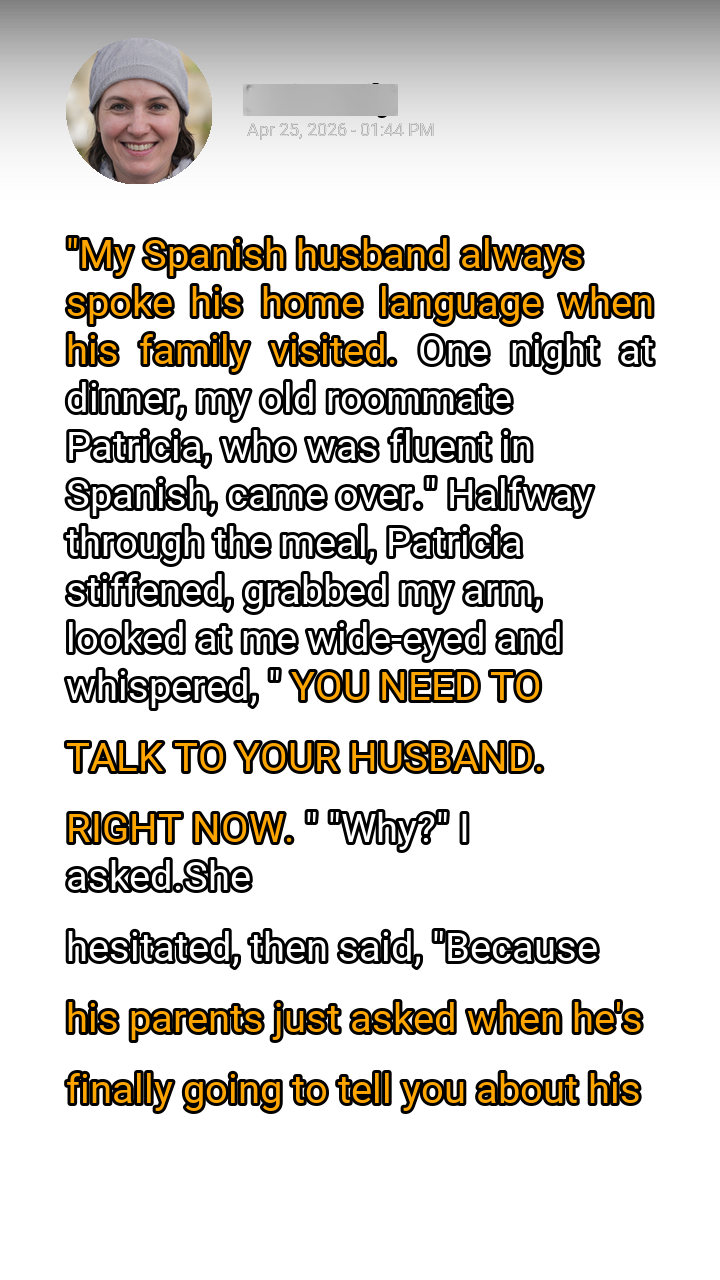
Our life together, Mateo’s and mine, was a vibrant tapestry woven from two distinct cultures, a beautiful, sometimes chaotic, blend of my quiet Midwestern roots and his fiery Spanish heritage. I adored Mateo; his laugh was a melody, his passion infectious, and his love, a comforting embrace that had swept me off my feet three years ago. We lived in a charming bungalow, its walls echoing with the scent of my freshly baked bread and the occasional, exuberant Spanish declarations that would erupt from Mateo when he was particularly excited. There was, however, one small, persistent thread in our tapestry that remained largely untangled by my hands: his native tongue. Whenever his parents, Elena and Ricardo, visited from their sun-drenched village near Valencia, our home transformed into a linguistic bubble of rapid-fire Spanish, a language I’d tried to learn, but never quite mastered beyond a few polite phrases and the names of various delicious foods. I’d always accepted it, seeing it as their way of connecting, a private familial dance I was content to observe from the periphery, trusting Mateo implicitly.
I remember that evening vividly, a crisp autumn chill just beginning to settle over the city. We were preparing for a special dinner. Patricia, my old college roommate and kindred spirit, was coming over. Patricia, with her razor-sharp wit and an uncanny ability to connect with people, was a beacon of calm and reason in my life. More importantly for tonight, she was also impeccably fluent in Spanish, having spent a year studying abroad in Seville and maintaining a close relationship with her host family. I’d invited her, partly because I missed her company, and partly, I admit, with a subconscious hope that her presence might bridge the linguistic gap that often left me feeling like an affectionate, if slightly bewildered, anthropologist at my own dinner table when Mateo’s parents were around. I wanted her to experience the warmth of Mateo’s family, and perhaps, for once, I wouldn’t have to rely solely on Mateo’s filtered translations or my own hopeful interpretations of their animated discussions.
The evening began with the usual delightful chaos. Elena, Mateo’s mother, a woman whose every gesture radiated an almost theatrical warmth, had brought her famous *paella valenciana*, the saffron-infused aroma filling every corner of our home. Ricardo, Mateo’s father, a man of fewer words but profound expressions, was already uncorking a robust Rioja, his eyes twinkling with satisfaction. Mateo, in his element, moved between the kitchen and the living room, a whirlwind of charm, translating snippets for me and Patricia, his arm slung casually around my waist one moment, then engaging his father in a rapid-fire discussion about local politics the next. Patricia, ever observant, offered polite interjections in flawless Spanish, her pronunciation so natural it often surprised even Mateo. She seemed to be enjoying the immersion, her eyes sparkling as she followed the energetic ebb and flow of their conversation, occasionally sharing a knowing glance with me when Elena launched into a particularly dramatic anecdote about a distant cousin.
As the meal progressed, the initial boisterousness settled into a comfortable hum. Plates were being cleared, coffee was brewed, and the conversation drifted from lighthearted reminiscing to more serious family matters, as it often did. I was laughing at something Mateo had just translated about a misadventure from his childhood when I noticed a subtle shift in Patricia. Her usual animated expression had subtly tightened. Her gaze, which had been tracking the conversation around the table with casual interest, now seemed to sharpen, focusing intently on Elena and Ricardo. A faint frown creased her brow, so slight I almost missed it amidst the clinking of porcelain and the murmur of voices. She took a slow sip of her wine, her eyes never leaving Mateo’s parents, who were now speaking in hushed, yet urgent, tones, their glances occasionally flickering towards Mateo, then quickly away.
I dismissed it at first, thinking perhaps she was just deep in thought, or perhaps catching a nuance I hadn’t. But then, it happened again. Elena leaned in conspiratorially towards Ricardo, her voice dropping even lower, her hand resting briefly on Mateo’s arm as he nodded, a flicker of something unreadable passing across his face. Patricia’s hand, which had been resting on the tablecloth near mine, subtly clenched. Her knuckles whitened just a fraction. I saw her lips press together in a thin line, her gaze now fixed on Mateo, then back to his parents. The air around her seemed to thicken, almost imperceptibly, as if she were suddenly encased in a soundproof bubble, processing words that were invisible to me. My own cheerful mood began to dissipate, replaced by a growing knot of unease in my stomach. The warmth of the room suddenly felt oppressive.
My heart began to pound a slow, heavy rhythm against my ribs. I tried to catch Patricia’s eye, a silent question forming on my lips, but she was entirely consumed by the Spanish dialogue unfolding before her. Then, abruptly, almost violently, her entire body stiffened. It was as if an electric current had shot through her. Her head snapped towards me, her eyes wide, almost dilated with an intensity that sent a shiver down my spine. Without a word, her hand shot out, her fingers closing around my forearm in a vice-like grip, her nails digging in just enough to convey the desperate urgency of the moment without causing pain. The warmth of her touch was gone, replaced by a chilling, desperate cold. Her face, usually so composed, was a mask of shock and grave concern. She leaned in so close I could feel her breath on my ear, her voice a low, urgent whisper that cut through the lingering sounds of the dinner party like a knife through silk. “You need to talk to your husband. Right now.”
The casual hum of the room, the clinking of cutlery, the soft Spanish murmurs, all faded into a distant echo. “Why?” I managed to whisper back, my own voice sounding alien and thin, my gaze darting from her terrified face to Mateo, who was now laughing heartily at something his father had said, utterly oblivious to the silent drama unfolding beside him. Patricia pulled back slightly, her grip on my arm unwavering, her eyes still wide, searching my face with an almost desperate pity. She hesitated, a long, agonizing moment stretching between us, as if weighing the immense burden of the secret she was about to unleash. Then, her resolve hardening, her voice barely audible above the faint clatter, she finally spoke the words that would shatter my carefully constructed world: “Because his parents just asked when he’s finally going to tell you about his…”
“…his *other* family.”
The words hung in the air, a phantom bell tolling the death of everything I thought I knew. My breath hitched, a sharp, ragged gasp caught in my throat. Patricia’s grip tightened, a desperate anchor in a world suddenly spinning out of control. *Other family?* The phrase echoed, distorted, in the sudden, deafening silence of my mind. My eyes, still wide with shock, flickered to Mateo. He was still laughing, a warm, genuine sound that now felt like a cruel mockery. How could he be so oblivious, so carefree, while my entire reality was being dismantled beside him? The aroma of saffron and Rioja, once comforting, now felt cloying, suffocating. A cold dread seeped into my bones, chilling me to the core. My carefully constructed world, woven with threads of trust and shared dreams, felt like a fragile glass sculpture, teetering on the edge of a precipice.
I tried to speak, but my tongue felt like sandpaper, thick and unresponsive. My gaze snapped back to Patricia, her face a canvas of profound sorrow and grim determination. She didn’t need to elaborate; the weight of her expression, the sheer devastation in her eyes, conveyed the unspeakable. Mateo had a secret. A secret so monumental, so fundamental, that it had been kept hidden from me for three years, nurtured in a language I couldn’t understand, shielded by the very people I had grown to love and trust. Elena and Ricardo, whose warmth I had always cherished, were complicit. The thought sent a fresh wave of nausea through me, a bitter taste rising in my mouth. Every animated conversation, every knowing glance I had dismissed as cultural nuance, now replayed in my mind, imbued with a sinister new meaning. The linguistic gap wasn’t just a barrier; it was a wall, built specifically to keep me out.
I felt a sudden, urgent need to escape, to breathe air that wasn’t thick with unspoken truths. My hand, trembling, reached for Mateo’s arm, pulling gently. He turned, his smile still in place, his eyes crinkling at the corners. “Mi amor, what is it?” he asked, his voice a melodic murmur that now grated on my nerves. I couldn’t look at him, not really. Not with Patricia’s words still ringing in my ears, not with the image of his parents’ hushed, urgent conversation burned into my memory. “Can we… can we talk for a moment? In the kitchen?” My voice was barely a whisper, a strained, thin sound that cut through the lingering dinner chatter with an unnatural sharpness. Even Mateo seemed to notice the abrupt shift in my tone. His smile faltered, his brow furrowing slightly in confusion.
“Of course, *cariño*,” he said, rising from his seat, his arm automatically going around my waist. The familiar touch, once a source of comfort, now felt alien and repulsive. I flinched, almost imperceptibly, pulling away just enough to break the contact. He paused, his eyes searching my face, a flicker of concern replacing his earlier amusement. Patricia, still seated, gave me a small, almost imperceptible nod of encouragement. Elena and Ricardo, sensing the sudden shift in atmosphere, had fallen silent, their eyes tracking our movement with a sudden, wary intensity. The air in the room, which had been so light and convivial just moments ago, was now thick with an unspoken tension, a silent alarm ringing only for me.
As we stepped into the kitchen, the soft clinking of dishes and the low murmur of Spanish from the dining room seemed to amplify the silence between us. I turned to face him, my heart hammering against my ribs, a dull ache beginning behind my eyes. “Mateo,” I started, my voice still shaky, “Patricia just… she just told me what your parents were saying.” His face, which had been a picture of mild confusion, suddenly went slack. The color drained from his cheeks, leaving him looking pale and drawn. His eyes, usually so warm and expressive, darted around the kitchen, avoiding my gaze, before finally settling on me, filled with a raw, undeniable terror. He knew. He knew exactly what I was talking about.
“What… what did they say, *mi vida*?” he stammered, his voice losing its usual smooth timbre, cracking with a nervous tremor. His hands, which had been reaching for mine, dropped to his sides, clenching into fists. The denial, the fear, the shame, it was all there, etched onto his suddenly unfamiliar face. I stared at him, my own fear giving way to a cold, hard anger. “They asked,” I said, my voice gaining strength, each word a hammer blow, “when you were finally going to tell me about your other family. About your wife. And your child.” The last words were a choked whisper, ripped from the deepest part of my gut. The kitchen, with its cheerful yellow walls and the lingering scent of saffron, suddenly felt like a tomb.
He flinched as if struck, his entire body recoiling. “No! Not… not my wife,” he choked out, his eyes wide with desperate pleading. “Not anymore. But… yes. Our son. From before. My parents… they want him to know you. To be part of our lives.” The words tumbled out, a torrent of confession, each one a fresh wound. My head spun, reeling from the sheer magnitude of the betrayal. A child. A son. In Spain. A secret kept from me for three years, while I had poured my heart and soul into building a life with him. The beautiful tapestry of our life together wasn’t just untangled; it was shredded, torn to pieces by a lie so profound I wondered if I had ever truly known the man standing before me. The love I had felt, so fierce and unwavering, now felt like a foolish illusion, a cruel joke played in a language I didn’t understand. I couldn’t look at him, not anymore. Not with the weight of that secret crushing the air from my lungs. Without another word, I turned, blindly reaching for my coat, the only thought in my mind a desperate need to escape the suffocating walls of our once-happy home, and the man who had shattered it all. The door slammed shut behind me, leaving the silence, and the wreckage, behind.