The scent of polished mahogany and old paper was a familiar comfort in Mr. Harrison’s law office, usually signifying the quiet finality of a well-executed deal or a meticulously planned estate. Today, however, it felt like a shroud. My father, Richard Vance, a titan in the tech industry whose name was synonymous with innovation and immense wealth, had passed away three weeks prior. The grief was still a raw, jagged thing in my chest, a constant dull ache beneath my ribs. But alongside it, a strange, almost unsettling sense of calm had settled. I was Mona Vance, his only child, and while I mourned him deeply, I also knew the practicalities that followed. My father had built an empire from scratch, a fortune estimated in the high hundreds of millions, possibly even a billion. As his sole progeny, the path ahead seemed clear, albeit shadowed by loss. I had grown up in the opulent, sprawling Vance estate, accustomed to a life of privilege, but also to the expectation of responsibility. I was prepared for the burden, for the weight of legacy. I expected no surprises from this reading of the will; only the formal transfer of what was rightfully, naturally, mine.
Mr. Harrison, my father’s long-time legal counsel – a man whose silver hair and rimless glasses lent him an air of intellectual rigor and unwavering discretion – cleared his throat, adjusting the thick, leather-bound document before him. The heavy silence in the room was punctuated only by the soft tick of an antique grandfather clock in the corner. Across from me, my Aunt Carol, a distant cousin who had always hovered on the periphery of our family’s orbit, sat stiffly, her eyes darting between me and the lawyer, a faint, almost imperceptible tremor in her hands. I ignored her. My focus was entirely on Mr. Harrison, waiting for the inevitable legal preamble. He spoke in a measured, somber tone, detailing the executor’s responsibilities, the dissolution of various business entities, and the allocation of charitable trusts. I listened, nodding occasionally, my mind already drifting to the logistical challenges of managing such a vast inheritance, the weight of a fortune that could reshape lives, including my own.
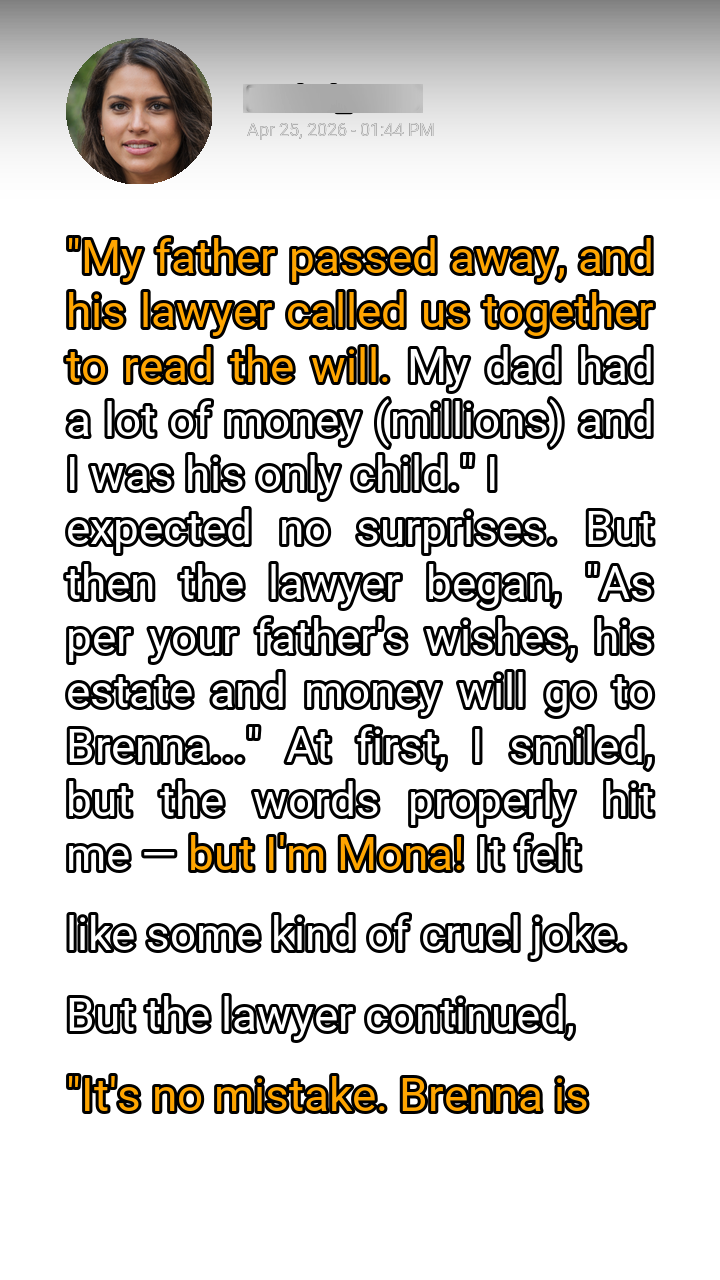
Then, he paused. His gaze, usually so steady and direct, flickered for a fraction of a second before settling back on the document. “And now,” he began, his voice dropping slightly, “as per your father’s final wishes, meticulously outlined and witnessed, his entire estate, encompassing all liquid assets, properties, and holdings, will be transferred in full…” My heart gave a small, expected flutter. This was it, the defining moment. “…to Brenna…” The name hung in the air, a foreign, dissonant note in the quiet room. I felt a strange smile tug at the corners of my lips, a polite, almost amused reaction. Brenna? Who was Brenna? Perhaps a middle name, a specific trust, a codicil I wasn’t aware of. My father had a quirky sense of humor, sometimes. I even leaned forward slightly, ready to interject with a lighthearted query, expecting him to correct himself or elaborate on this unusual phrasing.
But the words, properly, brutally, hit me then. Like a physical blow to the solar plexus, knocking the breath from my lungs. *Brenna.* Not Mona. My name wasn’t Brenna. My smile faltered, freezing on my face as if caught in a cruel tableau. The air grew thick, suddenly devoid of oxygen. My mind raced, grasping for any logical explanation, any shred of sense. Was this some kind of elaborate, darkly comedic twist from my father’s eccentric mind? A test, perhaps? My gaze shot to Mr. Harrison, silently pleading for him to clarify, to correct this glaring, impossible error. My heart began to pound a frantic, irregular rhythm against my ribs, echoing in my ears, drowning out the gentle tick of the clock. Aunt Carol, who had been holding her breath, let out a small, almost inaudible gasp, her eyes wide with a mixture of shock and morbid fascination.
The lawyer, however, remained utterly unperturbed, his expression as impassive as carved stone. He slowly, deliberately, lifted his gaze from the document, meeting my wide, disbelieving eyes. There was no hint of apology, no flicker of confusion, no suggestion of a mistake. His voice, when he spoke again, was even, devoid of emotion, each word a hammer blow against the fragile edifice of my reality. “I understand this may come as a shock, Mona,” he stated, his voice calm, almost clinical. “But it’s no mistake. The will is unambiguous. Every clause has been reviewed, cross-referenced, and affirmed by your father personally, on multiple occasions, right up until his final weeks.” The cold, hard reality began to seep into my bones, chilling me to the core. This wasn’t a joke. This wasn’t a test. This was real. My world, which had seemed so solid and predictable just moments ago, was crumbling around me, dissolving into a chaotic void of uncertainty and disbelief.
My throat was dry, constricted. I tried to speak, but only a small, strangled sound escaped. My hands, resting on my lap, were trembling violently. Mr. Harrison continued, his gaze unwavering, delivering the next devastating sentence with the precision of a surgeon. “Brenna is…”
Mr. Harrison continued, his gaze unwavering, delivering the next devastating sentence with the precision of a surgeon. “Brenna is… your half-sister, Mona. Richard Vance’s biological daughter from a relationship he had years before he met your mother. She is twenty-two years old and resides in a small town upstate.” The words struck me with the force of a physical blow, a concussive shockwave that vibrated through my very bones. Half-sister. A secret life. A hidden child. The elegant, polished office, the antique clock, even the very air seemed to waver, losing its solidity. My mind, which had been desperately scrambling for any plausible explanation—a charity, a foundation, a pet—now seized on this impossible truth, twisting it into a grotesque mockery of my reality. My father, the man I idolized, the pillar of my world, had harbored such a monumental secret. The grief for him, which had been a dull ache, now sharpened into a searing pain of betrayal, hotter and more devastating than any loss I had ever known.
A choked gasp escaped my lips, but no sound followed. My vision blurred, the edges of the room tilting precariously. Aunt Carol, across the table, finally let out a full, shuddering breath, her earlier tremor now a full-blown tremble, her eyes wide with a mixture of pity and a kind of grim satisfaction I couldn’t quite decipher. She knew. Of course, she knew. Her sudden presence at this reading, her nervous energy, her almost theatrical shock, it all clicked into place, forming a picture of deliberate, long-held deception. My father, the man who preached honesty and integrity, had built his empire on innovation and truth, yet had woven an elaborate tapestry of lies around his own life, around *my* life. The irony was a bitter taste in my mouth, burning hotter than any rage.
Mr. Harrison, oblivious or indifferent to my unraveling, continued his dispassionate recitation. “Richard maintained contact with Brenna and her mother for many years, providing for them discreetly. In his later years, he grew increasingly concerned about Brenna’s future, believing she deserved the opportunity to flourish without the public scrutiny and inherent expectations that come with the Vance name from birth. He felt, Mona, that you, having been raised within the framework of his success, were already equipped with the resilience, education, and social capital to forge your own path, independent of a direct inheritance. He believed it would make you stronger.” The sheer audacity of it, the paternalistic condescension, stole the remaining air from my lungs. He thought this would *make me stronger*? It was like being told your entire life was a lie, then being handed a pat on the head and told it was for your own good.
“My mother?” I finally managed to croak, the word tearing from my throat, raw and ragged. “Did my mother know about this… *other* family?” My gaze darted from the lawyer to Aunt Carol, demanding answers, demanding accountability. Mr. Harrison paused, a flicker of something that might have been regret crossing his usually impassive features. “Your mother, Eleanor, passed away before Richard made the final amendments to his will regarding Brenna. He made it clear that he wished to keep this aspect of his life entirely private, even from her. He believed it would protect her from unnecessary distress.” The implication was clear: my father had not only betrayed me but had also lived a double life that even my mother was unaware of. The perfect family portrait, the happy memories, all tainted by this corrosive secret.
My hands clenched into fists, digging my nails into my palms until the pain was a grounding force. “This is outrageous! It’s illegal! I’ll contest it! Every single word!” My voice rose, cracking with a desperate fury. “He can’t just… disinherit his only child for some secret family he kept hidden!” Mr. Harrison calmly shook his head. “I assure you, Mona, every legal avenue was explored. The will is ironclad. Richard went to extraordinary lengths to ensure its enforceability, even including specific clauses that explicitly disinherit any party attempting to challenge its provisions, beyond a modest trust established in your name for maintenance, which he deemed sufficient for your needs. It is, unequivocally, his final and complete declaration.”
The “modest trust.” The words were a fresh wound, a final insult. A pittance, a consolation prize, for the daughter he had raised, loved, and then, in his death, utterly abandoned. The Vance estate, the sprawling gardens, the art collection, the private jet, the billions – all gone. Not to a charity, not to a distant relative, but to a stranger, a ghost from his past, a living testament to a life I knew nothing about. My eyes fell on Aunt Carol again, who was now carefully avoiding my gaze, picking at a loose thread on her sleeve. She was more than just aware; she was likely complicit, a confidante in my father’s great deception. The thought sparked a cold, clear fire in my gut, sharper than the betrayal from my father.
As Mr. Harrison began to detail the specifics of Brenna’s inheritance, the logistics of the transfer, the new arrangements for the estate, his words became a distant hum, a meaningless drone. My world had not just crumbled; it had been utterly vaporized, leaving behind a smoking crater where my future once stood. The weight of legacy I was prepared to shoulder had been snatched away, replaced by the crushing burden of a truth I could never unlearn. I looked at the polished mahogany table, the expensive legal documents, the calm, unfeeling face of Mr. Harrison, and a single, burning thought solidified in my mind, pushing through the haze of shock and grief: I might not have my father’s money, but I still had his name. And I would use every ounce of that legacy, every shred of my privilege, to find Brenna. Not to beg, not to understand, but to confront the woman who had unknowingly, or perhaps knowingly, stolen my entire life. The battle for the Vance empire, I realized with a chilling clarity, was far from over.