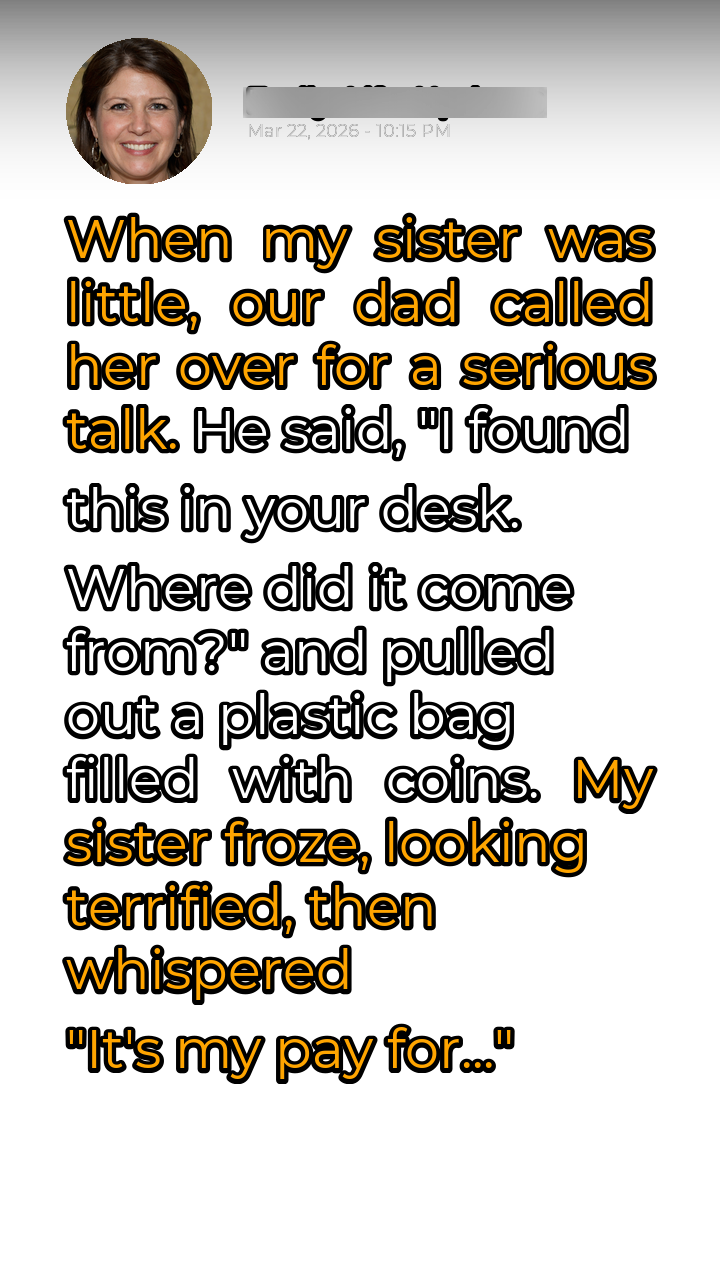
The air in the living room hung thick with unspoken tension, a palpable weight that pressed down on everything. Little Sarah, all of seven years old with pigtails askew and a smudge of dirt on her cheek, stood frozen before her father. Her small hands, usually busy building elaborate Lego castles or drawing fantastical creatures, were now twisting nervously in the hem of her dress. Her dad, a usually jovial man with a booming laugh that could fill a room, was unusually serious. The laughter lines around his eyes seemed etched deeper, his brow furrowed in concern. He held a clear plastic bag, the kind you get at the grocery store when you forget your reusable totes, but this one wasn’t filled with chips or candy, or even the usual assortment of school supplies. It was heavy, bulging with the dull gleam of coins – pennies, nickels, dimes, and the occasional quarter peeking through the plastic. “Sarah,” he began, his voice gentle but firm, a stark contrast to his usual boisterous tone, “I found this in your desk drawer. Can you tell me where it came from?” He held the bag up slightly, letting the coins shift and jingle softly. The sound, normally so innocuous, seemed to amplify the silence in the room, each clink a tiny hammer blow against the fragile peace. Sarah’s eyes darted around, searching for an escape route, a hidden door, a sudden distraction, but she was trapped, caught in the beam of her father’s unwavering gaze. Her lower lip trembled, a sure sign of distress. She knew she couldn’t lie. Her dad always knew. It was like he had a built-in lie detector, honed by years of parenting.
Finally, after what felt like an eternity stretching into an infinite abyss, she whispered, her voice barely audible, a mere breath of sound. “It’s my…my pay for…” She trailed off, unable to meet his gaze, her eyes fixed on the worn pattern of the living room rug. He knelt down, bringing himself to her level, his expression softening with concern. The sternness melted away, replaced by the worry etched on his face. “Pay for what, sweetheart? It’s okay, you can tell me.” He wanted to understand, to unravel the mystery of the bag of coins. He just didn’t think he was ready for the answer, for the bizarre truth that lay hidden beneath his daughter’s silence.
She took a shaky breath, a tiny gasp for air before plunging into the deep end. “It’s my pay for burying dead birds.” The words hung in the air, heavy and unexpected, like a lead balloon refusing to float. Her dad blinked, momentarily stunned, his mind struggling to process the information. Burying dead birds? Where did she even get the idea? And who in their right mind was paying her to do such a morbid task? A million questions raced through his mind, a chaotic jumble of confusion and apprehension. He needed to tread carefully, to navigate this strange situation with sensitivity and understanding. This was clearly more complicated than he initially thought, far more bizarre than a simple case of pilfered pennies.
He slowly stood up, still holding the bag of coins, the weight of the mystery pressing down on him. “Burying dead birds,” he repeated, more to himself than to her, testing the sound of the words, trying to make sense of their strange combination. “Who is paying you to do this, Sarah?” He tried to keep his voice neutral, to mask the rising tide of apprehension, but a hint of unease crept in, a subtle tremor that betrayed his inner turmoil. He knew kids had strange fascinations, quirky hobbies, and imaginary friends, but this was…unusual. He thought maybe it was another child, some sort of macabre game played in the shadows of the playground, but a nagging feeling told him that the truth was much more sinister, much more unsettling.
Sarah, sensing his confusion and fear, explained that Mrs. Gable, their elderly neighbor with the perpetually grumpy face and a garden overflowing with thorny rose bushes that seemed to claw at anyone who dared to venture near, had been enlisting her services. Apparently, Mrs. Gable’s cat, Mr. Whiskers, a sleek black feline with a penchant for hunting, was a particularly skilled hunter, and his “gifts” to her – the lifeless bodies of unfortunate birds – were causing her distress. Mrs. Gable, unable to stomach the task herself, squeamish at the thought of touching the deceased creatures, had offered Sarah a small fee for each burial performed in the pet cemetery she had created in the back corner of her yard, a small patch of land marked by tiny, hand-painted stones.
The dad, after a long talk with both Sarah and Mrs. Gable – a conversation filled with awkward silences and sheepish admissions from the elderly woman who sheepishly admitted to her unusual arrangement – decided to put an end to the bird-burying business. He explained to Sarah that while her intentions were good, her heart in the right place, it was important to respect all living creatures, both in life and in death, and that perhaps they could find a less morbid way to help Mrs. Gable. And to Mrs. Gable, he gently suggested that perhaps keeping Mr. Whiskers indoors more often, or at least fitting him with a bell, would solve the problem, preventing him from adding to her collection of feathered corpses.
In the end, Sarah, understanding the complexities of the situation, decided to donate her hard-earned coins to the local animal shelter, a place where animals were nurtured and cared for, a stark contrast to the graveyard she had been tending. She learned a valuable lesson about life, death, and the unexpected ways people cope with both. The bag of coins, once a symbol of a bizarre secret, became a testament to her compassion and her willingness to learn. And her dad, though initially shocked and disturbed, learned a valuable lesson too: that sometimes, the most unexpected discoveries can lead to the most meaningful conversations and the most profound understanding.